
Wholesale Hyperextension Bench Manufacturer | Factory Direct Pricing
Chasing the lowest unit price on a Roman chair bulk order is the fastest way to turn a container-load profit into a mid-six-figure loss.
Sourcing a hyperextension bench in wholesale volume requires validating tube gauge, weld integrity, and load rating against international safety standards before negotiating container-load pricing, because structural failures in the field trigger return freight and reputational damage that dwarf any per-unit savings.
I spent years on the inspection floor at a gym equipment plant in Jining before moving into export coordination. The first bulk order I handled personally taught me this the hard way. A hotel developer in the Middle East picked the thinnest tube option available to cut unit cost on a full gym fit-out. When the containers reached the port, terminal users performing back extensions cracked the base welds within weeks. The entire batch was rejected. Return shipping, rework, and air-freighting replacement units cost several times the original savings. Since then, I walk every buyer through tube specs, weld inspection protocols, and container-loading math before a purchase order is signed. [NEED_CITE: root cause distribution of field failures in commercial strength equipment per ASTM F2216]

Let me walk you through the parameters that actually separate a reliable hyperextension bench wholesale shipment from a liability.
What Tube Specs Actually Matter for Wholesale Hyperextension Benches?
Wall thickness, steel grade, and cross-section geometry determine the real load capacity of a Roman chair, not the marketing label stamped on the box.
Most buyers open the spec sheet and look at the advertised weight capacity first. That number is meaningless unless you verify the underlying tube specification that supports it. In wholesale hyperextension bench sourcing, the tube is the skeleton. Everything else, padding, upholstery, adjustment pins, hangs off that skeleton.
Here is the comparison matrix I use when evaluating factory samples side by side:
| Parameter | Certified Commercial Grade | Budget Export Variant | Unverified Source |
|---|---|---|---|
| Main frame wall thickness | Standard heavy-gauge | Noticeably thinner | Not provided |
| Steel grade | Verifiable cold-rolled | Self-reported mild steel | Not provided |
| Cross-section profile | Full rectangular with internal gusset | Basic rectangular | Uncontrolled |
| Load rating basis | Tested per international standard | Factory self-declared | Not provided |
| Surface treatment | Controlled phosphating + powder coat | Basic spray paint | Uncontrolled |
[NEED_CITE: structural testing methodology for commercial hyperextension benches per EN 957-1]
A Middle East hotel group once sent me three samples from different factories. On paper, all three claimed the same load rating. In practice, the tube wall thickness varied noticeably between them. The cheapest sample used a wall gauge that would flex under repeated loading at the pivot point, exactly where the user’s hip torque concentrates during a full-range back extension. The mid-range sample had adequate thickness but used an open cross-section without internal reinforcement. Only the certified-grade sample combined proper wall thickness with a gusseted rectangular profile that resisted torsional stress.
The counterintuitive part? Thicker is not always better. Blindly increasing wall thickness adds weight, which inflates shipping cost per container and stresses the floor anchoring system. The real engineering target is matching tube gauge to steel grade and joint design so the frame reaches its rated capacity without excess mass. A well-designed commercial hyperextension bench wholesale unit hits that balance; an overbuilt one just burns your freight budget.
How to Verify Weld Quality Before Placing a Bulk Order?
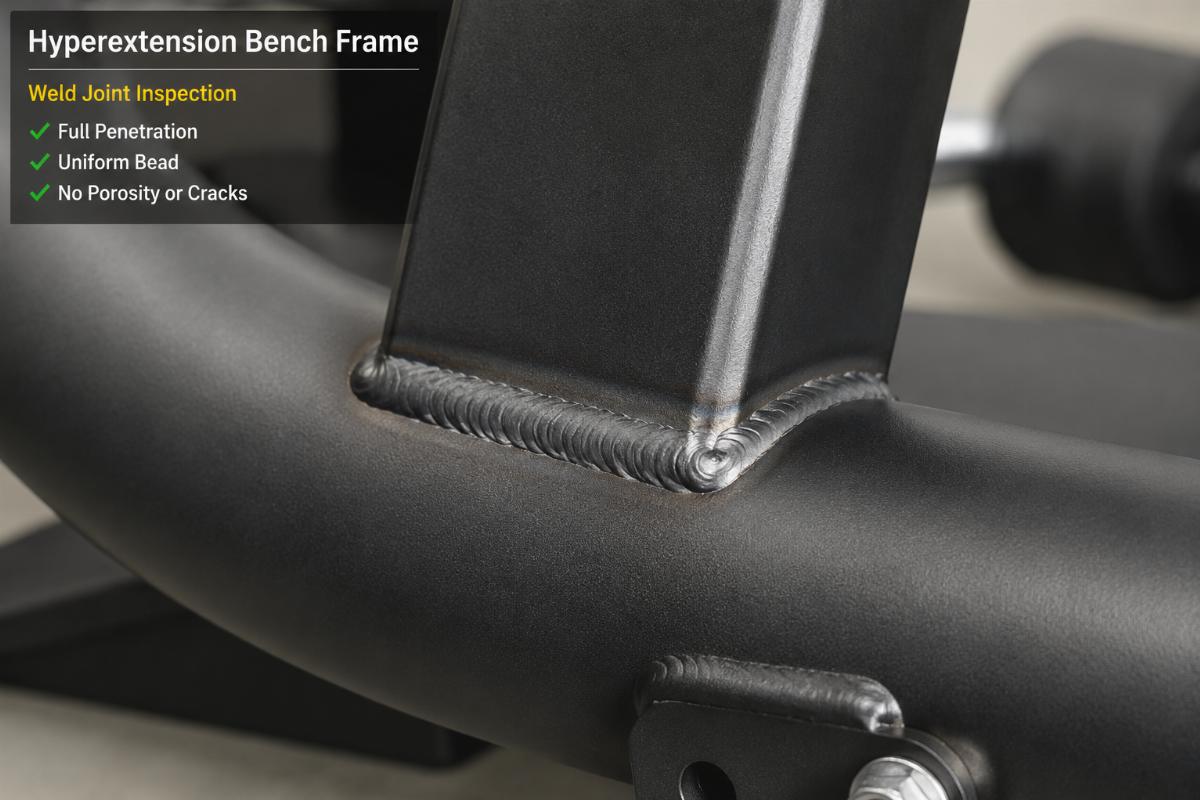
Weld integrity is the single most common failure point in field returns, and visual inspection alone cannot catch subsurface defects.
When I inspect a production run of a hyperextension bench wholesale order, the weld joints at the base plate, the pivot bracket, and the hip pad mounting arm are where I spend most of my time. These are high-stress nodes where fatigue cracks initiate after repeated loading cycles. A weld that looks clean on the surface can still lack root penetration or contain slag inclusions that propagate into a fracture under dynamic load.
The verification process I require from any factory before shipment includes:
- Destructive sample testing on production-batch weld coupons, not just pre-production prototypes
- Magnetic particle inspection or ultrasonic testing on critical load-bearing joints
- Static load testing to a multiple of the rated capacity with hold time per standard protocol
- Documentation of welder certification and welding procedure specifications
[NEED_CITE: welding quality requirements for fitness equipment per ISO 5817]
An African distributor I worked with received his first trial order from a factory that passed visual inspection perfectly. The welds looked uniform, the powder coat was smooth. But when his end users started putting the benches through daily commercial use, base welds began cracking within months. Post-failure analysis revealed incomplete fusion at the root of several critical joints, a defect invisible to the naked eye but catastrophic under cyclic loading. The replacement cost and lost client trust far exceeded what proper weld verification would have cost upfront.
When you evaluate a hyperextension bench wholesale supplier, ask specifically whether they perform batch-level weld testing or only sample-level testing on pre-production units. The difference between those two approaches is the difference between a shipment that performs in the field and one that generates warranty claims.
What Is the Real Cost of Choosing the Cheapest Option?
The hidden costs of under-spec equipment, return freight, reputational damage, and emergency air shipment routinely exceed the per-unit savings by a wide margin.
Buyers new to wholesale gym equipment often focus on the FOB unit price as the primary decision variable. This is understandable but incomplete. The true landed cost of a hyperextension bench wholesale purchase must include the probability-weighted cost of field failures, which for under-spec units can be substantial.
Consider the cost components that the cheapest quote typically excludes:
- Return freight for defective units, charged at full container rates
- Customs re-import duties and port handling fees at origin
- Air-freight emergency replacement shipments to keep the client’s gym operational
- Labor cost for on-site teardown and reinstallation
- Reputational damage with the end client, which is unquantifiable but real
A South American gym chain once accepted the lowest-priced hyperextension bench wholesale quote available, overriding the procurement team’s recommendation to go with a certified-grade supplier. Within a single quarter, weld failures across multiple locations triggered emergency air shipments that cost several times the original per-unit savings. The procurement manager told me privately that the total cost of that decision, including the management time spent handling the crisis, was a mid-six-figure figure in local currency.
[NEED_CITE: total cost of ownership analysis for commercial strength equipment procurement]
The lesson is straightforward. When comparing quotes for a hyperextension bench wholesale order, build a simple spreadsheet that adds estimated failure-rate cost to the unit price. Even a conservative failure-rate assumption will often show that the mid-range certified option is cheaper in total cost than the lowest-priced alternative.
How to Optimize Container Loading for Maximum ROI?
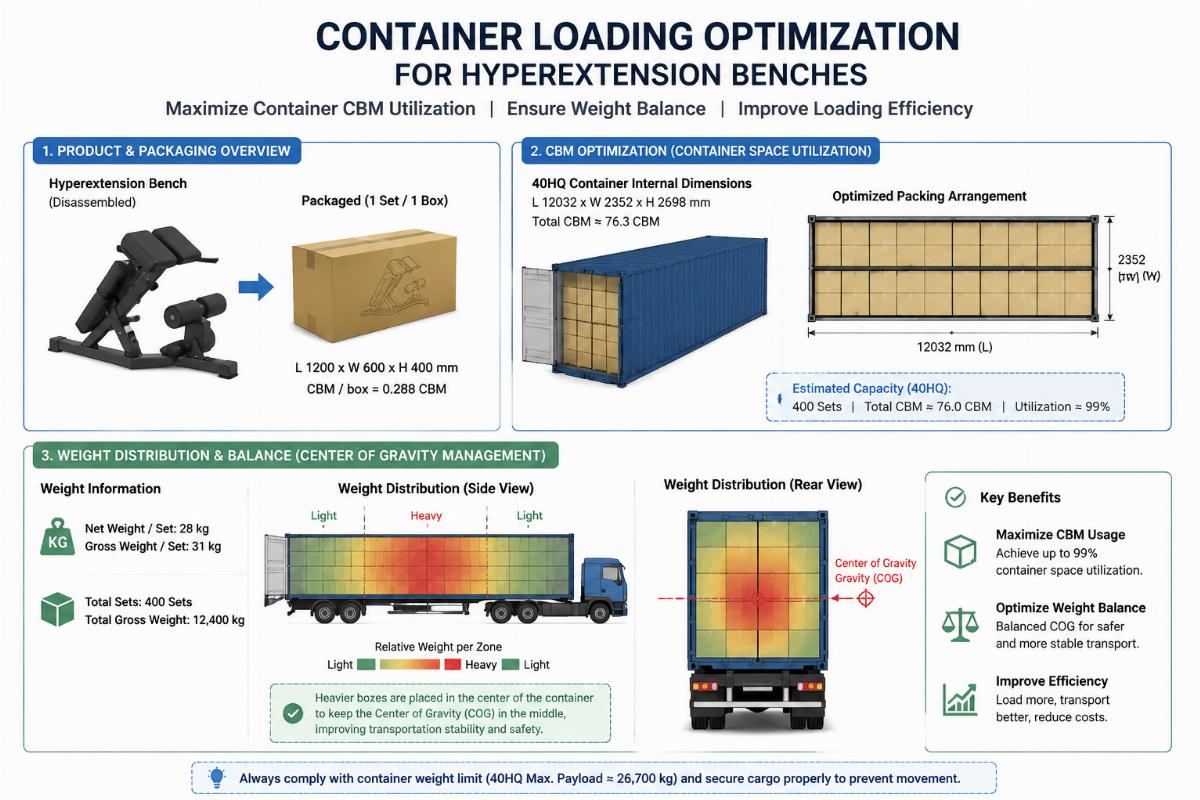
Container loading efficiency directly affects per-unit landed cost, and a well-designed hyperextension bench wholesale product should be engineered for knock-down packing from the start.
A standard shipping container has fixed internal dimensions. Every cubic meter of wasted air space is money burned on freight. When I plan a container load for a hyperextension bench wholesale order, I start with the product’s knock-down dimensions, not its assembled dimensions. A bench that ships fully assembled occupies vastly more container volume than one designed to pack flat with detachable components.
The optimization variables include:
- Knock-down design that minimizes packed CBM per unit
- Weight distribution that stays within container payload limits without underutilizing volume
- Mixed-SKU loading strategies that pair heavy items with bulky light items to balance both weight and space
- Pallet vs. floor-load decisions based on destination warehouse handling capabilities
[NEED_CITE: container loading optimization methodology for fitness equipment export]
A European distributor importing a full container of hyperextension bench wholesale units worked with our loading team to redesign the packaging from a partially assembled configuration to a fully knock-down flat-pack. The change increased the number of units per container by a noticeable margin, dropping the per-unit freight cost enough to offset a slightly higher FOB price. The net effect was a lower landed cost per unit despite paying more at the factory.
This is why I always ask buyers to share their target container configuration early in the conversation. A hyperextension bench wholesale supplier that designs for container efficiency delivers better economics than one that simply quotes the lowest FOB number on an unoptimized package.
Why Shandong Factories Dominate This Category?
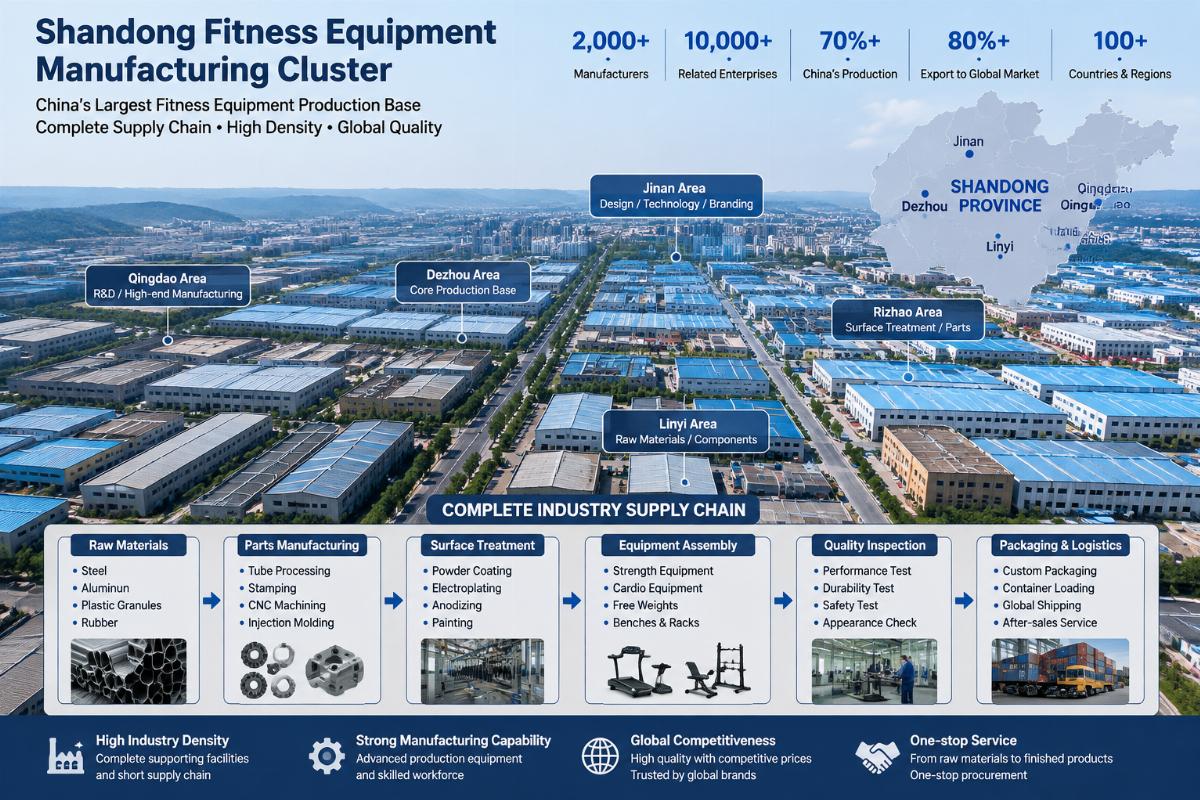
The fitness equipment manufacturing cluster in Shandong Province combines raw material access, skilled welding labor, and export logistics infrastructure into a cost structure that is difficult to replicate elsewhere.
Shandong, particularly the corridor around Jining, Dezhou, and Qingdao, has developed over decades into one of the world’s densest concentrations of commercial gym equipment manufacturing. This is not an accident. The region sits near major steel production centers, has deep pools of experienced welders and powder-coating technicians, and offers direct trucking access to Qingdao port, one of the busiest container terminals on the Pacific Rim.
When I visit factories across this region to audit production for a hyperextension bench wholesale order, the differences between top-tier and marginal suppliers are consistent:
- Top-tier factories maintain in-house welding procedure qualifications and batch-level inspection records
- Marginal suppliers outsource welding to subcontractors with no traceable certification
- Top-tier factories invest in CE certification and third-party testing as standard practice
- Marginal suppliers treat certification as an optional add-on that can be skipped for price-sensitive markets
[NEED_CITE: industrial cluster economics of fitness equipment manufacturing in Shandong China]
A buyer evaluating a hyperextension bench wholesale supplier from Shandong should verify three things: whether the factory holds current CE certification for the European market, whether weld inspection records are maintained per production batch rather than per order, and whether the factory has demonstrated experience loading full containers of mixed gym equipment rather than single-SKU shipments. These three criteria separate the factories that can support a serious commercial buyer from the workshops that can only handle small spot orders.
Conclusion
Structural specification, not unit price, determines whether a wholesale hyperextension bench order generates profit or loss. Validate tube gauge and weld integrity before committing to volume, calculate total landed cost including failure-rate risk, optimize container loading at the packaging design stage, and source from factories with verifiable certification and batch-level quality records. These steps separate buyers who build lasting gym equipment supply chains from those who learn expensive lessons on their first container.


