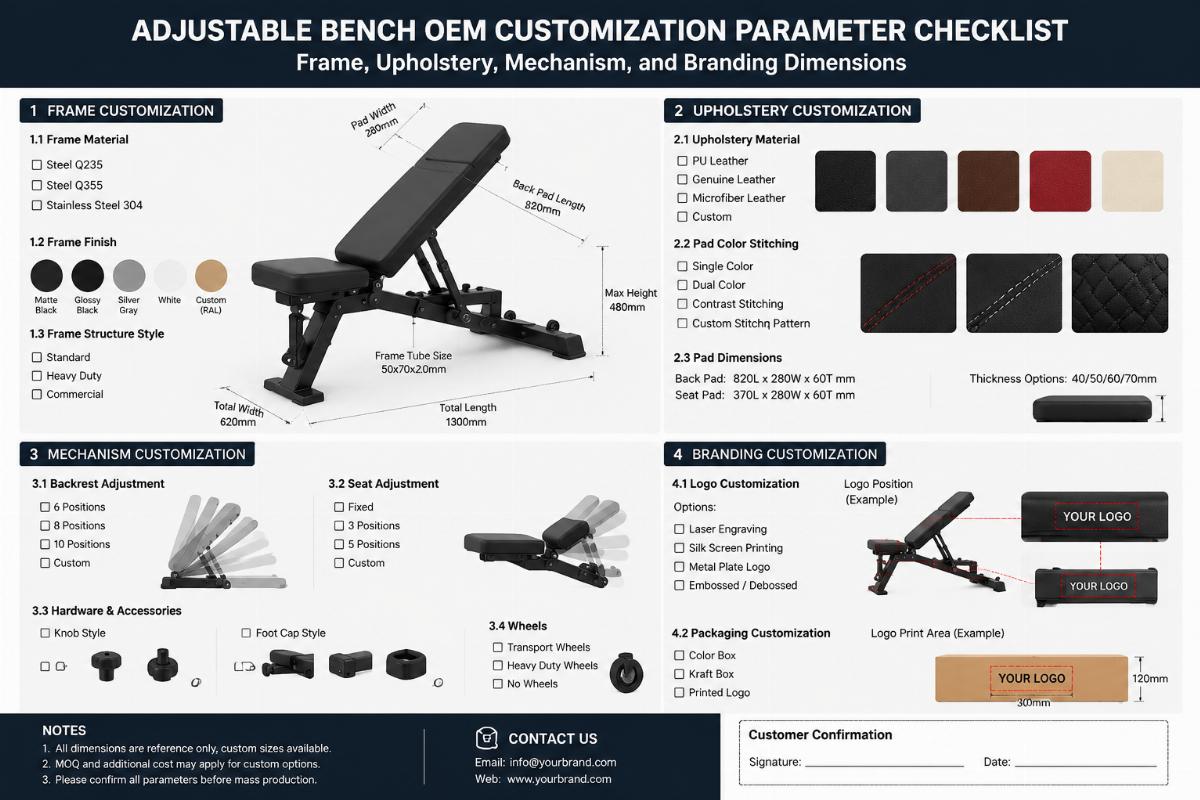
AB-Adjustable Bench Sub-Series for Military Base Strength Facilities: Wholesale Supplier
Load capacity ratings mean nothing if the adjustment mechanism fails under repetitive daily use.
Military base gyms require adjustable benches built with reinforced pin-hole steel thickness, full-penetration welding at stress points, and structural redundancy far beyond standard commercial specs — because daily usage volume and operator intensity in military settings destroy standard benches within months.
I learned this the hard way. A government fitness facility project came across my desk with a spec sheet calling for a three-position adjustable bench rated at 1200 lbs. The drawings looked straightforward. I sourced samples from a lower-cost supplier, and the units shipped clean. But within a fraction of the planned service cycle, the pin-hole positions on the backrest frame started deforming. The entire batch had to be recalled. The failure concentrated at the weld joints near the adjustment holes — not the frame itself, not the padding, not the feet. The adjustment mechanism. That single experience reshaped how I evaluate every adjustable bench for military base projects going forward. I now pull apart the adjustment points before I look at anything else. [NEED_CITE: ASTM F2216 standard requirements for adjustment mechanism structural integrity in strength equipment]
What follows is a field-grounded breakdown of why standard commercial benches fail in military installations, what separates a properly built adjustable bench for military base use from a standard one, how to validate the adjustment mechanism before committing to an order, and what really happens when procurement teams cut corners on the adjustment components.
Why Do Military Base Gyms Fail with Standard Commercial Benches?
Standard commercial adjustable benches are engineered for usage patterns that are fundamentally different from military base fitness facilities — and that mismatch is where failures begin.
In a typical commercial gym, an adjustable bench might see a moderate rotation of users across the day, with rest periods between sets and varied usage intensity. In a military base gym, the usage profile is drastically different. Personnel train in organized groups, often during condensed time windows. The bench is adjusted repeatedly — backrest angle changed, seat position slid, pin pulled and reinserted — dozens of times per session, multiple sessions per day, every single day. There is no gentle use. The adjustment mechanism is not a secondary feature; it is the most stressed component on the entire bench. [NEED_CITE: usage frequency and equipment wear correlation in institutional fitness environments]
The core problem is that most commercial adjustable bench manufacturers design their adjustment mechanisms to meet a baseline load rating — say, a static weight capacity — without engineering for the cumulative fatigue that comes from thousands of pin insertions and removals under load. The steel at the pin-hole positions is often the same thickness as the rest of the frame, or even thinner due to the material removed by the hol*come stress concentration points. Metal fatigue initiates at the hole edges. Cracks propagate. The welds adjacent to the holes — especially if they are spot welds rather than full-penetration welds — begin to separate.
I have inspected returned units from military base projects where the frame rails were perfectly straight, the padding was intact, and the rubber feet showed minimal wear. But the adjustment holes had elongated into oval shapes, and the pin no longer seated securely. The bench was structurally dead even though it "looked fine" on a visual inspection. That is the hidden failure mode. [NEED_CITE: metal fatigue failure modes in perforated steel structural members under cyclic loading]
The takeaway is simple: in a military base environment, the adjustment mechanism is not an accessory — it is the critical failure point. Any adjustable bench for military base procurement that does not specifically address pin-hole reinforcement, weld type, and steel thickness at the adjustment zones is a liability waiting to manifest.
What Makes the AB-Series Different for Military Applications?
The AB-series adjustable bench for military base facilities is engineered from the ground up around the adjustment mechanism — not as an afterthought, but as the primary structural design driver.
When we developed the AB-series at our manufacturing facility in Shandong, the starting point was not the frame geometry or the padding specification. It was the adjustment system. Every design decision flowed backward from the requirement that the pin-hole zones must withstand sustained, high-frequency adjustment under heavy load without deformation, elongation, or weld failure.
Here is how the AB-series addresses the specific failure modes that destroy standard benches in military settings:
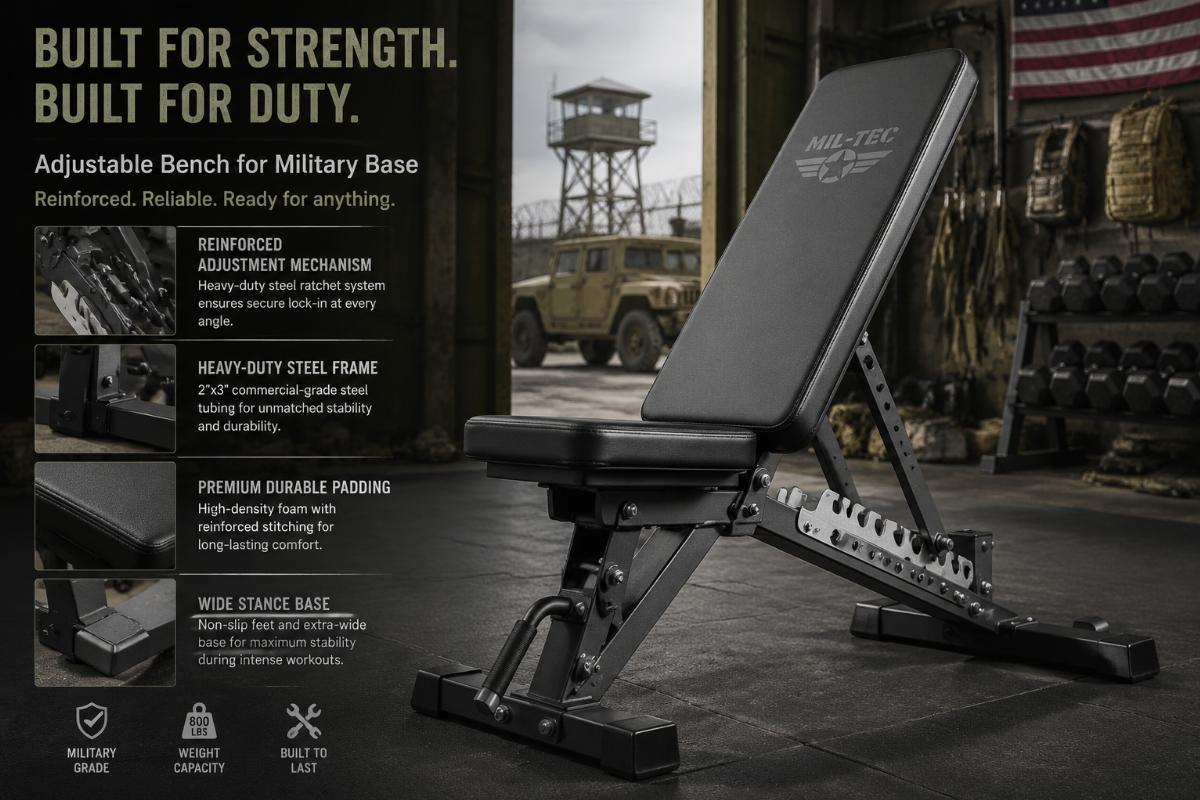
Pin-hole steel thickness and reinforcement. The steel at the adjustment hole positions is not the same gauge as the rest of the frame rail. It is thickened — a deliberate material buildup at the high-stress zones where the pin passes through. This is not achieved by simply using heavier gauge steel across the entire frame, which would add unnecessary weight. Instead, reinforcement plates are integrated at the adjustment positions, creating a localized zone of substantially greater material thickness. The holes are drilled through this reinforced zone, meaning the pin bears against significantly more material than it would in a standard bench. [NEED_CITE: engineering principles for stress distribution around holes in load-bearing steel members]
Full-penetration welding at adjustment joints. Where the adjustment brackets meet the main frame rail, the AB-series uses full-penetration welding — not spot welding, not tack welding. Full-penetration welding fuses the entire cross-section of the joint, creating a continuous metallurgical bond that distributes stress across the full width of the connection. Spot welds, by contrast, create discrete points of attachment with untreated steel between them. Under cyclic loading, those untreated zones become crack initiation sites. In a military base gym where the bench is adjusted hundreds of times per week, that difference is the line between a bench that lasts and one that fails.
Load redundancy beyond rated capacity. The AB-series adjustable bench for military base use is designed with a structural redundancy that goes well beyond the stated load rating. The frame, the adjustment mechanism, and the connection points are all engineered to handle loads substantially above the nominal rating. This is not marketing language — it is a design philosophy born from the understanding that military users do not always load benches within spec, and that dynamic forces during exercises like heavy dumbbell presses generate impact loads far exceeding static weight.
Seat rail slide mechanism durability. The seat adjustment slide on the AB-series uses a reinforced rail profile with guided contact surfaces that resist wear and play over extended use. Standard benches often use simple tube-in-tube sliding mechanisms that develop looseness quickly under high-frequency adjustment. The AB-series rail maintains tight tolerances through thousands of adjustment cycles.

These are not incremental upgrades. They represent a fundamentally different engineering approach to the adjustable bench for military base environments — one that treats the adjustment mechanism as the structural heart of the product rather than a convenience feature bolted onto a basic frame.
How to Validate Adjustment Mechanism Durability Before Ordering?
Before placing any order for an adjustable bench for military base facilities, procurement teams must conduct a component-level validation of the adjustment mechanism — not rely on spec sheet load ratings alone.
A load rating printed on a product sheet tells you what the bench can hold statically. It tells you nothing about how the adjustment mechanism will perform after thousands of cycles of adjustment under load. That is the gap that leads to field failures. Based on years of inspecting, testing, and de-briefing failed units from institutional projects, I have developed a validation checklist that any serious buyer should run through before committing to a production order.
Step 1: Inspect pin-hole zone steel thickness. Request a cross-section sample or a cut-away demonstration unit. Measure the steel thickness at the adjustment hole positions and compare it to the thickness of the main frame rail. If they are the same — or if the hole zone is thinner due to material removal — the bench is not built for high-frequency institutional use. The adjustment zone must be visibly and measurably thicker than the base frame material. [NEED_CITE: recommended minimum steel thickness ratios for adjustment mechanism zones in heavy-use strength equipment]
Step 2: Identify the weld type at adjustment bracket joints. Examine the joints where the adjustment brackets attach to the main frame. Full-penetration welds will show continuous, uniform weld bead along the entire joint length. Spot welds will show discrete, circular weld points with gaps between them. If the supplier cannot clearly identify the weld type or provides only external photos that obscure the joints, treat that as a red flag. Request welded cross-section samples if necessary.
Step 3: Test pin fit and retention under load. Insert the adjustment pin and apply lateral force. There should be zero perceptible play. Then load the bench to its rated capacity and re-test. If the pin shifts, rattles, or shows any movement under load, the hole tolerances are too loose or the pin diameter is undersized. In a military base setting, that play will accelerate wear and lead to hole elongation within a fraction of the expected service life.
Step 4: Evaluate the backrest angle adjustment range and lock security. The backrest should adjust through its full range of positions with a smooth pin pull-and-insert action — no binding, no excessive force required. At each locked position, the backrest must show zero deflection under load. Apply downward pressure on the backrest pad at each angle setting and check for any movement or clicking sounds that would indicate the pin is not fully seated or the hole is allowing micro-movement.
Step 5: Assess the seat slide mechanism. Slide the seat pad through its full range of travel. The movement should be smooth but tight — no wobble, no lateral play. Lock the seat at a mid-range position and apply force to the pad. Any shift or click indicates insufficient rail engagement or worn guide surfaces.
Step 6: Request fatigue test documentation. Ask the supplier for fatigue test records specific to the adjustment mechanism — not just the frame. A proper fatigue test cycles the adjustment mechanism through thousands of pin insertions and removals under load, then inspects the hole edges and weld joints for elongation, cracking, or deformation. If the supplier has no such test data, the adjustment mechanism has not been validated for institutional use. [NEED_CITE: fatigue testing protocols for adjustment mechanisms in commercial strength equipment per EN ISO 20957]

This validation process is not optional for military base procurement. It is the minimum due diligence required to avoid the costly cycle of deployment, failure, recall, and replacement that plagues under-specified bench purchases.
What Happens When You Cut Costs on the Adjustment Mechanism?
Choosing a lower-cost adjustable bench for military base facilities based on unit price alone inevitably results in total cost multiples higher than the initial savings — and the failure timeline is far shorter than most procurement teams expect.
I have seen this pattern repeat across multiple government and institutional fitness projects. The procurement team receives quotes for an adjustable bench for military base use. One supplier offers a unit at a noticeably lower price. The spec sheet looks comparable — same load rating, same adjustment positions, same pad dimensions. On paper, the cheaper option seems like a straightforward budget win.
Then the units deploy. Within a fraction of the expected service cycle, the first reports come in: adjustment pins feel loose, backrest positions have developed play, one unit has a visible crack at the weld near the pin hole. A site inspection confirms systemic failure across the batch. The adjustment mechanism steel was too thin. The welds were spot welds, not full-penetration. The pin holes elongated under repetitive use.
Now the procurement team faces a full batch recall. The cost of that recall is not just the replacement unit price. It includes shipping the defective units back, shipping replacement units out, downtime at the fitness facility while the swap is completed, administrative costs of processing the recall, and the reputational cost of delivering failed equipment to a military installation. When all of those costs are tallied, the "savings" from the lower unit price have been consumed many times over — and the facility is still left with a delayed timeline and a damaged vendor relationship. [NEED_CITE: total cost of ownership analysis for institutional fitness equipment procurement including recall and replacement logistics]
I have also seen the inverse: a project that initially invested in a properly specified adjustable bench for military base use — with reinforced pin-hole zones, full-penetration welds, and validated fatigue performance — run for extended periods without a single adjustment mechanism failure. The per-unit cost was higher at the point of purchase. But the total cost of ownership over the equipment lifecycle was substantially lower, because there were no recalls, no replacements, no downtime, and no emergency procurement cycles.
The cost difference between a properly built bench and a cost-cut bench is not measured in unit price. It is measured in failure rates, recall cycles, and total operational disruption. For military base fitness facilities where reliability is not optional, the economics always favor the properly engineered unit.

Conclusion
The adjustment mechanism is the single most critical component of any adjustable bench for military base facilities — and it is the component most commonly under-engineered in standard commercial products.
Military base gyms subject adjustable benches to usage intensity and frequency that far exceed typical commercial environments. Standard benches fail at the pin-hole zones and weld joints because they are not designed for that demand profile. A properly engineered adjustable bench for military base use — with reinforced adjustment zone steel, full-penetration welding, load redundancy, and validated fatigue performance — eliminates those failure modes and delivers reliable service over the full intended lifecycle. Procurement validation must go beyond spec sheet load ratings to include direct inspection of the adjustment mechanism components. The total cost of ownership always favors the properly built unit, regardless of initial price differences.