
AB-Adjustable Bench Sub-Series OEM Customization Options
More adjustment positions do not mean better performance—excessive angle options increase mechanical failure rates, and five to seven positions already cover the vast majority of training needs.
Adjustable Bench OEM Customization spans four core dimensions: frame geometry, upholstery specifications, adjustment mechanisms, and branding elements. Commercial buyers can modify backrest angle ranges, seat pad dimensions, tube wall thickness, foam density, leather color, and logo application methods—provided each parameter stays within engineered safety margins defined by international fitness equipment standards [NEED_CITE: EN 957-1 and EN 20957 structural safety requirements for adjustable benches].
I still remember a shipment that went sideways years ago. A gym chain based in the Middle East ordered a full batch of adjustable benches with seven-position backrest adjustment, custom seat pad color, and logo printing. They sent over a hand-drawn sketch—no tolerance callouts, no welding position markers, no pin hole specifications. We produced according to standard workshop practice. When the containers arrived at the port, the client discovered the adjustment pin holes were off by several millimeters. The pins rattled loose under load. Every single unit needed retrofitting. The replacement parts had to be air-freighted, and the cost of that mistake wiped out the margin on the entire order. Since that day, I broke down every customizable parameter on the adjustable bench sub-series into a structured checklist—angle increments, tube thickness, leather gauge, logo technique—and got every line signed off before a single weld was struck.
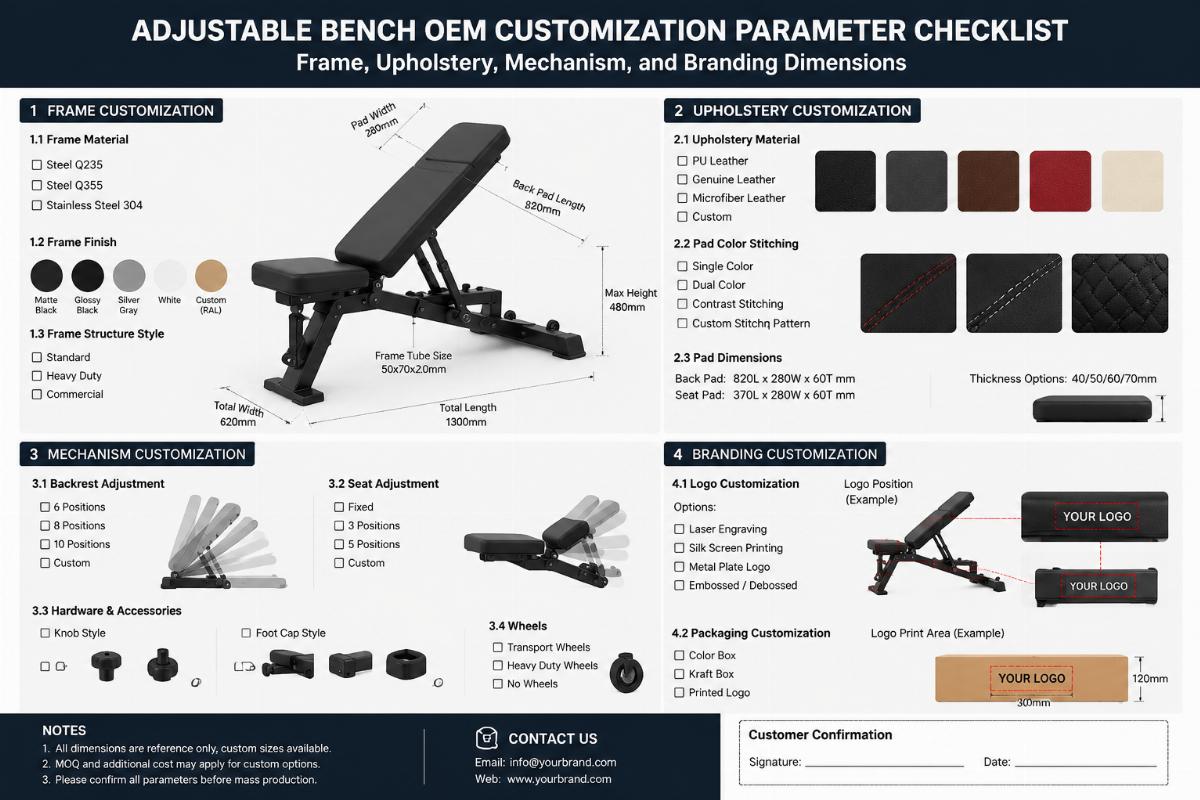
That experience shaped how I walk buyers through the customization process today. Let me break down what can actually be changed, what cannot, and how to specify your requirements so the factory delivers exactly what you need.
What Customization Options Are Available for AB-Adjustable Bench Sub-Series?
Adjustable Bench OEM Customization covers frame structure, adjustment mechanism design, upholstery materials, and surface branding—each with distinct engineering boundaries.
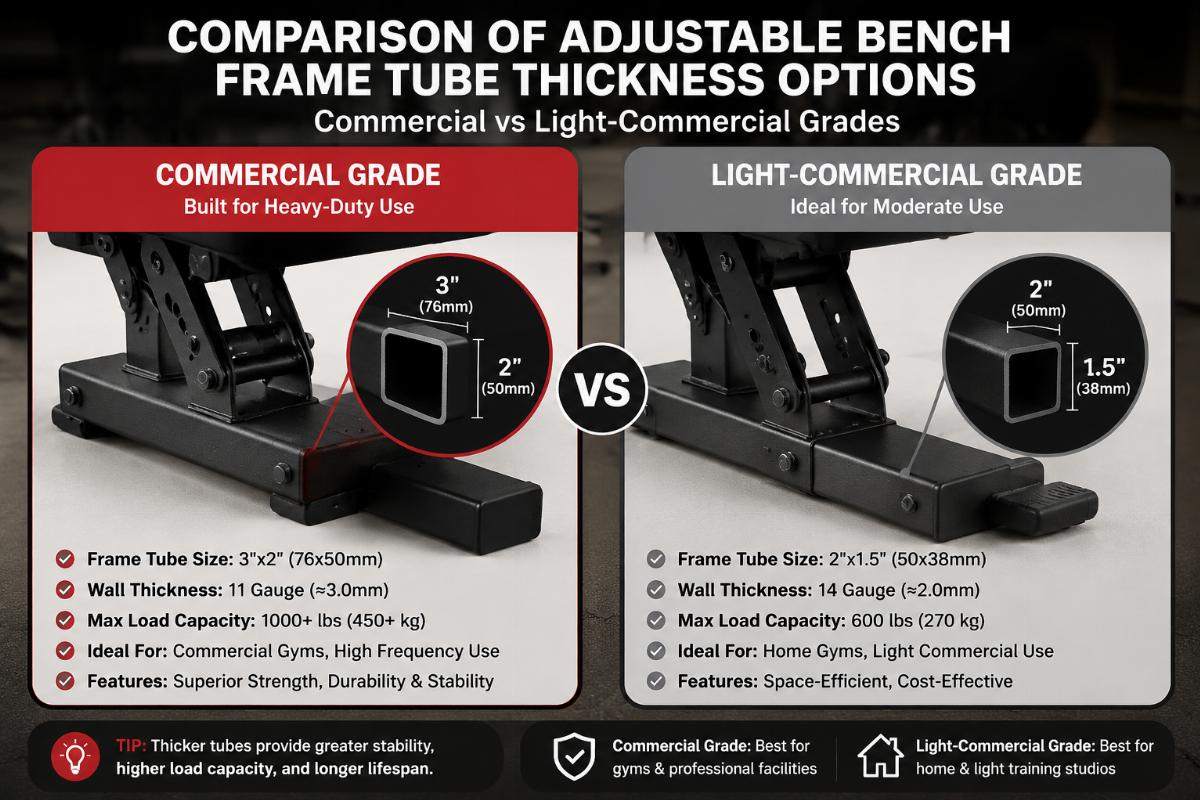
The frame is the backbone. Tube shape can shift from rectangular to oval profiles for visual differentiation, and overall frame dimensions can be adjusted to accommodate different user height ranges. However, the critical load-bearing joints—the weld points between the main frame and the base support—must remain within engineered positions. Moving these even slightly alters the center of gravity and compromises stability under dynamic loading [NEED_CITE: static load testing requirements per EN 957-1 for Class H adjustable benches].
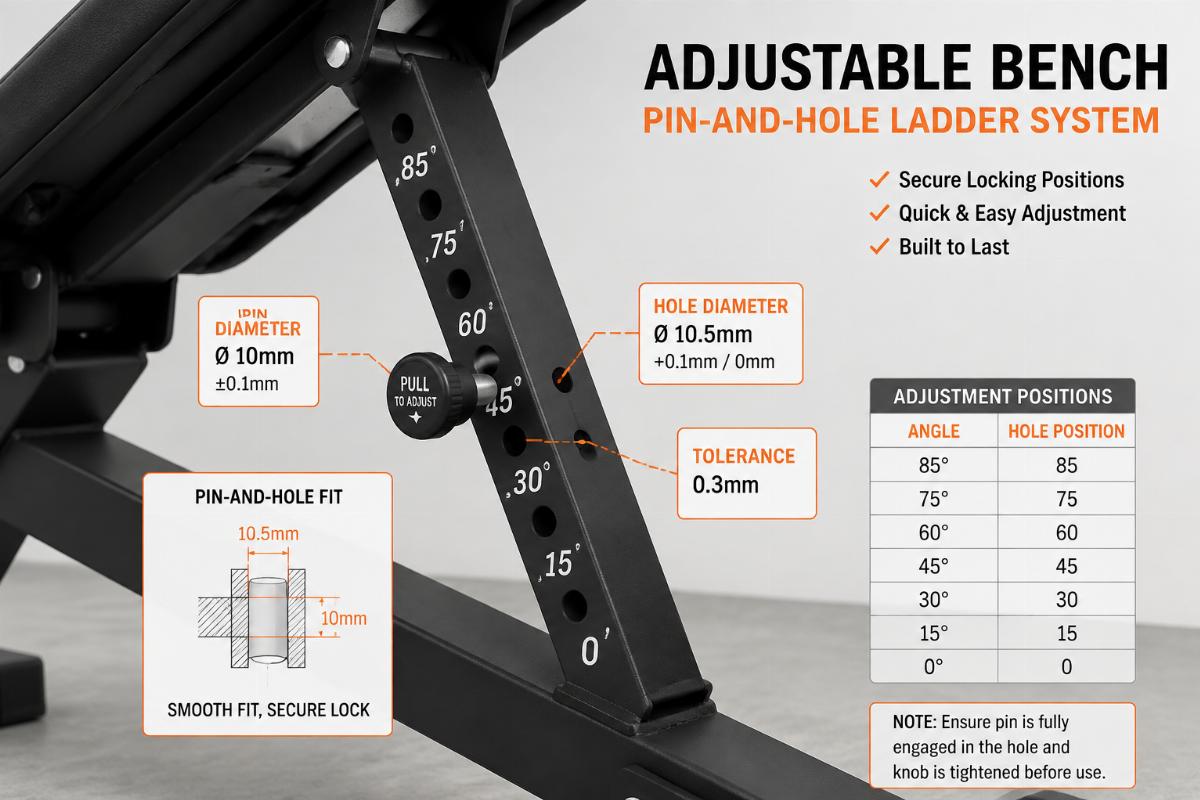
The adjustment mechanism offers the widest range of customization. Backrest angle positions can be configured from a minimal flat position to near-upright, with typical increments spaced at regular degree intervals. Seat pads can also feature independent adjustment on higher-end models. The ladder-style adjustment system with pin-and-hole engagement remains the industry standard for commercial environments due to its reliability and ease of maintenance.
| Parameter | Standard Commercial Spec | Customizable Range | Engineering Constraint |
|---|---|---|---|
| Tube wall thickness | Heavy-duty range | Light-commercial to reinforced | Must pass dynamic fatigue testing |
| Backrest angle positions | Multiple positions | Reduced or expanded range | Fewer positions reduce mechanism weight noticeably |
| Upholstery leather gauge | Commercial-grade PU | Standard to high-wear variants | Thicker leather adds weight but does not improve tear resistance alone |
| Foam density | High-density cold-cure | Medium to firm density bands | Density affects long-term compression resistance |
| Logo application | Screen printing | Embroidery, laser engraving, heat transfer | Laser engraving offers superior abrasion resistance in high-use settings |
| Frame finish | Powder coating | Custom RAL color matching | Color change does not affect structural properties |
A distributor in Southeast Asia once requested a cost-reduction modification: dropping the tube wall thickness from the commercial standard to a lighter gauge. The samples looked identical to the naked eye. But when the welding points underwent load testing, the thinner tubes could not handle the stress concentration at the joint intersections. The welds cracked under repeated cycling. The lesson: tube thickness is not a cosmetic parameter—it is a structural one, and any reduction must be validated through fatigue testing [NEED_CITE: dynamic fatigue testing protocols for welded fitness equipment frames].
Which Parameters Can Be Modified Without Compromising Structural Integrity?
Frame tube thickness, welding joint positions, and adjustment pin hole tolerances are the three parameters where unauthorized modification creates the highest risk of structural failure.
The adjustment pin holes deserve particular attention. These holes engage with the ladder bar to lock the backrest at each angle position. If the hole diameter, spacing, or positional tolerance drifts during production, the pin will either bind—making adjustment difficult—or sit loose, creating dangerous play under load. The tolerance on these holes must be held tightly; even minor deviation renders the adjustment mechanism unreliable [NEED_CITE: positional tolerance requirements for pin-and-hole adjustment mechanisms in strength equipment].
Welding joint positions are equally non-negotiable. The gussets and reinforcement plates at the base-to-frame junctions are positioned based on load distribution calculations. Shifting these changes how force transfers through the frame during heavy pressing movements. I have seen workshops attempt to "simplify" the gusset layout to save welding time, only to discover that the frame flexes noticeably under load—a failure that only reveals itself after months of gym-floor use.
Foam density and leather gauge, by contrast, are relatively safe to customize. The foam sits inside the pad and does not affect structural rigidity. Higher-density foam resists compression set over extended use, which matters in high-traffic commercial environments where benches see continuous use throughout the day. Leather gauge affects surface durability, but—here is a point many buyers misunderstand—tear resistance depends more on the foam layer beneath and the stitching pattern than on leather thickness alone. A moderately thick leather with high-density foam underneath and reinforced double-stitching will outlast a thicker leather stretched over low-density foam [NEED_CITE: upholstery durability factors for commercial fitness equipment padding].
| Modification Area | Structural Risk Level | Validation Required |
|---|---|---|
| Tube wall thickness reduction | High | Full dynamic fatigue test cycle |
| Weld joint repositioning | High | Engineering recalculation and prototype load test |
| Pin hole tolerance drift | High | Gauge inspection on every production batch |
| Foam density adjustment | Low | Compression set testing over simulated use period |
| Leather gauge change | Low | Tear resistance and abrasion testing |
| Angle position count reduction | Moderate | Mechanism weight and balance verification |
An African gym project client needed to consolidate shipment into a single container. They asked whether the backrest could be reduced from seven positions to five. The answer was yes—the simpler ladder bar was shorter, the adjustment mechanism weighed noticeably less, and the overall bench weight dropped enough to fit additional units per container. The trade-off was a slightly narrower angle range, but for the target market’s training preferences, five positions covered the essential movements. This is a customization that made commercial sense without touching any structural parameter.
How to Specify OEM Requirements to Avoid Production Disputes?
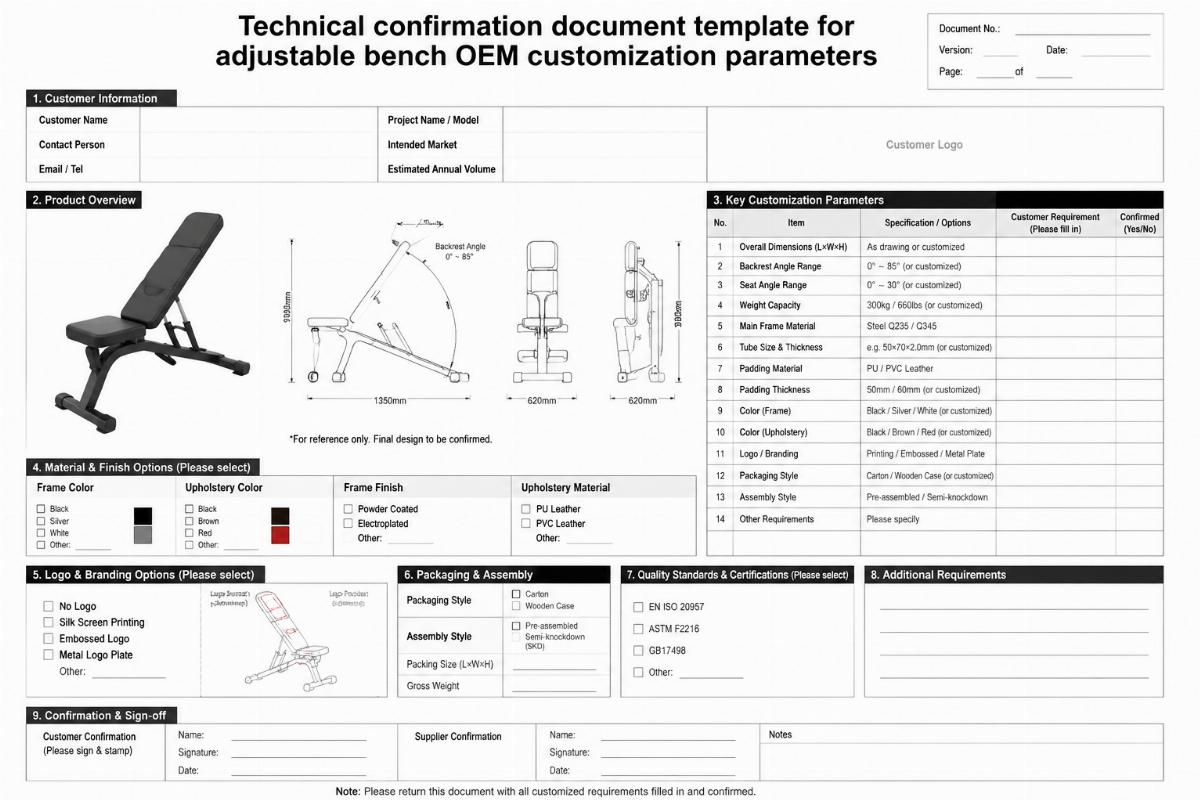
A detailed technical confirmation sheet with explicit tolerances, material specifications, and finish standards is the single most effective tool for preventing costly rework and shipment delays.
The hand-drawn sketch that caused the Middle East disaster I mentioned earlier was not an isolated incident. I have seen buyers send photos of competitor benches and say "make it like this," or provide written descriptions without dimensional references. These approaches leave too much room for interpretation between the buyer’s expectation and the factory’s standard practice.
The process I follow now involves a structured technical confirmation document that covers every customizable parameter in sequence. First, the frame dimensions and tube specifications are locked, including wall thickness and steel grade. Second, the adjustment mechanism is detailed—number of positions, angle range, pin diameter, and hole tolerance band. Third, upholstery specs are confirmed: foam density grade, leather type and color code, stitching pattern, and seam reinforcement method. Fourth, branding elements are specified: logo file in vector format, placement coordinates on the frame and pad, and application method—screen printing, laser engraving, or adhesive label.
Each section requires written sign-off before production begins. If the buyer wants to change any parameter after sign-off, the change is documented as a revision with a new approval cycle. This sounds bureaucratic, but it protects both parties. The factory knows exactly what to produce, and the buyer knows exactly what will arrive.
| Specification Category | Required Detail Level | Common Omission Risk |
|---|---|---|
| Frame dimensions | Full drawing with tolerance bands | Missing weld position callouts |
| Tube material | Steel grade and wall thickness | Unspecified material certification |
| Adjustment mechanism | Position count, angle values, pin specs | Tolerance on hole spacing not stated |
| Upholstery | Foam density, leather gauge, color code | Stitching pattern left to factory default |
| Branding | Vector logo file, placement coordinates | Application method not specified |
| Surface finish | RAL color code, coating thickness range | Texture or gloss level not defined |
A European distributor learned this the hard way when their first order of branded benches arrived with the logo screen-printed in a slightly different shade than expected. The logo file they provided was a low-resolution raster image, and the factory’s color matching was based on screen interpretation rather than a Pantone or RAL reference. The benches were structurally perfect, but the branding looked off. The entire batch had to be repainted and re-branded before the distributor would accept delivery. The cost of that rework was substantial—and entirely avoidable with a proper color reference specification.
What Are the MOQ and Lead Time Considerations for Custom Orders?
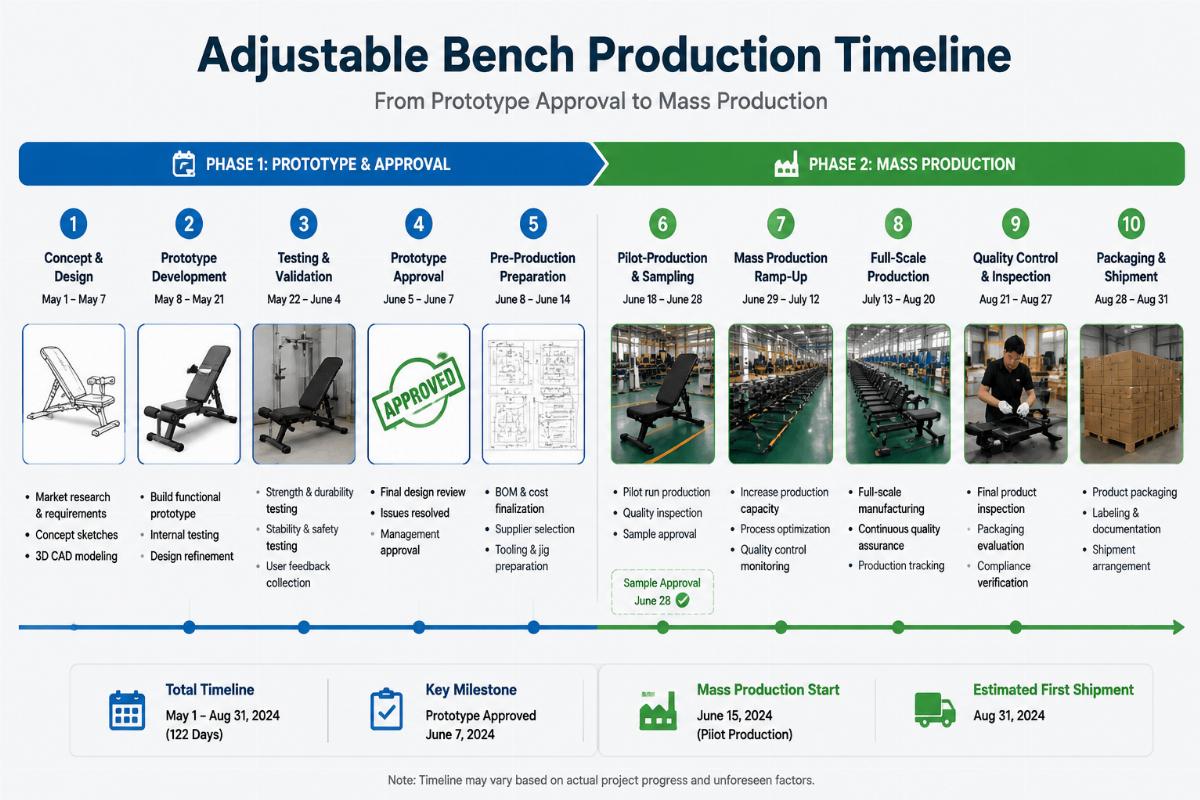
Custom color and logo orders typically extend production timelines noticeably beyond standard catalog items, while structural modifications require prototype approval before mass production can begin.
For Adjustable Bench OEM Customization, the minimum order quantity depends on the depth of customization. Standard catalog models with only a logo addition or color change on the frame powder coating can often be produced in relatively small batches—the factory simply adjusts the paint line and applies the client’s branding. These orders carry a moderate timeline extension over standard production.
When upholstery color is customized, the situation changes. Leather or vinyl must be sourced or dyed to the client’s specified color, which involves minimum material purchase quantities from the upholstery supplier. If the client wants a color that is not in the factory’s standard palette, the material supplier may require a minimum roll order, and this minimum effectively becomes the MOQ for the bench order.
Structural modifications—changing tube dimensions, altering the adjustment mechanism, or modifying frame geometry—require a prototype build and approval cycle. The factory produces one or two sample units, ships them to the buyer for physical inspection and testing, and only begins mass production after written approval. This prototype cycle adds a meaningful amount of time to the overall lead time, but skipping it is how the pin-hole tolerance disaster I described earlier happens.
| Customization Type | Typical MOQ Impact | Lead Time Extension |
|---|---|---|
| Frame color change only | Minimal | Moderate extension |
| Logo addition (standard placement) | Minimal | Moderate extension |
| Custom upholstery color | Material supplier minimum applies | Noticeable extension |
| Structural frame modification | Prototype approval required | Substantial extension |
| Adjustment mechanism redesign | Full prototype and testing cycle | Extended significantly |
A fitness chain in Latin America wanted a complete private-label adjustable bench with custom frame color, unique pad contour, and embossed logo. The pad contour change required a new foam mold, which carried its own tooling cost and minimum production run. The buyer initially wanted a small trial order, but the mold cost only made economic sense at a higher volume. We worked through the numbers together and arrived at an order size where the per-unit tooling amortization was acceptable. The lead time was longer than a standard order, but the buyer received a genuinely differentiated product—not just a logo swap.
How Does Customization Impact Pricing and Container Loading?
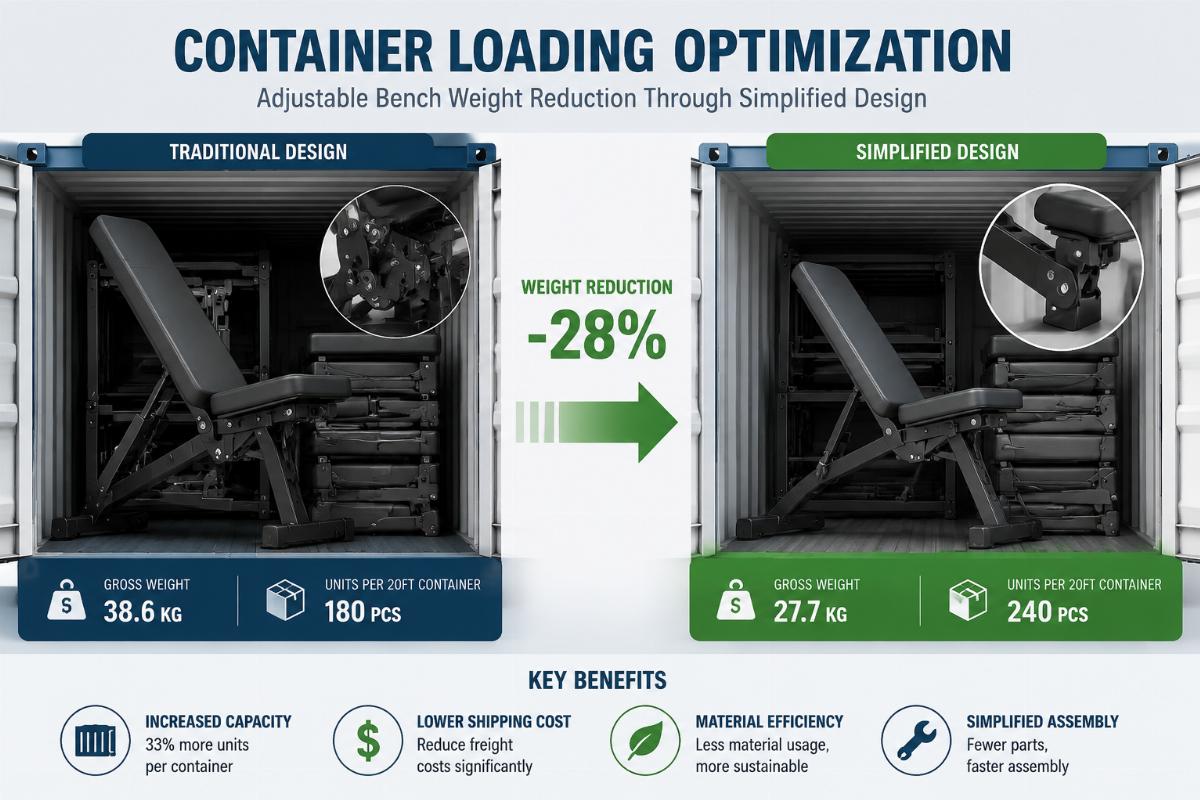
Simplified adjustment mechanisms reduce bench weight and increase container loading capacity, while premium upholstery and branding upgrades add cost without affecting logistics efficiency.
The relationship between customization and pricing is not linear. Frame color changes and logo additions carry relatively low incremental cost because they do not alter the production workflow significantly. The powder coating line is adjusted, the paint is mixed to the client’s reference, and the frames move through the same curing process. Laser-engraved logos cost more than screen printing upfront, but in high-use commercial environments, the engraved mark does not wear off the way printed ink can over time. The long-term cost of re-branding worn benches is avoided entirely [NEED_CITE: abrasion resistance comparison of logo application methods on commercial fitness equipment].
Structural simplification, conversely, can reduce both unit cost and shipping cost. Fewer adjustment positions mean less steel in the ladder bar, fewer pin holes to drill, and a lighter overall bench. When loading containers for overseas shipment, bench weight directly determines how many units fit within the container’s weight limit. A lighter bench means more units per container, which reduces the per-unit freight cost noticeably.
An importer in the Middle East was loading adjustable benches into standard shipping containers and found that the weight limit was reached before the volume was full. By working with us to reduce the backrest from seven positions to five and specifying a slightly lighter gauge tube that still passed all structural testing, the bench weight dropped enough to fit additional units per container. The per-unit landed cost decreased meaningfully, and the simplified mechanism actually improved reliability in the field because there were fewer moving parts to wear.
| Customization Factor | Unit Cost Impact | Container Loading Impact |
|---|---|---|
| Frame color change | Low incremental cost | No impact |
| Logo printing vs. engraving | Engraving costs more upfront | No impact |
| Premium upholstery upgrade | Moderate cost increase | Slight weight increase |
| Reduced adjustment positions | Noticeable cost reduction | Weight reduction improves loading |
| Tube thickness reduction | Cost reduction if validated | Weight reduction improves loading |
The key insight here is that not all customization adds cost. Some modifications—particularly those that simplify the mechanism or reduce material usage within safe engineering limits—can actually improve the commercial equation for the buyer. The trick is knowing which parameters to adjust and which to leave alone.
Conclusion
Adjustable Bench OEM Customization is a balance between branding flexibility and structural discipline. Buyers who invest time upfront to specify tolerances, validate material changes through testing, and approve prototypes before mass production consistently receive products that meet both their branding goals and their durability requirements. Those who skip these steps—relying on sketches, verbal agreements, or assumptions about factory defaults—discover the gaps only when the containers open at the destination port. The parameters that matter most are the ones you cannot see: pin hole tolerances, weld joint positions, and tube wall thickness. Get those right, and everything else follows.


