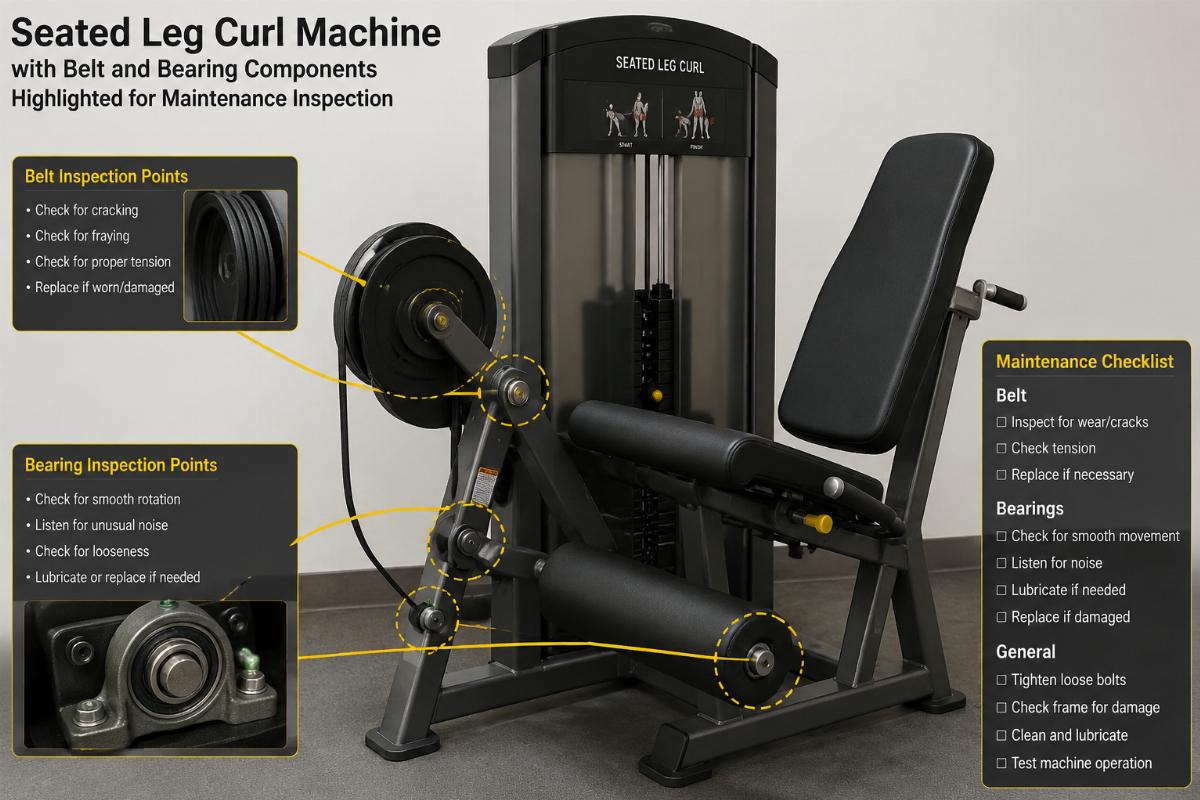
Functional Trainer Preventive Maintenance Schedule | OEM Supplier
Most gym owners blame cable fraying on poor build quality. The real culprit is almost always a missing or ignored preventive maintenance schedule.
A functional trainer preventive maintenance schedule should include weekly cable and pulley inspections, monthly lubrication of all moving contact points, quarterly tension checks and alignment verification, and semi-annual full-system audits covering frame welds, weight stack guide rods, and selectorized pin mechanisms. Following ISO-aligned maintenance intervals extends component life substantially and keeps downtime to a minimum across commercial, hotel, and studio environments.
I still think about a private gym in Riyadh where a brand-new dual adjustable pulley unit started shedding cable strands within a single summer season. The owner was furious, convinced the steel wire rope was defective. After flying out to inspect, I found the pulley grooves packed with fine desert sand acting like grinding paste, and zero lubrication on any pivot point. The maintenance card we shipped was in English and Chinese — neither of which the on-site technician read. That single communication gap cost us a full container replacement order and weeks of back-and-forth claims. Since then, I have built every functional trainer preventive maintenance schedule around one principle: the plan must survive contact with the actual floor, not just the factory floor. [NEED_CITE: root cause distribution of cable and pulley failures in commercial strength equipment per ISO 15243 damage categories]

Let me walk you through how a working schedule actually looks in the field, and where most operators get it wrong.
What Should a Functional Trainer Preventive Maintenance Schedule Cover?
A complete schedule touches four subsystems: cable and pulley assemblies, weight stack and guide rod mechanisms, frame and attachment hardware, and adjustment selectors including pop-pins and latch plates.
Skipping any one of these creates a cascade. A dry guide rod increases friction, which loads the cable unevenly, which accelerates pulley groove wear, which then frays the wire rope prematurely. The failure never starts where you see it. [NEED_CITE: ISO 20957-1 stationary training equipment safety and test requirements for cable-loaded strength machines]
Here is how a typical tiered schedule breaks down for a functional trainer in daily commercial use:
| Maintenance Interval | Cable and Pulley System | Weight Stack and Guides | Frame and Attachments | Selectorized Adjustments |
|---|---|---|---|---|
| Weekly | Visual inspection for fraying, seating check in pulley grooves | Listen for grinding or sticking during full travel | Check J-cup and latch tightness | Confirm pop-pin engagement |
| Monthly | Clean pulley grooves, apply dry-film lubricant to cable | Wipe guide rods, apply light silicone-based lubricant | Torque-check base bolts and upright connections | Lubricate adjustment holes and rails |
| Quarterly | Measure cable stretch and re-tension if needed | Inspect weight stack bumper pads for compression set | Examine weld zones for hairline cracks | Verify selector pin detent force |
| Semi-Annual | Full cable replacement assessment, shroud removal | Guide rod alignment verification | Complete hardware re-torque per spec | Replace worn selector pins and springs |
A distributor in Southeast Asia once asked me why their hotel clients kept calling about "sticking" weight stacks on our cable crossover units. The answer was humidity. Coastal properties in that region run dehumidifiers inconsistently, and un-lubricated guide rods develop surface oxidation within weeks. Once we added a monthly silicone wipe-down to their functional trainer preventive maintenance schedule, service calls dropped noticeably. [NEED_CITE: corrosion initiation thresholds for chrome-plated guide rods in high-humidity indoor environments]
How Often Should Cables and Pulleys Be Inspected?
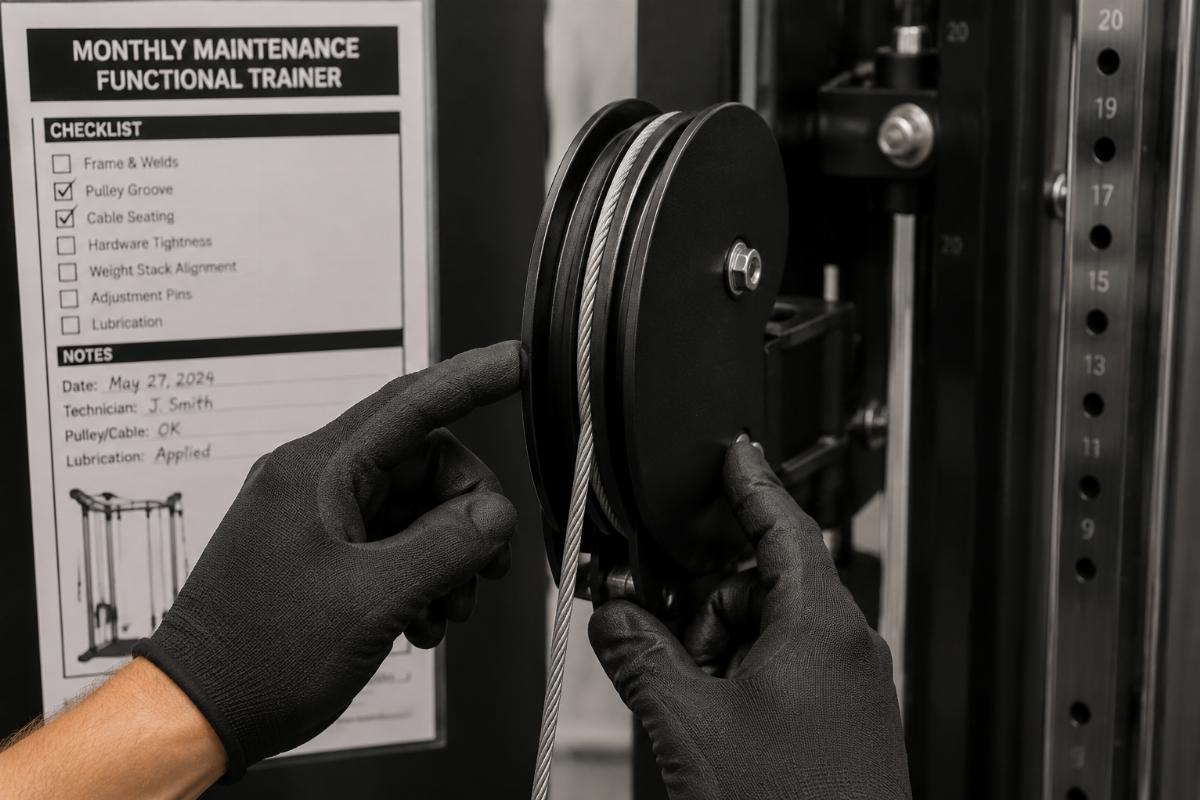
Cables on a functional trainer in commercial use need visual inspection every week and a formal tension-plus-stretch assessment every quarter. Pulleys must be groove-cleaned monthly and replaced when wear flats become visible.
The reasoning is mechanical, not arbitrary. Wire rope on a functional trainer runs over multiple pulleys with varying wrap angles. Each direction change introduces bending fatigue. In dry, sandy, or salty air environments, abrasive particles embed in the cable strands and act as internal cutting agents — even when the cable looks clean on the surface. [NEED_CITE: wire rope fatigue failure modes in multi-pully cable exercise equipment per manufacturer engineering bulletins]
I once serviced a beachfront resort gym in Latin America where three functional trainers needed full cable replacement within the same quarter. The facility had no sand-trapping mat at the entrance, and every member walked in with fine beach grit on their shoes. The grit migrated into the cable shrouds and worked itself into the strand interstices. No amount of external wiping could reach it. We revised their functional trainer preventive maintenance schedule to include a bi-weekly compressed-air blowout of the cable pathway and a floor mat requirement. Cable life extended substantially after that.
The inspection itself follows a simple sequence:
- Run the full cable travel under light load and listen for clicking or grinding — indicates pulley bearing contamination.
- Visually trace the entire cable length with a bright LED, checking for broken outer wires, "birdcaging," or core protrusion.
- Check pulley groove seating — the cable should sit flush at the groove bottom, not riding high or skipping.
- Measure free-hanging cable length against baseline and compare stretch; noticeable elongation beyond initial bedding means internal strand wear.
- Inspect pulley bearings for lateral play by hand; any wobble requires bearing or pulley replacement.

What Lubrication Points Are Often Missed?
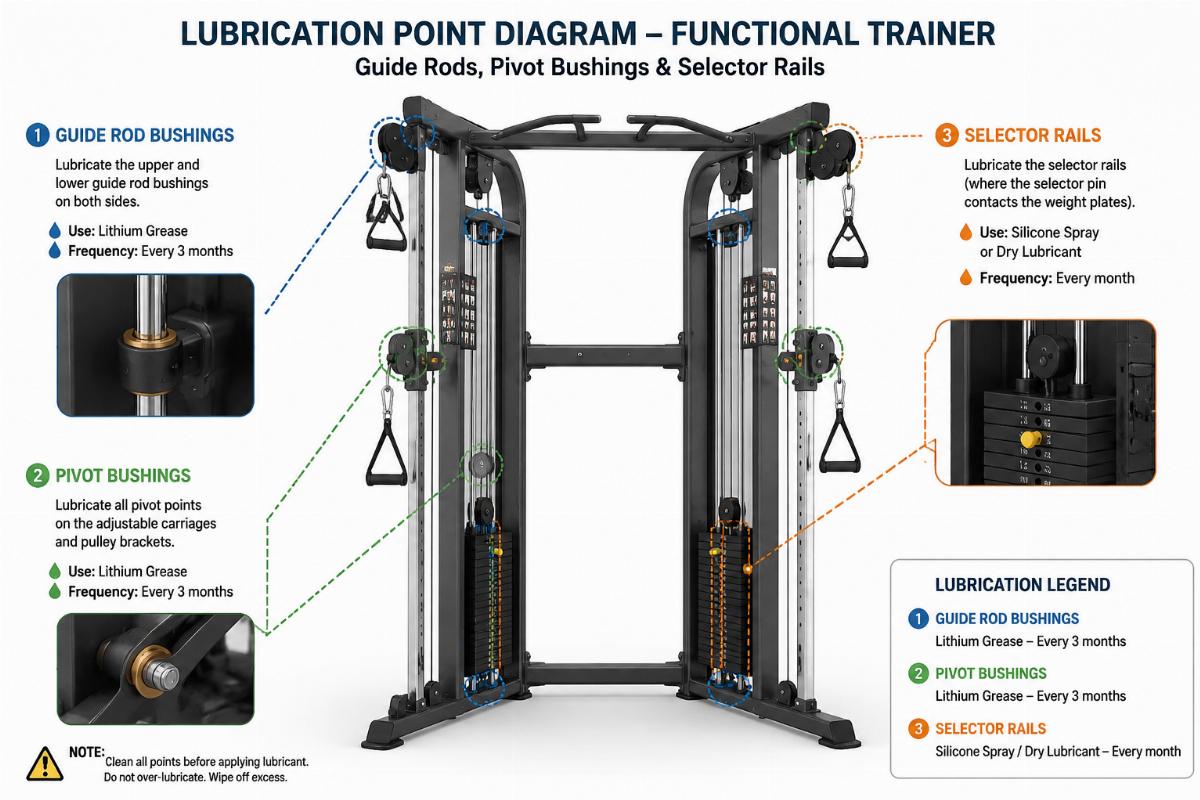
The most commonly neglected lubrication points on a functional trainer are the weight stack guide rods, the pulley shaft bearings, the selector pin rail holes, and the pivot bushings on adjustable arms.
Most gym operators lubricate what they can see — the exterior frame rails, maybe the seat adjustment tubes. The critical friction points are hidden inside shrouds, behind weight stack covers, or buried in pivot housings. [NEED_CITE: recommended lubricant types and intervals for linear guide systems and pivot bearings in strength training equipment]
A functional trainer preventive maintenance schedule that only addresses visible surfaces will still produce sticking, squeaking, and premature wear. The lubricant type matters as much as the location. Wet grease attracts dust and sand, turning into a grinding compound in arid climates. Dry PTFE film sprays work better in sandy or high-traffic environments because they leave no tacky residue. In humid coastal gyms, a light silicone spray on guide rods prevents oxidation without building up.
Here is a typical lubrication map for a dual-cable functional trainer:
| Lubrication Point | Recommended Lubricant Type | Application Method | Frequency in Commercial Use |
|---|---|---|---|
| Weight stack guide rods | Light silicone spray or dry PTFE | Wipe-on with lint-free cloth | Monthly |
| Pulley shaft bearings | Dry PTFE film or manufacturer-specified grease | Inject via bearing seal port if accessible | Quarterly |
| Selector pin rail holes | Dry PTFE spray | Spray and cycle pin through full range | Monthly |
| Adjustable arm pivot bushings | Dry PTFE or light machine oil | Apply at bushing interface, cycle through range | Monthly |
| Cable internal strands | None — do not lubricate wire rope | N/A | N/A |
That last row is counter-intuitive and important. Wire rope should never be oiled or greased on a functional trainer. Lubricant on the cable attracts particulate, accelerates pulley groove wear, and gives a false impression of cable health. Factory-applied internal lubrication is sufficient for the wire rope’s service life.
A Middle East fitness chain learned this the hard way when a well-meaning technician sprayed WD-40 on every cable he could reach. Within weeks, the lubricant migrated into pulley grooves, trapped fine sand, and accelerated groove wear across multiple units. Their functional trainer preventive maintenance schedule had to be rewritten from scratch. [NEED_CITE: lubricant compatibility and contamination risks in cable-pulley systems per equipment maintenance standards]
How Do You Adapt the Schedule for Different Environments?
A functional trainer preventive maintenance schedule must be adjusted for climate, usage intensity, and user profile — a hotel gym in a coastal city needs a fundamentally different cadence than a private studio in a dry inland market.
The baseline schedule I outlined above assumes moderate commercial use in a controlled indoor environment. Real-world deployments rarely match that assumption.
In arid, sandy regions — much of the Middle East, North Africa, and parts of Latin America — particulate ingress is the dominant threat. Pulley grooves clog, guide rods scratch, and cables abrade internally. The schedule should compress monthly tasks into bi-weekly cycles and add compressed-air cleaning of shrouded areas.
In tropical or coastal humidity zones — Southeast Asia, West Africa, Caribbean resort markets — corrosion is the primary enemy. Chrome-plated guide rods, bare steel adjustment pins, and even frame weld zones can develop surface rust if humidity control is inconsistent. Monthly silicone protection becomes non-negotiable, and semi-annual audits should include rust-spot treatment before it spreads.
In high-turnover boutique studios and CrossFit-style boxes — where functional trainers see back-to-back classes and heavier-than-average loads — cable fatigue and selector pin wear accelerate. Quarterly cable stretch measurements should shift to monthly, and pop-pin springs should be inspected for fatigue at every monthly service.
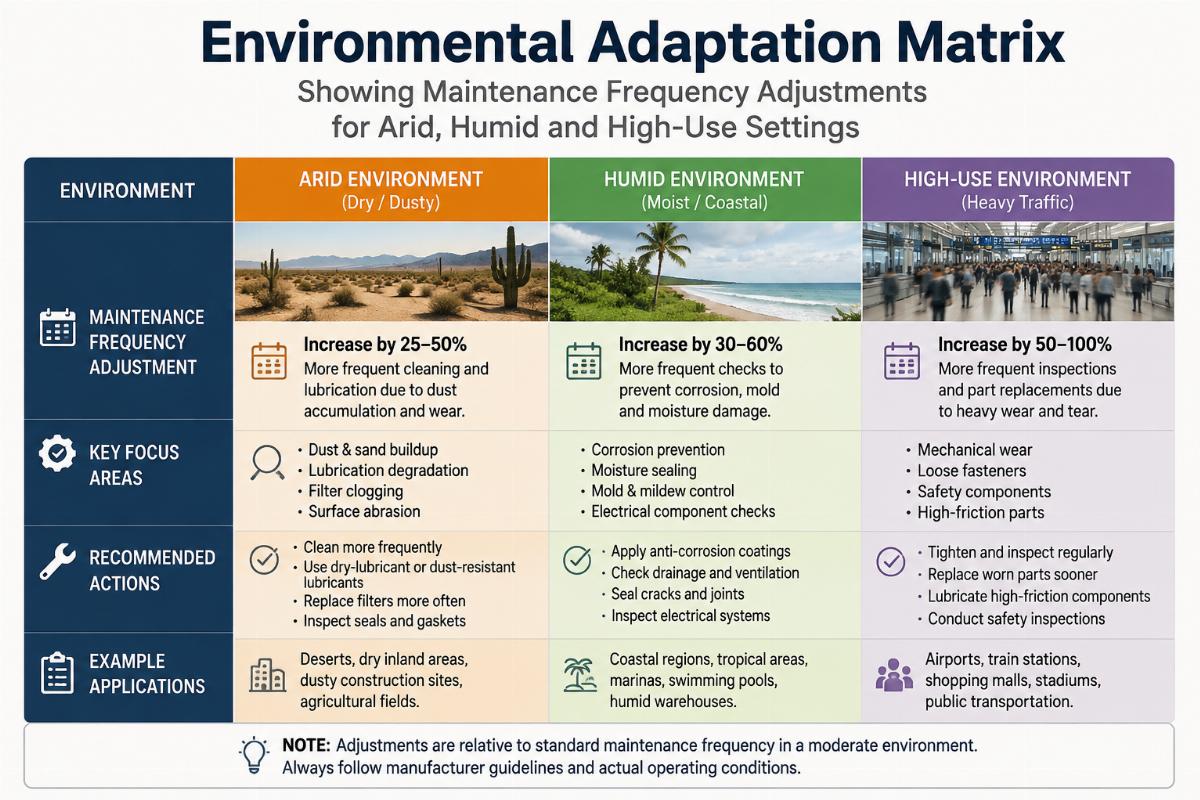
A distributor covering multiple regions across the Middle East and Southeast Asia asked us to produce a single functional trainer preventive maintenance schedule template that their local technicians could customize on-site. We built a base template with three environmental modifier columns — arid, humid, high-use — where each monthly task either stays, accelerates, or gains an additional sub-step. The key was keeping the language simple and the tool list minimal: lint-free cloth, silicone spray, dry PTFE spray, hex key set, and a bright flashlight. No specialized instruments required.
That template now ships inside every functional trainer we produce, printed in English, Arabic, Spanish, and Mandarin on a laminated card attached to the frame. Because a schedule only works if the person holding the wrench can actually read it.
When Should Components Be Replaced Rather Than Maintained?
Cables, pulleys, selector pins, and guide rod sleeves all have finite service lives — the functional trainer preventive maintenance schedule must define clear replacement thresholds, not just inspection checkpoints.
Inspection without replacement criteria creates a false sense of security. A technician can check a cable every week and still miss the moment when internal strand fatigue reaches a critical point, because external appearance lags behind internal damage. [NEED_CITE: wire rope discard criteria per ISO 4309 crane wire rope inspection standards adapted for fitness equipment applications]
Replacement triggers for a functional trainer typically include:
- Cable replacement when visible broken wires appear on the outer strand, when measured stretch exceeds initial bedding elongation by a noticeable margin, or when the cable no longer seats cleanly in the pulley groove.
- Pulley replacement when groove wear creates a visible flat spot, when bearing play is detectable by hand, or when the pulley produces audible grinding under load.
- Selector pin replacement when detent force drops and the pin slips under moderate load, or when the pin shaft shows visible bending.
- Guide rod sleeve replacement when the rod develops lateral play despite proper lubrication, indicating internal bore wear.
A gym operator in a European hotel chain kept running their functional trainers until something actually broke. Their reactive approach meant a single failed cable could take a unit offline for days while waiting for a replacement part. After switching to a threshold-based functional trainer preventive maintenance schedule — where cables are replaced at first signs of outer wire breakage rather than after full failure — their unplanned downtime dropped noticeably, and member complaints about out-of-order equipment nearly disappeared.
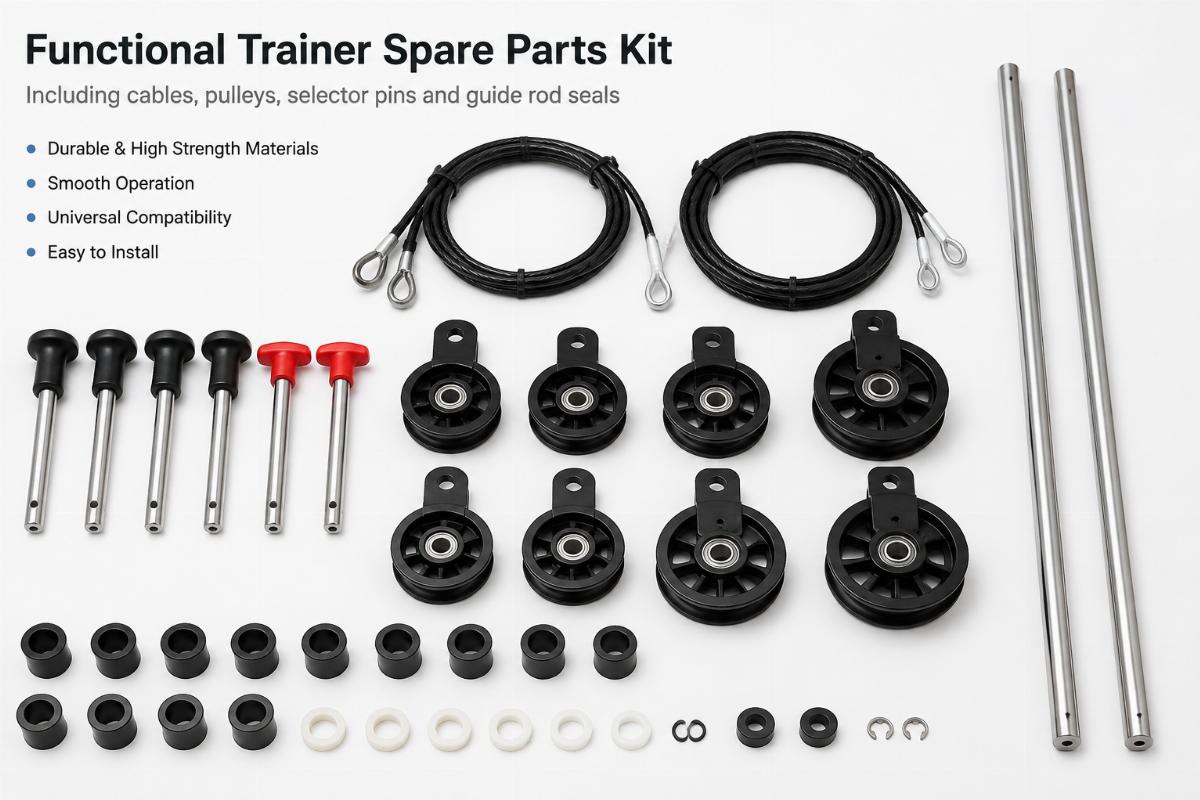
The spare parts to keep on hand are simple: a set of replacement cables matched to each model, a small stock of pulleys for the high-wear redirect positions, selector pin kits, and guide rod wiper seals. A supplier who bundles these consumables with the initial equipment order removes the longest lead time from the maintenance equation. [NEED_CITE: recommended spare parts inventory for commercial functional trainers based on mean time between failure data]
Conclusion
A functional trainer preventive maintenance schedule is not paperwork — it is the single most effective tool for protecting equipment investment, reducing downtime, and extending component life across any commercial, hospitality, or studio environment.
Build it around the four subsystems, adapt it to your climate and usage intensity, lubricate the right points with the right products, and define clear replacement thresholds before failure occurs. The difference between a functional trainer that lasts and one that constantly breaks down is almost never the steel — it is the schedule taped to the frame.