AD-70 Adjustable Dumbbell OEM Customization Wholesale Supplier
Most buyers think OEM customization means swapping a logo. The real disasters happen in dial sequence orientation and laser engraving direction.
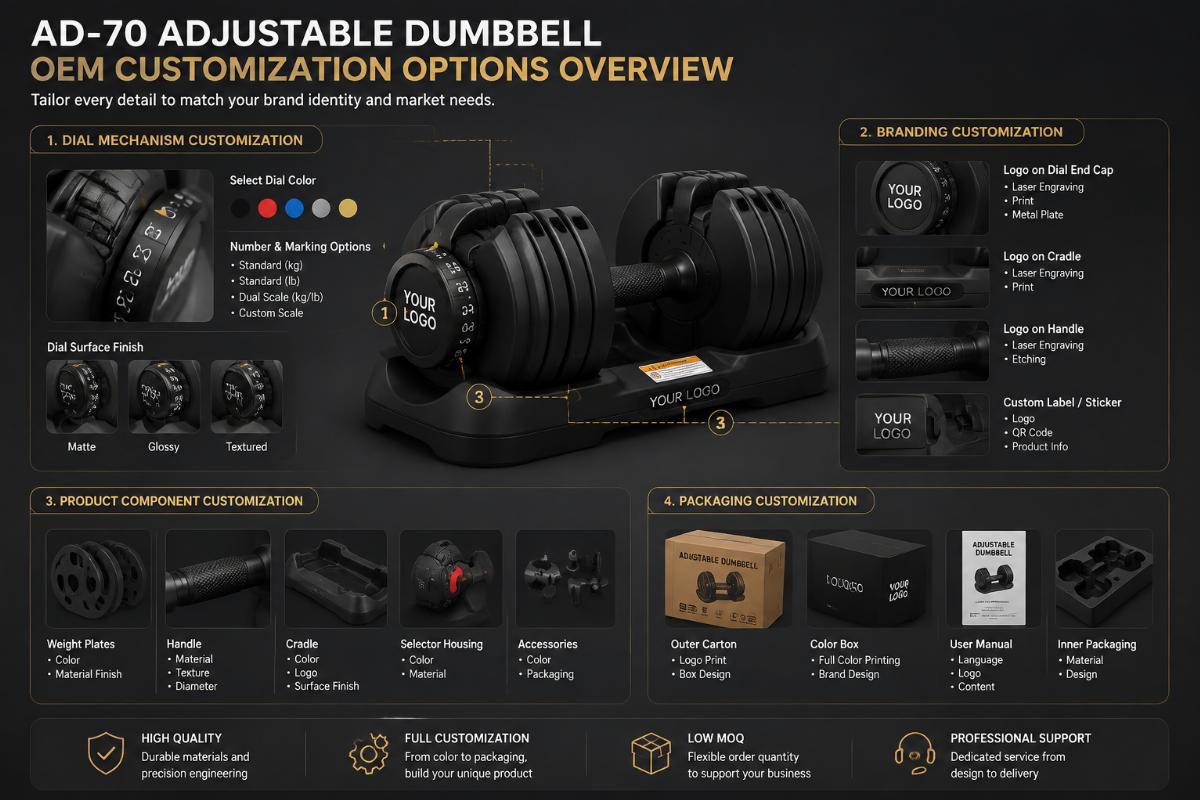
The AD-70 adjustable dumbbell OEM customization platform covers four major categories—branding identity, dial刻度 system, weight configuration, and packaging solutions—with over a dozen configurable options. Buyers must validate each parameter against acceptance criteria before approving mass production, because a single misaligned weight marking can trigger a full-container rework at destination port.
I still remember a shipment bound for Dubai. The buyer requested custom silk-screen branding and a different dial plate color. The factory rushed production and reversed the laser-engraved weight sequence. When the containers arrived, the buyer opened the first carton and found 5 lbs marked where 25 lbs should be. The entire container had to be pulled back, re-labeled, and re-palletized. The port demurrage and rework costs wiped out most of the margin on that order. Since then, I inspect every OEM order for adjustable dumbbells with the same intensity—packaging, nameplates, dial markings, not a single detail gets a pass. These adjustable dumbbells look simple on the surface, but the dial mechanism, tray latch tolerances, and weight plate variance can all cause failures if overlooked.
Let me walk you through what actually matters when you spec an AD-70 adjustable dumbbell OEM customization order, from the configurable options all the way to the documentation you need before the container leaves the port.
What Customization Options Are Available for AD-70 Adjustable Dumbbells?
The AD-70 adjustable dumbbell OEM customization platform supports modifications across branding identity, dial system, weight range, and packaging—each with its own validation requirements.
When importers first approach an AD-70 adjustable dumbbell OEM customization project, they usually start with the visible elements: logo placement, color schemes, and retail packaging. But the configurable scope runs much deeper. Here is what a typical customization checklist looks like:
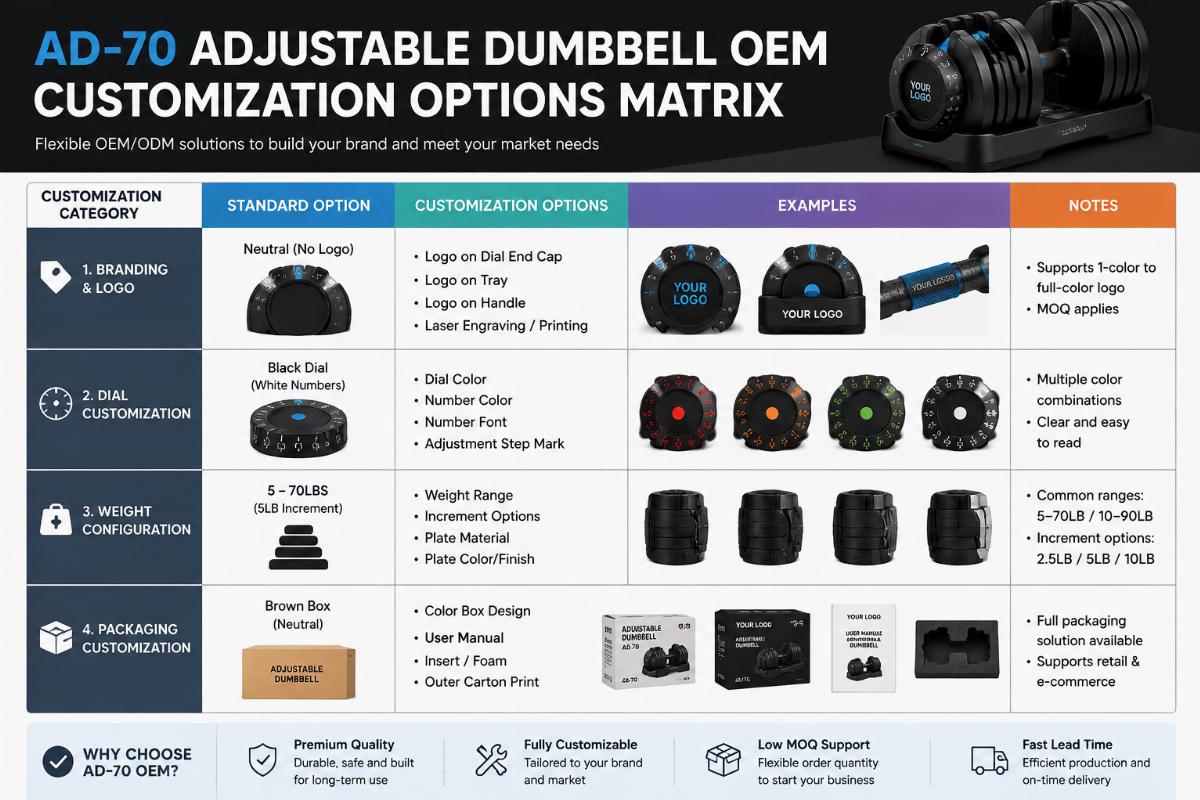
- Branding & Identity: Silk-screen logos on the dial face, laser-etched brand marks on the handle grip, custom nameplate material and finish, color-matched dial plates.
- Dial System: Weight increment selection (e.g., 5 lb steps vs. 2.5 kg steps), dial number orientation (clockwise vs. counterclockwise sequence), language variants for international markets, laser engraving depth and contrast level.
- Weight Configuration: Total range endpoints, number of internal weight plates, plate material (cast iron vs. steel composite), single-plate weight tolerance class, handle grip diameter and texture.
- Packaging & Logistics: Custom color box design with structural inserts, EVA molded tray vs. blister tray, palletization pattern, shipping mark placement, master carton labeling.
A distributor in Southeast Asia once ordered the AD-70 adjustable dumbbell OEM customization with a 2.5 kg increment dial for the European market. The factory defaulted to the standard 5 lb increment tooling. The dials physically fit, but the weight steps did not match the marketing materials already printed for that region. The entire batch had to be held while replacement dial plates were air-shipped. [NEED_CITE: dial increment standardization per ISO fitness equipment labeling requirements]
The key takeaway: every customizable element has a corresponding acceptance criterion. If you do not define it in the purchase order, the factory will default to its standard configuration—and "standard" varies by production batch.
What Are the MOQ and Lead Time Requirements for OEM Orders?
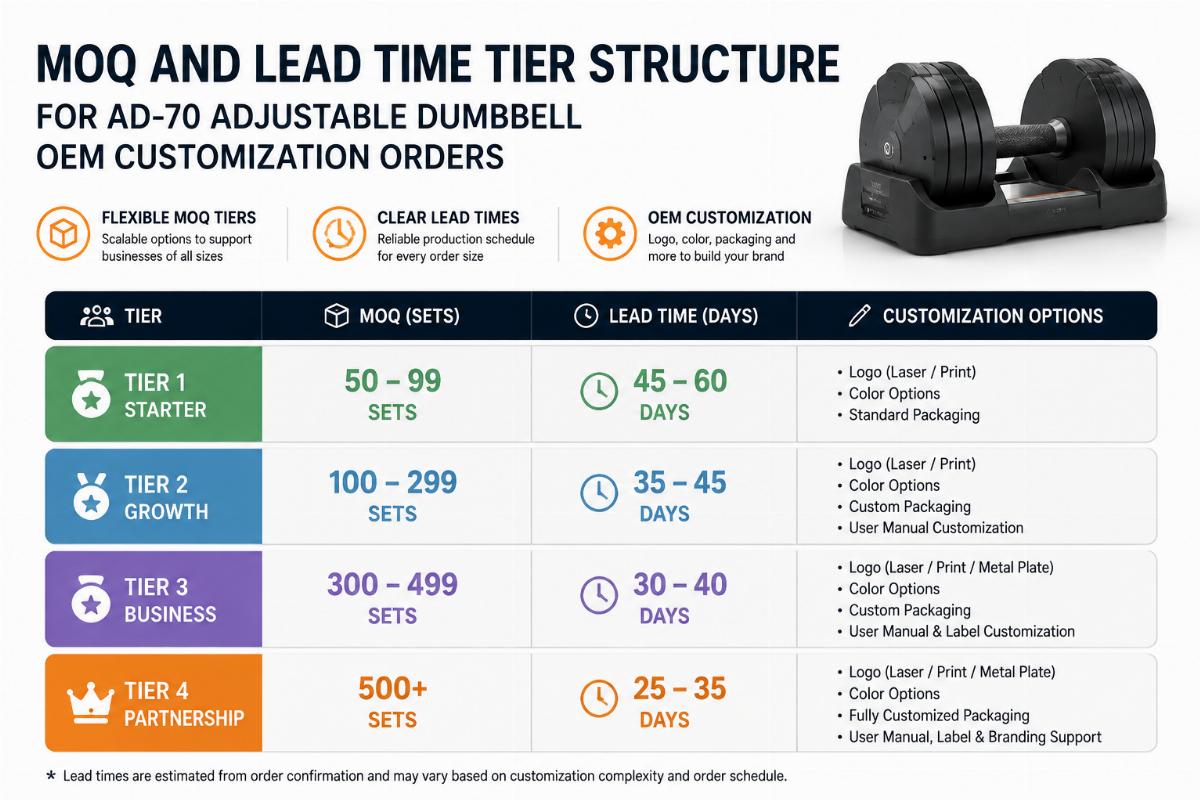
MOQ for AD-70 adjustable dumbbell OEM customization is tiered by configuration complexity—standard branding runs at lower thresholds, while deep customization of dial mechanisms or proprietary packaging triggers higher minimums and longer lead times.
Many buyers assume lower MOQ is always better. In practice, when order volume drops below the economic batch size, the per-unit mold amortization cost actually rises. A single custom EVA tray mold, for example, carries a fixed tooling charge. Spread across a small batch, that cost per unit becomes significant. Spread across a full container, it becomes negligible.
For the AD-70 adjustable dumbbell OEM customization, the typical structure looks like this:
- Standard branding only (logo swap, color match on existing dial): lower MOQ threshold, shorter production cycle, existing tooling used.
- Dial system modification (custom increment, new number layout, language change): moderate MOQ, additional lead time for dial plate tooling and first-article approval.
- Full packaging customization (new color box structure, custom EVA insert, retail-ready display carton): higher MOQ due to mold costs, extended lead time for packaging sample approval and structural testing.
- Proprietary weight configuration (non-standard range, custom plate count): highest MOQ, longest lead time, requires internal weight plate re-tooling.
A buyer in Latin America once requested the AD-70 adjustable dumbbell OEM customization with a proprietary 10-position dial that did not match any existing configuration. The factory quoted a reasonable per-unit price but required a full container to amortize the dial plate mold. The buyer tried to split the order across two SKUs to reduce the initial commitment. The result: per-unit cost rose noticeably, and the lead time extended because the factory had to schedule two separate dial plate runs. [NEED_CITE: economic batch size principles in injection mold tooling amortization]
Lead time itself depends on how many custom elements are in play. A standard branding-only order moves through production quickly because the dial mechanism, weight plates, and tray are all pre-tooled. Add a custom dial sequence and a new packaging mold, and the timeline stretches—first-article samples must be approved before mass production can begin, and packaging structural tests must pass before the shipping line will accept the carton spec.
How to Verify Dial Mechanism Quality Before Mass Production?
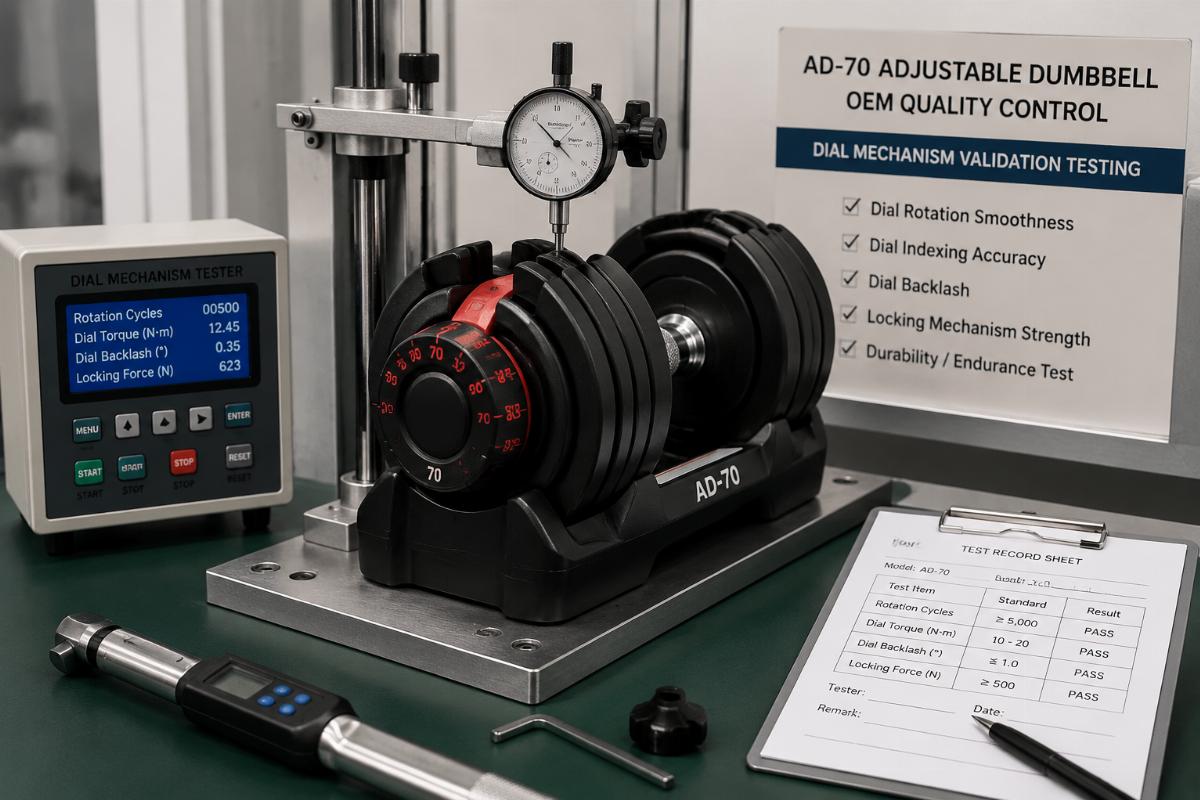
Dial mechanism reliability for the AD-70 adjustable dumbbell OEM customization must be confirmed through three validation tests: position accuracy, rotation endurance, and latch retention force—before a single unit enters mass production.
The dial mechanism is the heart of any adjustable dumbbell. It is also the component most likely to fail in the field if not properly validated. Most buyers assume the dial mechanism is a universal, off-the-shelf part. In reality, different weight ranges require different spring pre-load forces, and those forces must be individually calibrated. A dial that works smoothly on a lighter model may feel stiff or fail to engage on a heavier one.
Here is the validation sequence I require before approving any AD-70 adjustable dumbbell OEM customization dial mechanism:
- Position Accuracy Test: Rotate the dial through every weight position and verify that each click engages cleanly with no partial engagement or skipped positions. The dial must hold firm at each detent with no perceptible play. [NEED_CITE: dial detent engagement standards per fitness equipment safety protocols]
- Rotation Endurance Test: Cycle the dial through its full range repeatedly for an extended service simulation. After the cycle count is complete, re-test position accuracy. Any degradation in click feel or engagement signals a problem with the internal cam or spring.
- Latch Retention Force Test: With the dumbbell set to its maximum weight, apply lateral and vertical force to the handle. The weight plates must remain fully engaged with no disengagement, slippage, or audible clicking under load.
A gym equipment distributor in the Middle East received a sample batch of adjustable dumbbells where the dial mechanism felt smooth during initial inspection. But after extended rotation testing, several units developed a "dead zone" around one particular weight position—the cam surface had worn unevenly. The issue was traced to insufficient hardness treatment on the cam component. The entire batch was rejected before mass production began. [NEED_CITE: cam surface hardness requirements for repetitive mechanical engagement]
The factory supporting the AD-70 adjustable dumbbell OEM customization provides first-article samples specifically for this validation sequence. Do not skip this step. The cost of a sample shipment is a fraction of the cost of a container rejection at destination.
What Documentation Should Buyers Request for OEM Compliance?
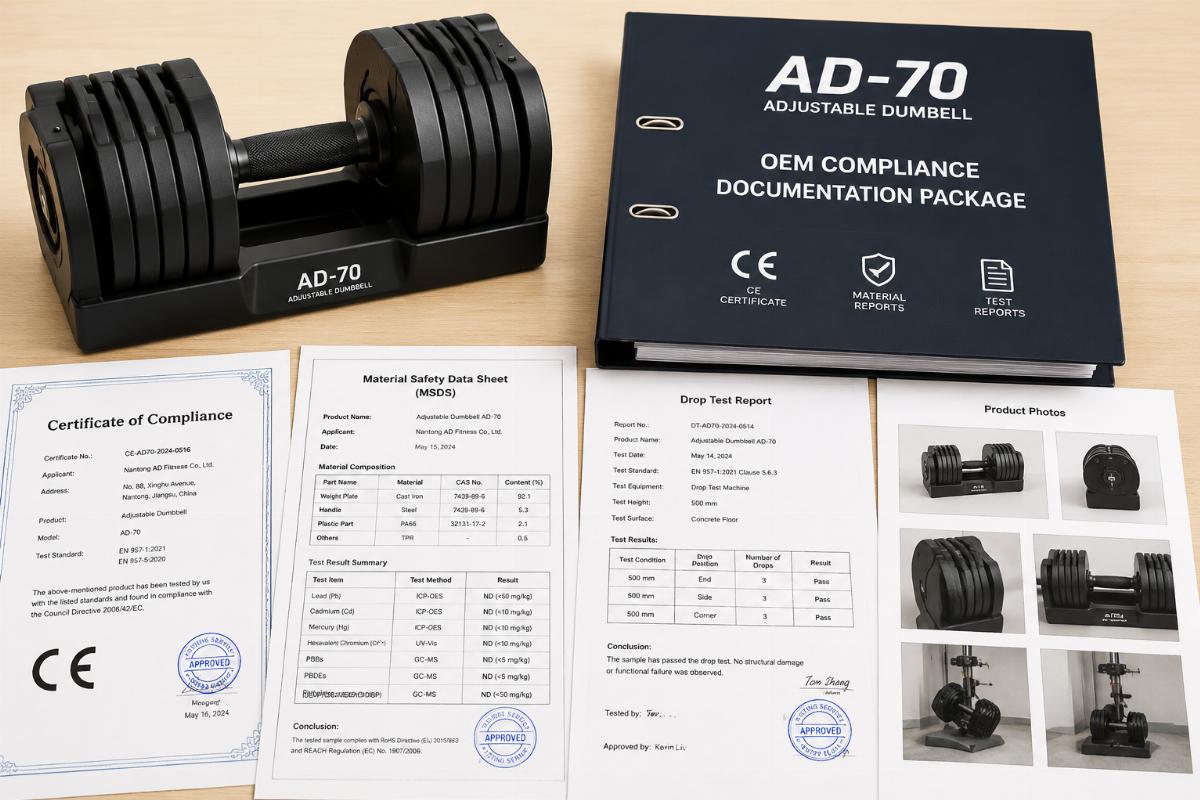
For AD-70 adjustable dumbbell OEM customization compliance, buyers must request CE certification, material test reports, dial calibration records, and packaging drop-test reports as mandatory documentation before shipment release.
Documentation is not paperwork for paperwork’s sake. It is your evidence trail if a product liability claim arises, if a customs authority questions the shipment, or if a retail buyer demands proof of compliance. Too many importers treat documentation as an afterthought—asking for it after the goods are already produced. By then, it is too late to fix gaps.
For the AD-70 adjustable dumbbell OEM customization, the required documentation package includes:
- CE Certificate: Confirms the product meets European safety directives. The certificate must specifically reference the adjustable dumbbell category, not a generic fitness equipment blanket. [NEED_CITE: CE marking requirements for fitness equipment under EU machinery directive]
- Material Test Reports: Verify that the weight plates, handle, and dial components meet declared material specifications. Reports should cover chemical composition and mechanical properties, issued by an accredited third-party lab.
- Dial Calibration Records: Batch-level records showing that each production lot passed the position accuracy and retention force tests described above. These records should be traceable to specific production dates and batch numbers.
- Packaging Drop-Test Report: Confirms that the retail packaging survives simulated shipping handling without product damage. The test protocol should match the declared shipping mode (e.g., ISTA standards for parcel delivery or containerized ocean freight).
A buyer in Africa once received a container of adjustable dumbbells without requesting material test reports in advance. When a retail customer later questioned whether the weight plates contained declared materials, the buyer had no documentation to provide. The cost of retroactive testing—pulling samples from already-distributed inventory, shipping them to an accredited lab, and re-issuing compliance statements—ran into multiple times the cost of pre-shipment testing. [NEED_CITE: third-party material testing accreditation standards for fitness equipment imports]
Build the documentation requirements into your purchase order from day one. The AD-70 adjustable dumbbell OEM customization process should include document review as a formal gate before mass production begins, not as a last-minute scramble before the container is sealed.
Conclusion
OEM customization for adjustable dumbbells extends far beyond logo placement—dial sequence, weight calibration, and packaging validation are where real risk lives. Define every parameter in your purchase order, validate the dial mechanism through position accuracy and endurance testing before mass production, and secure your compliance documentation before the container leaves the port. The AD-70 adjustable dumbbell OEM customization platform gives you the flexibility to build a differentiated product, but only if you treat each configurable element with the technical rigor it demands.