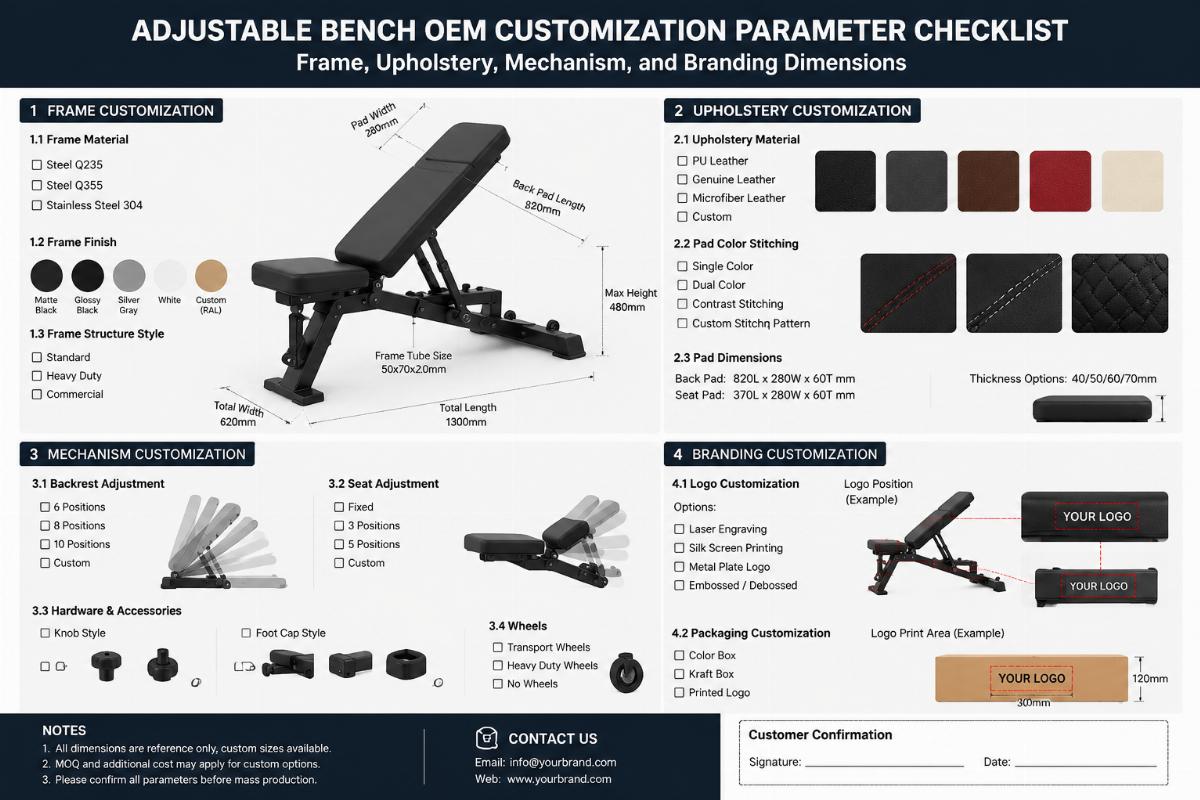
Adjustable Bench Specifications: OEM Manufacturer for Sale
More adjustment angles do not equal better value; they often introduce more points of failure.
For commercial gym owners and hotel procurement managers, the critical Adjustable Bench Specifications to verify are tube wall thickness of at least 3mm for the main frame, a dynamic weight capacity rating that exceeds static limits by a significant safety margin, and a pin-based adjustment mechanism with tolerance limits under 1mm to prevent wobble. Aesthetic features are secondary to structural integrity in high-traffic zones.
I still remember the smell of burning metal and the sharp screech of an angle grinder echoing through a hotel gym in Lagos. It was not a renovation project; it was an emergency repair. A batch of adjustable benches had arrived with backrest pin holes misaligned by mere millimeters. To the untrained eye, they looked perfect. But when a local coach loaded a barbell for a bench press, the entire seat assembly shuddered. The locking pins did not sit flush. I spent hours on the floor, grinding down the base plates to force a fit, knowing that every second of that wobble was a liability waiting to happen. That incident stripped away any illusion that spec sheets are just formalities. In the fitness equipment industry, a decimal point error in manufacturing translates directly to physical risk for the end user. [NEED_CITE: impact of manufacturing tolerances on equipment stability]
This experience dictates how I evaluate equipment today. Before discussing price or branding, I look at the bones of the machine. If the foundation is weak, no amount of padding or upholstery will save it from premature failure. Understanding the right Adjustable Bench Specifications is not about finding the cheapest option; it is about identifying the threshold where engineering meets endurance.
Why Do Commercial Benches Fail?
The most common misconception among buyers is that feature richness correlates with durability. They assume that a bench with seven backrest positions and four seat angles is superior to one with three and two. In reality, every additional adjustment point is a potential structural weakness if not engineered with precision. Commercial benches fail not because they lack features, but because their structural integrity cannot withstand the dynamic loads of a busy gym environment.
In high-volume facilities, equipment is subjected to forces far beyond static weight limits. A user dropping a dumbbell onto a bench creates an impact load that can be several times higher than the weight of the object itself. If the frame geometry is not designed to dissipate this energy, stress concentrates at the welds and pivot points. Over time, this leads to micro-fractures and eventual catastrophic failure. [NEED_CITE: fatigue cycle analysis in commercial fitness equipment]
Consider a case involving a chain gym in Southeast Asia. They purchased standard home-grade benches to cut costs. Within six months, cracks appeared at the weld joints where the backrest met the main frame. The issue was not the weight of the users, but the frequency of use combined with poor welding quality. The manufacturer had used manual welding techniques that lacked consistency, leading to uneven penetration and weak spots. This is why verifying the manufacturing process is as important as checking the final dimensions.
When reviewing Adjustable Bench Specifications, prioritize the design philosophy over the feature list. A simpler design with robust engineering will always outlast a complex one with compromised structural support. The goal is to ensure that the bench remains stable and safe regardless of how aggressively it is used.
Critical Specs: Tube Thickness & Weld Quality
The backbone of any adjustable bench is its steel frame. The thickness of the tubing determines its resistance to bending and torsion. For commercial applications, thin-walled tubes are a recipe for disaster. They may hold up under light use, but they will deform under the heavy, repetitive loads typical of a professional gym.
A reliable benchmark for commercial-grade equipment is a minimum tube wall thickness of 3mm for the main structural components. Anything less should be considered suitable only for light commercial or home use. This difference in material volume significantly impacts the rigidity of the frame. [NEED_CITE: industry standards for commercial fitness equipment tube thickness]
Equally important is the quality of the welds. Robotic welding offers superior consistency compared to manual methods. It ensures uniform penetration and reduces the likelihood of voids or weak spots. When inspecting Adjustable Bench Specifications, look for evidence of automated welding processes. Visual inspection of sample units can reveal much: smooth, consistent bead patterns indicate high-quality control, while irregular or porous welds suggest corner-cutting.
| Feature | Light Commercial / Home Grade | True Commercial Grade |
|---|---|---|
| Tube Wall Thickness | Thin-walled (often <2mm) | Heavy-duty (≥3mm) |
| Welding Technique | Manual (variable consistency) | Robotic (high consistency) |
| Structural Integrity | Prone to deformation under dynamic load | Resistant to bending and torsion |
| Longevity Expectancy | Short-term, low-frequency use | Long-term, high-frequency use |
At Bick, we adhere to these strict standards. Our commercial adjustable benches utilize 3mm+ commercial-grade steel and CE-certified welding processes. This is not a marketing claim but a baseline requirement for durability. We have seen too many projects fail because buyers focused on the finish rather than the foundation. By ensuring the core materials meet rigorous standards, we eliminate the most common causes of early equipment retirement.
Buyers should request detailed specification sheets that explicitly state tube dimensions and welding methods. If a supplier is vague about these details, it is a red flag. Transparency in Adjustable Bench Specifications is a sign of confidence in product quality.
The Adjustment Mechanism: Pin vs Lever Systems
The mechanism used to adjust the bench angle is critical for both safety and user experience. There are two primary types: pin systems and lever systems. While levers offer quick adjustments, they are prone to wear and tear, especially in high-traffic environments. Pins, when engineered correctly, provide superior stability and longevity.
The key issue with pin systems is tolerance. If the hole in the frame and the hole in the moving part are not perfectly aligned, the pin will not slide in smoothly, or worse, it will allow play even when locked. This play results in the dangerous wobble experienced in the Lagos hotel incident. The tolerance limit for pin holes should be strictly controlled, ideally under 1mm. [NEED_CITE: mechanical tolerance standards for fitness equipment adjustment mechanisms]
In contrast, lever systems rely on friction and cam action. Over time, the components wear down, reducing the holding force. This can lead to sudden shifts in angle during exercise, posing a serious safety risk. Additionally, worn levers often produce annoying clicking or grinding noises, which detract from the premium feel of a facility.
A boutique studio in Europe recently upgraded their equipment due to client complaints about noise. The original benches used a low-quality lever system that rattled with every adjustment. Switching to a precision-machined pin system eliminated the noise and provided a solid, secure feel. Users reported feeling more confident during heavy lifts, knowing the bench would not shift unexpectedly.
When evaluating Adjustable Bench Specifications, pay close attention to the description of the adjustment mechanism. Look for terms like "precision-machined," "tight tolerance," and "steel-on-steel" contact. Avoid systems that rely solely on rubber padding to reduce play, as this is a temporary fix for poor engineering. A well-designed pin system should offer smooth operation without excessive force, yet remain completely rigid when locked.
Weight Capacity: Static vs Dynamic Loads
Weight capacity is perhaps the most misunderstood specification in the industry. Most manufacturers list a static weight limit, which is the maximum weight the bench can hold when stationary. However, in a real-world gym setting, benches are subjected to dynamic loads. Dropping weights, explosive movements, and uneven weight distribution create forces that far exceed static limits.
A safe commercial bench must have a dynamic weight capacity rating that is significantly higher than its static rating. A good rule of thumb is to look for a dynamic rating that is at least double the expected maximum user bodyweight plus the weight being lifted. This safety factor accounts for the impact forces generated during intense workouts. [NEED_CITE: dynamic load testing methods for fitness equipment]
Static testing involves placing weights on the bench and measuring deflection. Dynamic testing, on the other hand, simulates real-use conditions by dropping weights onto the bench from a specified height. This test reveals weaknesses in the frame and welds that static testing might miss. Buyers should ask suppliers if their products undergo dynamic impact testing and request proof of certification.
International safety standards, such as EN ISO 20957, provide guidelines for testing fitness equipment. Compliance with these standards ensures that the equipment has been rigorously evaluated for safety and performance. [NEED_CITE: EN ISO 20957 safety requirements for strength training equipment]
Do not be misled by inflated static weight claims. A bench rated for 300kg statically may fail under a dynamic load of 150kg if the structure is not properly reinforced. Always prioritize dynamic performance data when reviewing Adjustable Bench Specifications. This ensures that the equipment can handle the rigors of daily commercial use without compromising user safety.
Checklist for Procurement
Purchasing commercial fitness equipment requires a disciplined approach. Relying on brochures and sales pitches is insufficient. A thorough verification process is necessary to ensure that the equipment meets the demands of your facility. Here is a practical checklist to guide your procurement decision.
First, verify certifications. Look for CE marks and compliance with international safety standards like EN ISO 20957. These certifications indicate that the product has undergone independent testing. Second, request sample stress tests. If possible, visit the factory or arrange for a third-party inspection to observe the testing process firsthand. Seeing the equipment under load provides invaluable insight into its true capabilities.
Third, examine the warranty and spare parts supply. A confident manufacturer will offer a comprehensive warranty and ensure the availability of spare parts for years to come. This is crucial for maintaining operational continuity. Finally, consider the supplier’s track record. Look for reviews and case studies from similar facilities. Real-world feedback is often more revealing than technical specifications alone.
By following this checklist, you can mitigate the risks associated with purchasing commercial fitness equipment. Focus on verifiable data and tangible evidence of quality. This approach ensures that your investment delivers long-term value and safety for your users. Understanding the nuances of Adjustable Bench Specifications empowers you to make informed decisions that protect your business and your clients.
Conclusion
Durability is not an accident; it is the result of precise engineering and rigorous testing.
Commercial adjustable benches must be evaluated based on their structural integrity, not just their features. Prioritize tube thickness, weld quality, and dynamic weight capacity to ensure long-term performance. By focusing on these critical Adjustable Bench Specifications, buyers can avoid common failures and invest in equipment that truly serves their facility’s needs.