01 / Scenario
STUDIO
P
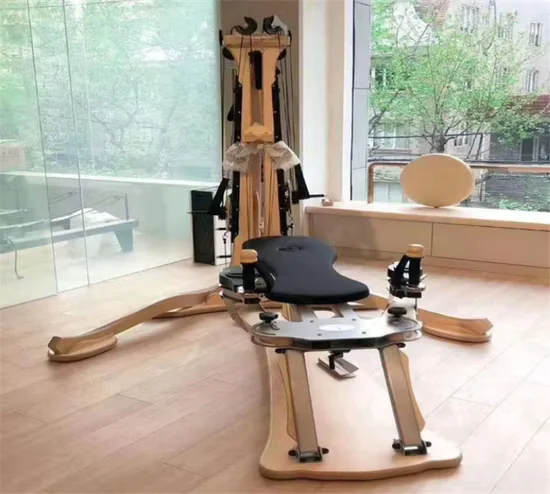
High-End Pilates Studios
Premium aesthetics meet quiet operation for boutique studio environments.
ISO
9001
CE
Certified
OEM
Available
10YR
Warranty
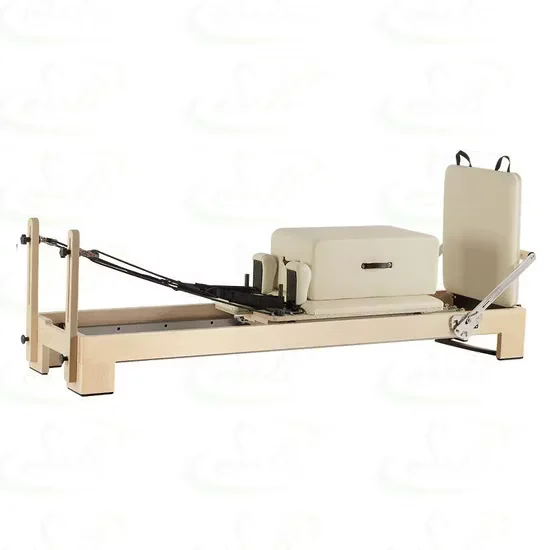
Pilates Reformer Core Training Bed, White Maple Wood Frame, 2460×730×680mm — solid hardwood construction eliminates warping and delamination risks common in veneered alternatives under daily studio loading. Includes long box, jump board, and platform with precision-machined carriage rail system for consistent glide performance. Every unit undergoes full load testing before shipment to ensure structural integrity for high-traffic commercial use.
// Spec Highlights
• Direct from Manufacturer · No Middlemen · Worldwide Shipping
01
// Material
Imported Solid Wood
Premium hardwood frames sourced for density and visual warmth.
02
// Hardware
Medical-Grade Silent
Whisper-quiet pulleys and springs for clinical environments.
03
// Customization
Appearance OEM
Color, upholstery, and branding tailored to your studio.
04
// Service
Layout Design
Free venue planning for studios and rehab institutions.
Every component is selected for longevity, performance, and aesthetic harmony - from imported hardwood frames to silent medical-grade accessories.
// Features
Solid Hardwood Frame Integrity — Solid white maple construction eliminates the warping and delamination failures that plague veneered and plywood reformer beds in high-humidity studio environments.
| Parameter | Value |
|---|---|
| Product Type | Pilates Reformer |
| Frame Material | Solid White Maple Wood |
| Product Dimensions | 2460×730×680mm |
| Net Weight | 100kg |
| Accessories Included | Long Box, Jump Board, Platform |
| Color Options | Solid color finishes available |
| Logo | Customized branding available |
| Accessory Compatibility | Long Box / Jump Board / Platform mounting interfaces |
| Warranty | 3 Years |
| Certification | ISO 9001 |
| Facility Type | Typical Use |
|---|---|
| Commercial Pilates Studio | High-frequency group and private reformer sessions |
| Rehabilitation Center | Controlled-load therapeutic movement protocols |
| Boutique Fitness Studio | Small-group reformer classes with rapid turnover |
| Hotel Wellness Center | Guest-access reformer training with minimal supervision |
| Private Training Facility | One-on-one instructor-led core and mobility work |
Solid hardwood resists the cyclic moisture and load stress that cause composite frames to separate and bind.
Studio operators in tropical and subtropical climates have watched laminated reformer beds delaminate within months of daily use. The adhesive layers in plywood and veneered boards absorb ambient moisture unevenly, creating differential expansion that warps the carriage rail plane. Once the rail twists even slightly, the carriage wheels develop lateral play and the glide becomes inconsistent — the single most common complaint from experienced instructors. A commercial white maple pilates reformer built from solid stock maintains dimensional stability because the grain structure runs continuously through the frame [NEED_CITE: wood dimensional stability under cyclic humidity loading]. There is no glue line to fail, no veneer to lift, and no composite core to compress under repeated carriage impact at the end stops.
The reformer serves as the primary linear-resistance platform in any Pilates environment, covering supine, prone, seated, and standing movement patterns across sagittal and frontal planes. In a multi-apparatus studio layout, it pairs with the Cadillac for decompression work and the Wunda Chair for closed-chain loading, forming the core triad of classical equipment. The 2460mm length accommodates full-body extension for users across a wide height range, while the 730mm width allows adequate lateral clearance for standing work beside the carriage. This commercial white maple pilates reformer fits efficiently into high-density studio floors where instructors need clear sightlines across multiple stations.
Every reformer stroke generates cyclic loading through the carriage wheels, rail contact surfaces, and spring anchor points. In a busy studio running six or more classes daily, each bed endures hundreds of carriage cycles, with impact loads concentrated at the end stops during explosive jump board sequences. The rail-to-frame joint carries both vertical carriage weight and lateral shear during unilateral exercises, making it the critical fatigue zone. Spring attachment hardware undergoes repeated tension-release cycles that can loosen inferior fasteners over time. Upholstery contact points on the shoulder blocks and headrest compress thousands of times weekly, and the vinyl or leather covering must resist sweat-driven degradation [NEED_CITE: fatigue loading patterns in cyclic-use fitness equipment].
White maple is selected for reformer frames because its tight grain structure and high Janka hardness rating provide a stable substrate for precision-machined rail surfaces. The carriage rail must be milled to a consistent tolerance along its entire length; any deviation creates a dead spot or binding point that an experienced practitioner detects immediately. Wheel material matters equally — nylon or sealed-bearing steel wheels track differently against hardwood than against aluminum, and the choice affects both acoustic signature and long-term wear. Spring configuration with progressive-resistance calibration allows instructors to layer resistance incrementally rather than in abrupt jumps, which is essential for rehabilitation populations. The accessory mounting interfaces for the long box, jump board, and platform must transfer load directly into the solid frame rather than relying on threaded inserts in composite material.
Plywood and veneered reformer beds enter the market at a lower price point, but the savings disappear quickly under commercial conditions. When a composite frame warps, the carriage rail can no longer be trued — the entire bed becomes unusable and requires full replacement rather than a component swap. Veneer surfaces chip at the corners and edges where instructors and clients grip the frame during standing exercises, exposing the composite core to moisture intrusion. Threaded inserts in particleboard or MDF strip under the cyclic load of jump board mounting, creating a safety liability during plyometric sequences. Non-standard hardware sourced for cost reduction means replacement parts are unavailable when fasteners corrode or fatigue [NEED_CITE: structural failure modes in composite wood fitness equipment].
The solid white maple frame is sourced with moisture content specifications matched to the destination climate, reducing the probability of post-delivery movement. Rail surfaces are machined to straightness tolerances that maintain consistent carriage tracking across the full stroke length. Every unit undergoes load testing before crating — not sample-based batch testing, but individual verification that the carriage glides without binding under offset loads. The three-year warranty covers frame structural integrity and moving-component function, backed by a manufacturing facility with 17 years of production heritage. Facility layout support includes CAD-based floor planning that accounts for the 2460×730mm footprint plus safe clearance zones between adjacent reformers and surrounding walls, ensuring instructors can circulate freely during group sessions.
Provide your studio floor dimensions and target station count to receive a 2D or 3D layout showing reformer placement with compliant clearance zones. Specify your expected daily class volume and average participant profile so the structural grade and spring configuration can be matched to actual throughput. Confirm any custom branding, color, or accessory requirements early to align production scheduling.
Q: How does solid white maple compare to plywood or veneered reformer frames over time?
A: Solid white maple maintains dimensional stability because its continuous grain structure resists the moisture absorption and differential expansion that cause plywood to delaminate and veneered surfaces to lift. In high-humidity studio environments, composite frames typically show warping at the rail plane within months, leading to inconsistent carriage glide that cannot be corrected without replacing the entire bed.
Q: What should I check to evaluate carriage glide quality before purchasing?
A: Run the carriage through its full stroke with an offset load simulating a user positioned toward one edge. A properly machined rail and wheel system will track without binding, lateral play, or dead spots. Ask the manufacturer for rail straightness tolerance data and wheel material specifications, as these determine whether the glide remains consistent after thousands of cycles under commercial use.
Q: How often do reformer springs need replacement in a commercial studio?
A: Spring lifespan depends on class volume and resistance levels used, but progressive-resistance springs in daily commercial service typically require inspection quarterly and replacement when the tension curve no longer matches the original calibration. Fatigue-induced failure is rare before visible deformation appears, so scheduled visual inspection for coil spacing irregularity and anchor-point wear is the practical maintenance approach.
Q: Are the long box, jump board, and platform interchangeable across different reformer brands?
A: Accessory mounting interfaces vary between manufacturers, and cross-brand compatibility is not guaranteed. The mounting hardware on this reformer is engineered for the included accessories, with load transfer designed specifically for the solid maple frame structure. Specify your accessory requirements at the procurement stage to ensure proper fit and safe load-rated connections.
Q: What maintenance does a solid wood reformer frame require compared to metal or composite?
A: Solid maple requires periodic conditioning with appropriate wood treatment to maintain moisture equilibrium and prevent surface checking. Unlike metal frames that need touch-up painting at chip points or composite frames that cannot be repaired once the core is exposed, a solid wood frame can be sanded and refinished locally if surface damage occurs, extending its service life meaningfully beyond disposable alternatives.
Premium aesthetics meet quiet operation for boutique studio environments.
Medical-grade silence and precision for sports & postpartum recovery.
Furniture-grade craftsmanship for premium residential installations.
Compact premium setups for one-on-one and small-group training.
Aesthetic Pilates integration for hybrid wellness studio programming.
Multi-unit deployment with instructor-grade reliability for certification programs.
Tell us about your project. Our team will respond within 24 hours with pricing, customization options, and shipping details.
// Sales Director
William
+86 132 2531 1800
// Export Manager
Bella
+86 198 5412 8032
william@bickfit.com