
Buy Functional Trainer Best Price 2026 Wholesale Supplier
The lowest quote on your desk is rarely the best price — it is usually the one hiding the most cost elsewhere.
In 2026, securing the best price from a functional trainer wholesale supplier means decoding the spec sheet, not chasing the bottom-line number. Steel grade, pulley bearing class, and weight stack construction form the three cost anchors that separate a machine that lasts a decade from one that needs rebuilding in eighteen months. A factory-direct source with container consolidation capability compresses logistics overhead without touching component quality — and that is where the real margin lives.
I remember standing on the FIBO floor in Cologne a few cycles back, watching a procurement director from a European gym chain spread three quotations side by side. All three were labeled "dual cable crossover" or "functional trainer," yet the spread between the highest and lowest was roughly triple. He asked me why. I pulled out a caliper, flipped one of the weight stacks, and pointed at the plate thickness and guide rod diameter. Then I spun the pulley on the cheapest unit — you could feel the grit through the cable. The gap was never about brand markup; it was about what the numbers on the page actually meant. [NEED_CITE: structural and mechanical factors driving fitness equipment cost variance]
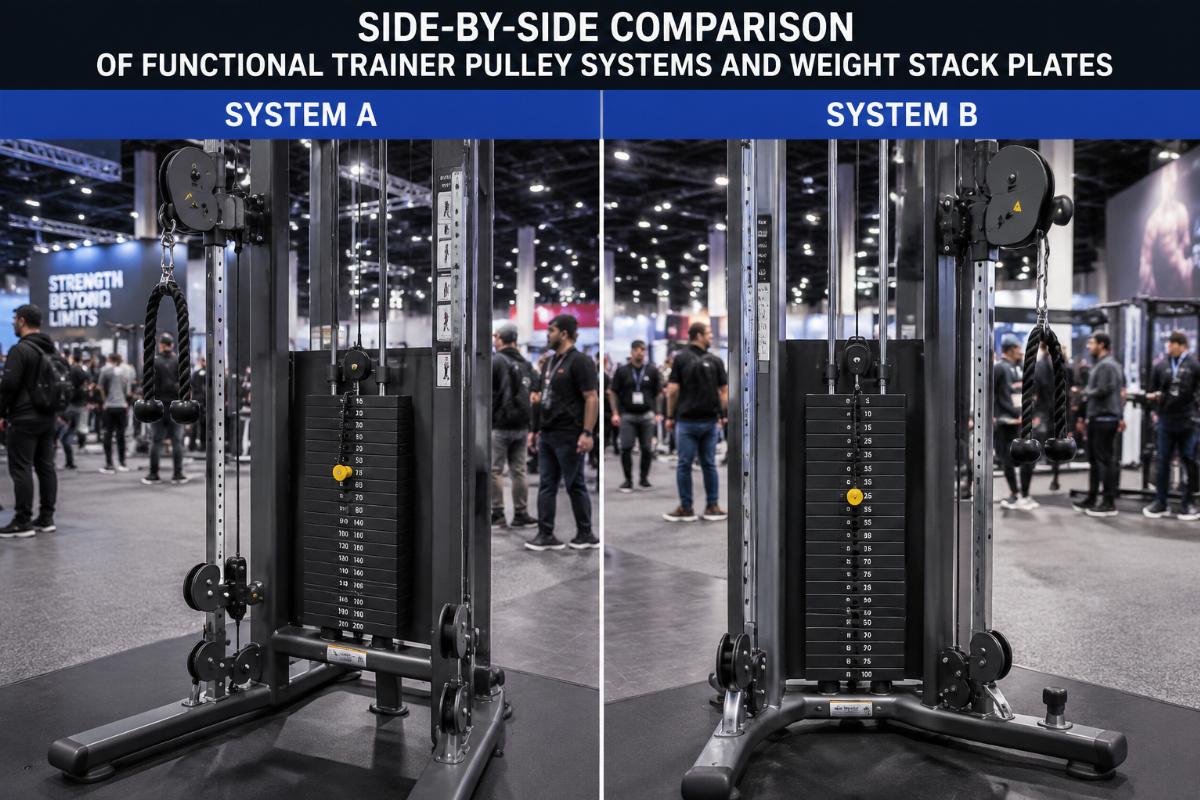
Let me walk you through how I break this down when buyers ask me to help them evaluate what a functional trainer wholesale supplier is really offering.
What Actually Drives Functional Trainer Pricing in 2026?
Three components dominate the bill of materials: the frame steel, the pulley-and-cable assembly, and the weight stack. Everything else is finishing.
The frame is the skeleton. Commercial-grade functional trainers use high-carbon steel tubing with wall thickness in the upper range of what the category allows, and the safety factor on static load is engineered well beyond the user-plus-stack dynamic. Cheaper units thin the wall to save on raw material cost, and you cannot see that difference from a product photo. [NEED_CITE: relationship between steel wall thickness and frame load safety factor in strength equipment] The welding process matters equally — continuous fillet welds at high-stress joints versus intermittent tack welds change the fatigue life of the frame by an order of magnitude.
The pulley system is where most buyers get misled. A functional trainer lives and dies by its cables and pulleys. The bearing inside the pulley wheel determines how smoothly the stack moves and how long the cable lasts. Commercial-grade sealed bearings handle the repetitive load cycle of a busy gym floor; unsealed or bushing-type pulleys feel rough within months and fray cables prematurely. Cable construction matters too — the strand count and core type dictate breaking strength and flexibility. [NEED_CITE: wire rope strand configuration and breaking strength correlation in fitness cable systems]
The weight stack is the most visible component and the easiest to inflate on paper. Buyers often assume heavier is better. It is not. What matters is plate thickness relative to guide rod precision. Thick plates on a loose, poorly machined guide rod create binding and uneven resistance. Thin plates on a tight, precision-ground rod feel smooth through the entire range of motion. Total stack weight is a marketing number; stack feel is an engineering outcome.
When you request pricing from a functional trainer wholesale supplier, ask for the steel grade designation, the pulley bearing type, and the weight stack plate thickness with guide rod tolerance. If they cannot provide those, you are comparing marketing brochures, not machines.
How to Compare Specs Across Price Tiers Without Getting Misled?
Build a simple matrix. Put the quotations in columns and the three cost-anchor components in rows. The gaps reveal themselves immediately.
| Component Factor | Budget Tier | Mid-Range Tier | Commercial Tier |
|---|---|---|---|
| Frame Steel Grade | Self-reported / Not provided | Standard grade / Verifiable | Certified grade / Batch-level traceable |
| Pulley Bearing Type | Bushing / Unsealed | Sealed ball bearing | Sealed commercial-grade bearing |
| Weight Stack Plate | Thin / Loose guide fit | Medium / Standard guide fit | Thick / Precision-ground guide |
| Cable Construction | Low strand count | Standard strand count | High strand count / Steel core |
| Surface Treatment | Basic powder coat | Standard powder coat | Controlled thickness / Adhesion-tested |
| Certification | None | Self-declared CE | Third-party tested CE/EN |
[NEED_CITE: EN standards applicable to commercial strength training equipment safety requirements]
I once helped a distributor in the Middle East evaluate four quotations for a full gym fit-out. Two of the suppliers listed "CE certified" on their spec sheets. When I asked for the test reports, one could not produce them, and the other had a certificate that covered a completely different product category. The buyer had been comparing a certified machine against a non-certified one and assumed they were equivalent. That mistake would have cost him container rejection at the port of entry.
The table above is not about finding the most expensive option. It is about making sure every line item on the quotation maps to a real, verifiable specification. A functional trainer wholesale supplier who can fill in every cell with evidence is a supplier worth negotiating with. One who leaves cells blank or writes "standard" is a supplier hiding something.

Factory-Direct vs Distributor — Where Does the Real Savings Come From?
The price gap between factory-direct and distributor is not just a markup removal — it is a structural difference in how logistics, customization, and compliance costs are allocated.
When a distributor quotes you, the price includes their margin, their warehousing overhead, and often a buffer for after-sales claims they handle locally. That model makes sense if you are buying one or two units and need immediate delivery from regional stock. It does not make sense if you are outfitting a commercial facility or building a dealer inventory.
Factory-direct pricing from a functional trainer wholesale supplier like Bick typically runs substantially below international brand pricing — the gap comes from eliminating the brand licensing layer, not from cutting corners on materials. Bick manufactures in Shandong Province with full control over the production line, which means spec customization, OEM branding, and container-load consolidation all happen under one roof. [NEED_CITE: cost structure comparison between factory-direct and distributor fitness equipment procurement models]
A commercial gym chain buyer I worked with was initially quoted by a European brand distributor for a set of dual-cable functional trainers. The per-unit price was high, but the real shock was the spare parts pricing — replacement cables and pulley assemblies were marked up to a level where maintaining the fleet over a few years would nearly equal the purchase cost. Switching to a factory-direct source with a spare parts supply agreement cut the total cost of ownership dramatically, because the replacement components were priced at production cost rather than retail margin.
For distributors and importers building private-label programs, the OEM flexibility matters. Being able to specify plate finish, color, branding placement, and packaging at the factory level — rather than accepting what a distributor happens to have in stock — changes the product from a commodity into a differentiated offering. The MOQ for OEM runs has become far more accessible in recent years, and a single-unit sample order is often feasible before committing to a full container.

Which Certifications and Tests Should You Demand Before Ordering?
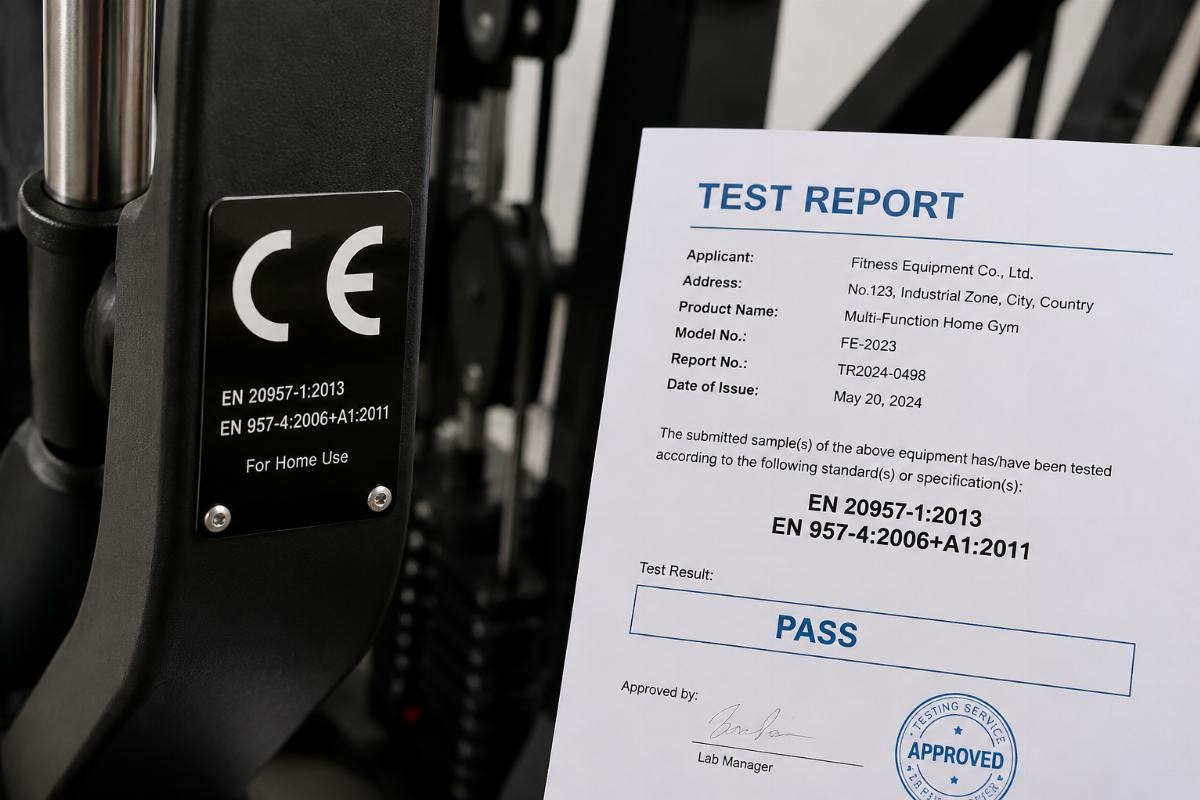
CE marking is not a bonus feature — it is the legal gate for placing equipment in European commercial spaces. Without it, your machine cannot be operated in a public gym regardless of how well it is built.
The relevant framework is the EN standard series for fitness equipment, which covers structural integrity, entrapment risks, cable and pulley safety factors, and labeling requirements. [NEED_CITE: EN ISO 20957 series applicable to strength training equipment safety and test methods] Any functional trainer wholesale supplier serving the European market should be able to produce third-party test reports — not self-declarations — covering load testing, fatigue cycling, and cable break strength.
Beyond CE, smart buyers request specific test documentation:
- Static load test report — proving the frame handles multiples of the maximum user weight plus stack weight without permanent deformation.
- Cable fatigue test — demonstrating the cable assembly survives repeated cycling well beyond expected commercial usage life.
- Weld inspection — either visual inspection records or, for high-volume orders, batch-level non-destructive testing on critical joints.
- Powder coat adhesion test — confirming the surface treatment will resist chipping and corrosion in humid gym environments.
A buyer from a Southeast Asian hotel development group once received a shipment of functional trainers that looked perfect on arrival. Within months, the guide rods on the weight stacks were corroding because the coating adhesion was insufficient for the coastal humidity. The supplier had skipped the adhesion test to save a small amount per unit. The replacement cost — shipping, downtime, member complaints — dwarfed the original savings many times over.
Always verify that the certification covers the exact model you are ordering, not a similar model from the same factory. Model-specific test reports are the only reliable proof.
How to Structure Your Order for the Best Unit Cost?
The unit price on a single functional trainer and the unit price on a container-load of mixed equipment are two completely different numbers — and the gap is where your negotiation leverage lives.
If you are a boutique studio buying one or two units, your focus should be on finding a functional trainer wholesale supplier with low MOQ flexibility and transparent single-unit pricing including shipping. Many factories now accommodate single-unit orders with retail-grade packaging, which is useful for testing the product before committing to volume.
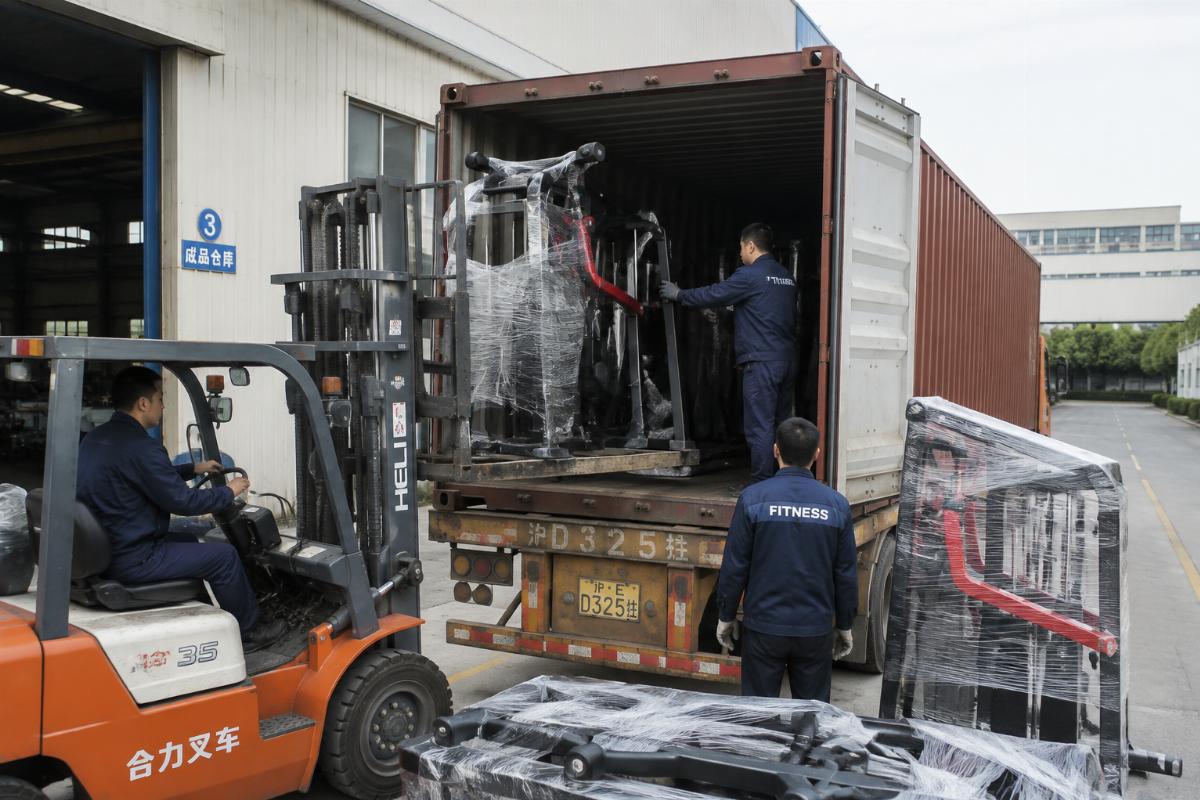
For commercial gyms and distributors, the strategy shifts to container consolidation. A full container can mix functional trainers with racks, benches, free weights, and cardio units — spreading the fixed logistics cost across a higher total value and pulling the per-unit landed cost down noticeably. The key is working with a supplier who has the product range depth to fill a container from a single source, rather than coordinating multiple factories and dealing with fragmented shipping schedules.
Long-term framework agreements offer another layer of cost reduction. Locking in an annual volume commitment with periodic call-offs gives the factory production planning certainty, and that certainty translates into better pricing. Several distributor clients I have advised moved from spot-ordering to annual frameworks and saw their per-unit cost drop meaningfully — not because the factory discounted the product, but because the elimination of order-by-order negotiation overhead and the production scheduling efficiency flowed through to the price.
Spare parts bundling is an underrated tactic. Including a spare cable set, extra pulleys, and wear-item inventory in the original container adds minimal freight cost but protects against downtime claims later. A functional trainer wholesale supplier who offers this as a standard option understands commercial operations; one who does not is thinking only about the initial sale.
Conclusion
Best price is a function of spec transparency, logistics intelligence, and compliance rigor — not the smallest number on a quotation. Decode the steel, the pulleys, and the weight stack. Demand test reports, not marketing claims. Consolidate your container, and negotiate the framework, not just the unit. The functional trainer wholesale supplier who can meet all three criteria will earn your order — and your repeat business.


