
China OEM Alternative to Body-Solid Pro Club Back Extension Bench
Most importers think a back extension bench is just a frame and a pad. The real failure point hides inside foam density and weld penetration depth — things no spec sheet ever shows.
Body-Solid Pro Club Back Extension Bench occupies a clear position in the North American light-commercial and high-end home market, but global commercial gym operators and importers can source equivalent steel structure, pad density, and adjustment functionality through a China OEM factory at a noticeably lower cost, with full container consolidation and destination-port compliance handled.
I still remember a container of Smith machines stuck at Apapa Port for well over a month because the CE certificate number on the paperwork didn’t match the actual production batch. The consignee in Lagos was calling daily, and the factory back in Shandong was waiting for payment clearance before scheduling new runs. That single mismatch turned a routine shipment into a mid-five-figure headache. Since then, I treat document pre-audit as non-negotiable, especially for Africa and Middle East lanes. When sourcing a Body-Solid Back Extension Bench alternative, the machine itself is only half the equation — the other half is whether it clears customs and survives daily commercial use without pad collapse or weld cracking. [NEED_CITE: root cause distribution of fitness equipment import delays at West African ports]

Let’s break down what actually matters when evaluating a replacement.
What Are the Core Specifications of the Body-Solid Pro Club Back Extension Bench?
The benchmark lies in three areas: main frame tube wall thickness, pad foam composition, and adjustment mechanism smoothness — not the external silhouette.
Body-Solid’s Pro Club line targets facilities that need durability beyond home-grade equipment but without the full price tag of premium commercial brands. The back extension bench in this series typically features a heavy-gauge steel frame, a wide durafirm-style back pad, and adjustable hip and foot pads to accommodate different user heights. [NEED_CITE: Body-Solid Pro Club series commercial hyperextension bench specification sheet]
Here is how the key build parameters compare against a typical China OEM commercial-grade replacement:
| Parameter | Body-Solid Pro Club Bench | China OEM Commercial-Grade Alternative |
|---|---|---|
| Main Frame Tube Wall | Heavy-gauge commercial class | Same gauge range, verifiable via mill certificate |
| Pad Foam | High-density durafirm type | High-density PU foam, comparable firmness |
| Adjustment Mechanism | Pop-pin with multiple positions | Pop-pin or ladder-type, smooth travel |
| Foot Roller Diameter | Commercial standard | Same or larger, with EVA or rubber overwrap |
| Surface Finish | Electrostatic powder coat | Electrostatic powder coat, same process |
| Weight Capacity | Commercial-rated | Commercial-rated, per EN ISO 20957 |
The critical insight: the external shape is nearly identical across brands. What separates commercial from residential grade is tube wall thickness category, bearing smoothness in the adjustment pivot, and whether the foot roller overwrap resists cracking after extended use. [NEED_CITE: EN ISO 20957 stationary training equipment standard requirements for structural integrity]
A distributor in West Africa once ordered what looked like an exact replica of a well-known American brand’s Roman chair. The first batch sold fine. Six months later, returns started pouring in — the pad had compressed flat and the weld at the hip pad bracket had fractured. The replacement unit had used standard EVA foam instead of high-density PU, and the weld penetration was superficial rather than full. No spec sheet would have revealed this. Only teardown inspection after failure told the story.

How Does a China OEM Alternative Reduce Cost Without Sacrificing Commercial Quality?
The price gap comes from supply chain structure, not material downgrade — factory-direct sourcing eliminates brand premium and intermediary markups.
When you buy a Body-Solid Pro Club back extension bench through a North American distributor, you are paying for the brand name, the domestic warehouse margin, the dealer network overhead, and the import logistics built into the retail price. A Body-Solid Back Extension Bench alternative sourced directly from a Chinese OEM factory removes every layer between the production line and your loading dock.
The typical price differential between a branded US-origin commercial bench and a comparable China OEM unit falls in a noticeable range — enough to matter when outfitting a full facility or filling a container for resale. [NEED_CITE: IHRSA global fitness industry equipment sourcing cost structure analysis]
Here is where the cost actually comes from:
- No brand licensing fee. The factory produces under your label or unbranded, so there is no royalty embedded in every unit.
- Direct raw material procurement. Shandong-based manufacturers source steel tube and foam from regional mills at volumes that keep per-unit material cost low.
- Consolidated container loading. A single forty-foot high-cube container can hold a mix of back extension benches, Smith machines, dumbbell sets, and plate-loaded units — spreading freight cost across the entire order.
- No domestic warehousing markup. The unit ships from factory to port to your destination, skipping the US or European warehouse step entirely.
A hotel developer in the Middle East needed to equip a fitness center across three properties. They wanted commercial-grade equipment but the branded quotes for a full package including back extension benches, cable crossovers, and free weight stations came in at a level that would have consumed the entire fit-out budget. Switching to a China OEM package with full container consolidation brought the total equipment cost down substantially while maintaining the same commercial-grade tube gauge, pad density, and powder coat finish. The savings went toward upgrading the flooring and adding a functional training zone. [NEED_CITE: commercial gym equipment package cost comparison between branded and OEM sourcing]

What Compliance and Quality Documents Must Be Verified Before Shipment?
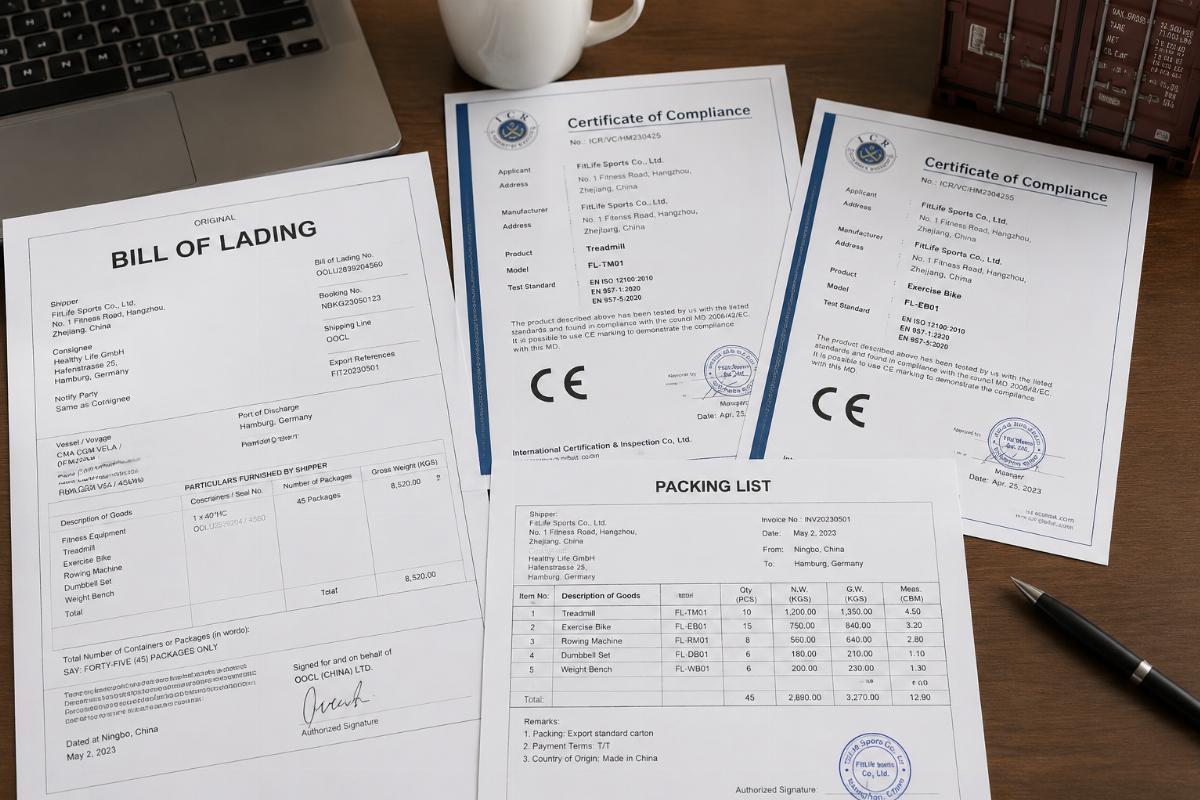
CE certificate batch matching, EN ISO 20957 test reports, material certificates, coating adhesion test records, and packing list consistency with the bill of lading — miss any one and the container sits at port.
This is where most importers learn the hard way. A CE certificate is not a universal pass. Customs authorities in many destination countries — particularly across Africa, the Middle East, and parts of Latin America — cross-check the certificate number against the production batch and the commercial invoice. If the number on the certificate does not match the batch marking on the actual units, the container gets held. [NEED_CITE: destination port customs document verification procedures for fitness equipment imports]
Here is the verification checklist I run before every shipment:
- CE certificate number matches production batch. The factory must provide a certificate that references the specific batch being shipped, not a generic document from three years ago.
- EN ISO 20957 test report covers the exact model. The report must list the model number and configuration being exported, not a different variant.
- Material certificate for main frame tube. The steel grade and wall thickness must be verifiable against the mill test certificate.
- Powder coating adhesion test record. Cross-cut adhesion test per standard methodology, with results documented.
- Packing list and bill of lading consistency. Every item, quantity, weight, and dimension must match across all shipping documents.
A buyer in Latin America received a container of back extension benches and adjustable benches. The CE certificate looked valid. But the certificate number referenced a different product category entirely — it was for a plate-loaded machine, not a hyperextension bench. The local customs inspector flagged it immediately. The container sat at the port for weeks while the factory scrambled to produce the correct documentation. The delay cost the buyer warehousing fees, demurrage charges, and lost sales to a competitor who had already opened a new studio in the same district.

How to Avoid Cargo Hold Risks During Container Consolidation and Destination Customs Clearance?
Document pre-audit, correct HS code classification, and certificate-to-batch alignment are the three non-negotiable controls for Africa and Middle East shipping lanes.
When you consolidate a Body-Solid Back Extension Bench alternative with other equipment into a single container — say, combining Roman chairs with functional trainers, cable machines, and free weight sets — the documentation complexity multiplies. Each product category may carry a different HS code, a different CE certificate scope, and a different inspection requirement at the destination port.
The core risk controls:
- HS code pre-classification. Confirm the correct harmonized system code for each item before the commercial invoice is finalized. Misclassification triggers customs re-examination and potential penalty.
- Certificate batch alignment. Every CE certificate in the document package must correspond to the actual product and batch loaded in the container. This is not a formality — it is the single most common reason for container detention on West African routes.
- Pre-shipment document review. Before the container leaves the factory, every document — commercial invoice, packing list, bill of lading, certificate of origin, CE certificates, test reports — must be cross-checked line by line against the physical cargo.
A distributor in East Africa regularly imports full containers of commercial gym equipment. On one shipment, the back extension benches were loaded with the correct CE documentation, but the adjustable benches in the same container had a certificate that referenced an older model revision. The customs authority at Mombasa held the entire container pending clarification. The resolution required the factory to issue a revised declaration, which took weeks of back-and-forth communication across time zones. The lesson: every single SKU in a consolidated container needs its own document trail, verified before the doors close.
How to Move from Single-Unit Sample Testing to a Full Gym Package?
Start with one bench to validate pad density, weld quality, and adjustment smoothness — then scale to a complete cardio, strength, and free weight package with container optimization.
The most reliable path for a new buyer evaluating a Body-Solid Back Extension Bench alternative is to order a single sample unit first. This is not a small order mentality — it is due diligence. The sample lets you physically inspect the tube wall thickness, press into the pad to assess foam density recovery, cycle the adjustment mechanism repeatedly to check for play or roughness, and examine the weld joints at high-stress brackets.
Once the sample passes your physical inspection, the next step is to discuss a full facility package. A capable OEM factory will provide:
- Complete gym layout planning. Cardio zone, selectorized strength line, plate-loaded section, free weight area, functional training zone — all dimensioned to your floor plan.
- Mixed container loading optimization. The factory calculates how many back extension benches, Smith machines, dumbbell racks, and cable crossovers fit into a single container or multiple containers, maximizing space utilization and minimizing per-unit freight cost.
- OEM branding flexibility. Your logo on the frame, your color scheme on the pads, your retail packaging — from single-unit MOQ to full container quantities.
- After-sales support structure. Spare parts supply, technical documentation, and warranty terms aligned with your market’s expectations.
A boutique studio owner in Southeast Asia started with a single back extension bench sample. After confirming the build quality matched commercial expectations, they expanded to a full package including a half rack, adjustable bench, dumbbell set, and a compact functional trainer. The entire order fit into a single consolidated container, and the factory handled all documentation for destination port clearance. The studio opened on schedule, and the equipment has been in daily use without structural or pad integrity issues.

Conclusion
A Body-Solid Pro Club Back Extension Bench alternative sourced from a qualified China OEM factory delivers equivalent commercial-grade construction at a substantially lower total cost, provided the buyer verifies pad material, weld quality, and — most critically — document compliance before shipment. The machine itself is straightforward; the real expertise lies in ensuring that every certificate, every HS code, and every batch number aligns perfectly with the physical cargo, so the container clears customs and reaches the gym floor without delay.


