
Commercial Gym Equipment Supplier for France: China Factory Direct
Most buyers think CE marking is enough to clear French customs. It isn’t — NF EN 957 test reports are the real gatekeeper, and missing them can strand a full container at Fos-sur-Mer for weeks.
Sourcing from a gym equipment supplier for France requires three pre-shipment validations: full NF EN 957 compliance documentation, accurate HS code classification for French customs duty calculation, and container consolidation planning aligned with Marseille port handling节奏. When done correctly, factory-direct sourcing from Shandong delivers a meaningful landed-cost advantage over European brand distribution, without sacrificing commercial-grade durability.
I still remember a shipment I handled years ago — a full 40HQ of plate-loaded machines heading to a hotel fitness center in the south of France. Everything looked perfect on paper: CE certificates in order, commercial-grade steel frames, powder coating done to spec. But when the container reached Marseille, the customs broker flagged the shipment because the NF EN 957 fatigue test reports were missing for the leg press and chest press units. The CE mark covered general safety directives, but French commercial procurement standards specifically require NF EN 957 test documentation for any equipment placed in a public-use fitness environment [NEED_CITE: NF EN 957 scope and mandatory application for commercial gym equipment in France]. We spent over two weeks coordinating with the testing lab in Qingdao to expedite the supplementary reports, and the client’s opening date slipped by a full month. That container sat at the terminal accumulating demurrage charges the entire time.
Since then, I’ve built every France-bound quotation around a pre-shipment compliance checklist that goes well beyond the CE directive. The difference between a smooth delivery and a port-side nightmare lies in the details most suppliers won’t volunteer.
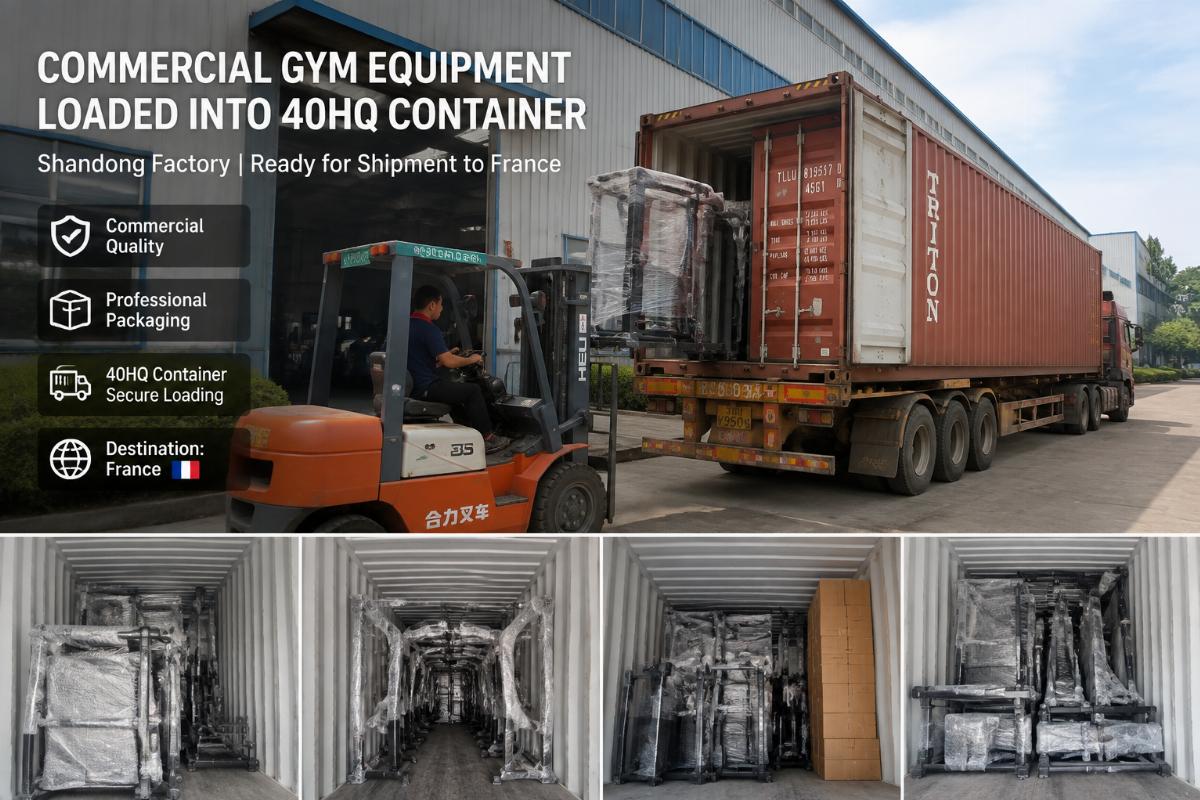
Let me walk you through the four areas where French buyers need to focus their due diligence when evaluating a gym equipment supplier for France.
What Certifications Are Mandatory for Gym Equipment in France?
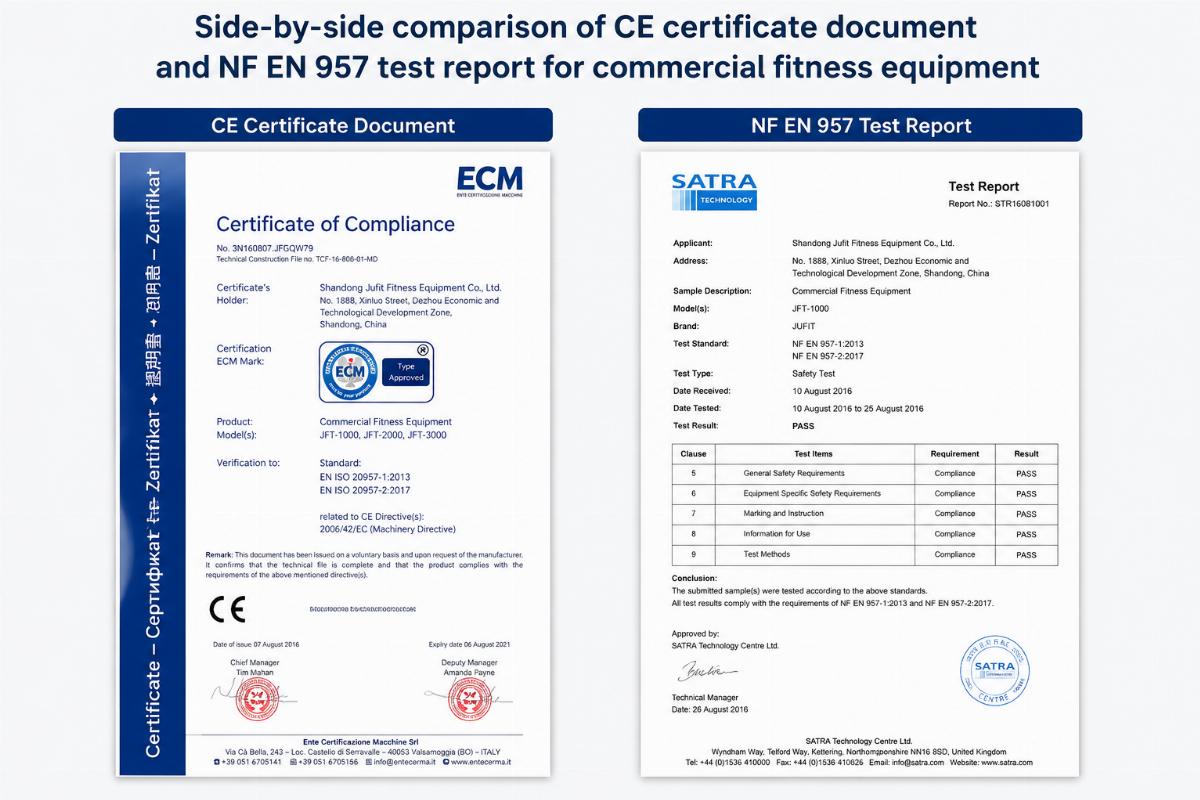
CE marking is the baseline; NF EN 957 is the commercial procurement standard that French buyers actually get audited against. Many gym equipment supplier for France candidates will tell you their products are "CE certified" and leave it at that. But CE marking under the Machinery Directive 2006/42/EC only confirms that the equipment meets general health and safety requirements — it does not substitute for product-specific performance standards [NEED_CITE: relationship between CE Machinery Directive and EN product standards for fitness equipment].
NF EN 957 is the European standard specifically governing stationary training equipment, and it is divided into multiple parts covering different equipment categories. For commercial gym environments in France, the relevant parts include:
| Certification Element | CE Marking Only | CE + NF EN 957 Full Package |
|---|---|---|
| General Safety Compliance | Covered | Covered |
| Fatigue Testing (100,000+ cycles) | Not Required | Required |
| Stability Testing per Equipment Class | Not Required | Required |
| Load-Bearing Structural Verification | Self-Declared | Third-Party Tested |
| User Weight Capacity Validation | Self-Declared | Tested to Standard |
| French Commercial Use Acceptance | Vulnerable | Robust |
The fatigue testing requirement is where most shipments fail. NF EN 957 Part 1 specifies general safety requirements, while Parts 2 through 10 cover specific equipment types — treadmills, stationary bikes, rowing machines, strength training benches, power racks, and cable pulley systems [NEED_CITE: NF EN 957 part structure and equipment category coverage]. Each part defines minimum cycle counts for fatigue testing, maximum allowable deflection under load, and stability thresholds that must be met without structural deformation.
A gym chain owner in Lyon once told me he received a shipment from a supplier who claimed "full European compliance." The CE certificates were genuine, but when his insurance auditor visited the new facility, he asked for the NF EN 957 test reports. The supplier couldn’t produce them. The insurance company refused to cover any injury claims originating from that equipment until proper documentation was provided [NEED_CITE: French insurance requirements for commercial gym equipment certification documentation].
What you need to request from any gym equipment supplier for France before placing an order:
- CE Declaration of Conformity referencing Machinery Directive 2006/42/EC
- NF EN 957 test reports from an accredited third-party laboratory (not self-declared)
- Test reports must cover each specific equipment model, not just a "representative sample"
- Reports should be dated within the past three years to reflect current production standards
- Material certificates for load-bearing structural components
How Does Factory-Direct Pricing Compare to European Distributors?
The unit price gap is substantial, but the real comparison must be made on a landed-cost basis including freight, customs duty, port handling, and last-mile delivery to the gym site.
When French buyers first contact a gym equipment supplier for France, the initial quotation often shows unit prices that are dramatically lower than what they would pay through European brand distributors or local dealers. This is expected — Shandong-based manufacturers operate with significantly lower production costs, and the absence of intermediary markups creates a visible price advantage [NEED_CITE: typical price differential between Chinese factory-direct and European brand distribution for commercial gym equipment].
However, the unit price is only the starting point. The true cost comparison requires building a complete landed-cost model:
| Cost Component | European Brand Distributor | Chinese Factory Direct |
|---|---|---|
| Equipment Unit Price | Premium Tier | Noticeably Lower |
| Sea Freight (per CBM) | Included or Minimal | Buyer Arranged |
| French Customs Duty | Included | HS Code Dependent |
| Port Handling at Marseille | Included | Buyer Arranged |
| Inland Transport to Gym | Included or Coordinated | Buyer Arranged |
| On-Site Assembly | Usually Included | Separate Quotation |
| Warranty Claims Handling | Local Dealer Network | Factory Coordination Required |
The customs duty calculation deserves special attention. Commercial gym equipment entering France is classified under specific HS codes, and the duty rate varies by equipment type. Cardio equipment such as treadmills and ellipticals typically falls under a different tariff heading than plate-loaded strength machines or free weight equipment [NEED_CITE: EU TARIC classification and duty rates for commercial fitness equipment by HS code]. A gym equipment supplier for France who understands European import procedures should be able to provide the correct HS codes for each product category so your customs broker can calculate the exact duty burden before you commit to an order.
I worked with a hotel developer in Nice who was outfitting a resort fitness center. The initial factory quotation looked exceptionally attractive — until we mapped out the full landed cost including the specific duty rates for his equipment mix. Even after adding freight, duty, port charges, and inland transport, the total landed cost came in substantially below what he would have paid through a European brand dealer for equivalent commercial-grade equipment. The key was that the factory provided accurate HS classifications upfront, which allowed precise duty calculation rather than unpleasant surprises at customs.
One often-overlooked cost factor is the assembly and installation requirement. Commercial gym equipment typically arrives in multiple packed components — frames, upholstery, cable systems, weight stacks, and electronic consoles for cardio units. European distributors usually include on-site assembly in their pricing. When sourcing factory-direct, you need to budget for local assembly labor or negotiate an installation support package with your gym equipment supplier for France [NEED_CITE: assembly and installation cost considerations for factory-direct gym equipment imports to Europe].

What Is the Optimal Container Mix for a French Gym Setup?
The most cost-effective container strategy is not simply filling a 40HQ with the cheapest equipment — it is engineering a product mix that maximizes cubic utilization while matching the typical layout requirements of a French commercial gym.
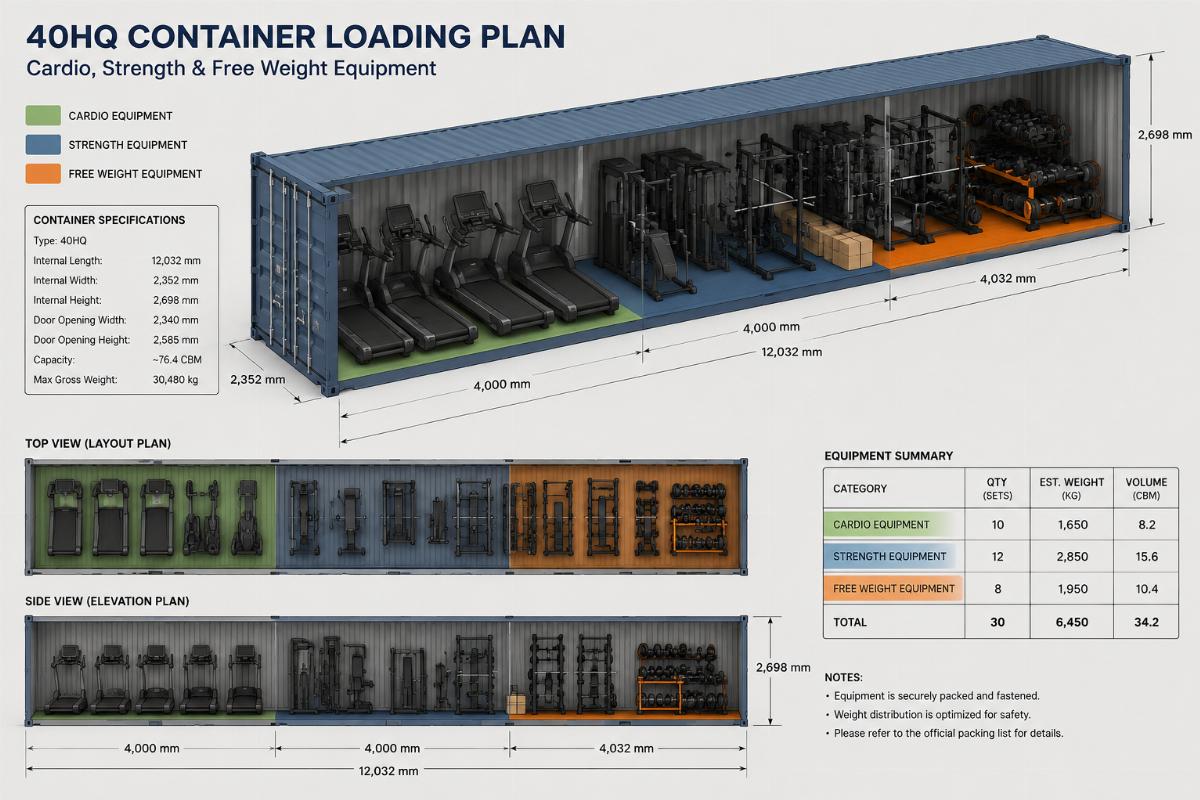
A standard 40-foot high-cube container offers approximately 76 cubic meters of usable space. The challenge is that gym equipment comes in vastly different dimensional profiles. Commercial treadmills are bulky but relatively lightweight. Plate-loaded strength machines are dense and heavy. Free weight equipment — dumbbells, barbells, weight plates — is extremely dense and compact. A gym equipment supplier for France who understands container logistics will help you build a loading plan that fills the container efficiently without exceeding weight limits.
Based on typical French commercial gym layouts, the recommended equipment mix for a full container follows this general pattern:
| Equipment Category | Typical Volume Share | Weight Profile | Container Loading Strategy |
|---|---|---|---|
| Cardio Equipment | Substantial | Light to Medium | Loaded first, floor-level placement |
| Plate-Loaded Strength | Significant | Heavy | Mid-container, weight-distributed |
| Selectorized Machines | Moderate | Medium | Nested within available cubic space |
| Free Weights and Racks | Compact | Very Heavy | Bottom-layer, centered over axles |
| Functional Training Gear | Variable | Light to Medium | Fills remaining gaps and voids |
The weight distribution inside the container is critical. Maritime shipping regulations enforce strict weight limits, and uneven weight distribution can lead to container rejection at the factory loading yard or additional charges at the port [NEED_CITE: container weight distribution requirements and axle load limits for maritime shipping]. A gym equipment supplier for France experienced with European shipping will plan the loading sequence to ensure the container’s center of gravity remains within acceptable parameters.
I once reviewed a loading plan from a buyer who had simply ordered full container quantities of his top-selling items — which happened to be mostly commercial treadmills. The container was physically full at roughly half its weight capacity, meaning he was paying to ship air. Conversely, another buyer ordered almost exclusively in rubber-coated dumbbells and weight plates. The container hit its maximum weight limit with barely a third of the cubic space filled. Both scenarios resulted in inefficient use of freight spend.
The solution is collaborative planning. Share your gym floor plan with your gym equipment supplier for France before finalizing the order. A competent factory will use loading simulation software to optimize the container mix, ensuring you receive a balanced equipment package that fills the container both volumetrically and gravimetrically [NEED_CITE: container loading optimization methods for mixed gym equipment shipments].
How to Verify a Gym Equipment Supplier for France Before Ordering
The verification process must go beyond website claims and catalog photos — it requires document authentication, production facility assessment, and reference checks with verifiable European clients.
The barrier to entry for claiming "CE certified" or "exporting to Europe" is essentially zero. Any factory can display a CE certificate on their website, and many do — including factories whose certificates have expired, whose certificates cover different product categories, or whose certificates were obtained through agencies that do not perform genuine conformity assessments [NEED_CITE: common compliance document fraud patterns in Chinese fitness equipment exports to Europe].
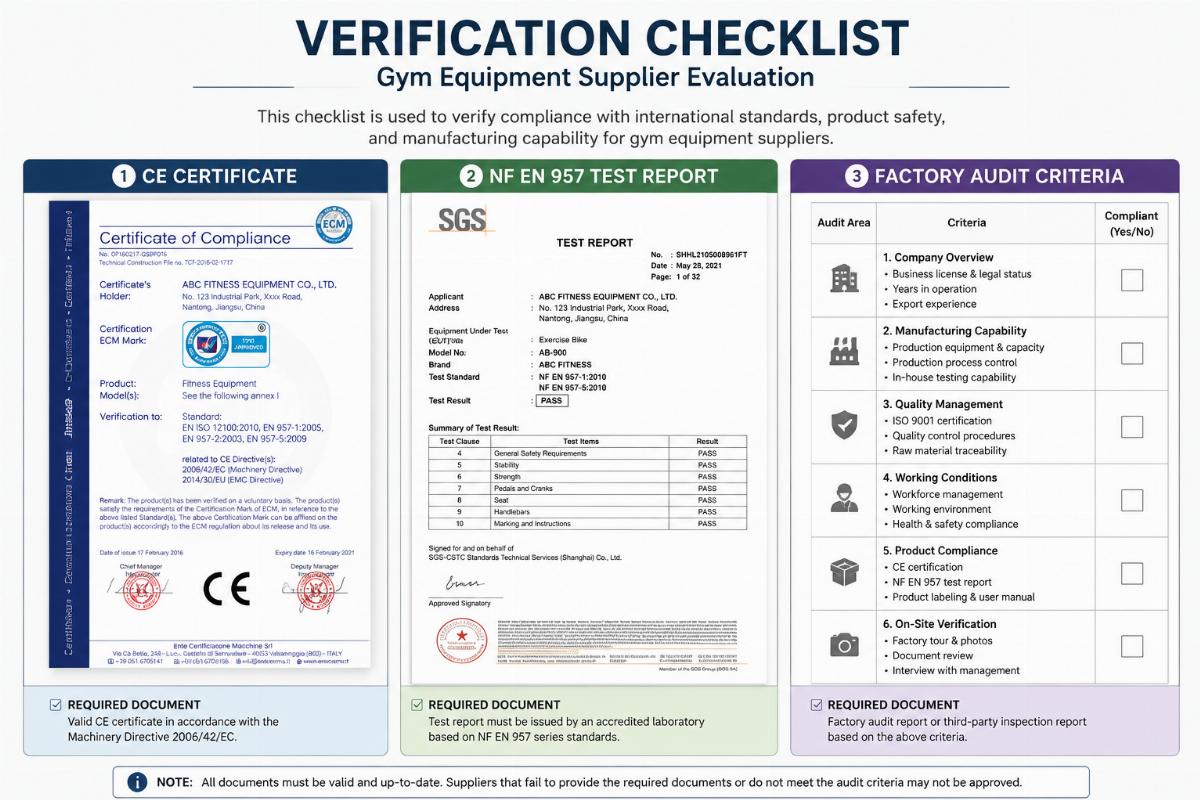
Here is the verification framework I recommend for any French buyer evaluating a gym equipment supplier for France:
Step 1 — Document Authentication
Request the CE Declaration of Conformity and verify that it specifically lists the exact model numbers you intend to purchase. Cross-check the notified body number (if applicable) against the NANDO database maintained by the European Commission [NEED_CITE: NANDO database verification process for CE conformity assessment bodies]. For NF EN 957, request the original test reports and verify the testing laboratory’s accreditation status.
Step 2 — Production Capability Assessment
Ask for a live video tour of the production facility — not a pre-recorded marketing video, but a real-time walkthrough where you can ask questions and request to see specific production areas. Pay attention to welding quality on structural frames, the consistency of powder coating application, and the assembly testing procedures before packaging [NEED_CITE: visual inspection criteria for commercial gym equipment manufacturing quality].
Step 3 — European Client References
Request contact information for at least two European clients who have received shipments within the past year. Speak to them directly about their experience with product quality, documentation accuracy, delivery timelines, and after-sales support responsiveness. A gym equipment supplier for France who cannot provide verifiable European references should raise immediate concern.
Step 4 — Sample Order Validation
Before committing to a full container order, place a sample order for your highest-value or highest-risk equipment pieces. This allows you to physically inspect build quality, verify that the documentation matches the actual products, and test the delivery timeline from order placement to arrival at your facility.
A boutique studio owner in Bordeaux followed this exact process when evaluating suppliers for her Pilates and functional training studio. She requested NF EN 957 test reports for the reformer machines and cable systems she intended to purchase. One supplier provided reports that clearly referenced different model numbers than what was being quoted. Another supplier’s test reports were dated several years prior and did not reflect their current production specifications. The supplier she ultimately chose — who provided current, model-specific test reports and agreed to a sample shipment before the full order — delivered equipment that passed her insurance auditor’s review without any complications.
Conclusion
Sourcing from a gym equipment supplier for France is a viable path to significant cost savings, but only when compliance documentation, landed-cost modeling, container optimization, and supplier verification are all addressed before the first payment is released. The factories in Shandong with genuine European export experience understand these requirements and build their quotation processes around them. The ones who don’t will cost you far more in port delays, compliance failures, and equipment rejections than whatever initial price savings they appeared to offer. Do the homework upfront, and the factory-direct model works exactly as intended.


