
Commercial Treadmill Supplier for Spain: China Factory Direct OEM
Bigger horsepower on the nameplate rarely means a better commercial treadmill. Continuous duty output, frame steel thickness, and CE mechanical compliance are what actually determine whether the machine survives a Spanish hotel gym or ends up rotting in a warehouse.
Sourcing from a commercial treadmill supplier Spain buyers trust means working directly with Shandong factories that can deliver CE-certified machines at factory-direct pricing, provided you verify motor real output, measure frame wall thickness with calipers, and ship spare parts inside the same container.
Back when I was handling procurement for a gym chain in Madrid, I sourced commercial treadmills from a southern China factory purely on price. The motor nameplate read 4.0 HP, but under continuous load it barely held 3.0 HP. Within months, bearings started screaming across the floor, the hotel manager refused to pay the balance, and the entire shipment ended up sitting in a Valencia port warehouse. Now I split my time between Ho Chi Minh City and European projects, and the three things I check first are always the same: dynamometer-tested motor power, caliper-measured steel thickness, and whether spare parts ship inside the same container. [NEED_CITE: root cause distribution of commercial treadmill field failures by component type]
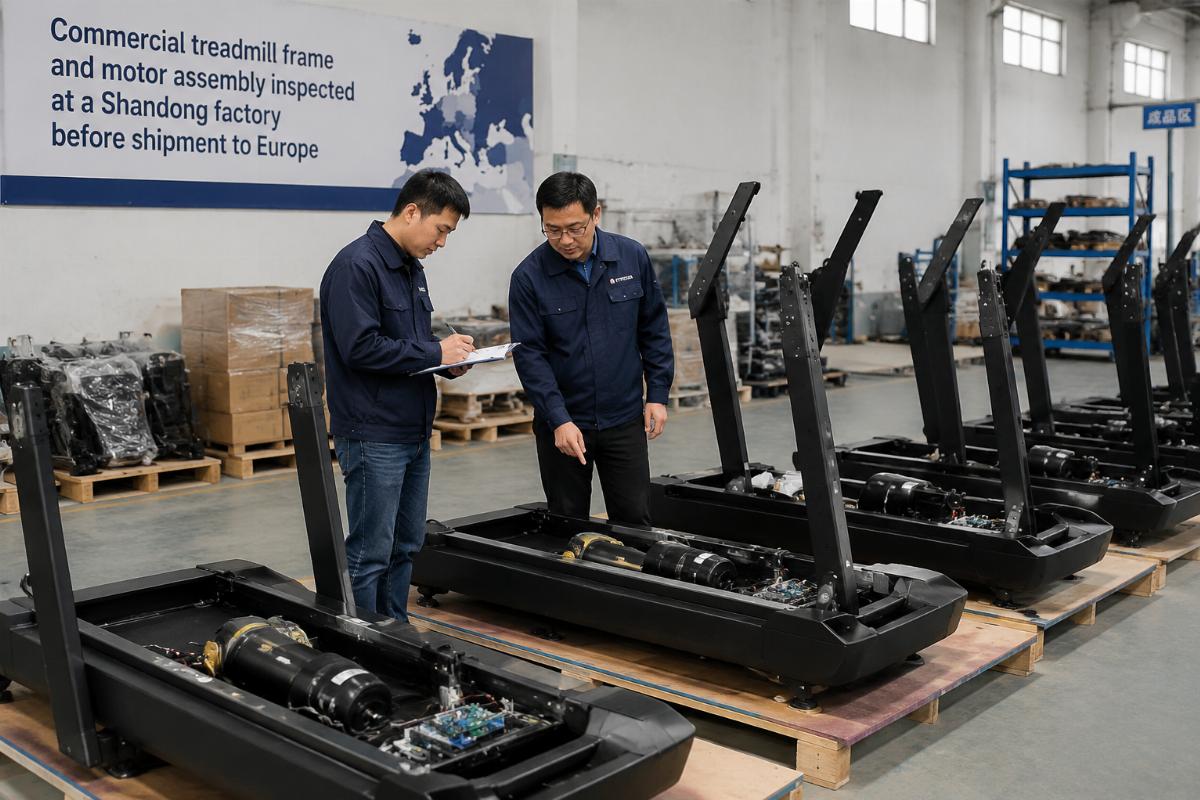
Let me walk you through the specs, verification steps, OEM terms, and pitfalls that separate a reliable commercial treadmill supplier Spain operators recommend from one that disappears after the deposit clears.
What Specs Matter for Commercial Treadmills in Spain?
Motor continuous duty power, deck thickness, and frame steel wall gauge decide service life — not the number of preset programs or the size of the touchscreen.
European gym environments run machines for extended daily hours, often in coastal cities where humidity accelerates corrosion. The specs that actually matter break down as follows:
| Parameter | What to Request | What to Ignore |
|---|---|---|
| Motor power | Continuous duty HP rating verified by dynamometer | Peak HP printed on the nameplate |
| Running deck | Minimum thickness specified in mm, material grade | "Anti-slip surface" marketing claims |
| Frame steel | Wall thickness measured at multiple points | "Heavy-duty frame" without gauge data |
| CE scope | Full Machinery Directive coverage including mechanical and flammability tests | Electrical-only CE self-declaration |
| Roller diameter | Bearing grade and seal type | Roller count alone |
[NEED_CITE: EN ISO 20957 stationary training equipment safety requirements for treadmills]
A Barcelona fitness center once ordered a full gym package from a supplier that quoted attractive deck dimensions but used substandard layered wood instead of specified phenolic-coated MDF. The decks warped noticeably within a short cycle, forcing replacement at roughly double the original per-unit cost when labor and downtime were included. The commercial treadmill supplier Spain buyers encounter at trade shows often shows flawless samples — the production batch is where corners get cut.

The lesson: ask for material certificates, not brochure photos. A serious commercial treadmill supplier Spain operators work with will provide third-party test reports for motor output and deck load endurance without being asked twice.
How to Verify a China Factory’s Claims Before Ordering?
Demand third-party inspection reports, live factory video calls, and sample teardown testing — never place a bulk order based on PDF certificates alone.
Verification breaks into three layers, each targeting a different failure mode I have seen firsthand:
Layer 1 — Motor real output. Request a dynamometer test report from an accredited lab. The test should measure continuous duty output at rated load, not no-load spin speed. [NEED_CITE: IEC 60034 electric motor rating and performance testing methods] A factory that hesitates or offers only an in-house printout is signaling that the nameplate number will not survive independent measurement.
Layer 2 — Frame steel wall thickness. Require caliper measurement photos taken at multiple weld joints and straight tube sections, ideally captured during a live video walkthrough. Tolerance on welded steel frames can drift noticeably between sample and mass production. I once watched a Madrid distributor receive a first sample that passed, only to find the bulk shipment wall thickness had thinned beyond acceptable tolerance — the failure only surfaced when a technician opened a return unit months later.
Layer 3 — CE technical file completeness. A valid CE mark under the EU Machinery Directive requires a full technical construction file, not just a one-page certificate. [NEED_CITE: EU Machinery Directive 2006/42/EC essential health and safety requirements] Check whether the notified body number on the certificate is real, whether the file covers mechanical structure and running belt flammability, and whether the factory can produce the risk assessment document on request. Some factories hold electrical CE only, leaving the mechanical side unverified — a gap that becomes a liability the moment an injury occurs in a Spanish gym.

A credible commercial treadmill supplier Spain buyers partner with will welcome all three verification steps and absorb the cost of sample teardowns. Factories that push back are usually the ones where the gap between sample and production is widest.
What Are the OEM Terms and MOQ for Spanish Buyers?
Shandong factories support flexible MOQ from single units to full gym packages, but branding terms — mold ownership, spare parts supply period, and artwork approval workflow — must be locked in writing before the deposit clears.
OEM arrangements for the Spanish market typically follow one of three structures:
| OEM Level | What It Covers | Typical MOQ Expectation | Key Contract Point |
|---|---|---|---|
| Logo print only | Customer logo on shroud and console | Low MOQ, even single units | Artwork file approval and print position confirmation |
| Full private label | Custom color, console design, packaging | Moderate MOQ per SKU | Mold cost ownership and exclusivity territory terms |
| Complete turnkey package | Cardio, strength, free weights, flooring | Container-load consolidation | Phased shipment schedule and spare parts inclusion |
[NEED_CITE: EuropeActive facility standards for commercial fitness equipment procurement]
A distributor in Madrid once placed a private-label order where the mold fee was paid but the contract never specified who owned the mold. When the business relationship ended, the factory retained the mold and continued producing under a different brand for a competing distributor. The lesson is simple: mold ownership clauses belong in the purchase agreement, not in a side email.
Spare parts terms deserve equal attention. A reliable commercial treadmill supplier Spain buyers depend on will include a spare parts list with the first shipment — covering belts, deck lubricant, lower roller bearings, and console fuses — at no extra freight cost, because shipping a single replacement part from China to Spain later costs multiples of the part value in courier fees and machine downtime. I have seen a hotel fitness center in Seville wait weeks for a replacement drive belt that should have traveled in the original container for a negligible marginal cost.

How to Avoid the Most Common Import Pitfalls?
Ship spare parts inside the same container, archive the full CE technical file on arrival, and tie payment milestones to independent inspection results — these three defenses stop most losses before they start.
The pitfalls I list below are not theoretical. Each one comes from a shipment I either procured myself or inherited when a client asked for help resolving a dispute.
Pitfall 1 — Spare parts shipped separately or not at all. When parts travel on a different bill of lading, Spanish customs can hold them for weeks, and the machine sits idle. The cost of downtime in a hotel or commercial gym environment far exceeds the marginal freight cost of loading parts into the same container. Always confirm in the purchase contract that spare parts are container-loaded together with the main shipment.
Pitfall 2 — CE documentation treated as a formality. Many buyers file the CE certificate and never look at the technical construction file. When a Spanish labor inspector or insurance assessor requests the full file after an incident, the factory is often unreachable or unresponsive. [NEED_CITE: EU market surveillance regulation requirements for imported machinery technical documentation] Archive the complete technical file — risk assessment, test reports, declaration of conformity, and user manuals in Spanish — before releasing the balance payment.
Pitfall 3 — Payment structure with no inspection gate. A payment schedule that releases the balance before shipment inspection removes all leverage. Tie the final payment tranche to a passing inspection report from an independent surveyor, whether that surveyor is appointed by the buyer or by a recognized inspection firm. A commercial treadmill supplier Spain buyers trust will agree to this structure without negotiation, because the inspection validates their own production quality.

One additional point worth flagging: flammability compliance for the running belt and side rails is occasionally overlooked in initial specifications but enforced during Spanish facility inspections. Confirm that the belt material meets the relevant flammability class under EN standards, and request the test certificate as part of the CE technical file.
Conclusion
Spec verification, written OEM terms, and inspection-linked payment are the three non-negotiable foundations for importing commercial treadmills from China into Spain.
Motor continuous duty output, deck and frame material integrity, and complete CE mechanical documentation separate a machine that serves a Spanish gym reliably from one that becomes a costly liability. A commercial treadmill supplier Spain operators return to is one that welcomes third-party verification, ships spare parts in the same container, and locks mold ownership and spare parts supply periods in the signed contract — not one that competes on nameplate horsepower alone.


