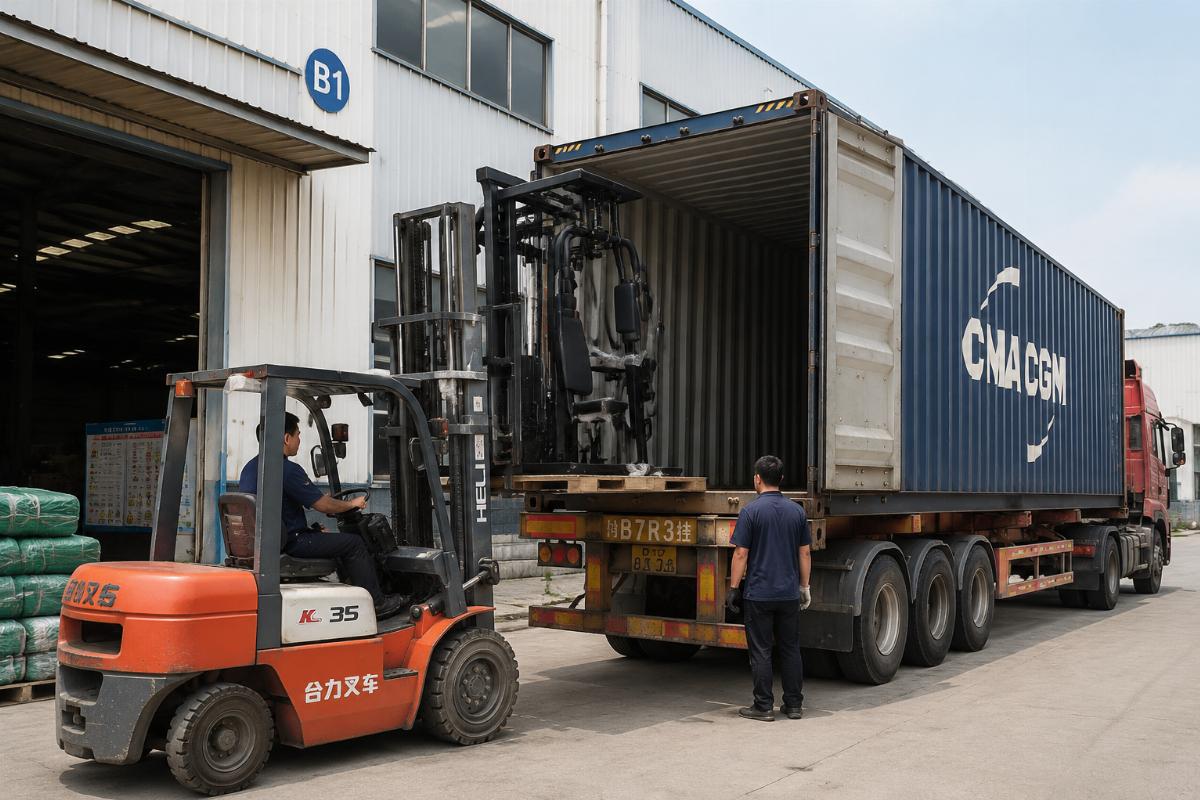
Container Consolidation for Hack Squat Machine with Other SKUs | Bulk Wholesale Supplier
Most buyers think mixed containers save money. The real cost driver is how you declare each SKU at customs, not how tightly you pack the box.
The key to clearing a consolidated fitness equipment container lies in three things: separating HS codes by equipment function, declaring every item with its full name, material, and intended use, and following a weight-distributed loading sequence. Skipping any one of these will almost certainly trigger a customs hold, regardless of how clean your paperwork looks on the surface.
I still remember a 40HQ we sent to a gym project in the Middle East. It was loaded with hack squat machines, a Smith machine, plate-loaded rows, and a batch of commercial treadmills. The buyer’s own freight forwarder lumped everything under one generic description on the commercial invoice. When the container hit Jebel Ali port, customs flagged it immediately—strength equipment and motorized cardio machines fall under entirely different HS code chapters. The container sat at the terminal for over two weeks. The demurrage and storage fees alone ran into the mid-four figures, and the buyer had to hire a local customs broker to re-classify and re-file every single line item. [NEED_CITE: HS code classification differences between motorized cardio and non-motorized strength equipment per WCO Harmonized System] That case reshaped how I handle every container consolidation fitness equipment order that leaves our facility.
Getting container consolidation fitness equipment right is not about stuffing more units into one box. It is about treating each SKU as its own customs entity from the moment the packing list is drafted.
Why Do Mixed Fitness Equipment Containers Get Held at Customs?
The single biggest reason is HS code misclassification caused by grouping fundamentally different equipment types under one declaration line.
Strength machines, free weights, and motorized cardio equipment are not the same thing in the eyes of any customs authority. A hack squat or a cable crossover is a non-motorized mechanical device. A commercial treadmill or an elliptical has an electric motor, a drive system, and electronic controls. Customs systems worldwide separate these by function and drive mechanism. [NEED_CITE: WCO Harmonized System general rules for classification of machinery by function and drive type] When a forwarder declares "gym equipment" or "fitness machines" as a blanket description, the customs officer has no basis to assign a correct code, and the default response is to hold the container for inspection.
A distributor in West Africa once received a container of free weights and functional training racks. The packing list described the dumbbells simply as "weights." Customs at the destination port classified the rubber-coated dumbbells under a rubber products heading instead of a steel fitness equipment heading. The tariff differential was substantial—the buyer paid a significantly higher duty rate than necessary, and the correction process took weeks. [NEED_CITE: HS code classification principles for rubber-coated vs. bare metal fitness weights]
The risk factors that trigger holds in container consolidation fitness equipment shipments include:
- Blanket product descriptions without per-SKU breakdowns
- Combining motorized and non-motorized equipment under one HS code
- Failing to declare material composition (e.g., cast iron vs. rubber-coated vs. urethane)
- Missing end-use statements (commercial gym, hotel fitness center, residential)
- Inconsistent quantities between the packing list and the bill of lading
Each of these is avoidable with disciplined documentation, and each one compounds when multiple SKUs share a single container.
How to Correctly Classify HS Codes for Hack Squat, Smith Machine, and Cardio Equipment?
The classification rule is simple: separate by function first, then by drive mechanism. Non-motorized strength equipment and motorized cardio equipment must never share the same HS code line.
The international Harmonized System uses a six-digit base code that is consistent across virtually all importing countries, but each country adds its own extension digits for tariff rates and regulatory controls. [NEED_CITE: WCO Harmonized System six-digit structure and national tariff extension differences] For container consolidation fitness equipment, the practical approach is to build a classification sheet that maps every SKU to its correct code before the container is even loaded.
Here is how the major categories break down:
| Equipment Category | Function Type | Drive Mechanism | HS Code Chapter Direction |
|---|---|---|---|
| Hack Squat Machine | Strength, lower body | Non-motorized, mechanical | Non-motorized gym apparatus |
| Smith Machine | Strength, multi-joint | Non-motorized, guided bar | Non-motorized gym apparatus |
| Plate-Loaded Machines | Strength, isolated | Non-motorized, weight stack | Non-motorized gym apparatus |
| Commercial Treadmill | Cardio, running/walking | Motorized, electric drive | Motorized gym apparatus |
| Elliptical Cross Trainer | Cardio, full body | Motorized or self-generated | Motorized gym apparatus |
| Exercise Spin Bike | Cardio, cycling | Self-generated, magnetic resistance | Non-motorized or light motorized |
| Cable Crossover | Strength, functional | Non-motorized, cable-pulley | Non-motorized gym apparatus |
| Rowing Machine | Cardio, full body | Motorized or magnetic | Depends on drive type |
| Free Weights (Dumbbells, Plates) | Resistance | Non-motorized | Separate by material |
The critical point is that even within "non-motorized," material matters. Cast iron weight plates, rubber-coated bumper plates, and urethane hex dumbbells may attract different tariff treatments depending on the destination country’s local code extensions. [NEED_CITE: Destination-country tariff differentiation by material composition for fitness weights]
For every container consolidation fitness equipment order, I prepare what I call an HS Code Mapping Sheet. It lists each SKU, its full product name, primary material, drive type, end-use environment, and the six-digit international HS code plus any known destination-country extension. This sheet travels with the commercial invoice and packing list. It is not always requested, but when customs does ask, it resolves the question in hours instead of days.
What Documents Are Required for Smooth Mixed-SKU Container Clearance?
You need three core documents prepared to per-SKU granularity: a detailed Commercial Invoice, a line-item Packing List with material and use declarations, and the HS Code Mapping Sheet.
Most customs delays in container consolidation fitness equipment shipments are not caused by missing documents. They are caused by documents that are too vague. A commercial invoice that says "gym equipment, 1x40HQ" is essentially an invitation for a hold. Customs needs to see exactly what is inside, what it is made of, and what it is for.
The document package I use for every consolidated container includes:
Commercial Invoice — Each SKU on its own line with full product name (e.g., "Commercial Hack Squat Machine, Model HSK-200, steel frame with urethane pads"), unit price, total price, Incoterms, and country of origin. No grouping. No abbreviations that a customs officer would not recognize.
Packing List — Every carton, crate, and pallet itemized with net weight, gross weight, dimensions, and the number of pieces per package. For free weights, the material must be stated explicitly: cast iron, rubber-coated cast iron, chrome-plated steel, competition urethane. [NEED_CITE: Customs documentation requirements for mixed-material fitness equipment shipments]
HS Code Mapping Sheet — As described above. One row per SKU. This is the document that turns a potential three-week customs review into a two-day clearance.
Certificate of Origin — Required by many destination countries for tariff preference programs. Must match the country of origin stated on the commercial invoice exactly.
Bill of Lading — The product description on the B/L must be consistent with the commercial invoice. A mismatch between these two documents is one of the fastest ways to trigger a hold.
A hotel fitness center project in Southeast Asia provides a useful comparison. The buyer’s procurement team insisted on receiving the full document package before the container was shipped. Every cardio unit, every strength machine, every set of dumbbells had its own line on every document. When the container arrived, clearance was completed in a matter of days instead of the typical week-plus. The buyer later told me that the preparation work felt excessive at the time, but the port experience proved otherwise. [NEED_CITE: Impact of detailed per-SKU documentation on customs clearance turnaround time]
For any container consolidation fitness equipment shipment, the rule is: if a customs officer cannot identify the product, its material, and its purpose from your paperwork alone, the container will be held. Period.
How to Plan Loading for a 40HQ with Strength Machines, Free Weights, and Cardio?
The loading sequence must follow a strict logic: heaviest items at the bottom and against the walls, lighter and more fragile items on top and in the center, and the卸货 sequence planned in reverse order of delivery priority.
A 40HQ container can hold a substantial amount of mixed fitness equipment, but only if the loading plan accounts for weight distribution, product protection, and the order in which the buyer will need to access each item at the destination. [NEED_CITE: FIATA best practices for mixed-cargo container loading weight distribution]
In container consolidation fitness equipment loading, the most common mistake is prioritizing fill rate over logic. A container that is packed to the ceiling with no regard for weight placement will create problems at both ends: structural stress during transit, and a nightmare during unloading when the buyer needs to access items at the back of the container first.
The loading hierarchy I follow is:
Floor layer — Free weights (weight plates, dumbbells, kettlebells, barbells) placed in crates or on pallets directly on the container floor. These are the densest items and serve as the ballast base.
Wall layer — Large strength frames (Smith machines, power racks, functional trainers) stood upright and secured against the container walls. These provide structural bracing and protect the interior side panels.
Mid layer — Plate-loaded machines (hack squat, leg press, chest press) positioned in the middle zone, secured with straps and load bars to prevent shifting.
Top and door zone — Cardio equipment (treadmills, ellipticals, exercise bikes) loaded last, positioned nearest the container doors if they are the first items needed at the destination. These are typically the lightest relative to their volume and most vulnerable to compression damage.
Accessories and flooring — Gym flooring rolls, battle ropes, medicine balls, and small accessories packed into any remaining voids to eliminate movement.
A buyer in Latin America once received a container where the forwarder had loaded all the treadmills first to "get the big stuff in." The result: the strength machines and free weights were stacked on top, and the buyer had to unload nearly the entire container just to reach the dumbbells and plates that were supposed to be installed first. The re-handling cost was significant. [NEED_CITE: Container loading sequence impact on unloading efficiency at destination]
Our team provides a three-dimensional loading plan for every container consolidation fitness equipment order, showing the exact position of each SKU group within the container. This plan is shared with the buyer before loading begins, so both sides agree on the sequence and can plan their receiving and installation workflow accordingly.
Conclusion
Container consolidation fitness equipment shipments succeed or fail at the documentation and planning stage, long before the container doors are sealed.
HS code separation by function and drive type, per-SKU material and use declarations, and a weight-distributed loading sequence are the three non-negotiable elements. Treat each item as its own customs entity, prepare the paperwork to answer every question a customs officer might ask, and plan the loading so the buyer can unload in the order they need. The container will clear faster, the buyer will save on port charges, and the equipment will arrive in the condition it left the factory.