Commercial Monkey Bar Rig Manufacturer OEM Wholesale Factory Direct
Writing "steel frame" in your contract is not enough — the real risk is that nobody locked down the steel grade, wall thickness tolerance, or batch-level CE documentation.
A trade assurance monkey bar rig contract must go beyond price and lead time to cover four verification checkpoints: material grade and wall thickness tolerance, welding procedure qualification, CE DOC alignment with the production batch, and loading supervision with photographic evidence — each clause tied to a specific penalty or rejection trigger.
I still remember a full container of strength equipment heading to Dubai that got stuck at Jebel Ali for weeks. The customs broker kept asking for the CE Declaration of Conformity tied to the exact batch serial numbers, and the factory kept sending the same generic certificate from three years prior. The warehouse fees piled up, the buyer was furious, and the whole shipment almost got returned. That was the moment I realized a contract without batch-traceable documentation is just a piece of paper. Since then, I have made it a point to check every material certificate, welding log, and loading photo before a single container leaves Qingdao. [NEED_CITE: customs clearance delay root causes for fitness equipment imports into UAE]
If you are sourcing a commercial monkey bar rig for a gym, studio, or distribution business, here is exactly what your contract needs to protect you.
What Trade Assurance Clauses Must a Monkey Bar Rig Contract Include?
A monkey bar rig manufacturing contract needs enforceable clauses on material verification, welding inspection, CE documentation, and loading supervision — not just unit price and delivery date.
Most buyers focus on the commercial terms: unit price, payment milestones, lead time, and Incoterms. Those matter, but they do not protect you when the rig arrives with bent crossbars, porous welds, or paperwork that customs will not accept. A proper trade assurance monkey bar rig agreement should include four technical annexes that sit alongside the purchase order.
The first annex covers material specifications. You need the exact steel grade, the wall thickness range with acceptable tolerance, and the surface treatment method. The second annex lists welding standards, including the Welding Procedure Specification and Procedure Qualification Record that the factory must follow. The third annex requires CE documentation that matches the production batch, not a generic template. The fourth annex defines loading supervision steps, including photo checkpoints and bracing requirements. [NEED_CITE: essential technical annexes in fitness equipment manufacturing contracts]
Each annex must link to a specific consequence. If the wall thickness falls outside the agreed tolerance, the buyer has the right to reject the batch at the factory’s cost. If the CE DOC does not match the batch serial numbers, the factory must reproduce the documents within a set number of days or face a penalty. If loading photos show insufficient bracing and damage occurs in transit, the factory covers the replacement cost. Without these triggers, the trade assurance monkey bar rig contract is just a wish list.
A distributor in South America once received a full container of monkey bar rigs where nearly a third of the pull-up bars were bent. The factory blamed the shipping line, the shipping line blamed the loading team, and nobody took responsibility because the contract had no loading supervision clause. The buyer ended up paying for replacements out of pocket, which cost several times the original savings from choosing the cheapest quote. That kind of loss is entirely avoidable with the right contract language.
How to Verify Steel Grade and Wall Thickness Before Production?
Require the factory to submit mill test certificates for every heat number and allow third-party thickness measurement before the first weld.
The steel tube is the skeleton of any monkey bar rig. If the tube is thinner than specified, the rig will flex under dynamic loads. If the steel grade is lower than promised, the welds may crack over time. Most contracts just say "steel frame" or "carbon steel," which gives the factory room to use whatever is cheapest on the market that week.
Your trade assurance monkey bar rig contract should specify the exact steel grade, such as Q235B or equivalent, and the nominal wall thickness with a tolerance range. The factory must provide mill test certificates that include the heat number, chemical composition, and mechanical properties. [NEED_CITE: steel tube wall thickness tolerance standards per ISO 65] You should also require a third-party inspector to measure the wall thickness using an ultrasonic gauge on a random sample of tubes before production begins. The inspection report becomes part of the shipment documentation.
One common mistake is accepting a single certificate for the entire order. Steel comes in batches, and each heat number has its own certificate. If the factory uses tubes from two different heats, you need two certificates. The contract should state that missing or mismatched certificates are grounds for shipment hold.
A gym chain in the Middle East ordered custom multi-grip monkey bar rigs for a new facility. The factory used thinner tubes on the later batches to save cost, and the rigs started showing visible deflection after a few months of heavy use. Because the original contract did not require per-batch mill certificates, the buyer had no proof to claim a replacement. The factory argued that the tubes met "industry standard," which turned out to be thinner than what was verbally agreed. A proper trade assurance monkey bar rig clause would have caught this before the first container was sealed.
Which Welding and CE Documents Protect You at Customs?
The contract must list the Welding Procedure Specification, Procedure Qualification Record, and batch-specific CE Declaration of Conformity — generic certificates will not clear customs in most markets.
Welding quality determines whether a monkey bar rig lasts five years or five months. Poor welds can crack under repeated dynamic loading, especially at the joints where the horizontal bars meet the uprights. Your trade assurance monkey bar rig contract should require the factory to follow a documented Welding Procedure Specification and to hold a valid Procedure Qualification Record for the joint types used in the rig. [NEED_CITE: welding procedure qualification requirements per ISO 15614]
The factory should also provide weld inspection reports, either visual or dimensional, for each production batch. If the order is large or the rig design is complex, you may want to require non-destructive testing on a sample of critical joints. The inspection method and acceptance criteria should be written into the contract annex.
CE documentation is equally critical, especially if you are importing into Europe or markets that recognize CE marking. The CE Declaration of Conformity must reference the exact product model and the production batch. A generic certificate that says "monkey bar rig" without a model number or serial range is worthless at customs. The trade assurance monkey bar rig contract should require the factory to issue a new DOC for each batch, signed by an authorized person, and to include it in the shipping documents. [NEED_CITE: CE Declaration of Conformity requirements for EN 20957 fitness equipment standards]
A buyer in the European Union once had a container held at the port because the CE DOC listed a different model name than what was on the commercial invoice. The customs officer flagged it as a mismatch, and the container sat in the terminal for weeks while the factory tried to issue a corrected document. The storage fees alone cost several times the price of reissuing a piece of paper. A simple clause requiring batch-level DOC alignment would have prevented the entire situation.
How to Prevent Transit Damage Through Loading Supervision?
Define loading photo checkpoints, bracing standards, and damage claim procedures in the contract — FOB delivery does not mean your responsibility ends at the factory gate.
Many buyers assume that once the container leaves the factory, the risk transfers to the shipping line. In practice, if the rig was loaded improperly and arrives damaged, the shipping line will blame the loading team, the loading team will blame the factory, and the factory will point to the FOB clause. Nobody pays, and the buyer is left with a container full of bent metal.
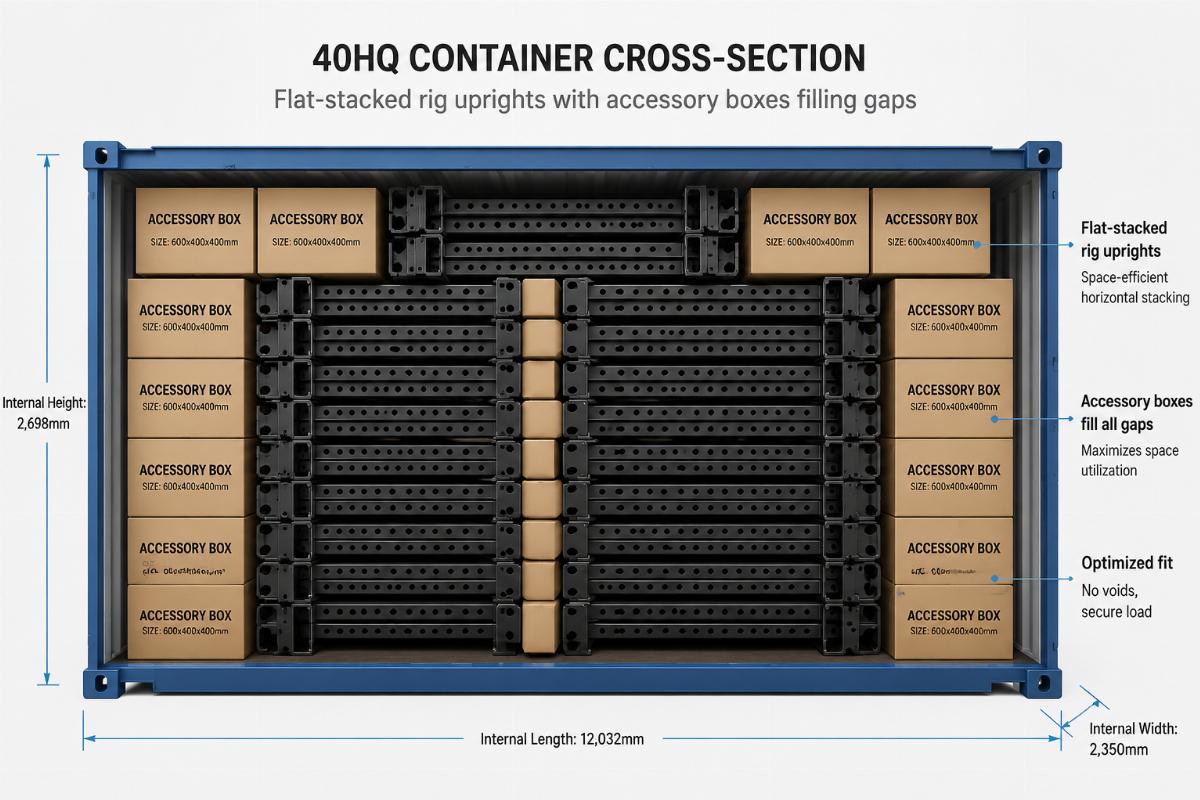
Your trade assurance monkey bar rig contract should include a loading supervision annex that specifies how the rig must be braced inside the container. The annex should list photo checkpoints: one photo of the empty container, one photo of the first layer loaded with bracing visible, one photo of the final layer before the doors are closed, and one photo of the sealed container with the number visible. The factory must send these photos to the buyer within a set number of hours after loading. [NEED_CITE: container loading best practices for heavy fitness equipment]
The contract should also define what happens if damage is found at destination. If the loading photos show proper bracing but the rig is still damaged, the claim goes to the shipping line or insurance. If the photos show missing or insufficient bracing, the factory covers the replacement cost. This clause removes the ambiguity that usually leads to months of back-and-forth emails.
A studio owner in Southeast Asia ordered a set of monkey bar rigs for a new CrossFit box. The rigs arrived with the uprights dented and the pull-up bars scratched. The factory said the damage happened in transit and refused to replace the parts. The buyer had no loading photos to prove whether the bracing was adequate or not. The dispute dragged on for months, and the buyer eventually paid for replacements just to open the studio on time. A trade assurance monkey bar rig contract with clear loading supervision terms would have resolved the issue in days.
What Lead Time and MOQ Terms Suit Custom Monkey Bar Rigs?
Custom monkey bar rigs require separate lead time clauses for mold development and repeat orders, with MOQ structured by container-load tiers.
Off-the-shelf monkey bar rigs are straightforward: you pick a model, pay the deposit, and the factory ships within a standard lead time. Custom rigs are different. If you need a specific grip configuration, a non-standard height, or a branded color, the factory has to build a mold or adjust the jig. That takes time, and the lead time for the first order will be noticeably longer than for repeat orders.
Your trade assurance monkey bar rig contract should separate the mold development phase from the production phase. The mold development lead time should be stated as a range, with a clear milestone for mold approval before production begins. Once the mold is approved, the production lead time for the first batch should be documented separately. For repeat orders, the lead time should be shorter because the mold already exists. [NEED_CITE: typical mold development and production lead times for custom steel fitness equipment]
MOQ is another area where custom rigs differ from standard models. Most factories set MOQ by container load, because producing a small batch of custom rigs does not justify the mold cost. The trade assurance monkey bar rig contract should list the MOQ for each container size, such as a 20-foot container or a 40-foot high cube. Some factories also offer tiered pricing, where the unit price drops if you order multiple containers in a single shipment.
A gym owner in Latin America wanted a custom monkey bar rig with a specific multi-grip layout for a boutique studio. The factory quoted a lead time that included mold development, but the contract did not separate the two phases. When the mold took longer than expected, the entire production was delayed, and the gym opening was pushed back. The buyer had no contractual basis to claim a penalty because the lead time was stated as a single block. A trade assurance monkey bar rig contract with phased milestones would have given the buyer leverage to keep the factory on schedule.
At Bick, we handle custom monkey bar rig orders by breaking the timeline into clear phases: mold design, mold approval, first-article inspection, and batch production. The MOQ is flexible, starting from a single unit for sample verification up to full gym packages that fill multiple containers. We consolidate container loads for buyers who want to mix monkey bar rigs with other strength equipment, and we provide loading supervision with photo reports for every shipment. The contract covers each phase with specific milestones, so there is no ambiguity about what happens if something falls behind.
Conclusion
A trade assurance monkey bar rig contract is only as strong as its technical annexes and enforcement triggers. Material certificates, welding records, batch-level CE documents, and loading photos are not optional extras — they are the difference between a smooth delivery and a port-side disaster. Lock these clauses into your agreement before you pay the deposit, and you will save yourself from the kind of problems that no amount of email follow-up can fix.