
Dual Adjustable Pulley Brand Comparison: Hammer Strength vs China Wholesale Manufacturer
The real gap between premium and budget dual adjustable pulleys has nothing to do with the logo on the frame—it comes down to bearing seal ratings, steel gauge consistency, and whether the supplier can ship replacement pulleys within weeks instead of months.
When evaluating a Dual Adjustable Pulley brand comparison, the core answer for commercial buyers is this: Hammer Strength machines carry a price premium driven largely by marketing, distribution margins, and dealer network overhead. A well-vetted China wholesale manufacturer producing to the same commercial-grade specifications—specifically P4-grade sealed bearings, 3mm minimum cold-rolled steel frames, and 1,000 lb-rated cables—can deliver functionally identical performance at roughly half the landed cost, provided you verify quality through documentation rather than brochures.
I remember walking through a gym in São Paulo a few years back. The owner had just spent a small fortune on branded cable crossover machines. Within half a year, the pulley stacks on two units were grinding noticeably. He called the brand’s regional service center, only to be told the replacement bearings were on backorder with no firm delivery date. The machines sat idle for months. That kind of downtime doesn’t just frustrate members—it quietly eats into membership retention and referral revenue. It was that moment I started digging deeper into what actually separates one Dual Adjustable Pulley from another on the showroom floor versus inside the housing. [NEED_CITE: root cause distribution of cable machine failures per ISO 15243]
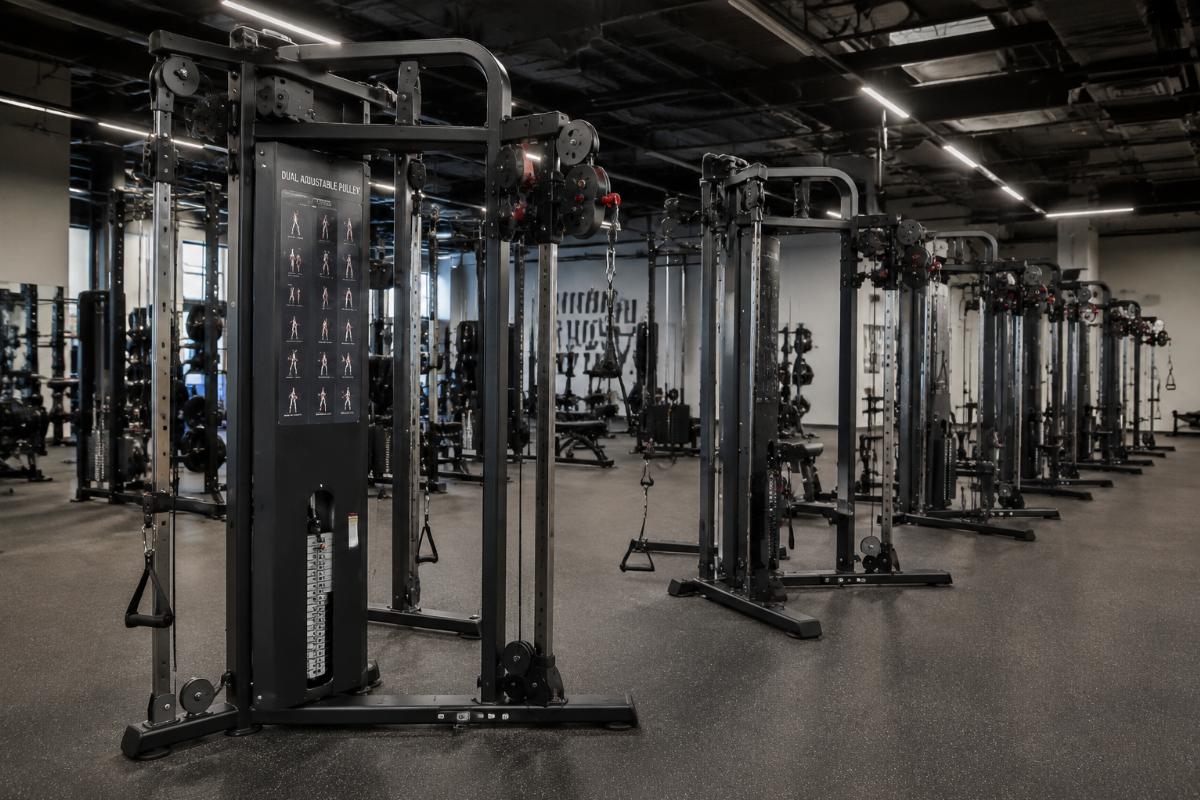
Let me walk you through what I have found after years of inspecting factory floors, tearing down competitor units, and sourcing directly for buyers who cannot afford to guess.
What Really Separates Premium DAPs from Budget Options?
The difference is not the brand name stamped on the shroud—it is the bearing seal class, the steel thickness tolerance, and the consistency of weld penetration.
Most buyers assume that paying a premium guarantees better raw materials. The reality is more nuanced. The cold-rolled steel used in premium commercial frames and the steel used in mid-tier factory-direct frames often comes from the same handful of certified mills. The divergence happens at three specific points: bearing specification, welding quality control, and cable rating.
| Parameter | Premium Branded DAP | Mid-Range Factory-Direct | Budget Unverified |
|---|---|---|---|
| Bearing seal rating | P4-grade sealed, high-RPM rated | P4-grade sealed, standard commercial | Open or basic shielded |
| Frame steel minimum gauge | 3mm cold-rolled, batch-certified | 3mm cold-rolled, mill certificate available | 2mm or unverified gauge |
| Cable rated load | 1,000 lb+ with safety factor | 1,000 lb rated, verifiable spec sheet | Unrated or self-reported |
| Weld inspection | Batch-level destructive testing | Sample-level testing, documented | Visual only or none |
| Pulley groove finish | Machined to prevent cable fraying | Machined, acceptable tolerance | Cast or rough-turned |
[NEED_CITE: bearing seal classification and RPM suitability per ISO 15243]
I once had a buyer send me a pulley from a well-known brand that had started squeaking within months. When we opened the housing, the bearing was a basic shielded type—nothing wrong with that for light use, but completely unsuited for a commercial environment where the same pulley sees hundreds of rotations daily. The brand had spec’d a bearing for a different duty cycle than what the machine actually endured. That is the kind of mismatch no marketing brochure will ever tell you about.
The takeaway here is simple: when you run a Dual Adjustable Pulley brand comparison, ignore the paint finish and focus on the bearing housing, the weld seams, and the cable specification sheet. Those three elements tell you whether the machine was engineered for commercial abuse or designed to a price point.

Hammer Strength vs Factory-Direct: Where Does the Money Go?
A significant portion of a branded machine’s retail price funds dealer margins, regional warehousing, advertising campaigns, and showroom presentation—not necessarily the steel or the bearings inside.
When you buy a Hammer Strength unit through an authorized dealer, the price you pay includes the factory cost, the brand’s margin, the distributor’s margin, the dealer’s margin, freight to a regional warehouse, and the cost of maintaining a sales and service network. None of that is inherently bad—these networks provide real value in terms of local support. But for buyers who understand their own maintenance capabilities or who work with a responsive factory-direct partner, a large share of that spend becomes optional.
A China wholesale manufacturer operating at commercial grade does not eliminate quality. It redirects the budget. Instead of paying for a branded name and a three-layer distribution chain, the buyer’s dollar goes toward the same 3mm steel, the same P4 bearings, and the same 1,000 lb cables—just without the intermediary markups. I have seen full container orders of commercial cable crossovers, Smith machines, and plate-loaded units land at a buyer’s warehouse for roughly half the per-unit cost of equivalent branded machines, with every piece passing the same functional load tests.
[NEED_CITE: commercial gym equipment cost structure breakdown including distribution margins]
A distributor in the Middle East once told me he switched his entire cable machine lineup to a factory-direct source after calculating the landed cost difference. He kept one branded unit on the showroom floor for comparison. His customers—experienced gym operators themselves—could not reliably tell which machine was which during a blind pull test. The difference they noticed was the price tag, not the feel.
This is not to say branded machines are bad. They offer established warranty networks and proven long-term track records. But the Dual Adjustable Pulley brand comparison that matters most is not about which logo looks better. It is about whether the buyer is paying for engineering or paying for the brand’s overhead.

How to Verify Quality When Sourcing from China?
Ask for the bearing spec sheet, the steel mill certificate, and the weld inspection protocol before you place a deposit—not after the container arrives.
Sourcing a Dual Adjustable Pulley from a China wholesale manufacturer is a sound commercial decision, but only if you treat the verification process with the same seriousness you would apply to any capital equipment purchase. The factories capable of producing true commercial-grade equipment are absolutely there. The challenge is separating them from the workshops that cut corners on the components you cannot see from the outside.
Here is the verification sequence I recommend to every buyer I work with:
-
Request the bearing specification document. Confirm the seal rating (P4-grade sealed for commercial use), the bore diameter, and the dynamic load rating. If the factory cannot produce a spec sheet from the bearing supplier, walk away. [NEED_CITE: bearing specification documentation standards for fitness equipment]
-
Ask for the steel mill certificate. The certificate should reference the steel grade, the thickness, and the batch number. A factory that uses certified cold-rolled steel will have no hesitation in sharing this.
-
Review the weld inspection protocol. Commercial-grade frames require batch-level or sample-level destructive testing on weld samples. Visual inspection alone is insufficient for high-load cable machines.
-
Check the cable specification. The cable should be rated for a minimum commercial load with a clearly stated safety factor. Ask for the breaking strength test report.
-
Evaluate the spare parts commitment. A reliable factory will maintain a spare parts inventory for at least several years and can ship replacement pulleys, bearings, and cables on short notice. This is where many low-tier suppliers fail catastrophically.
[NEED_CITE: fitness equipment sourcing verification checklist per industry procurement guidelines]
I have seen buyers receive beautiful sample units that passed every visual inspection, only to discover that the production batch used downgraded bearings and thinner steel. The only defense against this is documentary verification at every stage—sample, pre-production, and random in-line inspection.

Total Cost of Ownership: Brand Premium vs Long-Term Risk
The cheapest machine to buy is rarely the cheapest machine to own—but the most expensive machine to buy is not automatically the cheapest to own either.
Total cost of ownership for a Dual Adjustable Pulley includes the purchase price, freight, installation, routine maintenance, unscheduled repairs, replacement parts, and revenue lost during downtime. A branded machine typically costs more upfront but offers predictable service response and parts availability through its dealer network. A factory-direct machine costs less upfront but places greater responsibility on the buyer to select a supplier with genuine long-term support capability.
The risk with an unvetted China wholesale manufacturer is not the initial price—it is the silence after the sale. When a pulley fails and the supplier cannot provide a replacement bearing for months, the machine becomes a very expensive piece of decoration. I have seen this pattern repeat across multiple regions: buyers attracted by the lowest quote, then stranded by a supplier who lacks spare parts inventory, technical documentation, or simply the willingness to respond.
| Cost Factor | Branded DAP | Vetted Factory-Direct DAP | Unvetted Factory-Direct DAP |
|---|---|---|---|
| Initial purchase price | High | Moderate | Low |
| Spare parts availability | High, via dealer network | Moderate to high, if supplier commits | Low or unpredictable |
| Mean time to repair | Short, with local support | Moderate, depends on supplier response | Extended, often problematic |
| Long-term component durability | High, proven track record | High, if specifications verified | Variable, often compromised |
| Downtime revenue impact | Low | Low to moderate | High |
[NEED_CITE: total cost of ownership methodology for commercial fitness equipment]
The smart buyer does not choose between "brand" and "China wholesale" as abstract categories. The choice is between a branded machine with a known support structure and a factory-direct machine from a supplier who can demonstrably provide bearing spec sheets, steel certificates, weld protocols, and a committed spare parts pipeline. When that supplier commitment is real—as it is with established commercial manufacturers who understand that their reputation depends on machines still running years after the container clears customs—the total cost of ownership drops substantially while the performance gap narrows to negligible.

Conclusion
A Dual Adjustable Pulley brand comparison that focuses only on logos and price tags will lead you to the wrong decision every time. The real differentiators are bearing seal grade, frame steel certification, weld inspection standards, and the supplier’s ability to support the machine long after delivery. A vetted China wholesale manufacturer producing to verified commercial specifications can match branded performance at a fraction of the cost—provided you do the documentation work upfront and choose a partner who treats after-sales support as a core obligation, not an afterthought.


