01 / Scenario
STUDIO
P
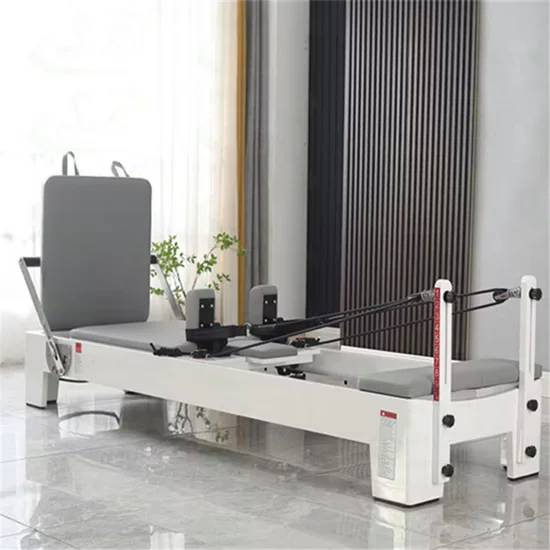
High-End Pilates Studios
Premium aesthetics meet quiet operation for boutique studio environments.

ISO
9001
CE
Certified
OEM
Available
10YR
Warranty
Oak Wood Pilates Reformer, Full-Track Flat Bed, 2460×730×680mm — solid oak frame ensures torsional rigidity and long-term rail alignment for smooth carriage travel across the full 2460mm stroke. Includes long box, jump board, and platform with standardized接口 for flexible programming. Backed by 3-year warranty and 100% load testing before shipment.
// Spec Highlights
• Direct from Manufacturer · No Middlemen · Worldwide Shipping
01
// Material
Imported Solid Wood
Premium hardwood frames sourced for density and visual warmth.
02
// Hardware
Medical-Grade Silent
Whisper-quiet pulleys and springs for clinical environments.
03
// Customization
Appearance OEM
Color, upholstery, and branding tailored to your studio.
04
// Service
Layout Design
Free venue planning for studios and rehab institutions.
Every component is selected for longevity, performance, and aesthetic harmony - from imported hardwood frames to silent medical-grade accessories.
// Features
11-Gauge Traceability — Every oak wood Pilates reformer frame is sourced from kiln-dried timber with moisture content certificates traceable to the mill batch.
| Parameter | Value |
|---|---|
| Product Type | Pilates Reformer |
| Model | SRY-12 |
| Frame Material | Oak Wood (solid) |
| Color | Solid Color |
| Accessories Included | Long Box / Jump Board / Platform |
| Product Dimensions | 2460 × 730 × 680 mm |
| Net Weight | 100 kg |
| Warranty | 3 Years |
| Logo | Customized |
| Target User | Adult / Unisex |
| Facility Type | Typical Use |
|---|---|
| Commercial Pilates studio | Daily group reformer classes across beginner to advanced levels |
| Boutique fitness studio | Core-conditioning programming alongside mat and barre sessions |
| Rehabilitation & physiotherapy center | Low-impact resistance training and post-injury movement recovery |
| Home & private practice studio | One-on-one instructor-led reformer sessions |
Veneered particleboard frames compress at the carriage rail anchor points, while solid oak resists the cyclic torsion of full-track reformer use.
Many studios purchase commercial Pilates reformers without verifying whether the frame is solid timber or laminated composite. Under the repeated off-center loading of jump board work and long box sequences, particleboard frames develop micro-fractures at the rail mounting bolts. The carriage begins to drift laterally, and within a year the track alignment degrades enough to produce audible scraping during footwork series [NEED_CITE: EN 957 structural requirements for stationary training equipment]. Solid oak maintains dimensional stability across humidity cycles, keeping the rail parallel and the carriage glide consistent through thousands of sessions.
The commercial oak wood Pilates reformer serves as the primary resistance-training station in a studio floor plan, covering sagittal and frontal plane movements for the full kinetic chain. It pairs with a tower or wall unit for standing work and a spine corrector for supplementary flexion-extension drills. In high-density boutique studios, reformers typically occupy the central floor zone, with spacing calculated around the 2460 mm length plus instructor walkway clearance. The flat bed profile accommodates users across a wide range of limb lengths and torso proportions without requiring frame-size variants.
The carriage endures eccentric loads every time a user performs single-leg footwork or unilateral strap work, creating asymmetric force on the rail and wheel assembly. Over a typical commercial day of back-to-back classes, the track experiences hundreds of loaded travel cycles with directional reversals at varying positions along the bed. The carriage wheels and their bearing surfaces absorb the majority of this fatigue, and non-sealed bearings allow studio dust and chalk residue to infiltrate the race, accelerating wear [NEED_CITE: bearing seal classification and contamination ingress in linear motion systems]. The oak frame itself resists torsional deflection at the rail anchor zone, but the interface between metal rail and wood substrate remains the critical long-term stress junction. Upholstery on the shoulder rests and headrest compresses under body weight repetition, and low-density foam loses recovery within months of commercial use.
Solid oak as a frame material provides inherent resistance to the humidity fluctuations common in studios where group classes generate significant ambient moisture. The 2460 mm overall length establishes a full-track design, meaning the carriage can travel the complete bed length without a dead zone — essential for long stroke work and jump board sequences. Net weight of 100 kg indicates sufficient mass in the timber and hardware to resist walking or shifting during dynamic exercises like short box rotations. The included Long Box, Jump Board, and Platform expand the movement catalog without requiring separate procurement, though their interface fit to the carriage and frame rails should be confirmed for flush seating and zero lateral play [NEED_CITE: dimensional tolerance standards for modular fitness equipment accessories].
A reformer built on a veneered MDF frame may meet static load benchmarks at the point of sale, but it lacks the fatigue resistance for daily class rotation. Once the rail anchor bolts begin to loosen in compressed particleboard, realignment becomes a recurring maintenance event rather than a one-time calibration. Non-sealed carriage bearings require scheduled disassembly and cleaning — downtime that removes the unit from revenue-generating class slots. Thin upholstery on the shoulder blocks and headrest compresses to the substrate within a season of heavy use, forcing either a re-upholstery cost or a degraded user experience that drives client attrition. Non-standardized accessory mounting points mean that a damaged Jump Board or Long Box cannot be replaced from a generic supplier, locking the studio into a single-source parts dependency.
The oak timber frame is sourced with moisture-content documentation, ensuring the wood arrives at equilibrium with typical indoor climate conditions and will not warp after installation. Rail mounting hardware is torqued to specification and verified at the factory, preventing the carriage drift that plagues under-specified reformers. Each unit undergoes a loaded travel test across the full track length before shipping, confirming smooth carriage motion without binding or lateral play. The 200μm industrial powder coating applied to all metal hardware resists corrosion from studio humidity and cleaning agents. Floor layout support includes CAD-compatible dimensions for spacing this 2460 × 730 mm unit with proper instructor clearance on all sides. OEM customization covers color matching and logo application for studio branding consistency across a multi-unit floor.
Provide your studio floor area and planned reformer count to receive a 2D-3D layout showing spacing, instructor circulation, and accessory storage zones. Specify expected daily class volume so that carriage bearing and upholstery grade can be matched to your usage intensity. Indicate your client demographic profile to confirm the accessory suite covers the required movement range. State any color, logo, or upholstery customization requirements for brand alignment across your equipment floor.
Q: How do you determine whether a reformer frame is genuinely solid oak rather than veneered composite?
A: Request a cross-section sample or a timber species certificate from the supplier. Solid oak shows continuous grain through any cut edge, while veneered board reveals a laminated surface over a particle or fiber core. In commercial use, the difference becomes visible at bolt holes and rail mounting points where composite material compresses and crumbles under cyclic load, whereas solid oak retains thread engagement and fastener clamping force.
Q: Does a full-track flat bed design affect which exercises can be programmed on the reformer?
A: A full-track design allows the carriage to travel the entire bed length without mechanical stops or dead zones. This is necessary for long-stroke footwork, jump board plyometrics, and advanced repertoire sequences that require extended range. Half-track or short-bed designs limit the exercise catalog and may restrict programming for taller clients or instructors teaching long-box sliding series.
Q: When the carriage develops lateral play or noise, how do you isolate whether the cause is the track or the wheel assembly?
A: Remove the carriage from the rails and inspect the wheel tread for flat spots, debris embedding, or bearing roughness when spun by hand. Then examine the rail surface for scoring, dents, or misalignment at the mounting bolts. If the wheels spin smoothly off the track but bind when reinstalled, the issue is rail alignment or frame torsion. If roughness persists off the track, the wheel bearings require service or replacement.
Q: Are the Long Box, Jump Board, and Platform interchangeable with accessories from other reformer brands?
A: Accessory compatibility depends on the carriage width, rail profile, and mounting interface dimensions specific to each reformer model. While some industry-standard carriage widths exist, pin placement and seating geometry often differ between manufacturers. Confirm interface measurements before procuring third-party accessories to avoid lateral play or insecure attachment during loaded use.
Q: What is the expected replacement interval for upholstery and springs under commercial class frequency?
A: Upholstery lifespan depends on foam density, vinyl or leather grade, and the number of daily contact cycles. In high-frequency studios running six or more classes daily, shoulder rest and headrest foam may compress noticeably within a year if low-density material is used. Springs lose calibrated tension over thousands of stretch cycles and should be tested for resistance consistency during scheduled maintenance intervals.
Premium aesthetics meet quiet operation for boutique studio environments.
Medical-grade silence and precision for sports & postpartum recovery.
Furniture-grade craftsmanship for premium residential installations.
Compact premium setups for one-on-one and small-group training.
Aesthetic Pilates integration for hybrid wellness studio programming.
Multi-unit deployment with instructor-grade reliability for certification programs.
Tell us about your project. Our team will respond within 24 hours with pricing, customization options, and shipping details.
// Sales Director
William
+86 132 2531 1800
// Export Manager
Bella
+86 198 5412 8032
william@bickfit.com