FR-300 Functional Rig Supplier for Israel Market | Factory Direct
Most rig orders for Israel fail at the loading dock, not the gym floor. The wrong upright gauge or a miscalculated crossbeam height turns a functional training rig into a pile of scrap metal before it ever sees a rep.
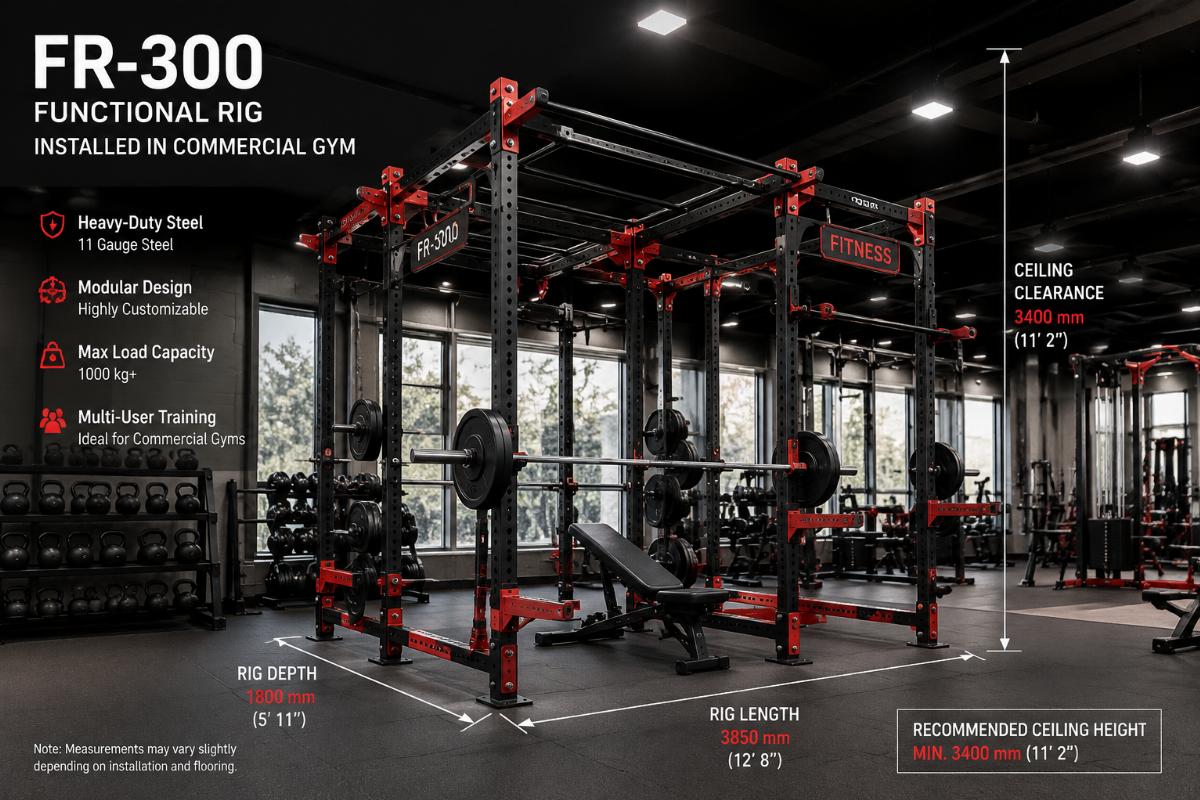
When sourcing a functional rig for the Israeli market, the single most critical factor is ceiling clearance — not price, not lead time, not attachment count. Israeli commercial spaces frequently occupy converted warehouses, basements, or mixed-use buildings where structural beams, HVAC ducts, and sprinkler lines eat into overhead space. A rig that fits a 4-meter ceiling in Texas will not fit a 3.2-meter ceiling in Haifa. The buyer who confirms ceiling height before locking specifications avoids on-site rework, wasted floor padding, and a client who refuses to sign the acceptance sheet.
I learned this the hard way. Early in my career, I shipped a standard-height functional rig to a CrossFit box in Haifa. The building was a converted industrial space — common across Israel’s port cities. The ceiling looked fine on a video call. What nobody checked was a low-hanging concrete beam running perpendicular to the rig’s length. The uprights hit the beam with less than a centimeter to spare. We had to cut and re-weld on site, and the floor padding we’d already laid down had to be ripped up and replaced. The client was not happy. Since that job, the first question I ask on any Israel rig order is ceiling height — measured at the exact installation point, not at the doorway.
A functional rig looks simple from the outside. Uprights, crossbeams, pull-up bars, maybe a few attachment points. But the upright gauge, crossbeam spacing, hole pattern, and attachment compatibility determine whether the rig survives daily commercial use or starts wobbling within months. [NEED_CITE: structural load requirements for functional training rigs per EN 20957-1] Factory-direct sourcing means we lock down every dimension before the order is placed — no arguing at the port, no improvising with an angle grinder in a Tel Aviv warehouse.
Getting these details right is what separates a functional rig supplier that delivers a turnkey solution from one that delivers a headache. Let me walk you through what matters.
What Upright Gauge and Steel Grade Actually Mean for Rig Longevity?
The upright is the spine of the rig. Its wall thickness and steel grade determine load capacity, weld integrity, and long-term resistance to deformation under dynamic loads.
Most entry-level rigs on the global market use 50×50 mm uprights with 2.0 mm wall thickness. They look identical to heavier-duty rigs in photos. Under a static load — say, a 100 kg athlete hanging from a pull-up bar — they perform fine. Under dynamic loads — kipping pull-ups, muscle-ups, band-resisted movements, athletes swinging on J-cups — the thinner walls flex. Over time, that flex fatigues the welds at the crossbeam joints. [NEED_CITE: fatigue failure mechanisms in welded steel structures under cyclic loading]
The FR-300 series uses 75×75 mm uprights with 3.0 mm wall thickness, made from cold-rolled steel. The larger cross-section increases the moment of inertia substantially, which translates to noticeably less deflection under the same dynamic load. The thicker wall also gives the welds more material to fuse into, which matters when you’re dealing with the kind of repetitive stress a commercial CrossFit box puts on a rig every single day.
Here is how the common specifications compare across typical rig tiers:
| Parameter | Entry-Level Rig | Mid-Range Rig | FR-300 Series |
|---|---|---|---|
| Upright Dimensions | 50×50 mm | 60×60 mm | 75×75 mm |
| Wall Thickness | 2.0 mm | 2.5 mm | 3.0 mm |
| Steel Grade | Standard mild steel | Upgraded mild steel | Cold-rolled steel |
| Hole Pattern Spacing | Westside-compatible | Mixed spacing | Westside-compatible |
| Load Rating | Self-reported | Sample-level tested | Full batch-level tested |
| Weld Inspection | Visual only | Visual + spot check | Verifiable per joint |
A distributor in the Levant once ordered a batch of rigs from a competitor — 50×50 uprights, 2.0 mm walls — for a chain of boutique fitness studios. Within months, two of the rigs developed visible flex at the top crossbeam joints during kipping movements. The studio owners demanded replacement. The distributor ate the cost of the rigs, the return shipping, and the installation labor. That is a mid-five-figure loss on an order that was supposed to be a volume win.
The lesson is not complicated: the cheapest rig is only cheap until it fails. As a functional rig supplier, we spec the FR-300 with commercial-grade steel and verifiable weld quality because the cost of a field failure in Israel — where labor rates are high and clients are litigious — dwarfs the marginal material savings on a lighter rig.

How Do You Handle Israel’s Ceiling Height Constraints Without Sacrificing Functionality?
The answer is modular upright customization — not cutting on site.
Israel’s commercial real estate market is dense. Gym spaces are often converted retail units, basement levels, or upper floors of mixed-use buildings. Ceiling heights vary wildly — sometimes within the same building. A standard 3.5-meter rig will not work in a space with a 3.2-meter clear height. But you cannot just chop 30 centimeters off the uprights and call it a day. The crossbeam mounting holes, the pull-up bar height, and the attachment point alignment all shift when you change upright length.
Here is the process we follow for every Israel order:
- Request ceiling height at the exact installation coordinates. Not a general "about 3.3 meters" — we need the measurement at the rig’s footprint, accounting for any beams, ducts, or sprinkler drops.
- Confirm the rig’s functional height requirements. A standard pull-up bar needs to be high enough for a full hang with feet clear of the floor. For most athletes, that means the bar sits at roughly 2.3 to 2.5 meters from the floor. If the ceiling is 3.0 meters, you have maybe half a meter of clearance above the bar — enough, but tight.
- Adjust upright length at the factory, not the field. We cut the uprights to the exact required length, re-drill the crossbeam mounting holes to maintain proper spacing, and relocate any attachment points that fall outside the adjusted range. The rig arrives ready to bolt down.
- Verify attachment compatibility after adjustment. Some attachments — like landmine posts or storage pegs — mount at fixed positions on the upright. If the upright is shortened, those positions may need to shift. We confirm this before production, not after delivery.
A gym owner in Be’er Sheva ordered a multi-station rig for a ground-floor commercial space. The ceiling was 3.1 meters, with an HVAC duct running across the center. We adjusted the uprights to 2.9 meters, relocated the top crossbeam mounting holes, and shifted the pull-up bars to maintain functional height. The rig fit with clearance to spare, and the HVAC duct was not an issue because the rig’s footprint was set back from the duct’s path.
The risk of skipping this step is real. A buyer in the Middle East once ordered standard-height rigs without confirming ceiling clearance. The rigs arrived, the installers started assembling, and the uprights hit the ceiling grid. The buyer had to choose between lowering the ceiling — which meant relocating lighting and sprinklers — or cutting the uprights on site. Neither option was cheap. [NEED_CITE: common installation failures in overhead-constrained commercial fitness spaces]

What Attachment Compatibility Standards Should a Functional Rig Supplier Follow?
Westside hole spacing is the baseline. Anything less creates a compatibility gap that limits the rig’s long-term utility.
The Westside hole pattern — 1-inch holes spaced at 1-inch intervals in the load-bearing zone (the bottom two-thirds of the upright), with 2-inch spacing in the top third — is the de facto standard for functional rig attachments in the commercial market. J-cups, safety straps, band pegs, dip handles, landmine posts, and pulley systems from most major accessory manufacturers are designed around this pattern.
If a rig uses a non-standard hole pattern — say, holes every 75 mm, or a mix of 1-inch and 25 mm holes — the buyer locks themselves into a single manufacturer’s accessory ecosystem. That is a problem when the buyer wants to add a third-party pulley system, or when the original manufacturer discontinues an attachment, or when the buyer needs a specific accessory that is only available in a Westside-compatible format.
The FR-300 series follows full Westside-compatible spacing throughout the load-bearing zone. This means any standard accessory — from any manufacturer — bolts on without modification. For the Israeli market, where buyers often source attachments from multiple suppliers to optimize cost and availability, this compatibility is not a luxury. It is a requirement.
Beyond hole spacing, the attachment interface itself matters. The diameter of the hole, the tolerance on the hole position, and the surface finish of the upright all affect how well attachments seat and how easily they can be adjusted. Loose tolerances mean attachments wobble. Rough surface finish means attachments bind when you try to slide them into position. We hold the FR-300’s hole tolerances to a level that ensures attachments slide in cleanly and lock firmly without play.
| Compatibility Factor | Non-Standard Rig | FR-300 Series |
|---|---|---|
| Hole Pattern | Proprietary spacing | Westside-compatible |
| Hole Diameter Tolerance | Loose | Controlled |
| Surface Finish | As-rolled | Controlled finish |
| Third-Party Attachment Fit | Vulnerable | Robust |
| Long-Term Accessory Ecosystem | Limited | Open |
A CrossFit box in central Israel had an older rig from a European manufacturer that used a proprietary hole pattern. When they wanted to add a cable pulley attachment, they could not find anything compatible. They ended up having a local fabricator weld custom brackets — which voided the rig’s warranty and introduced a structural weak point. As a functional rig supplier, we design the FR-300 to avoid that trap entirely.

How Does Factory-Direct Sourcing Change the Risk Profile for Israeli Buyers?
Factory-direct sourcing eliminates the layer of intermediaries that typically absorbs — or ignores — specification errors before they reach the field.
When a buyer purchases through a trading company or a regional distributor, the specification sheet passes through multiple hands. Each hand introduces a chance for miscommunication. Ceiling height gets rounded up. Upright gauge gets downgraded to hit a price point. Attachment compatibility gets assumed rather than confirmed. By the time the rig arrives at the port in Haifa or Ashdod, the specs on the shipping manifest may not match what the buyer actually needs.
With factory-direct sourcing, the specification conversation happens between the buyer and the production floor. There is no intermediary filtering the information. If the buyer says the ceiling is 3.1 meters, that number goes directly into the production spec. If the buyer needs Westside-compatible hole spacing, that requirement is locked into the tooling before the first upright is cut.
This direct line also means customization is faster and cheaper. Need uprights cut to a non-standard length? The factory adjusts the cutting program. Need additional attachment points welded at specific heights? The factory adds them to the jig. A trading company would have to go back to the factory, negotiate the change, and add a margin on top. The factory just does it.
For the Israeli market, where orders are often mid-size — a single rig for a boutique studio, or a small batch for a fitness chain — this direct relationship is especially valuable. The order is not large enough to justify a dedicated project manager at a trading company, but it is large enough that a specification error would be costly. Factory-direct sourcing gives the buyer the attention of a dedicated contact without the overhead of a middleman.

A fitness equipment distributor in the region once told me about an order they placed through a European trading company. The trading company quoted a price based on 50×50 uprights. The buyer assumed 75×75. The trading company did not clarify. The rigs arrived with 50×50 uprights. The buyer refused acceptance. The trading company blamed the factory. The factory blamed the trading company. The buyer was stuck with rigs they could not use and a dispute that took months to resolve. That is the kind of risk that factory-direct sourcing eliminates — not by promising perfect communication, but by removing the node where miscommunication happens.
What Should Buyers Verify Before Placing an Order?
A short checklist, built from real failures I have seen or helped resolve:
- Ceiling height at the exact installation point. Not a general estimate. Measure where the rig will stand.
- Structural obstructions. Beams, ducts, sprinkler drops, lighting tracks — anything that reduces clear height or blocks the rig’s footprint.
- Floor condition and loading capacity. A rig bolted to a concrete slab is one thing. A rig on a raised floor or a basement slab with limited load capacity is another. [NEED_CITE: floor load requirements for commercial functional training installations]
- Attachment compatibility requirements. Confirm the hole pattern matches the accessories the buyer plans to use — now and in the future.
- Delivery access. Can a container reach the site? Is there a loading dock, or will the rig need to be hand-unloaded? Israeli urban sites often have tight access.
- Electrical and drainage requirements. If the rig includes a cable pulley system or a water-resistant coating for a humid environment, confirm the infrastructure is in place.
These are not theoretical concerns. Every item on this list comes from a real order where something went wrong — or where something almost went wrong because we caught it early.

Conclusion
A functional rig is only as good as the specifications behind it. Ceiling clearance, upright gauge, hole pattern compatibility, and factory-direct communication are not details — they are the difference between a rig that performs for a decade and one that becomes a liability within months. The FR-300 series is built around these realities, with commercial-grade steel, Westside-compatible spacing, and modular upright customization that locks down dimensions before production begins. For the Israeli market, where spaces are tight and clients are demanding, that discipline is not optional.