
Chinese Roman Chair Manufacturer vs PowerLine: Cost Comparison
The cheapest quote on a Roman chair is rarely the cheapest purchase. Comparing a Chinese Roman chair manufacturer to PowerLine on factory price alone is misleading — total landed cost and lifecycle durability reveal the real value gap. When you factor in steel gauge, welding integrity, packaging efficiency, and container loading, the per-unit cost picture flips entirely.
I still remember a Middle East gym owner who chose a rock-bottom Roman chair quote from a trading company. Three months later, welds were cracking under normal commercial use. The return freight, replacement shipping, and downtime cost several times what he would have paid for a properly built unit from a verified Chinese Roman chair manufacturer in the first place. [NEED_CITE: failure root cause distribution in commercial hyperextension benches per ISO 20957] That experience is exactly why I now walk every buyer through the full cost anatomy before they sign a purchase order.

Let me walk you through what actually determines whether a Chinese Roman chair manufacturer delivers real savings — or a very expensive lesson.
What’s Really Included in a Roman Chair’s Price Tag?
Most buyers stop at the FOB number and call it a day. The real cost story begins the moment the container leaves the port. A factory quote for a Roman chair covers the bare unit — steel, padding, hardware, and basic assembly. But the total landed cost includes freight, import duties, last-mile delivery, assembly labor, warranty claims, and replacement logistics. [NEED_CITE: total cost of ownership model for imported commercial fitness equipment]
Here is where the gap between a Chinese Roman chair manufacturer and a branded supplier like PowerLine gets interesting. The branded unit carries a premium on the invoice, yes. But it also carries engineered packaging that maximizes container density, standardized welding that survives transit vibration, and padding density that resists compression over years of daily use. The cheaper alternative often looks attractive until you calculate per-unit freight on a half-empty container, or until the third weld joint fails and you are paying return shipping on a batch of defective units.
A South American distributor once compared two Roman chair quotes side by side. The lower-priced option used fully assembled packaging — bulky, heavy, and impossible to stack efficiently. The slightly higher-priced option from a Chinese Roman chair manufacturer used knock-down flat-pack design with nested components. The flat-pack solution loaded roughly a third more units per container. When you divide the total freight bill by units landed, the per-unit shipping cost difference was substantial enough to erase the factory price advantage of the assembled competitor entirely.
The lesson: never evaluate a Chinese Roman chair manufacturer on the proforma invoice alone. Ask for a container loading plan, a packaging specification sheet, and a warranty claim rate from existing buyers. Those three documents tell you more about real cost than any price list ever will.
Steel, Welds & Padding: Where Chinese Manufacturers and PowerLine Diverge
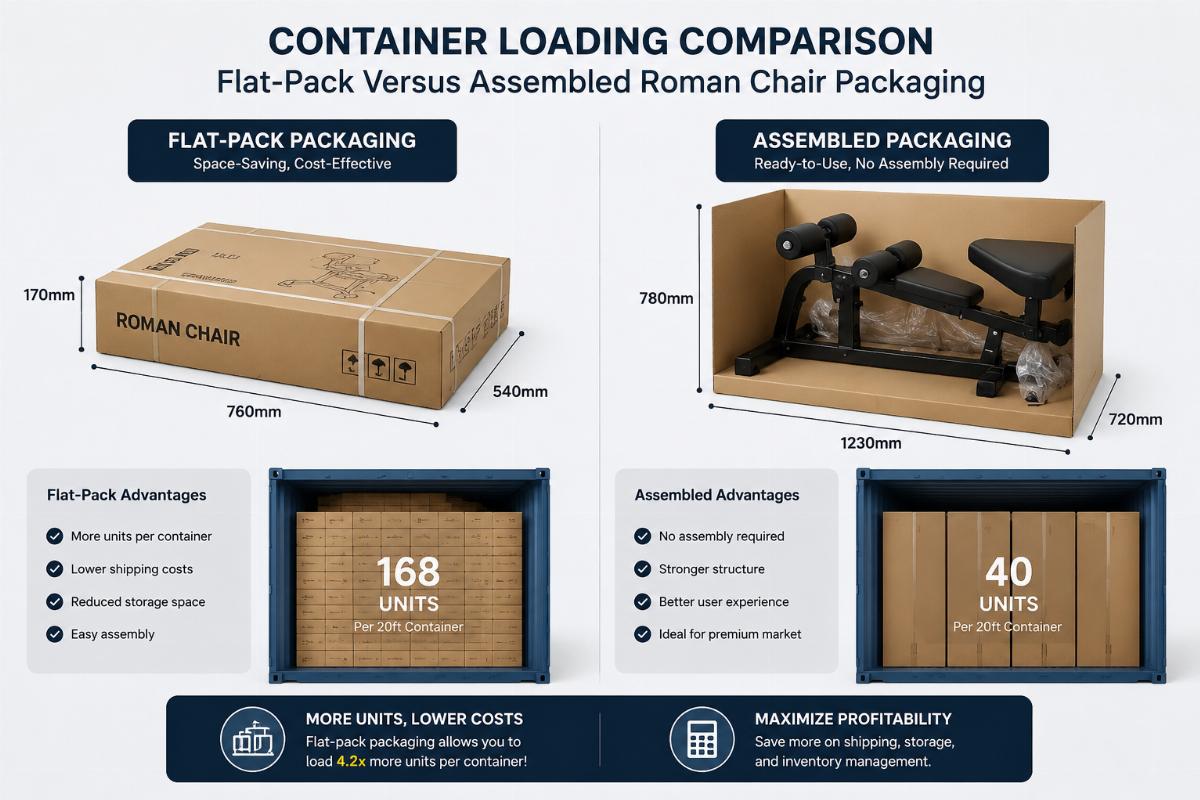
Specification sheets lie. Physical samples and third-party inspection reports do not. When you compare a Chinese Roman chair manufacturer against PowerLine, the critical divergence points are steel tube wall thickness, welding methodology, and padding foam density. These three elements determine whether the equipment survives commercial gym use or starts failing within months.
| Factor | Budget Import Spec | Branded Spec (PowerLine Class) | Verified Chinese Roman chair manufacturer Spec |
|---|---|---|---|
| Steel tube gauge | Basic / thin-wall | Certified heavy-duty | Certified heavy-duty (12ga equivalent) |
| Welding method | Spot weld / intermittent | Full continuous MIG | Full continuous MIG |
| Padding density | Basic / low-resilience | High-resilience commercial | High-resilience commercial |
| Frame finish | Self-reported | Verifiable powder coat | Verifiable powder coat |
| Load rating claim | Self-reported | Certified | Certified per EN/ASTM |
[NEED_CITE: steel tube gauge and load capacity correlation in commercial strength equipment]
Steel tube wall thickness is the single most manipulated variable in budget Roman chair production. A supplier may quote 12-gauge on paper, but the actual delivered product measures noticeably thinner — sometimes by a meaningful margin. The tolerance gap between what is promised and what arrives is where structural integrity disappears. Under repeated hyperextension loading, thin-wall tubing flexes microscopically at every joint, accelerating fatigue crack initiation at weld points. [NEED_CITE: fatigue failure mechanisms in welded steel fitness frames]
Welding methodology is equally telling. Spot welding or intermittent tack welding is fast and cheap, but it creates stress concentration points. Under commercial use — where a Roman chair sees dozens of users per day with varying body weights and movement patterns — spot welds are vulnerable to progressive cracking. Full continuous MIG welding distributes load across the entire joint, substantially extending fatigue life. A Chinese Roman chair manufacturer that invests in full MIG welding across the frame is signaling that they understand commercial durability requirements.
Padding is the silent differentiator. Low-density foam feels acceptable on day one but compresses permanently within weeks of daily use, leaving users sitting on hard substrate. High-resilience commercial-grade foam maintains shape and support over extended service life. The density difference is not visible in photos — it requires physical sampling or a material specification sheet to verify.
The Container Math: How Packaging Kills or Saves Your Per-Unit Cost
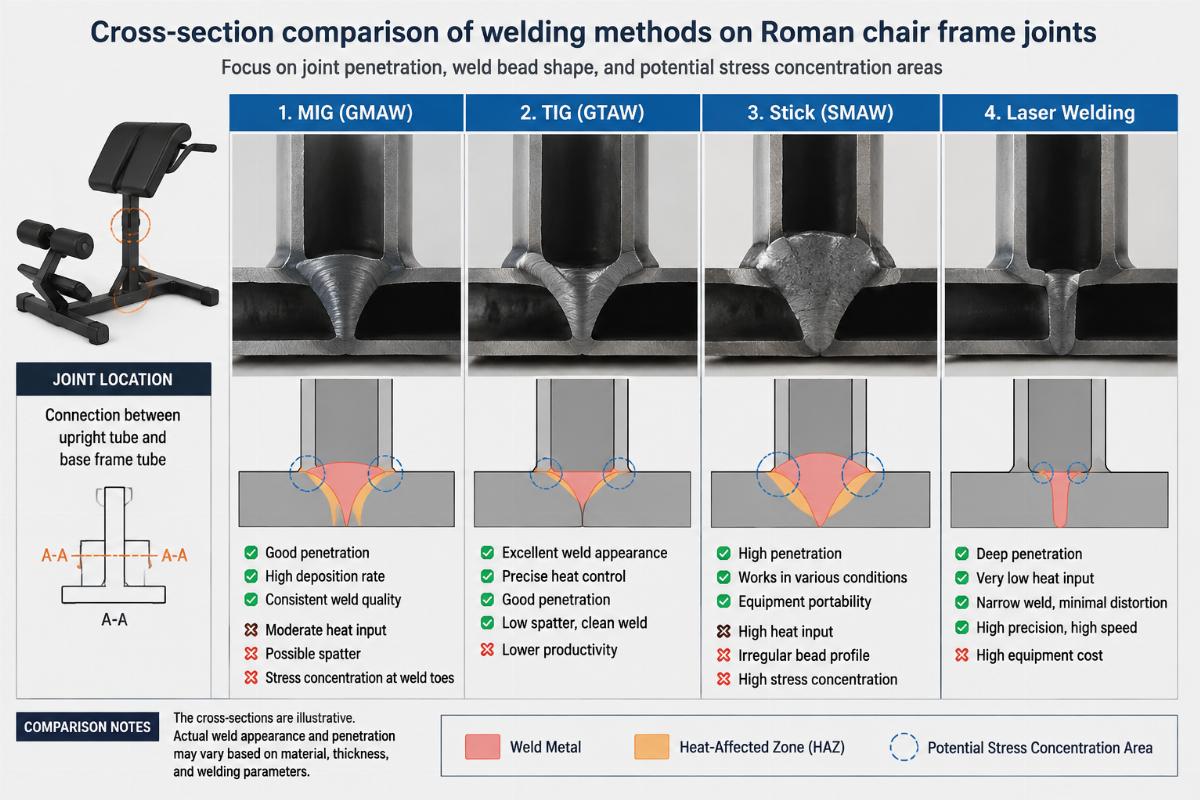
The factory price is only the opening chapter. Packaging design writes the rest of the cost story. This is the single most overlooked factor when buyers compare a Chinese Roman chair manufacturer against a branded alternative. A Roman chair that ships fully assembled occupies vastly more container volume than the same chair designed for knock-down flat-pack shipping. The difference in per-unit landed cost is dramatic.
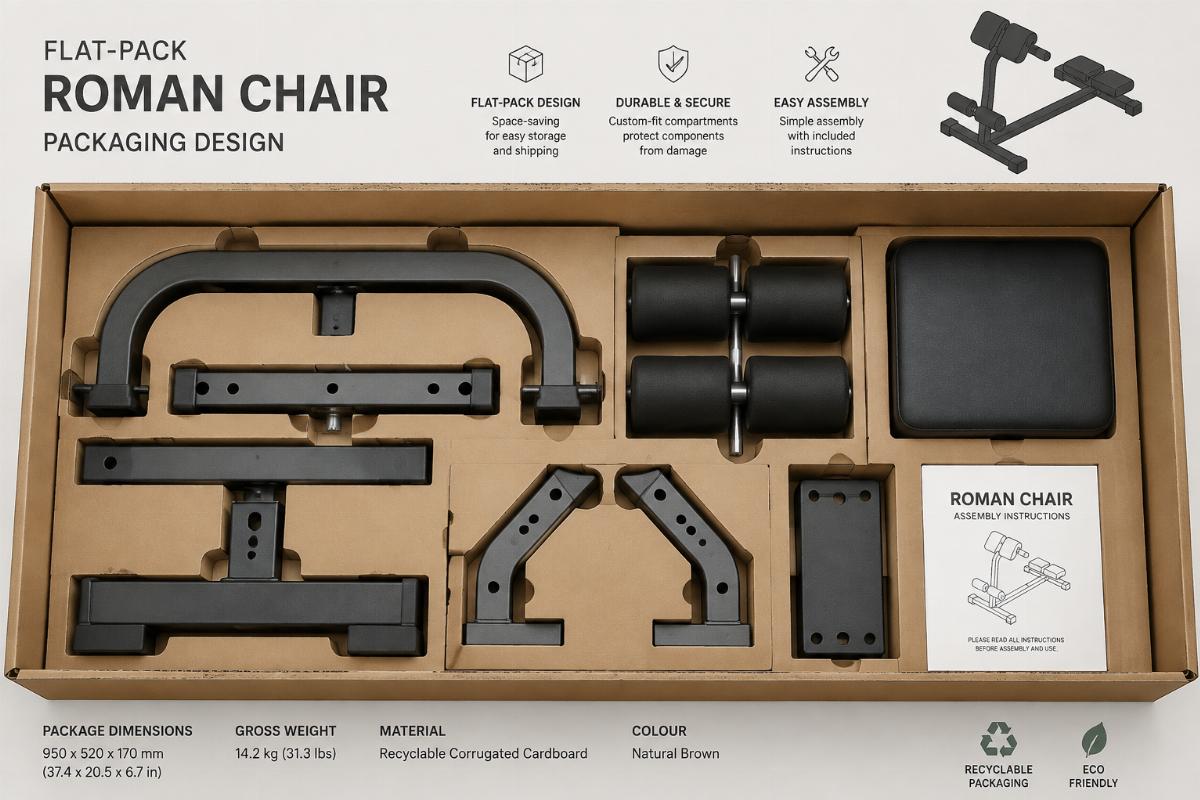
Consider the loading math. A fully assembled Roman chair, with its extended frame and fixed pad assemblies, cannot be nested or stacked efficiently. A standard container might hold a limited number of assembled units. The same model, redesigned with removable pads, detachable foot rollers, and bolt-together frame sections, can be packed flat with components nested inside the main frame tube. The loading density increases substantially — often by a third or more of additional units per container.
[NEED_CITE: container utilization efficiency in flat-pack versus assembled fitness equipment shipping]
When you divide total ocean freight by units received, the per-unit freight cost drops noticeably. Add in the fact that flat-pack units are lighter per package (less air, less protective void fill), and the duty calculation — which in many markets is based on weight or declared value — also shifts in favor of the knock-down design. A Chinese Roman chair manufacturer that offers engineered flat-pack packaging is effectively giving you a freight discount that never appears on the product invoice.
I worked with a distributor who was comparing two Roman chair suppliers. Supplier A quoted a lower unit price but shipped assembled. Supplier B — a Chinese Roman chair manufacturer with flat-pack capability — quoted slightly higher per unit. When we ran the full container load calculation including freight, duties, and inland transport, Supplier B’s per-unit landed cost was lower. The distributor saved a meaningful amount per container by choosing the flat-pack option, and those savings compounded across multiple orders throughout the year.
The takeaway: always request a container loading diagram and unit count per container before comparing quotes. A Chinese Roman chair manufacturer that provides this documentation transparently is one that understands the full cost equation.
Real Failure Stories: When "Cheap" Becomes the Most Expensive Choice
The most expensive Roman chair you will ever buy is the one that fails in the field. I have seen this pattern repeat across multiple markets and buyer types. The initial savings on a budget Roman chair evaporate the moment warranty claims, return freight, and reputational damage enter the picture.
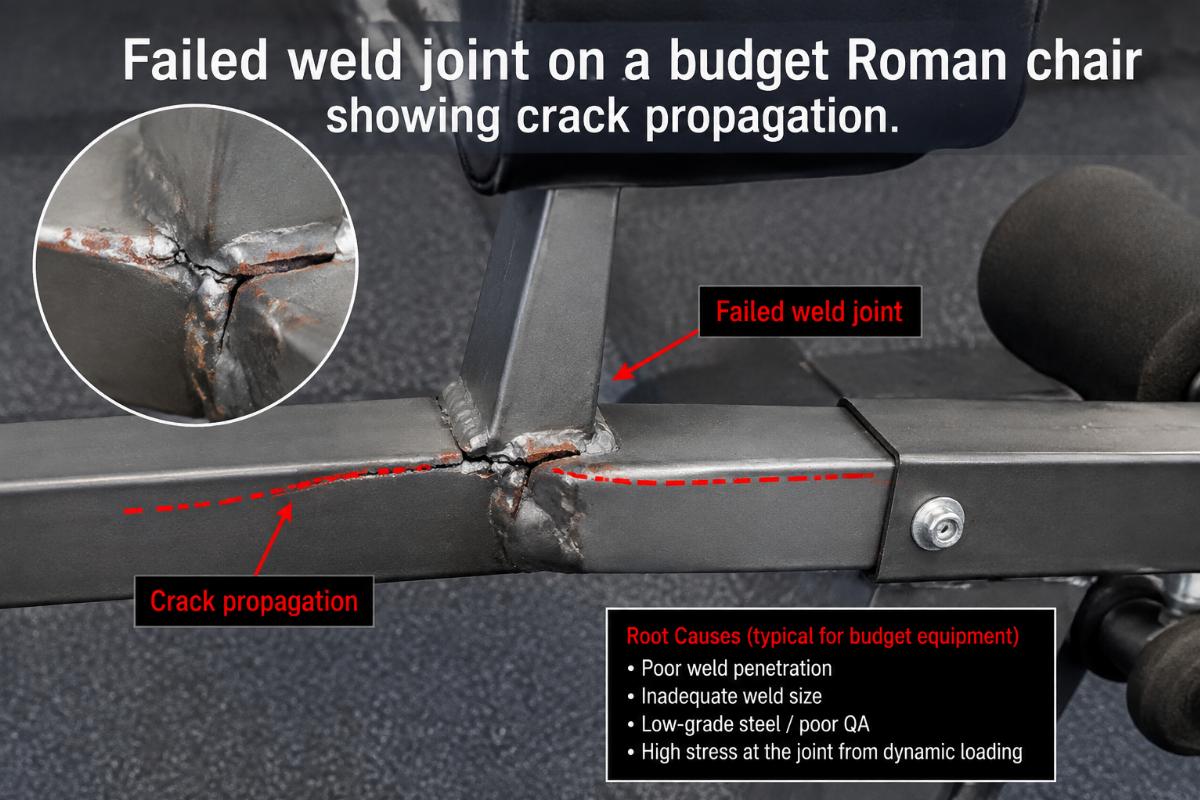
A gym owner in the Middle East purchased a full batch of Roman chairs from a low-cost supplier selected purely on price. The units looked acceptable upon arrival. Within a short period of commercial operation, weld cracks began appearing at the main frame joints — precisely where the hyperextension load concentrates during use. The supplier offered replacement units but placed the return freight burden on the buyer. The cost of shipping defective units back, combined with the cost of receiving and installing replacements, plus the downtime of having unusable equipment on the gym floor, resulted in a total expense that far exceeded what a properly built unit would have cost initially. [NEED_CITE: warranty claim cost analysis in imported commercial fitness equipment]
In another case, a hotel fitness center project specified Roman chairs for a multi-property rollout. The procurement team selected the lowest bidder without requesting third-party inspection. Upon arrival at the first property, the site team discovered that the actual steel tube wall thickness was noticeably thinner than what the supplier had declared. The load-bearing capacity was compromised. The entire batch had to be rejected, the project timeline was delayed, and the procurement team had to source replacement equipment on short notice at premium pricing.
These are not isolated incidents. They are the predictable outcome of evaluating a Chinese Roman chair manufacturer — or any supplier — on price alone. The failure modes are consistent: weld fatigue from inadequate welding methodology, frame flex from thin-wall tubing, and padding collapse from low-density foam. Each failure triggers a cost cascade that dwarfs the initial savings.
How to Verify a Chinese Roman Chair Supplier Before You Order
Verification is not optional. It is the single most important step in protecting your investment. Before placing an order with any Chinese Roman chair manufacturer, you need a structured due diligence process that goes far beyond the product catalog and price list.
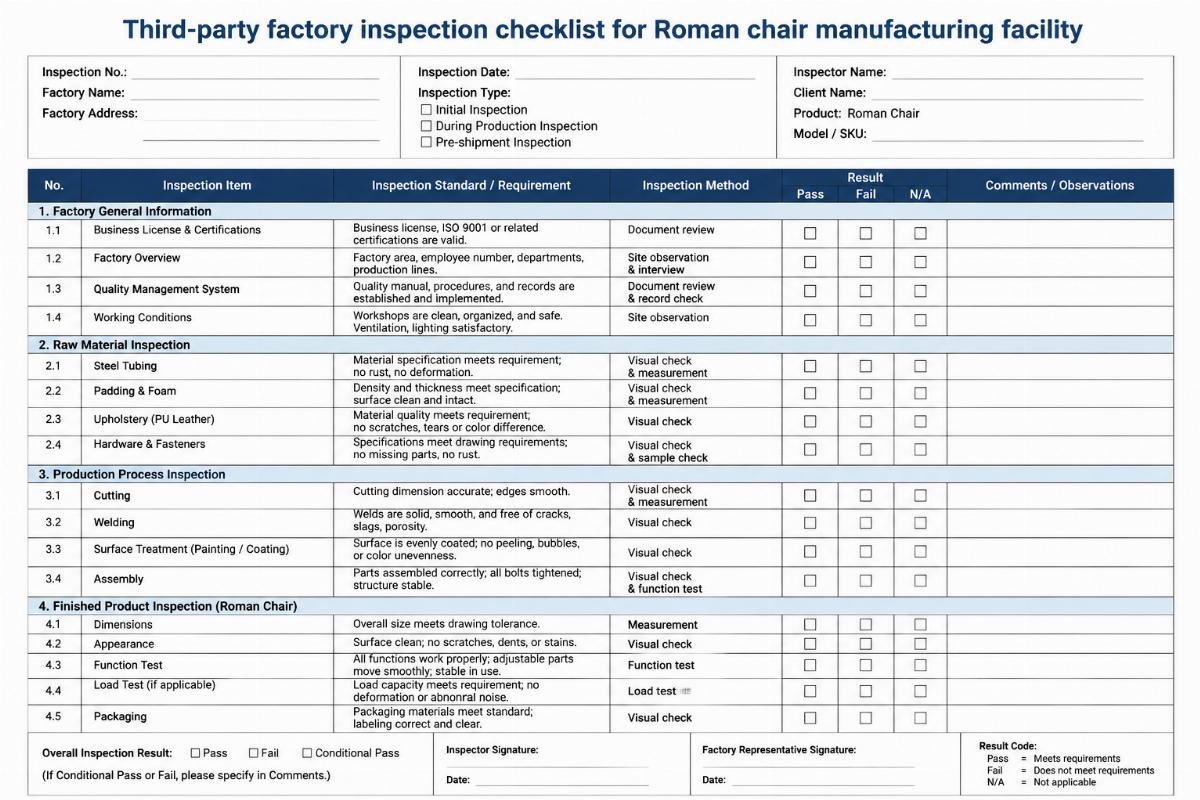
Request third-party inspection reports. A credible Chinese Roman chair manufacturer will have no hesitation providing inspection documentation from recognized third-party agencies. These reports cover material verification, dimensional accuracy, weld quality, and load testing. If a supplier cannot or will not provide this documentation, treat it as a red flag. [NEED_CITE: third-party inspection standards for imported commercial fitness equipment]
Conduct a factory audit — in person or via a trusted agent. Physical verification of production capabilities, quality control processes, and material storage conditions is essential. Check whether the factory uses certified steel stock with traceable mill certificates. Observe the welding stations — are operators performing full continuous welds, or are they using spot welds to cut cycle time? Inspect the padding production area — is foam density tested and documented?
Ask for a container loading plan. A professional Chinese Roman chair manufacturer will provide a detailed loading diagram showing unit count per container, packaging configuration, and weight distribution. This document demonstrates that the supplier has engineered their product for efficient international shipping, not just for low production cost.
Request references from existing buyers in your region. A supplier with genuine export experience will be able to connect you with current customers who can speak to product quality, delivery reliability, and after-sales support. This is particularly valuable when evaluating a Chinese Roman chair manufacturer for the first time.
Verify certifications. CE marking, EN/ASTM compliance, and relevant safety certifications should be documented and verifiable. A Chinese Roman chair manufacturer that maintains these certifications as standard practice — rather than as a special-order option — demonstrates a commitment to international market requirements.
Conclusion
Factory price is the tip of the cost iceberg. Total landed cost, lifecycle durability, and packaging efficiency determine whether a Roman chair purchase is a bargain or a burden. A Chinese Roman chair manufacturer that invests in proper steel gauge, full continuous welding, high-resilience padding, and engineered flat-pack packaging will deliver a lower true cost per unit than a branded alternative — but only if you evaluate the full equation, not just the invoice. Verify before you order, and the savings will be real.


