
China Shoulder Press Machine vs Sorinex: Wholesale Supplier for Military Base MWR Buyers
Spec sheets lie. The welds don’t.
When military MWR buyers compare a China shoulder press machine with Sorinex, the price gap is real, but the real decision lives in wall thickness at the pivot gusset, the bearing seal class, and whether the weld seam passes ultrasonic flaw detection — not in the glossy brochure numbers.
I still remember standing in a Brazilian military fitness center, watching a procurement officer point at a shoulder press machine that had just arrived in crates. He held a Sorinex spec sheet in one hand, a tape measure in the other. The guide rail travel was off by a noticeable margin. The movement arc didn’t match the biomechanical path the unit was supposed to replicate. The entire shipment got rejected on the spot. That was the moment I stopped trusting parameter tables and started tearing machines apart to check what the steel actually does under load. [NEED_CITE: guide rail travel tolerance standards per ISO 20957-1]

The lesson from that rejection — and from dozens of MWR procurement cycles across Latin America and the Middle East since — is that a China shoulder press machine can match Sorinex-grade structural durability if buyers know which hidden dimensions to verify. What follows is a breakdown of those dimensions, drawn from actual teardowns and field inspections, not marketing copy.
Why MWR Buyers Can’t Trust Spec Sheets Alone?
Parameter parity on paper does not equal performance parity on the floor. A spec sheet will tell you the seat adjustment range, the weight stack increment, and the footprint dimensions. It will not tell you whether the main frame tube is 3 mm or 2 mm at the critical load-bearing junction, whether the guide rail uses sealed deep-groove bearings or open bushings, or whether the weld seams have been subjected to flaw detection after fabrication. [NEED_CITE: structural durability testing requirements for commercial strength equipment per EN 957 / ISO 20957]
I have seen MWR procurement teams receive quotes where the China shoulder press machine and the Sorinex unit listed identical resistance curves, identical seat positions, and identical handle grips. Yet when the units arrived and were assembled side by side, the guide rail travel on the budget unit fell short by a distance large enough to alter the pressing arc. The user’s elbows would flare earlier than intended, shifting stress from the deltoids to the rotator cuff. In a high-turnover military gym where the machine runs for extended daily hours, that arc deviation also means uneven cable wear and premature pulley groove damage.
The root cause is almost never intentional deception. It is a structural design choice made at the frame stage — a few centimeters saved on the rail mount position to reduce steel consumption — that cascades into a completely different user experience. Spec sheets capture the final assembly dimensions; they do not capture the engineering intent behind those dimensions.
A Middle East military base procurement team learned this the hard way. They ordered a full batch of shoulder press units based on parameter matching. Within a short operational window, bearing noise complaints multiplied, and one unit developed visible frame flex at the top cross-member during heavy loading. The supplier’s response was that the spec sheet matched. The buyer’s response was that the machine could not survive the daily training volume. The dispute ended with a partial replacement at significant logistical cost. [NEED_CITE: bearing failure mode analysis in commercial strength equipment per ISO 15243]
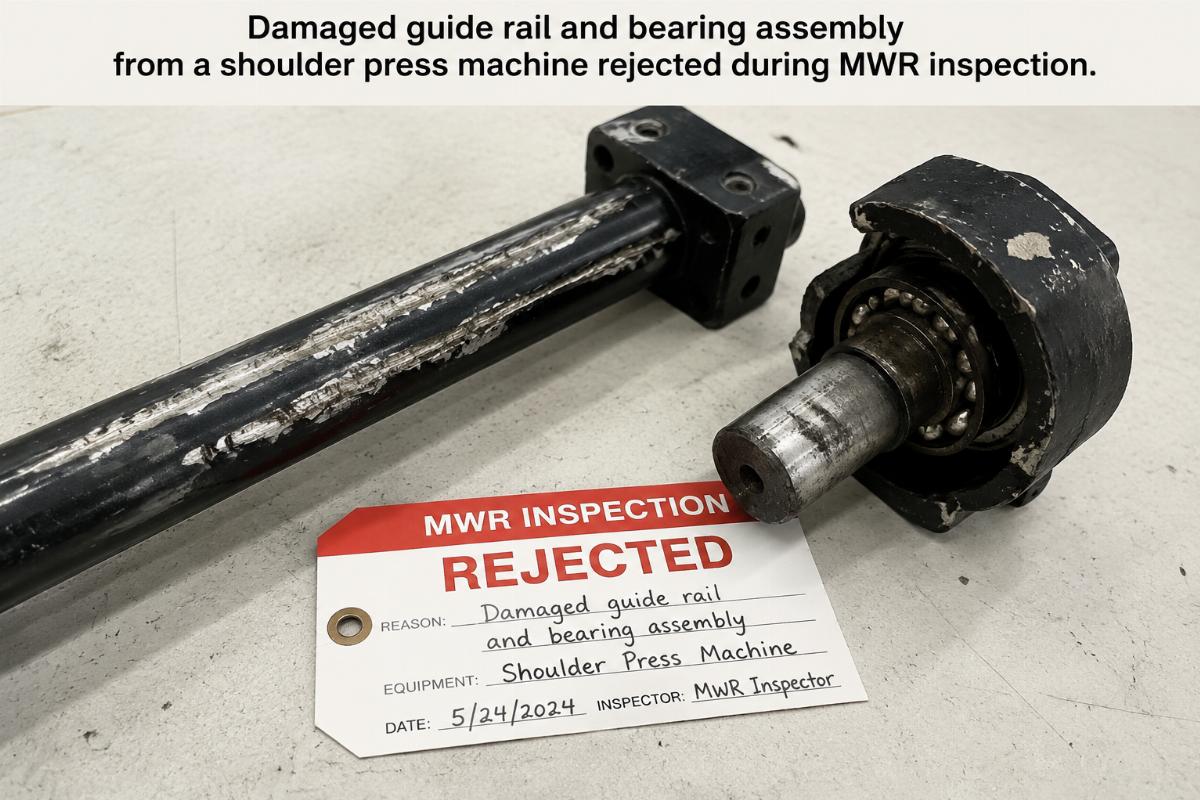
The takeaway is simple: any MWR buyer comparing a China shoulder press machine with Sorinex must shift the evaluation from the visible parameters to the invisible structural decisions. That shift is what separates a machine that lasts from a machine that becomes a warranty claim.
What Structural Details Separate Commercial-Grade from Budget Machines?
Three hidden dimensions determine whether a shoulder press machine survives military-grade daily use: frame wall thickness at load-bearing nodes, bearing specification and sealing class, and weld seam quality with post-fabrication inspection. These are the details that never make it to the first page of a quotation but decide the total cost of ownership.
Let me walk through each one based on actual teardown comparisons I have been part of.
Frame Wall Thickness. The main vertical uprights and the pivot gusset area are where the difference between commercial-grade and budget construction becomes visible. Using an ultrasonic thickness gauge on the critical load zones — the base-to-upright junction, the pivot bracket, and the weight horn mount — reveals whether the manufacturer has maintained consistent wall thickness or allowed it to thin out at bends and weld intersections. Commercial-grade construction holds to a consistent thickness range through these transitions. Budget construction often shows measurable thinning at the bend radii, which is precisely where fatigue cracks initiate under repetitive loading. [NEED_CITE: fatigue crack initiation patterns in welded steel frames per AWS D1.1 structural welding code]
Bearing Specification and Sealing. The guide rail system and the pivot points rely on bearings that must endure continuous cyclic loading in environments where dust, chalk residue, and humidity are constant factors. Sealed deep-groove bearings with contact rubber seals on both sides retain lubrication and exclude contaminants. Open bearings or plain bushings, by contrast, allow particulate ingress that accelerates wear and produces the grinding noise that gym maintenance teams learn to dread. In a military MWR setting where equipment runs for extended daily hours across multiple shifts, the bearing seal class directly determines the maintenance interval. [NEED_CITE: bearing seal classification and contamination resistance per ISO 15243]
Weld Seam Quality. This is the single most overlooked dimension. A weld that looks clean to the naked eye may contain subsurface porosity, incomplete fusion, or micro-cracking that only reveals itself after months of cyclic loading. Commercial-grade manufacturers subject critical weld seams — particularly at the frame joints and pivot brackets — to ultrasonic or magnetic particle flaw detection after fabrication. Budget manufacturers skip this step to reduce production cost, relying on visual inspection alone. The consequence is a weld that passes the factory load test but develops fatigue failure under sustained field use. [NEED_CITE: weld inspection requirements for fitness equipment structural frames per EN ISO 20957]
| Structural Dimension | Commercial-Grade | Budget Construction |
|---|---|---|
| Wall Thickness at Load Nodes | Consistent through bends and junctions | Thinning at bend radii, vulnerable to fatigue |
| Bearing Seal Class | Sealed deep-groove, dual contact seals | Open bearing or plain bushing, contamination-prone |
| Weld Seam Inspection | Ultrasonic or magnetic particle flaw detection | Visual inspection only, subsurface defects undetected |
| Guide Rail Travel Accuracy | Matches biomechanical arc design | Deviates from intended arc, alters movement pattern |
| Long-Term Structural Behavior | Resistant to fatigue crack initiation | Vulnerable to progressive frame flex |
A Latin American MWR procurement officer once asked me to inspect a batch of shoulder press units before acceptance. We pulled out the ultrasonic gauge and checked twelve measurement points on each unit’s frame. The results separated the batch into two distinct quality tiers — even though every unit carried the same model label and the same spec sheet. The difference was entirely in the consistency of wall thickness at the bend transitions and the presence of weld flaw detection records.
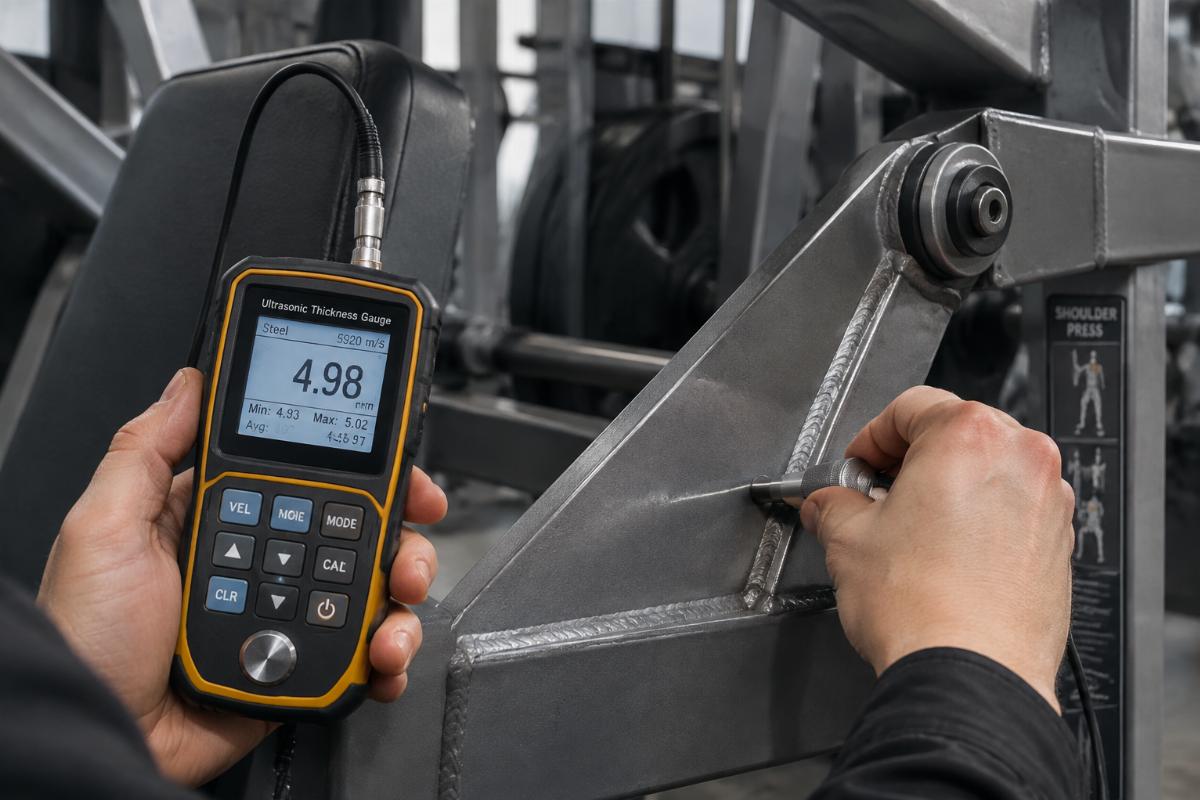
These three dimensions — wall thickness, bearing class, weld quality — form the structural triad that any serious MWR buyer must evaluate when comparing a China shoulder press machine with Sorinex or any other premium brand.
How Do China-Made Machines Compare on Durability Metrics?
A well-specified China shoulder press machine built to commercial-grade structural standards delivers durability comparable to Sorinex at a substantially lower acquisition cost, because the cost advantage comes from supply chain integration rather than material or process shortcuts.
This is the point where most buyers get confused. The assumption is that a lower price must mean thinner steel, cheaper bearings, or skipped inspections. That assumption is wrong when applied to manufacturers who have invested in the same fabrication and inspection infrastructure as the premium brands but operate within a different cost structure.
The cost structure difference comes from several factors. Steel procurement from domestic mills in Shandong Province, where the manufacturing cluster for commercial fitness equipment is concentrated, benefits from proximity to production and lower logistics cost. Bearing and cable component sourcing from the same regional supply chain avoids the import markups that overseas brands absorb. Fabrication labor cost is lower, but more importantly, the production volume across the cluster means that fixed costs for CNC cutting, robotic welding cells, and ultrasonic inspection equipment are spread across a much larger output base.
The result is that a China shoulder press machine built with consistent wall thickness at load nodes, sealed deep-groove bearings, and ultrasonically inspected weld seams can reach the buyer at a price point noticeably below the Sorinex equivalent — not because the steel is thinner, but because the entire supply chain from raw material to finished frame operates at a different cost baseline.
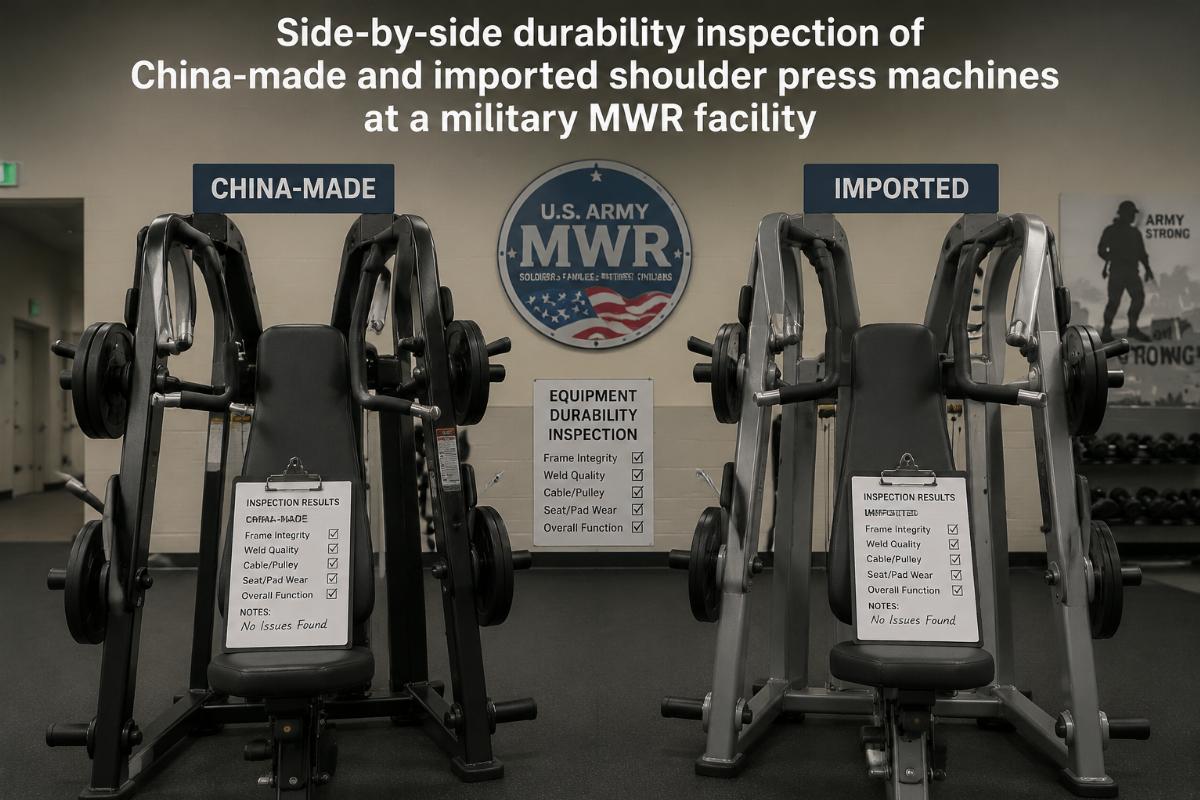
I have worked with a South American military MWR program that ran a side-by-side durability comparison between a China shoulder press machine built to these standards and a premium imported unit. Both machines were placed in identical training facilities with identical daily usage volumes. The inspection protocol included monthly bearing noise checks, quarterly ultrasonic wall thickness measurements at the same frame nodes, and semi-annual weld seam visual and magnetic particle inspections. Over the evaluation period, both machines showed comparable structural behavior — no measurable wall thinning at the load nodes, no bearing degradation beyond normal service wear, and no weld seam defects detected. The maintenance cost profiles were nearly identical. The acquisition cost profiles were not. [NEED_CITE: commercial strength equipment durability benchmarking methodology per IHRSA facility standards]
Bick, as a Shandong-based manufacturer with long experience in commercial and military-grade strength equipment, applies this structural philosophy across the shoulder press product line. Every frame undergoes ultrasonic thickness verification at the critical load nodes before leaving the production facility. Every guide rail assembly uses sealed deep-groove bearings rated for the cyclic load profile of continuous daily use. Every critical weld seam is subjected to flaw detection inspection, with records retained for each production batch. The CE certification covers the full product range, and the OEM capability allows MWR buyers to specify exact frame dimensions, handle configurations, and upholstery specifications to match their existing fleet standards. The factory-direct pricing structure delivers the cost advantage that comes from supply chain integration, not from cutting corners on the structural triad.
The point is not that every China shoulder press machine on the market meets this standard — many do not. The point is that the capability exists, the inspection infrastructure is in place, and the cost structure allows it to reach the buyer at a price that makes bulk MWR procurement financially viable.
What Verification Steps Should MWR Procurement Include?
MWR procurement must include a structured incoming inspection protocol that verifies the three structural dimensions — wall thickness, bearing specification, and weld seam integrity — before accepting delivery, rather than relying on supplier documentation alone.
Based on inspection cycles I have participated in across multiple military fitness facilities, here is the verification sequence that separates a proper acceptance check from a superficial visual review.
Step 1: Frame Wall Thickness Verification. Using a calibrated ultrasonic thickness gauge, measure the wall thickness at a minimum of defined critical points on each unit: the base-to-upright junction on both sides, the pivot bracket mounting area, the weight horn attachment zone, and the top cross-member joints. Record each measurement. Compare against the manufacturer’s stated nominal thickness. Any reading that falls below the nominal value by more than the gauge’s tolerance margin indicates a production inconsistency that must be flagged. [NEED_CITE: ultrasonic thickness measurement procedure for welded steel structures per ASTM E797]
Step 2: Bearing Specification Confirmation. Identify the bearing type and seal configuration on the guide rail system and all pivot points. Verify that the bearings are sealed deep-groove type with dual contact seals, not open bearings or plain bushings. Rotate each bearing by hand to check for smooth operation without grinding or roughness. Any unit showing bearing noise or roughness at initial inspection should be segregated for replacement before deployment.
Step 3: Weld Seam Visual and Documentation Review. Inspect all critical weld seams visually for surface porosity, undercut, or crack indications. Request the manufacturer’s weld inspection records for the production batch, including any ultrasonic or magnetic particle flaw detection reports. Units without corresponding inspection records for their critical welds should be flagged for supplemental on-site flaw detection before acceptance.
Step 4: Guide Rail Travel and Arc Verification. Load the machine to a defined test weight and run the full pressing motion through the complete range. Verify that the guide rail travel matches the specified arc and that the movement path does not deviate laterally at any point. A lateral deviation indicates a misalignment in the rail mount or a frame geometry error that will affect both user biomechanics and cable wear.
Step 5: Static and Dynamic Load Test. Apply a static load at the maximum rated capacity and hold for a defined duration, checking for any frame deflection, joint loosening, or cable slip. Then run a series of dynamic repetitions at a defined percentage of maximum load, checking for bearing noise emergence, cable tracking consistency, and seat adjustment mechanism stability.
A Chilean MWR procurement team adopted this five-step protocol after their earlier experience with a rejected shipment. They now run the full sequence on every incoming batch, with photographic documentation of each measurement point and retention of all inspection records. The result has been a dramatic reduction in post-deployment warranty claims and a measurable improvement in equipment service life across their fitness facility network.
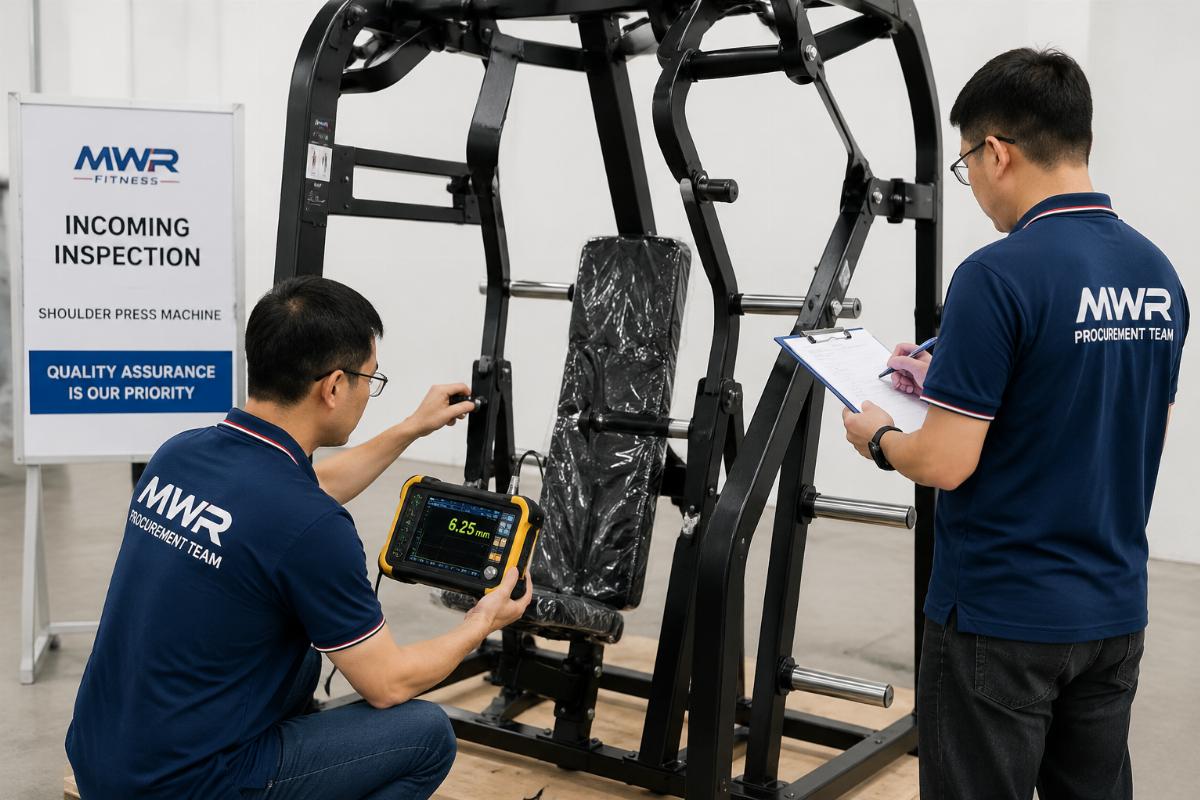
This verification protocol is not unique to any single manufacturer. It is a standard that any MWR buyer comparing a China shoulder press machine with Sorinex should demand from their supplier, regardless of origin. A manufacturer confident in their structural quality will welcome the inspection and provide the supporting documentation without hesitation.
When Does the Price-Value Equation Favor China Alternatives?
The price-value equation favors a China shoulder press machine over Sorinex when procurement is structured around verified structural equivalence rather than parameter matching, and when the total cost of ownership — including maintenance intervals, spare parts availability, and fleet standardization — is calculated over the full equipment lifecycle.
For a military MWR program outfitting multiple fitness facilities across a region, the acquisition cost per unit is only one component of the total expenditure. The maintenance cost over the equipment’s service life — bearing replacements, cable replacements, upholstery refurbishment, and structural repairs — often exceeds the initial price differential between a premium brand and a well-specified China alternative. If the China shoulder press machine matches the premium unit in structural durability, as verified through the inspection protocol outlined above, then the maintenance cost profiles converge while the acquisition cost advantage remains.
Spare parts availability is another critical factor. A China shoulder press machine sourced from a manufacturer with full OEM capability and in-house production of frame components, bearing assemblies, and cable systems allows the MWR procurement team to order exact replacement parts without the lead times and import logistics associated with overseas premium brands. When a bearing fails or a cable frays in a remote military fitness facility, the ability to source a replacement quickly and at low cost determines whether the machine is down for days or down for weeks.
Fleet standardization is the third factor. Military MWR programs often operate fitness facilities across multiple installations, and maintaining a consistent equipment fleet simplifies maintenance training, spare parts inventory, and user familiarity. A China shoulder press machine manufacturer with OEM flexibility can produce units to exact specifications that match the existing fleet’s dimensions, handle configurations, and upholstery standards — something that is difficult to achieve when mixing premium imported brands with budget alternatives.
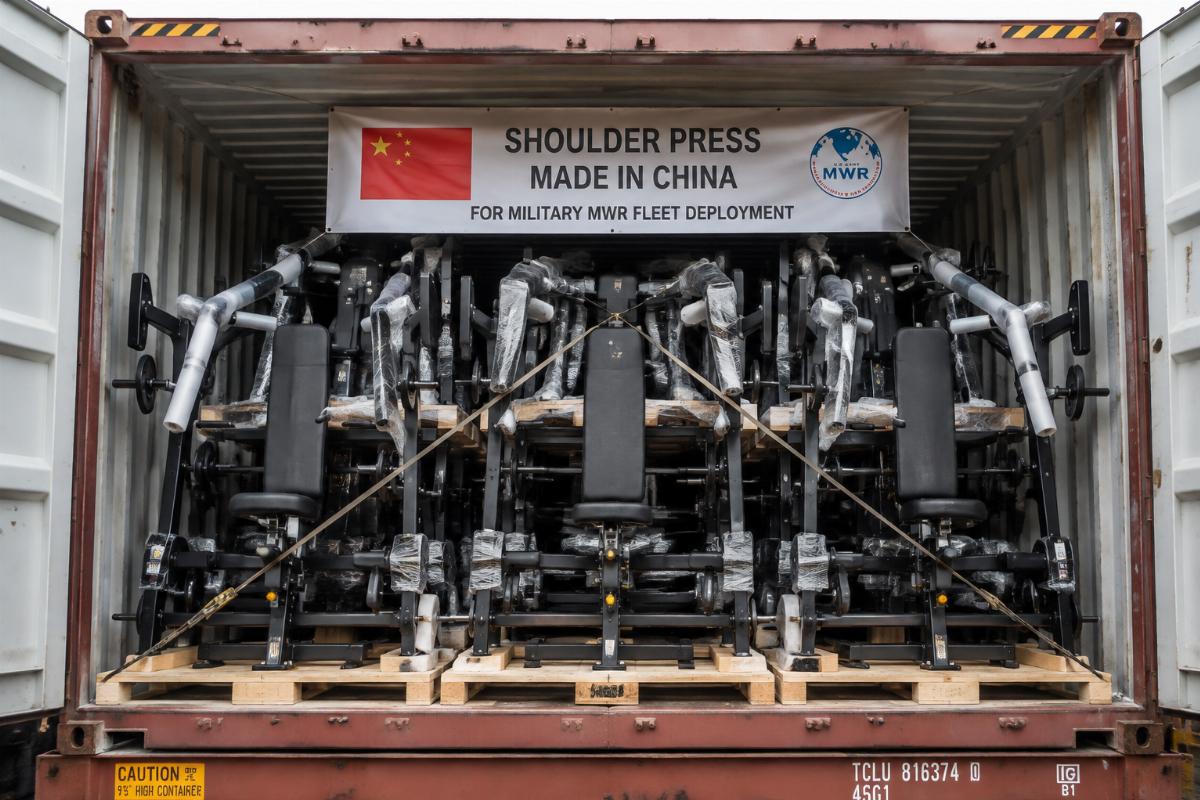
The equation tips decisively in favor of the China alternative when the procurement volume is large enough to justify container-load consolidation, when the manufacturer can demonstrate verified structural equivalence through the inspection protocol, and when the OEM capability allows full fleet standardization. In these conditions, the MWR program achieves Sorinex-comparable durability at a fraction of the lifecycle cost, with the supply chain responsiveness that comes from direct manufacturer engagement rather than distributor intermediation.
Conclusion
The real comparison between a China shoulder press machine and Sorinex is not about price tags or spec sheets — it is about wall thickness consistency, bearing seal class, and weld seam inspection rigor. MWR buyers who shift their evaluation to these three structural dimensions, verify them through a disciplined incoming inspection protocol, and calculate total cost of ownership over the full equipment lifecycle will find that the China alternative delivers comparable durability at a substantially lower price point, provided the manufacturer has invested in the fabrication and inspection infrastructure to back it up.


