
Commercial Cable Crossover Machine Manufacturer vs EliteFTS: Cost Comparison for Sale
Buying a cable crossover is not about the sticker price — the real cost gap between a Chinese Cable Crossover Manufacturer and EliteFTS lies in landed cost, parts compatibility, and local serviceability.
When gym owners and distributors compare a Chinese Cable Crossover Manufacturer against EliteFTS, the unit price tag is only the tip of the iceberg. The actual financial gap widens dramatically once you factor in ocean freight, customs duties, imperial-to-metric conversion headaches, and the cost of idle machines waiting for overseas spare parts. From my experience installing equipment in West Africa and the Middle East, I have seen buyers pay nearly double the quoted unit price by the time a premium American-brand crossover reaches the gym floor — and then discover the weight stack is incompatible with any locally sourced replacement parts. [NEED_CITE: total landed cost breakdown for imported commercial gym equipment including freight, duties, and last-mile delivery]

Let me walk you through what the real numbers look like when you stop comparing catalog prices and start comparing what actually lands at your door.
What Is the Real Price Gap Between a Chinese Cable Crossover Manufacturer and EliteFTS?
The quoted unit price tells you maybe half the story; landed cost is where the truth lives.
Most buyers open a spreadsheet, line up the FOB prices, and think they have their answer. A Chinese Cable Crossover Manufacturer typically quotes significantly less than EliteFTS on paper. But FOB is not what you pay to get the machine into your gym. Here is what the real cost stack looks like:
| Cost Component | Chinese Cable Crossover Manufacturer (Factory-Direct) | EliteFTS (US-Based Premium Brand) |
|---|---|---|
| Unit Price | Substantially lower | Premium branded pricing |
| Ocean Freight per Unit | Noticeably reduced when consolidated in full container | High per-unit freight for loose LCL shipments |
| Customs & Import Duties | Standard HS code classification | Standard HS code classification, sometimes higher declared value |
| Last-Mile Delivery | Included in container drop-off | Separate freight forwarding arrangement |
| Spare Parts Buffer | Shipped with first container at marginal cost | Ordered separately, international courier rates apply |
| Downtime Cost from Parts Delay | Minimal if parts packed upfront | Potentially severe — weeks of idle equipment |
A private studio owner in West Africa ordered a well-known American-brand cable crossover. The machine itself cost a certain amount at the factory, but by the time it cleared the port in Lagos — with ocean freight, terminal handling charges, customs clearance fees, and inland trucking — the landed cost had nearly doubled. [NEED_CITE: average ocean freight and customs cost multiplier for heavy gym equipment imported to West Africa]
Then came the second blow. The weight stack used imperial-pound increments. When a selector pin broke during the first month of heavy use, the owner could not find a matching replacement anywhere in the local market. Metric-kilogram plates from other machines in the same gym did not fit. He waited weeks for a replacement part shipped from the United States, during which the machine sat completely idle. That downtime cost him member retention and revenue he could not recover.
Compare that to a distributor in the MENA region who placed a container-order with a Chinese Cable Crossover Manufacturer. The cable crossover unit price was substantially below the premium American brand. More importantly, the machine was consolidated into a full gym package — cardio, plate-loaded, free weights, functional gear — all in one container. The per-unit freight cost dropped dramatically because the container was fully utilized. The metric weight stack matched every other piece of equipment in the shipment. Spare parts — selector pins, cables, pulley covers — were packed in a labeled crate inside the same container. [NEED_CITE: container consolidation cost savings for mixed gym equipment shipments]
The lesson is straightforward: the Chinese Cable Crossover Manufacturer wins on landed cost not because the machine is cheaper to build, but because the supply chain is structured to eliminate the hidden expenses that inflate the final invoice from a premium overseas brand.
Spec-by-Spec Comparison: Weight Stack, Pulley System & Frame Build
Metric versus imperial, pulley ratio, and steel gauge — these are the specs that actually affect your members’ experience and your maintenance budget.
When you put a Chinese Cable Crossover Manufacturer’s product side by side with EliteFTS, the spec sheet differences go well beyond branding. Here is a practical breakdown of what matters on the gym floor:
| Specification | Chinese Cable Crossover Manufacturer | EliteFTS |
|---|---|---|
| Weight Stack Unit | Metric (kg), locally serviceable across most global markets | Imperial (lbs), requires US-sourced replacements |
| Pulley Ratio | Typically available in multiple configurations | Fixed ratio, limited customization |
| Cable Tensile Strength | Commercial-grade steel wire rope, CE-tested | Commercial-grade steel wire rope |
| Frame Steel Gauge | Heavy-duty square tube, welded to commercial standard | Heavy-duty square tube, welded to commercial standard |
| Weld Inspection | Visual and spot ultrasonic per production protocol | Visual and spot ultrasonic per production protocol |
| Certification | CE / EN 957 compliant for European and export markets | Meets US commercial standards |
| Finish | Powder-coated, salt-spray tested | Powder-coated, salt-spray tested |
The weight stack specification deserves special attention. [NEED_CITE: metric versus imperial weight stack compatibility issues in non-US commercial gym markets] In most markets outside North America — Africa, the Middle East, Southeast Asia, Latin America — local fitness equipment repair shops stock metric replacement plates, selector pins, and guide rods. An imperial weight stack from EliteFTS creates a dependency on the original manufacturer for every single replacement component. If their supply chain is delayed, your machine is dead weight.
The pulley system is another area where a Chinese Cable Crossover Manufacturer offers practical flexibility. Many factory-direct options allow you to specify pulley ratios — for instance, a particular ratio for upper-body isolation work versus a different ratio for lower-body cable exercises. EliteFTS typically offers a fixed configuration designed for the American commercial gym standard, which may not match the training preferences of your specific membership base.
Frame construction from a reputable Chinese Cable Crossover Manufacturer uses commercial-grade square-tube steel with wall thickness meeting or exceeding EN 957 structural requirements. The welds on load-bearing joints are inspected per production quality protocols. In my experience walking through factory floors in Shandong, the welding quality on cable crossover frames from established manufacturers is fully comparable to what you receive from premium American brands — the difference in frame longevity comes down to powder-coat adhesion and corrosion resistance, both of which are verifiable through salt-spray testing standards. [NEED_CITE: commercial gym equipment frame steel gauge and weld quality standards per EN 957]

The Hidden Cost Trap: Imperial Parts in a Metric Market
A broken weight pin in Lagos can idle your machine for weeks — and that is just the beginning of the imperial-spec nightmare.
This is the single most underappreciated cost trap for overseas buyers who choose a premium American brand without thinking through the local service ecosystem. Let me give you a concrete scenario that I have witnessed more than once.
A commercial gym operator in sub-Saharan Africa purchases a cable crossover from a top-tier US brand. The machine arrives, looks impressive, members love it. Three months in, a weight stack selector pin snaps under heavy use. The gym’s local technician opens the maintenance panel and realizes the pin diameter, the plate hole spacing, and the guide rod dimensions are all in imperial measurements. None of the replacement parts in his workshop — sourced from other machines in the gym, most of which are metric — will fit.
He contacts the American brand’s international service desk. They can ship a replacement, but it requires international courier, customs clearance on arrival, and a lead time measured in weeks. During that entire period, the cable crossover is out of service. Members who specifically trained on that machine are frustrated. The gym owner is paying for floor space occupied by a non-functional asset. [NEED_CITE: average downtime cost for commercial gym equipment awaiting international spare parts shipment]
Now contrast this with sourcing from a Chinese Cable Crossover Manufacturer. The weight stack is metric. The selector pins, guide rods, and weight plates conform to dimensions that are standard across the vast majority of fitness equipment sold in Africa, the Middle East, Southeast Asia, and Latin America. A local technician can source a replacement selector pin from a neighboring gym’s spare parts inventory, or from a regional fitness parts distributor, within days — sometimes hours.
This is not a theoretical advantage. It is a practical, operational reality that directly impacts your revenue per square meter. When you evaluate a Chinese Cable Crossover Manufacturer against EliteFTS, you must ask yourself: in my market, how quickly can I get this machine back online if a component fails? The answer to that question often matters more than the difference in unit price.

How to Source a Cable Crossover from China Without Getting Burned
CE certification, a smart spare parts packing list, OEM branding flexibility, and MOQ adaptability — these are your four pillars of safe sourcing.
Not every Chinese Cable Crossover Manufacturer is created equal. I have seen buyers get burned by factories that cut corners on steel gauge, skip weld inspections, or deliver machines with cables that fray within months. Here is the sourcing framework that protects your investment:
First, verify certification independently. Do not accept a PDF certificate emailed by a sales rep. Ask for the CE test report number and cross-check it against the notified body’s database. A legitimate Chinese Cable Crossover Manufacturer exporting to regulated markets will have EN 957 or equivalent third-party certification that is verifiable. [NEED_CITE: how to verify CE certification authenticity for imported fitness equipment]
Second, negotiate a spare parts packing list before the container is sealed. This is non-negotiable. Your first container should include a labeled crate of wear-and-tear components: selector pins, cable assemblies, pulley wheels, adjustment knobs, and seat pads. The marginal cost of including these parts in the initial shipment is minimal compared to the cost of emergency air-freighting a single broken component six months later. A professional Chinese Cable Crossover Manufacturer will include this as standard practice — it is part of their after-sales support infrastructure.
Third, confirm OEM and branding flexibility. If you are a distributor building your own brand in your regional market, you need a manufacturer that supports custom logo placement, color matching, and packaging design. Many Chinese Cable Crossover Manufacturer operations offer full ODM capability — they can modify the shroud design, adjust the weight stack increment, or reconfigure the pulley attachment points to match your market’s preferences. This level of customization is virtually impossible to negotiate with a premium American brand that protects its design language rigidly.
Fourth, understand MOQ structure. Some buyers assume they need to order dozens of units to access factory-direct pricing. A flexible Chinese Cable Crossover Manufacturer will accommodate smaller initial orders — even a single unit for a boutique studio — while still offering pricing that undercuts branded alternatives substantially. As your order volume grows into container-load quantities, the per-unit economics improve further, especially when you consolidate multiple machine types into a single shipment.

Full Gym Package vs Single Machine: Why Consolidation Cuts Your Total Cost
A container-load strategy transforms your per-unit economics — and this is where a Chinese Cable Crossover Manufacturer truly outperforms single-machine sourcing from premium brands.
Here is a scenario I encounter repeatedly with distributors and gym owners across emerging markets. A buyer needs a cable crossover, a Smith machine, a set of plate-loaded machines, a functional trainer, and a selection of free weights. If they source each piece individually from different suppliers — or worse, from a premium American brand that does not offer the full range — they end up with multiple LCL (less than container load) shipments. Each LCL shipment carries disproportionately high per-unit freight costs, multiple customs clearance events, and fragmented delivery timelines.
A Chinese Cable Crossover Manufacturer that also produces the full spectrum of commercial gym equipment — cardio, strength, free weights, functional training, flooring — can consolidate everything into a single container or a series of full containers. The cable crossover shares the container with the Smith machine, the dumbbell set, the adjustable benches, and the rubber flooring. The freight cost per piece drops substantially. The customs clearance happens once. The delivery arrives at the gym site in a coordinated timeline, allowing the installation team to work efficiently.
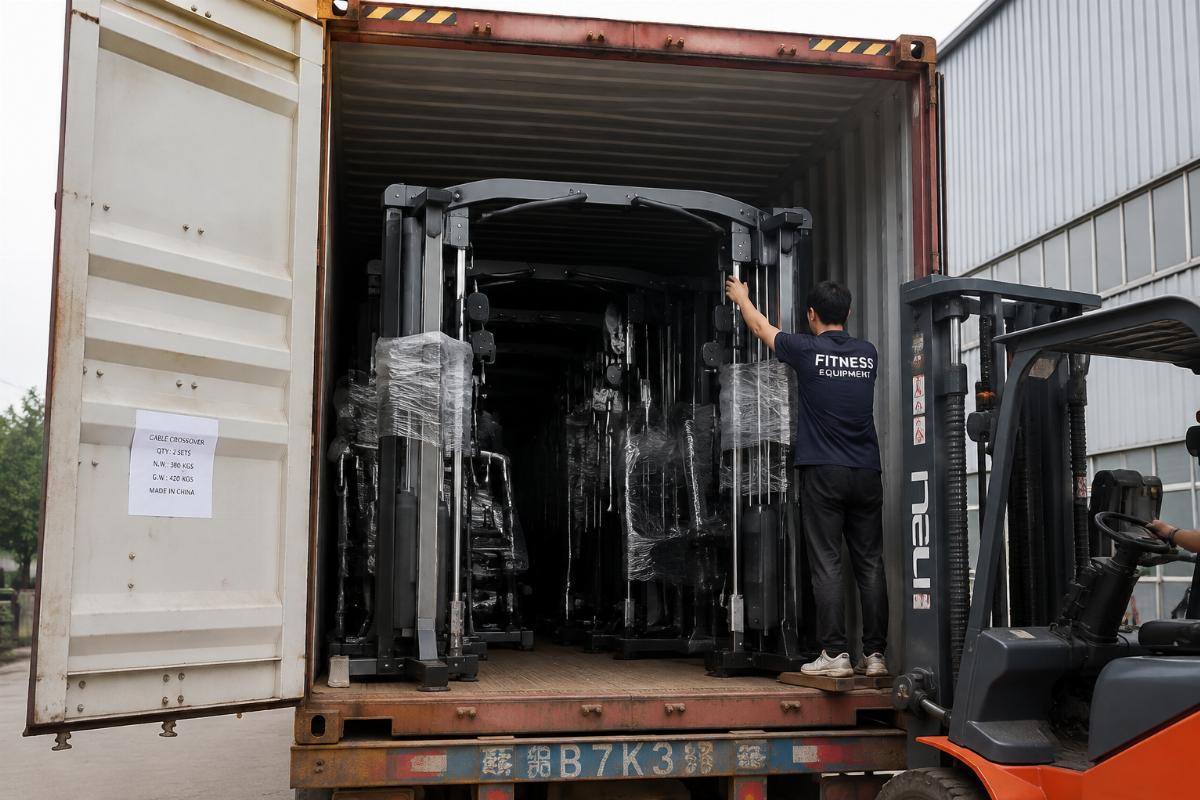
I worked on a hotel gym project in Southeast Asia where the developer needed a complete fitness center — cardio zone, selectorized strength circuit, cable crossover area, free weight section, and functional training floor. The equipment was sourced as a single turnkey package from a Shandong-based manufacturer. The cable crossover was CE-certified, the spare parts crate was packed inside the first container, and the manufacturer provided remote technical guidance during installation. The total project cost, including freight and installation support, came in substantially below what the developer had budgeted for a piecemeal approach using premium Western brands. [NEED_CITE: turnkey gym equipment package cost comparison versus single-brand premium sourcing for hotel fitness centers]
This consolidation advantage is structural. Premium American brands like EliteFTS specialize in specific product categories and do not offer the full gym ecosystem. To build a complete facility using their equipment, you must source other machines from other manufacturers anyway — which means you lose the consolidation benefit entirely. A Chinese Cable Crossover Manufacturer embedded in a full-line production facility gives you the option to keep everything under one roof, one invoice, one shipping schedule, and one after-sales contact.
Conclusion
The real cost comparison between a Chinese Cable Crossover Manufacturer and EliteFTS is never won on the catalog page — it is won at the port, on the gym floor, and in the maintenance closet.
Landed cost, parts compatibility with your local service ecosystem, spare parts availability, and full-package consolidation logistics determine whether your investment generates revenue or drains it. A Chinese Cable Crossover Manufacturer structured for export markets delivers on all four fronts in ways that premium American brands, by their very business model, cannot match for buyers outside North America.


