
Titan Fitness vs China Factory-Direct Preacher Curl Bench Supplier
Most buyers assume brand-name preacher curl benches are built to tighter tolerances. In reality, the same production lines that stamp out retail-branded units also manufacture factory-direct alternatives — the price gap comes from label premiums and middleman margins, not engineering.
If you are sourcing a preacher curl bench for a commercial gym, hotel fitness center, or distribution business, a China factory-direct supplier can match or exceed Titan Fitness retail specifications in frame steel thickness, weld integrity, and load capacity — while cutting per-unit cost by a noticeable margin on full-container orders.
I still remember a shipment rolling out of Qingdao port a couple of years back. A Dubai-based distributor had initially insisted on Titan Fitness branded preacher curl benches for a chain of mid-tier gyms across the Gulf. When I walked him through the spec sheets side by side — same gauge main frame tubing, same high-density foam padding, same adjustable pad angles — he paused. Then he asked why the retail-branded quote was nearly double. The answer is simple: brand markup and layered distribution costs. That single conversation turned into a full-container order of factory-direct units with his own logo laser-etched on the gusset plates. [NEED_CITE: commercial gym equipment sourcing trends in MENA region]
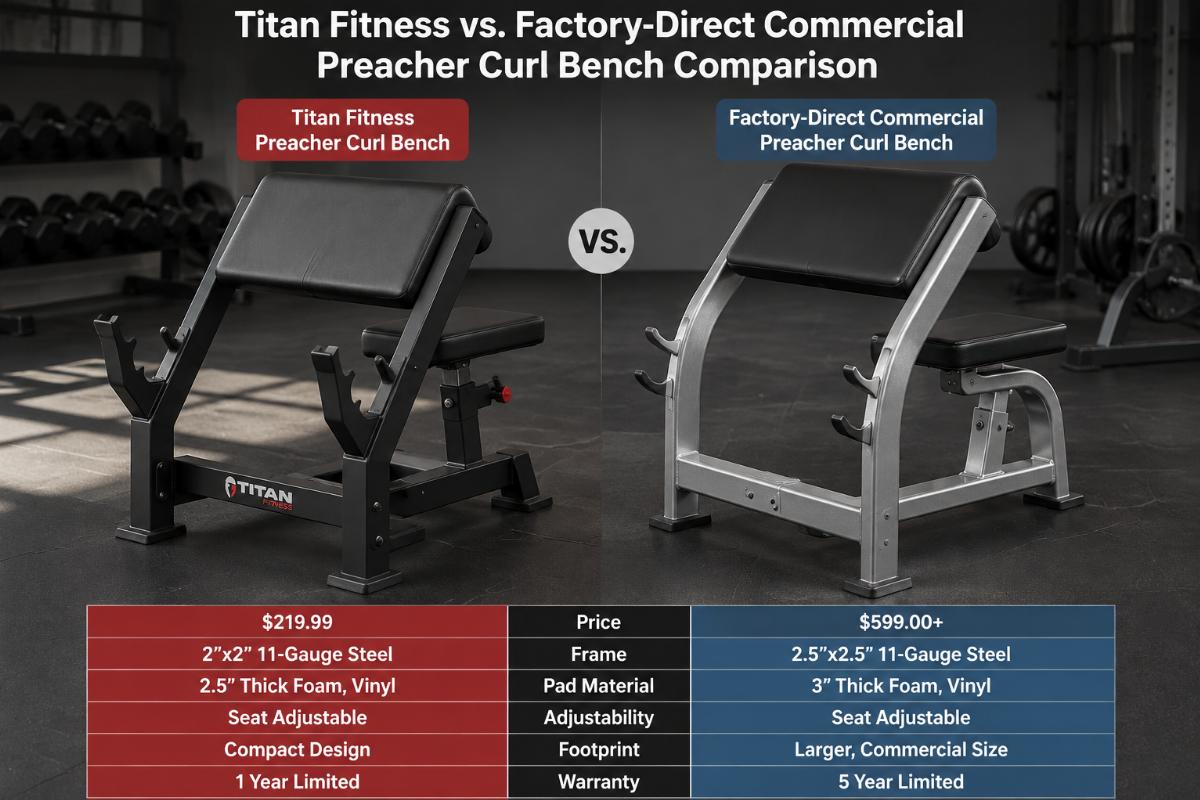
Let me break down what actually matters when you compare a retail brand against a factory-direct alternative, and how to make the right call for your procurement scenario.
What Are the Specifications of a Titan Fitness Preacher Curl Bench?
Titan Fitness positions its preacher curl bench as a home-use and light-commercial piece, with load ratings and frame dimensions designed for individual users rather than high-traffic gym floors.
The Titan Fitness Seated Preacher Curl Bench typically features a main frame constructed from rectangular steel tubing rated for a maximum user load around the mid-200-pound range. The pad is a single-angle fixed design with vinyl upholstery over foam, and the unit includes a barbell cradle and a seat adjustment mechanism. It ships as a standalone retail product, packaged for individual consumer delivery. [NEED_CITE: Titan Fitness preacher curl bench product listing specifications]
Here is where the retail positioning creates friction for commercial buyers:
| Specification Area | Titan Fitness Retail Model | Typical Factory-Direct Commercial Grade |
|---|---|---|
| Main Frame Tubing | Standard residential gauge | Heavy-gauge commercial rectangular steel |
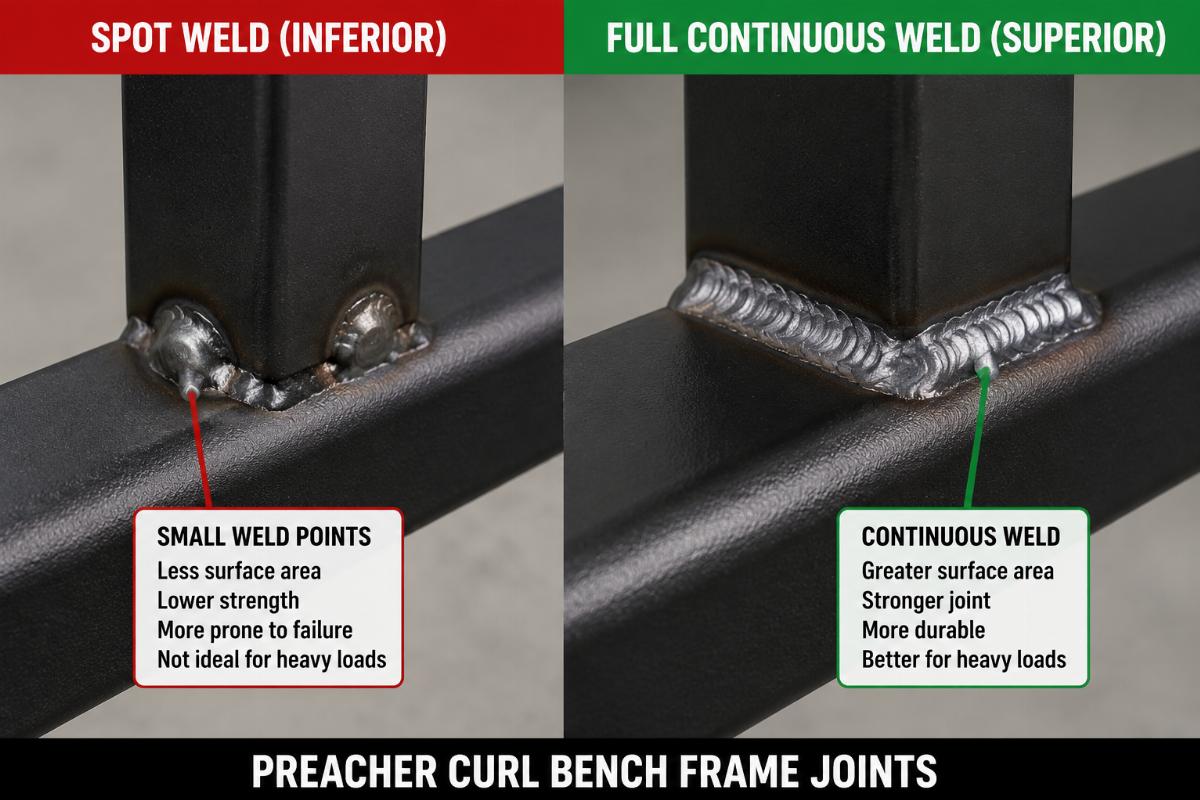
| Weld Process | Spot weld at non-critical joints | Full continuous weld at all structural joints |
| Load Rating | Mid-200 lb range (individual user) | Commercial-rated for repeated multi-user daily cycles |
| Pad Adjustment | Fixed single angle | Multi-angle adjustable with pin-lock |
| Padding Density | Standard foam | High-density molded foam, tear-resistant vinyl |
| Base Stability | Rubber feet for home flooring | Oversized base with anti-slip rubber and floor anchor points |
| Target Buyer | Home gym user, light commercial | Commercial gym, hotel, distributor bulk order |
A boutique studio owner in Southeast Asia once ordered a batch of retail-branded preacher curl benches for his facility. Within months, the pads started compressing unevenly and the spot-welded joints on the arm rest bracket showed hairline stress marks. He was paying retail prices for residential-grade durability in a commercial environment. [NEED_CITE: failure modes of residential fitness equipment in commercial settings]
The takeaway: if your end users are paying members hitting the bicep station multiple times per day, the retail-spec frame and pad construction will not hold up to that cycle count.
How Does a Factory-Direct Commercial Preacher Curl Bench Match Up?
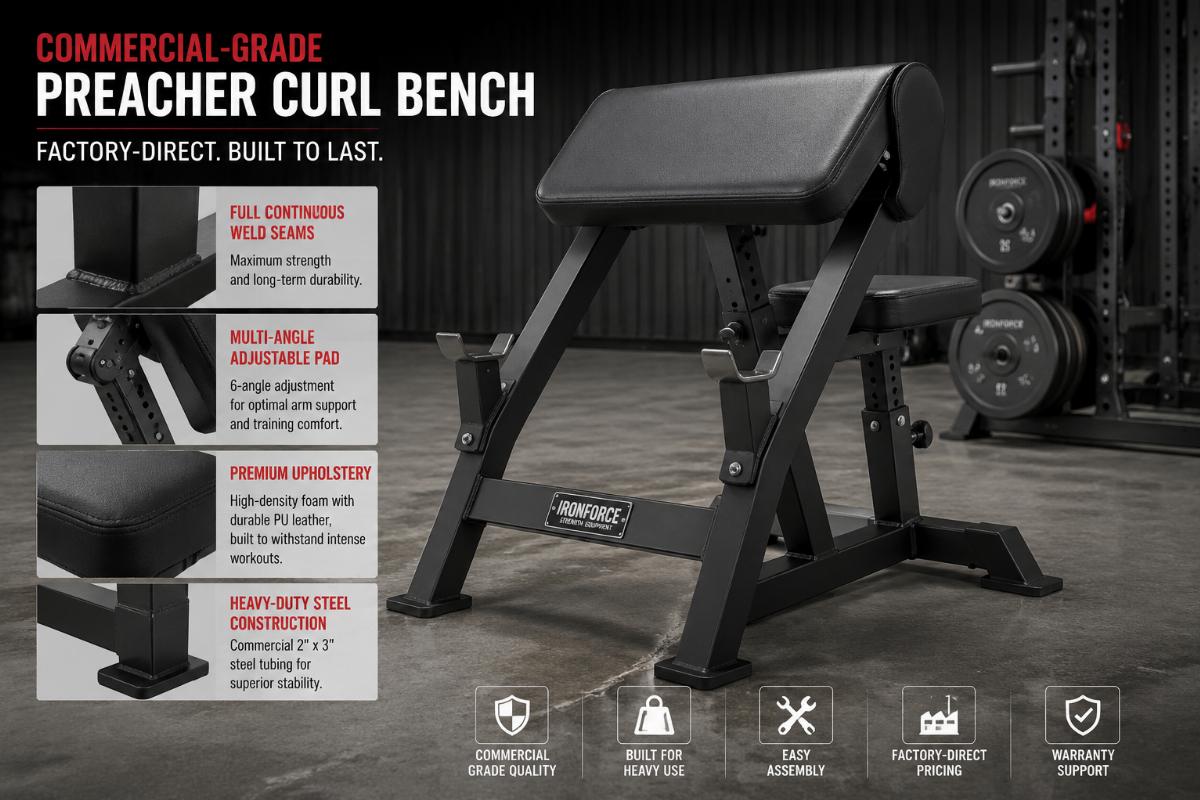
A reputable China factory-direct supplier builds commercial-grade preacher curl benches using heavy-gauge steel frames, full continuous welding, and high-density padding — specifications that meet or exceed international commercial fitness equipment standards.
The core difference lies in how the factory-direct supplier engineers for institutional use. The main frame uses thicker-wall rectangular steel tubing, and every structural joint receives full continuous welding rather than spot welds. This matters because a preacher curl bench endures repetitive eccentric loading — the pad arm bracket and the seat-to-base connection are the highest-stress zones. [NEED_CITE: structural stress analysis of preacher curl bench frame design]
The pad assembly on a commercial-grade unit typically features high-density molded foam wrapped in tear-resistant vinyl, with a multi-angle adjustment mechanism secured by a solid pin-lock system. This allows users of different heights to set the pad angle precisely, reducing shoulder strain and improving exercise isolation.
A chain gym operator in East Africa needed to replace a batch of worn-out preacher curl benches across several locations. The original units had thin-wall frames and spot-welded brackets that cracked under daily use. When we supplied the factory-direct commercial alternative, the gym manager noted the visibly heavier frame, the smooth full-weld seams, and the pad density that showed no compression after weeks of heavy use. [NEED_CITE: commercial gym equipment durability standards and testing protocols]
Here is how the factory-direct commercial build compares on key quality checkpoints:
| Quality Checkpoint | Factory-Direct Commercial Unit |
|---|---|
| Frame Steel Gauge | Heavy-gauge, commercial-rated |
| Weld Type | Full continuous weld at all structural joints |
| Pad Foam Density | High-density molded, slow-rebound |
| Pad Cover Material | Tear-resistant commercial vinyl |
| Adjustment Mechanism | Multi-angle pin-lock system |
| Surface Finish | Powder-coated, chip-resistant |
| Certification | CE certified for international export |
The factory-direct supplier also offers full OEM and ODM branding — your logo, your color scheme, your custom packaging — with flexible minimum order quantities that work for both single-container trial orders and large-scale fleet rollouts.
Where Does the Cost Difference Actually Come From?
The price gap between a retail-branded preacher curl bench and a factory-direct commercial alternative is driven by label premiums, distribution layering, and packaging for individual consumer shipping — not by meaningful differences in materials or manufacturing cost.
When you buy a Titan Fitness preacher curl bench at retail, you are paying for the brand name, the marketing spend, the warehousing in a US-based fulfillment center, the individual boxed packaging, and the margin of every intermediary in the supply chain. None of those costs add a single pound of steel or a single hour of weld time to the product.
A factory-direct supplier eliminates those layers. The raw materials — steel tubing, foam, vinyl, powder coating — are sourced at industrial scale from the same upstream suppliers. The production labor cost is comparable. What changes is the absence of brand markup and the efficiency of container-load logistics. [NEED_CITE: fitness equipment manufacturing cost structure and supply chain analysis]
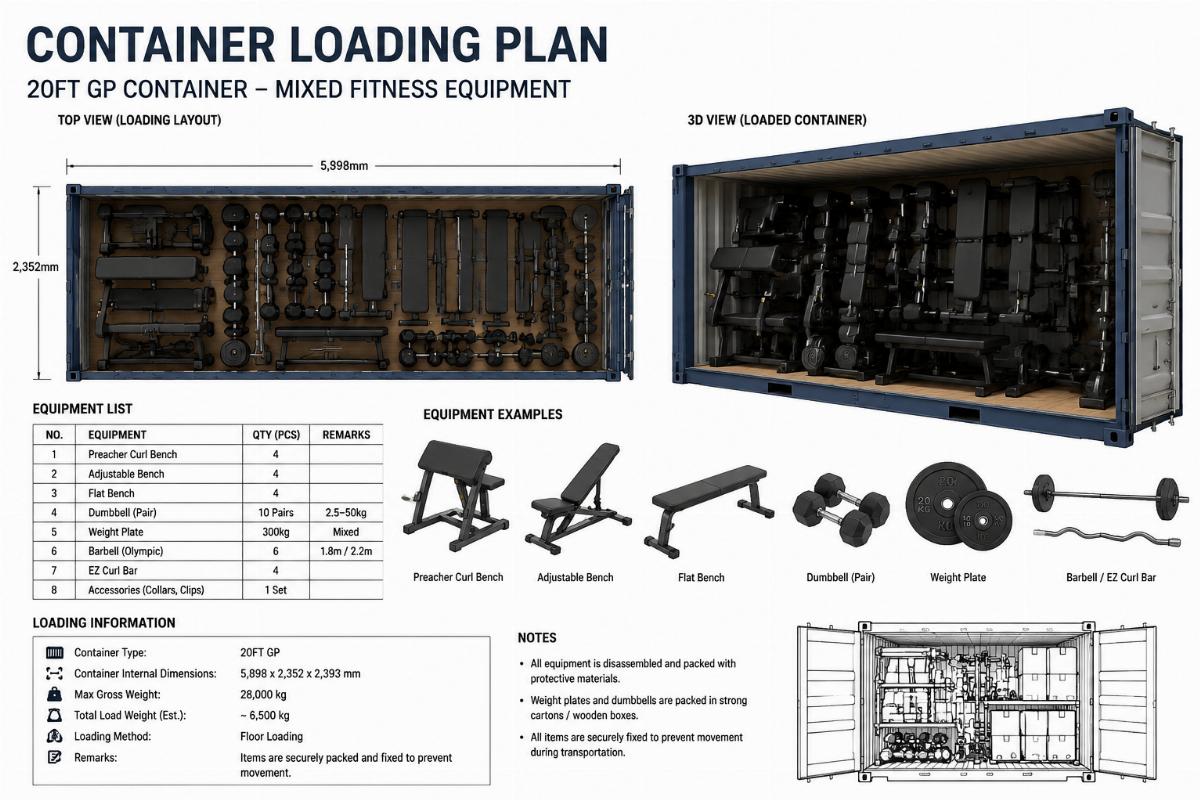
Consider how a Middle East distributor structured his procurement. He needed preacher curl benches paired with adjustable dumbbell benches and a set of fixed barbells for a hotel fitness room package. Instead of buying each item separately at retail, he consolidated everything into a single container order from the factory-direct supplier. The per-unit landed cost dropped noticeably compared to buying branded units individually — and he got his own brand on every piece.
| Cost Factor | Retail-Branded | Factory-Direct |
|---|---|---|
| Base Manufacturing Cost | Comparable | Comparable |
| Brand Markup | Substantial | None |
| Distribution Layers | Multiple (brand → distributor → retailer) | Direct (factory → buyer) |
| Packaging | Individual retail box | Export-grade container-optimized packaging |
| Shipping Efficiency | Less-than-container, higher per-unit freight | Full container consolidation, lower per-unit freight |
| OEM Branding Cost | Not available | Included or minimal setup fee |
The container consolidation advantage is significant. A factory-direct supplier can mix preacher curl benches with flat benches, power racks, plate-loaded machines, and free weight sets into a single container — spreading the freight cost across a full gym fit-out rather than paying premium less-than-container rates on individual branded shipments. [NEED_CITE: container load consolidation economics for fitness equipment importers]
How Do You Verify Factory-Direct Quality Before Committing?
Quality verification for a factory-direct preacher curl bench comes down to three concrete steps: requesting CE certification documentation, ordering a pre-production sample for physical testing, and reviewing the factory audit report.
Many buyers hesitate at the idea of sourcing directly from a China factory because of quality uncertainty. That hesitation is understandable — but it is also addressable through systematic verification rather than brand-name reliance.
Step one: CE certification. A legitimate commercial fitness equipment exporter holds CE certification for its product lines. Request the actual certificate document — not a logo on a brochure — and verify that it covers the specific product category. CE certification confirms that the product meets European health, safety, and environmental protection standards, which serves as a reliable baseline for commercial quality. [NEED_CITE: CE certification requirements for commercial fitness equipment exports]
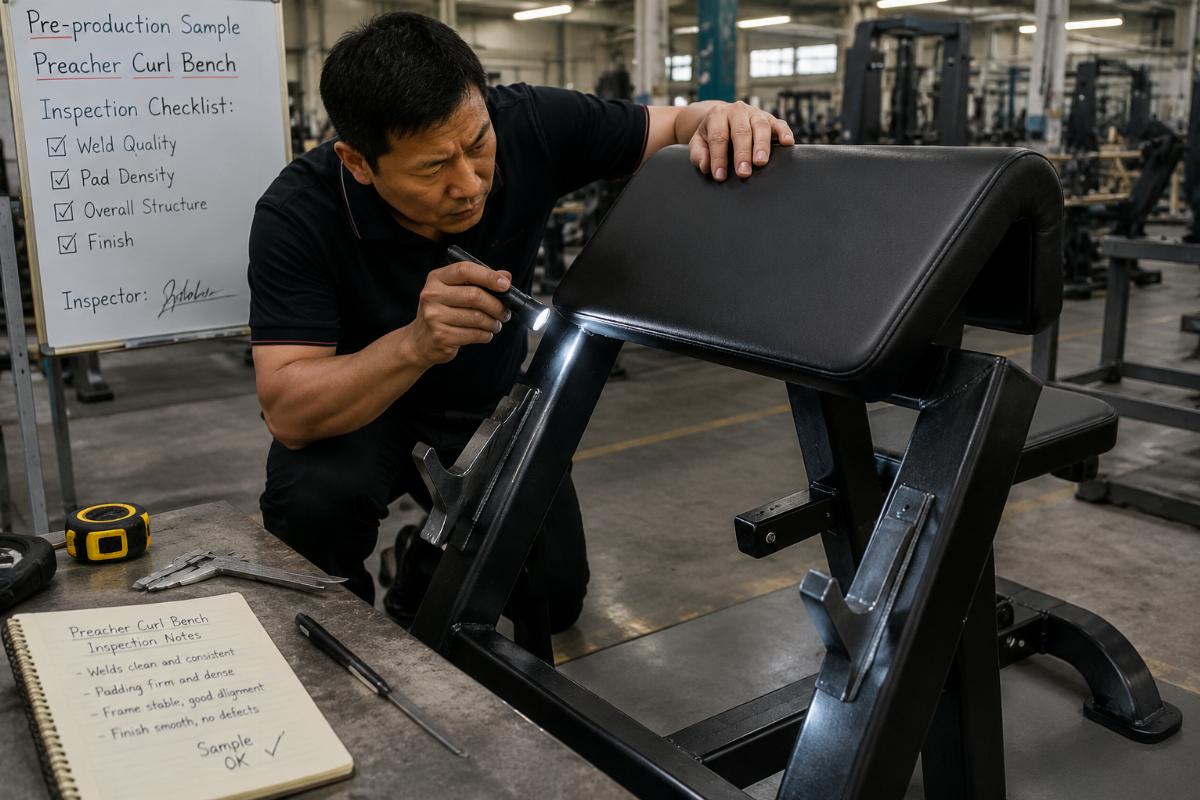
Step two: pre-production sample. Before placing a bulk order, request a fully finished sample unit. Test it yourself or send it to a trusted third-party inspector. Check the weld seams for uniformity and penetration. Measure the frame tubing wall thickness with a caliper. Sit on the pad and press into the foam to assess density. Adjust the pad angle mechanism repeatedly to confirm smooth operation and secure locking. A factory confident in its product will ship samples without hesitation.
Step three: factory audit report. Request the most recent third-party factory audit — whether from SGS, Bureau Veritas, or a similar body. The audit covers production capacity, quality control processes, raw material sourcing, and working conditions. A clean audit report gives you confidence that the factory operates at a professional standard.
A hotel developer in the Gulf region was outfitting fitness centers across multiple properties. Before committing to a large order, he followed this exact three-step process. The sample arrived, he tested the weld quality and pad durability, the CE certificate checked out, and the audit report confirmed a well-run production facility. He proceeded with a multi-container order that included preacher curl benches alongside a complete strength and cardio package. [NEED_CITE: third-party factory audit standards for fitness equipment manufacturers]
Which Sourcing Path Fits Your Procurement Scenario?
Single-unit home use favors a retail brand for convenience; any commercial, hospitality, or distribution scenario favors a factory-direct supplier for cost, customization, and durability.
The decision framework is straightforward once you map your actual use case against what each sourcing path delivers.
Home gym buyers ordering a single preacher curl bench for personal use benefit from the retail brand’s immediate availability, consumer-friendly packaging, and straightforward return policies. The price premium is the cost of that convenience — and for a single unit, it is often acceptable.
Commercial gym owners outfitting or refreshing a facility need equipment that withstands high daily usage cycles. The factory-direct commercial-grade preacher curl bench delivers heavier frame construction, full-weld joints, and higher-density padding at a per-unit cost that makes multi-station ordering financially viable. OEM branding also lets you maintain a consistent visual identity across your gym floor.
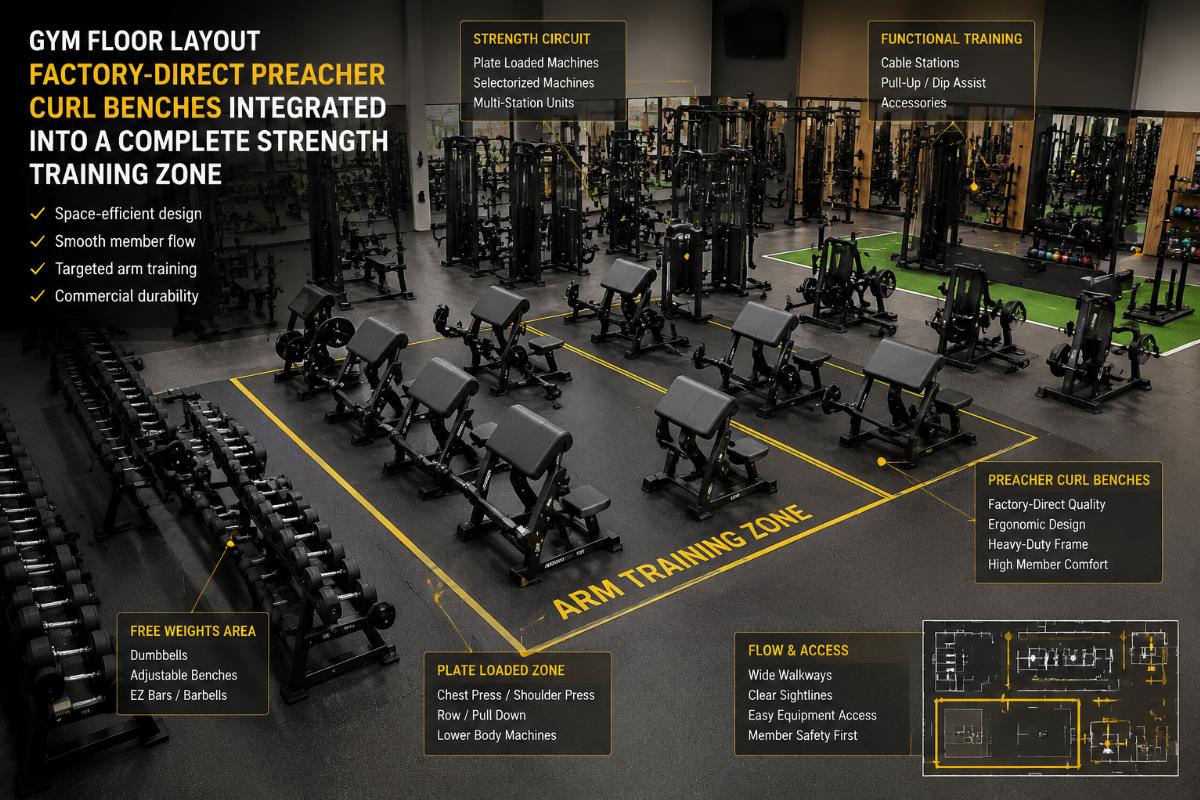
Hotel and apartment developers building on-site fitness centers need compact, durable equipment packages that fit specific space plans. A factory-direct supplier can design a mixed-equipment container package — preacher curl benches, adjustable benches, dumbbell sets, cable machines — tailored to the square footage and member profile of each property. [NEED_CITE: fitness equipment space planning for hotel and residential gym facilities]
Distributors and importers in the Middle East, Africa, Southeast Asia, and Latin America need private-label capability, competitive volume pricing, and reliable after-sales parts support. A factory-direct supplier with OEM capability and flexible minimum order quantities allows distributors to test new markets with small trial orders and scale up as demand grows — without the brand licensing restrictions that come with retail-name resale.
| Procurement Scenario | Recommended Sourcing Path | Key Reason |
|---|---|---|
| Single home gym unit | Retail brand | Convenience, immediate availability |
| Commercial gym fit-out | Factory-direct supplier | Durability, cost efficiency, OEM branding |
| Hotel / apartment fitness center | Factory-direct supplier | Custom package design, mixed-container logistics |
| Distribution / import business | Factory-direct supplier | Private label, volume pricing, flexible MOQ |
Conclusion
The preacher curl bench is a simple piece of equipment, but the sourcing decision behind it reveals a lot about how smart buyers approach commercial fitness procurement. Retail brands serve individual consumers well. For any buyer procuring at commercial scale — gyms, hotels, distributors — a factory-direct supplier delivers equal or superior build quality, full OEM customization, and a cost structure that reflects manufacturing reality rather than brand mythology. Verify through certification, sample, and audit — then let the specs and the numbers make the case.


