
Hammer Strength China OEM Plate Storage Tree for 5-Star Hotel Groups
A plate storage tree is never just a "metal rack." The moment you mount it on a Hammer Strength ISO-Lateral frame, every millimeter of pin-hole deviation becomes a field failure.
The core answer to sourcing a Hammer Strength plate storage tree OEM replacement for five-star hotel projects is this: true compatibility is not achieved through 1:1 drawing replication, but through 1:1 assembly verification. Hole-position tolerance control and welding fixture precision are the two non-negotiable parameters that determine whether the unit installs cleanly or requires on-site rework that wipes out your entire margin.
I still remember the shipment that went to a luxury hotel in the Gulf region a couple of years back. The client had specifically requested ISO-Lateral structured plate-loaded machines, and the budget only allowed for domestic OEM sourcing. We replicated the original drawings down to the last dimension. When the containers reached the site, the weight plate pin holes were off by a couple of millimeters across the entire batch. Not a single unit could accept the standard Olympic inserts without on-site cutting and re-drilling. The rework labor cost alone consumed the profit from the whole order. Since that day, I have obsessively tracked hole-position tolerance and welding jig accuracy on every plate storage unit that leaves the workshop floor. [NEED_CITE: root cause analysis of plate-loaded machine field failures in hospitality fitness installations]
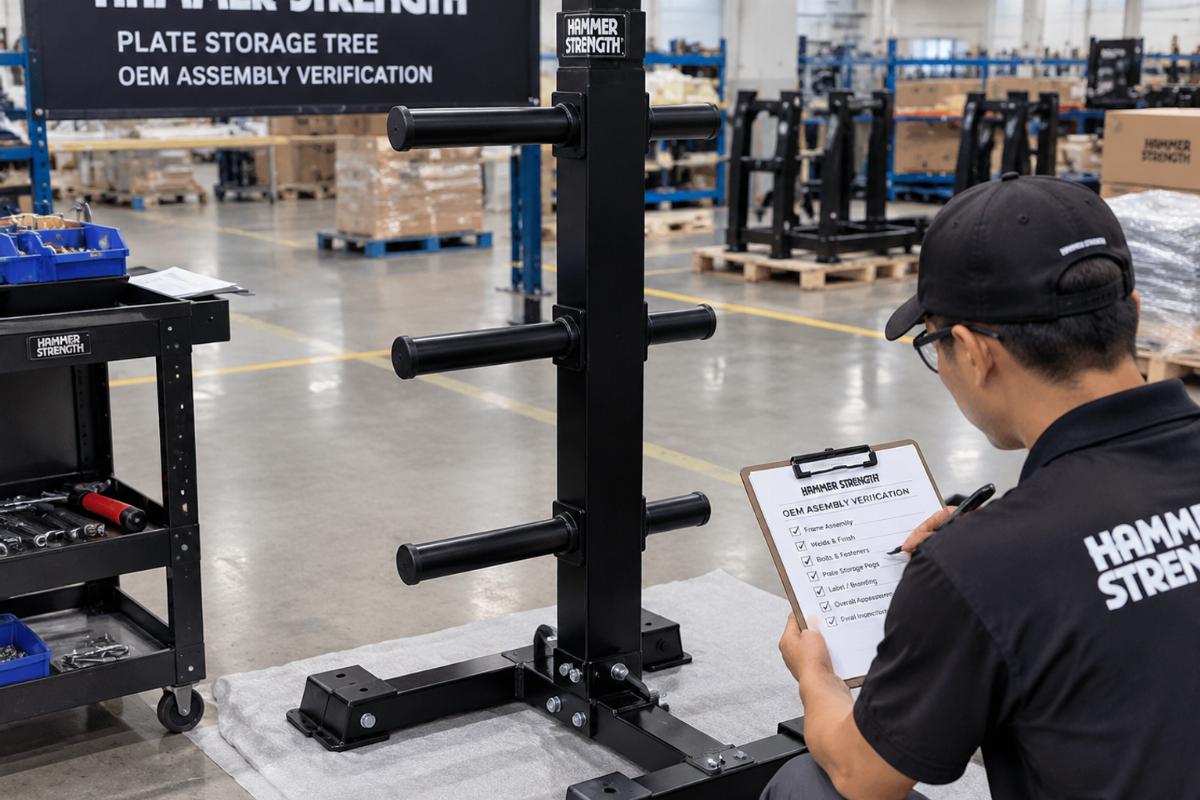
That painful lesson reshaped how I approach every commercial gym plate rack OEM project today. Let me walk you through what actually matters when you are sourcing these units for high-end hospitality environments.
What Is the Core Structure of a Hammer Strength Plate Storage Tree?
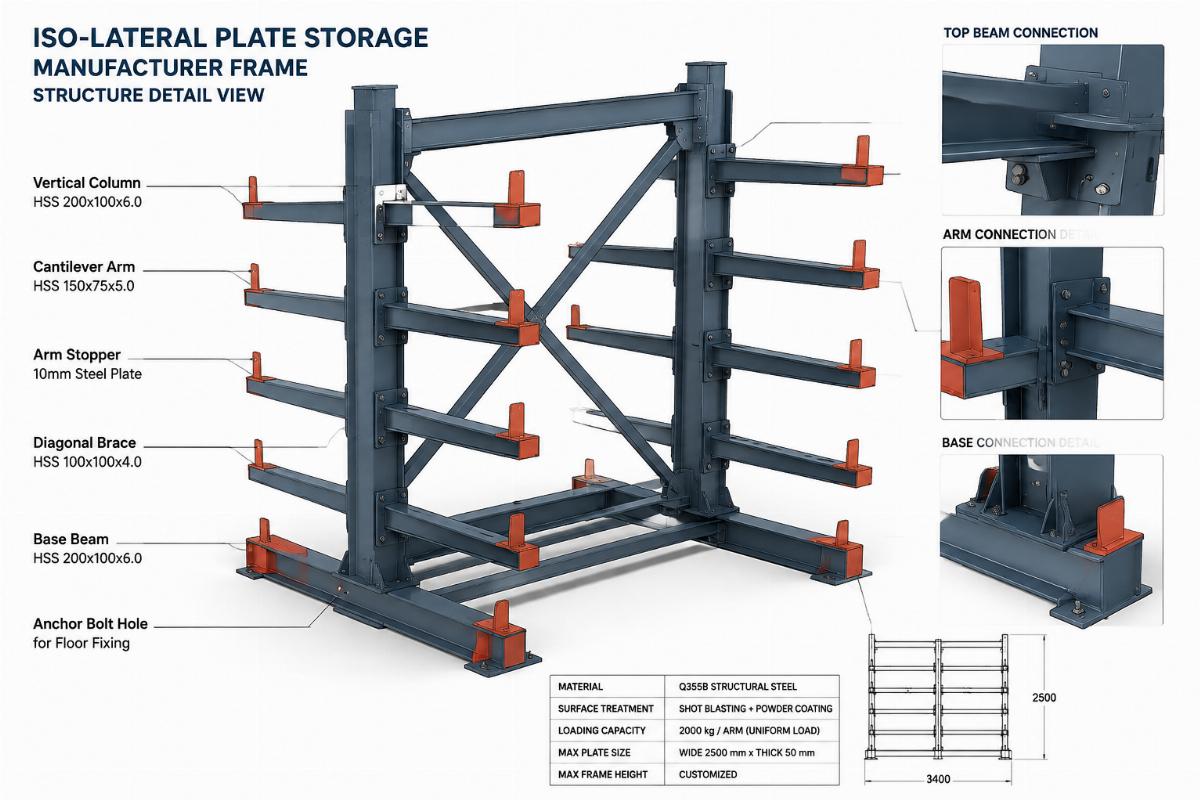
The defining feature is the integration of ISO-Lateral independent movement architecture with plate storage functionality in a single frame. This is not a simple vertical peg rack welded to a base. The original design embeds the storage pegs into the structural frame of the plate-loaded machine itself, meaning the storage unit must bear dynamic loads during plate loading and unloading while maintaining alignment with the machine’s pivot axis.
For any Hammer Strength plate storage tree OEM project, the manufacturer must replicate two functional systems simultaneously:
| Structural Element | Function | OEM Replication Requirement |
|---|---|---|
| Load-bearing frame | Supports machine structure and stored plates | Must match original steel gauge and gusset geometry |
| Storage peg array | Holds Olympic plates in organized tiers | Peg diameter, spacing, and angle must match plate hub bore |
| Pin-hole interface | Accepts weight plate insert pins | Tolerance must align with plate manufacturer specifications |
| Base plate and foot | Provides ground stability under eccentric load | Center of gravity and footprint must prevent tipping |
The critical insight most buyers miss is that the storage pegs are not passive components. When a technician loads multiple plates on one side, the eccentric force transfers directly through the peg mounting bracket into the main frame. If the welding fixture used during fabrication allows even slight angular drift, the pegs will not sit perpendicular to the ground, causing plates to slide toward one end and creating an uneven visual appearance that five-star hotel clients find unacceptable. [NEED_CITE: ISO 20957-1 stationary training equipment safety requirements for load-bearing structures]
I have seen hotel procurement teams approve drawings that looked perfect on paper, only to receive units where the pegs leaned visibly inward. The drawing was correct. The welding jig was not.
What Are the Three Critical Verification Points for OEM Replacement?
Hole-position tolerance, welding fixture precision, and weight plate compatibility form the non-negotiable verification triad. Missing any one of these will result in field failures, regardless of how closely the external dimensions match the original.
Let me break down each point with the practical detail that drawing reviews never capture.
Hole-Position Tolerance
The pin holes on the storage pegs must accept the insert pins of Olympic weight plates. Different plate manufacturers use slightly different pin diameters and collar geometries. If your OEM manufacturer holds loose tolerances, plates will either not slide onto the pegs or will wobble excessively, creating noise and an impression of poor quality that contradicts the five-star environment. The tolerance band here is tight, and it must be verified with go/no-go gauges on every production batch, not just the pre-production sample. [NEED_CITE: Olympic weight plate hub bore diameter specifications across major commercial brands]
Welding Fixture Precision
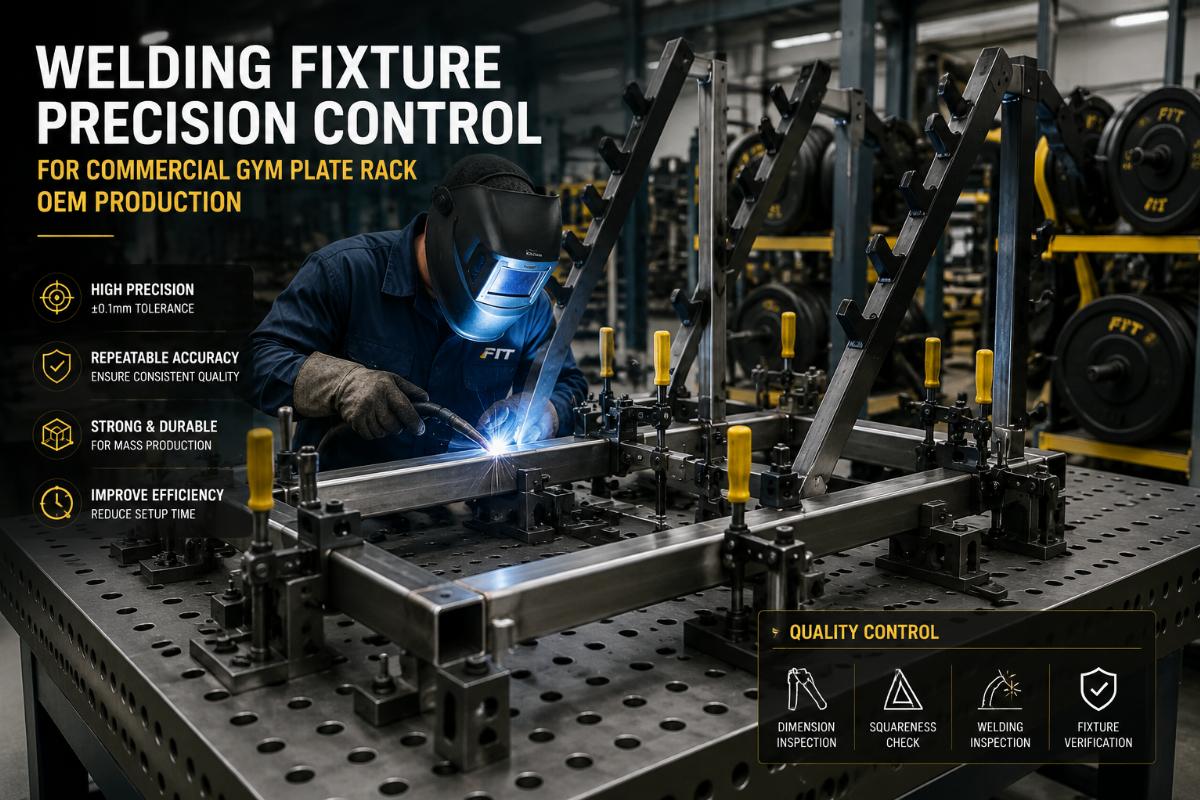
This is the hidden variable that separates a reliable commercial gym plate rack OEM supplier from a workshop that merely copies shapes. A proper welding jig locks every tube, gusset, and peg mount in exact position before any arc is struck. Without jig-controlled fabrication, thermal distortion during welding shifts components by imperceptible amounts during production, but these amounts accumulate across the frame until the final assembly no longer matches the drawing. The difference between a fixture-welded frame and a freehand-welded frame becomes obvious only when you try to mount plates.
Weight Plate Compatibility
Not all Olympic plates are identical. Rubber-coated competition plates, steel grip plates, and bumper plates from different brands have varying hub lengths, collar shapes, and pin hole positions. A Hammer Strength plate storage tree OEM unit must be tested against the specific plate brand the end client intends to use. I have seen projects where the storage tree worked perfectly with the client’s initial plate order but failed when they procured additional plates from a different supplier for an expansion phase.
| Verification Point | Sample-Level Check | Batch-Level Check | Field Validation |
|---|---|---|---|
| Hole-position tolerance | Go/no-go gauge on pre-production sample | Random sampling per production lot | On-site plate insertion test |
| Welding fixture precision | Dimensional audit of first-off unit | Fixture calibration log review | Visual peg perpendicularity check |
| Plate compatibility | Test with client-specified plate brand | Verify plate supplier consistency | Full-load stability test |
A distributor in the African market once ordered a full container of plate storage units. The pre-production sample passed all checks. The production batch, however, showed noticeable hole-position drift because the manufacturer switched welding jugs midway through the run to accommodate a different frame variant. The entire batch required rework before the distributor would accept shipment. [NEED_CITE: welding fixture calibration impact on dimensional consistency in fitness equipment manufacturing]
How Do Five-Star Hotel Projects Avoid On-Site Rework?
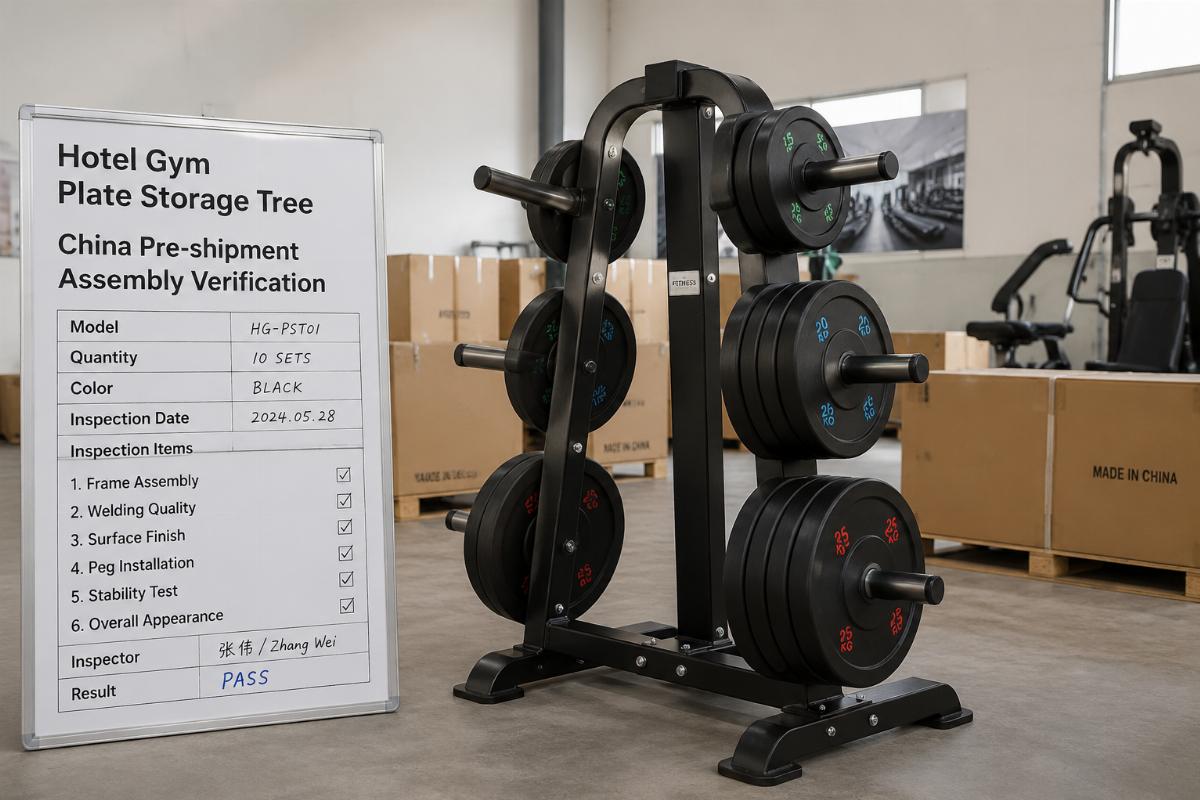
The answer is upgrading from drawing confirmation to physical assembly verification before bulk production begins. Drawing approval alone is insufficient for hospitality fitness installations where aesthetic precision and installation speed directly affect the hotel’s opening timeline.
Here is the verification workflow I now insist on for every hotel group project involving plate-loaded equipment:
Step One: Pre-Production Sample with Client-Specified Plates
The manufacturer must produce a complete sample unit and test it with the exact weight plate brand and model the hotel has specified. This is not optional. The sample must be photographed and video-documented during plate loading and unloading cycles to verify smooth insertion, stable storage, and clean visual alignment.
Step Two: Pin-Hole Tolerance Audit Report
The manufacturer must provide a measurement report showing actual hole positions against nominal drawing dimensions, with deviation values listed for each peg. This report must be generated using calibrated measurement tools, not tape measures. [NEED_CITE: dimensional inspection methodology for fitness equipment structural components]
Step Three: Welding Fixture Calibration Certificate
Request documentation showing the welding jig was calibrated before the production run began. This certificate should include fixture reference dimensions and the date of last calibration. If the manufacturer cannot provide this, it is a strong signal that jig-controlled fabrication is not part of their process.
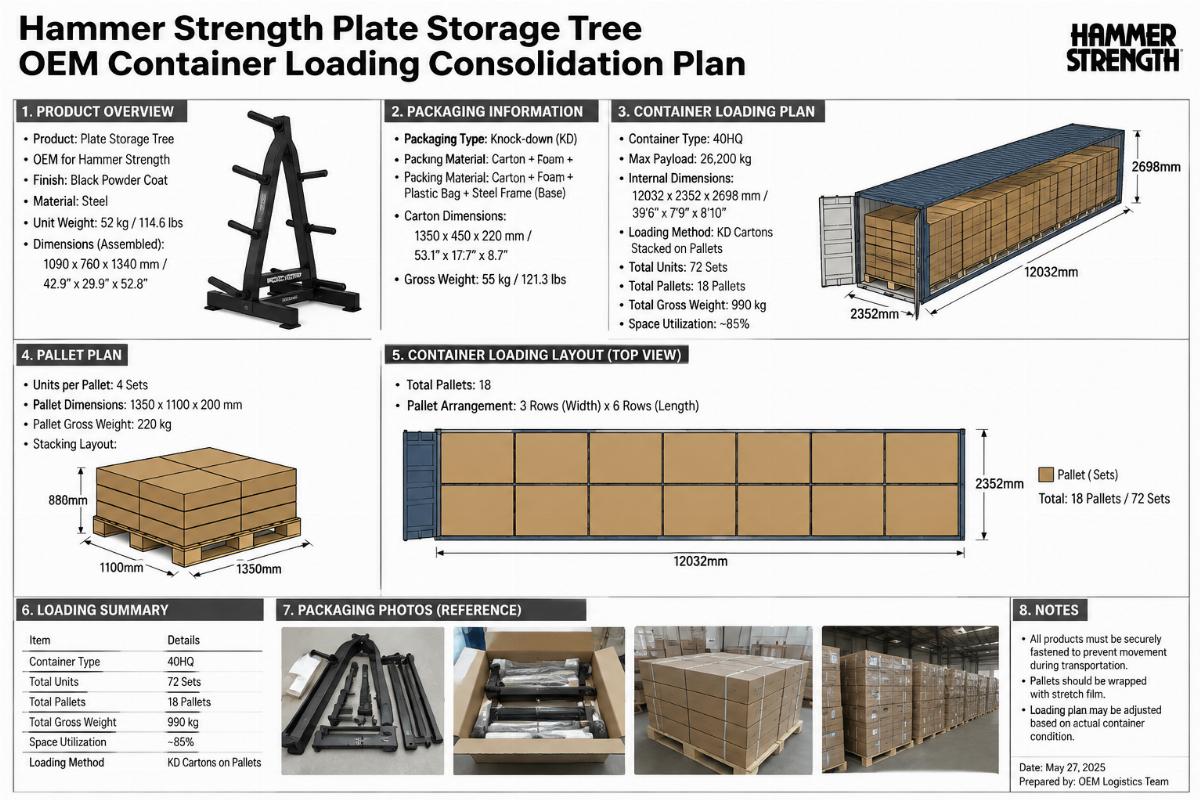
Step Four: Container Loading Simulation
Before crating, stack the finished units in the configuration planned for container loading. Verify that no unit is damaged by contact with adjacent units during transit. For hotel projects where multiple machine types share a container, plan the loading sequence to protect finished surfaces.
I worked on a resort project in Southeast Asia where the fitness center occupied a compact footprint adjacent to the pool area. The plate storage units needed to integrate seamlessly with the free-weight zone layout. By running the full assembly verification protocol before production, we identified a peg-angle issue that would have caused plates to lean visibly when installed against the resort’s design wall. The correction was made at the factory. The units installed cleanly on site, and the resort’s technical director signed off without a single punch-list item.
How Do You Balance Cost and Quality in Full-Gym Procurement?
Plate storage trees can be cost-optimized as secondary structural components, but the core load-bearing frame and peg mounting interfaces must never be compromised. This is where many procurement teams make expensive mistakes by treating all steel structures as interchangeable.
In a full-gym procurement package, the plate storage tree represents a relatively small portion of the total equipment budget. However, its failure rate in the field disproportionately affects client satisfaction because it is the component that hotel maintenance staff and gym users interact with daily. A wobbly peg or a plate that will not slide on smoothly creates an immediate impression of equipment quality issues across the entire facility.
The practical approach is to apply rigorous tolerance and fixture requirements to the plate storage interface while allowing cost optimization on non-critical frame elements. For example, the decorative shrouds and cover panels can use lighter gauge steel without affecting function. The base plate thickness and gusset reinforcement, however, must match the original specification because they directly affect stability under eccentric loading.
For distributors procuring container loads, the cost structure works differently. The key variables are minimum order quantity per SKU, container loading efficiency, and private-label packaging requirements. A well-planned mixed container that combines plate storage trees with complementary plate-loaded machines maximizes per-container value while keeping individual SKU quantities within manageable MOQ ranges. [NEED_CITE: container loading optimization strategies for commercial fitness equipment export]
I have helped distributors consolidate orders where plate storage trees were packed alongside cable crossover frames and Smith machines in a single container. The loading plan accounted for weight distribution, surface protection, and unloading sequence at the destination warehouse. This approach reduced per-unit shipping cost significantly compared to dedicated containers for each product category.
Conclusion
Sourcing a Hammer Strength plate storage tree OEM replacement for five-star hotel projects demands assembly-level verification, not drawing-level approval. Hole-position tolerance, welding fixture precision, and plate compatibility must be validated through physical testing before bulk production begins. Treat the plate storage tree as a precision interface component rather than a simple steel rack, and your field installation experience will reflect that discipline.


