HD-700 Plate Loaded Series OEM Customization Options Wholesale Supplier
Thicker steel does not automatically mean better equipment. The real answer to what HD-700 plate loaded series OEM customization options a wholesale supplier can offer lies in four configurable modules: frame gauge, upholstery material, paint finish, and branding application. Buyers must match each module to their target market’s actual usage intensity rather than defaulting to the heaviest spec available.
HD-700 plate loaded series OEM customization through a qualified wholesale supplier covers frame tube thickness selection across multiple gauge tiers, seat and pad material upgrades from standard PU to premium options, powder coating color and texture choices, and private-label branding through screen printing, laser etching, or metal nameplates. A reliable wholesale supplier will guide buyers through modular configuration rather than forcing full custom tooling, keeping lead times within standard production windows for most combinations.
I spent my early years on a factory floor in Dongguan welding Smith machine frames before moving into order coordination, spending long days negotiating spec sheets with gym buyers across the Middle East and South America. The HD-700 series has passed through my hands in dozens of container loads, and the single most frustrating phrase I hear is "just make it like the imported big brands." One Saudi buyer wanted a private-label plate loaded chest press and specified a particular tube gauge for the frame. We quoted based on our standard configuration, but the buyer came back with a cheaper quote from another source using thinner material. They switched suppliers. When the container reached Jeddah, the weld joints on the shroud covers had cracked across multiple units, requiring a full container rework. OEM customization is unforgiving: a single parameter mismatch at the port becomes a mid-six-figure lesson. [NEED_CITE: common failure modes in plate loaded equipment weld joints under mismatched material thickness]
Let me walk through each customization dimension and how buyers should approach them.
What OEM Customization Options Are Available for HD-700 Series?
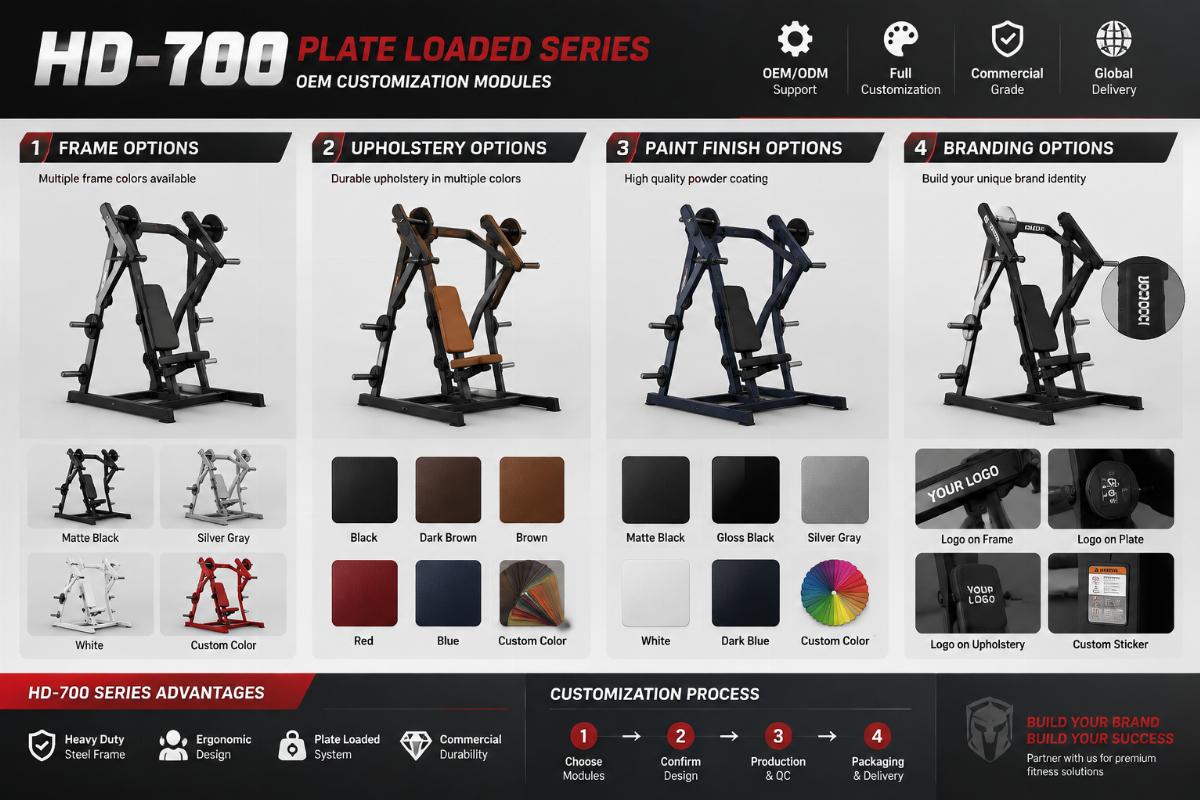
The HD-700 plate loaded series supports customization across four independent modules, and a competent wholesale supplier will let buyers mix and match across these modules without requiring full custom mold development.
The frame module covers tube gauge selection, joint reinforcement options, and pivot point bearing specifications. The upholstery module addresses foam density, cover material type, and stitch pattern choices. The paint module handles color matching, texture selection, and coating process type. The branding module determines how the buyer’s logo and model information appear on the finished equipment.
Each module operates on a tiered structure. For the frame, buyers typically choose between a commercial-grade tier, a heavy commercial tier, and a light commercial tier. [NEED_CITE: frame gauge classification standards for commercial fitness equipment per EN 957 or equivalent] The upholstery tier ranges from standard synthetic leather to premium options with enhanced abrasion resistance. The paint tier spans standard electrostatic powder coating to specialty finishes with additional corrosion protection. The branding tier moves from basic screen printing to durable metal nameplate attachment.
A Middle East distributor once approached us wanting to outfit a chain of hotel fitness centers. They needed equipment that looked premium but would not face the abuse of a hardcore bodybuilding gym. We configured the HD-700 series with mid-tier frame gauge, upgraded upholstery in a neutral color palette, and a matte black powder coat with their brand name applied through metal nameplates. The result was a product line that matched their market positioning without over-engineering the frame for loads it would never encounter.

The key insight here is that a wholesale supplier worth working with will help buyers avoid the trap of specifying the highest tier across every module. Over-specification inflates unit cost, increases shipping weight, and does not necessarily extend service life in low-intensity environments.
How to Choose the Right Frame Gauge for Your Market?
Frame gauge selection must align with the actual user profile and usage frequency at the installation site, not with the buyer’s assumption that heavier always equals better.
Tube gauge in fitness equipment refers to the wall thickness of the steel frame members. Thinner gauge numbers indicate thicker steel. The common tiers available through a wholesale supplier for plate loaded equipment include a light commercial option suitable for apartment gyms and boutique studios, a standard commercial option for full-service fitness centers, and a heavy commercial option for high-traffic facilities with intense daily usage. [NEED_CITE: structural load requirements for plate loaded strength equipment per ASTM or EN safety standards]
| Application Environment | Frame Tier | Usage Intensity | Typical User Profile |
|---|---|---|---|
| Hotel and apartment fitness rooms | Light commercial tier | Moderate, shorter sessions | General fitness users, residents |
| Commercial gym and fitness chain | Standard commercial tier | High, extended daily hours | Regular members, group classes |
| Hardcore bodybuilding and athletic facility | Heavy commercial tier | Extreme, heavy loads continuously | Advanced lifters, competitive athletes |
A South American gym chain buyer initially requested the heavy commercial tier for all locations, including their smaller boutique studios. After reviewing their actual member traffic data and typical session patterns, we recommended the standard commercial tier for the studio locations and the heavy commercial tier only for their flagship facilities. This adjustment reduced their per-unit cost noticeably while still providing adequate durability where it mattered.
The mistake many new buyers make is treating frame gauge as a simple quality indicator. In reality, an over-gauged frame in a low-intensity environment adds dead weight, increases shipping cost per container, and provides zero functional benefit. Conversely, an under-gauged frame in a high-intensity environment leads to flex under load, accelerated wear at pivot points, and eventual structural complaints. [NEED_CITE: relationship between frame deflection and user perception of equipment quality in commercial gym settings]

When evaluating a wholesale supplier, ask them to explain which gauge tier they recommend for your specific deployment scenario and why. A supplier who simply pushes the heaviest option without asking about your end users is either inexperienced or prioritizing margin over fit.
What Are the MOQ and Lead Time for Custom Orders?
Standard modular customization through a wholesale supplier can be completed within regular production lead times, and flexible MOQ policies support everything from single-unit samples to full container orders.
This is one of the most persistent misconceptions in the fitness equipment import business. Many buyers assume that any customization request will extend production timelines substantially. The reality is that when customization stays within pre-engineered modular options, the wholesale supplier can integrate these choices into standard production scheduling without meaningful delay. Only fully custom mold development, non-standard frame geometry, or proprietary mechanism redesigns push lead times beyond normal windows.
For the HD-700 plate loaded series, a wholesale supplier with mature production infrastructure typically handles frame gauge selection, upholstery color and material choice, standard paint color matching, and basic branding application as routine production variations rather than custom engineering projects. [NEED_CITE: typical production lead time ranges for modular OEM fitness equipment orders]
| Customization Type | Impact on Lead Time | MOQ Flexibility |
|---|---|---|
| Frame gauge selection from standard tiers | No meaningful extension | Single unit to full container |
| Upholstery color from available palette | No meaningful extension | Single unit to full container |
| Standard paint color match | Minor extension for specialty colors | Single unit to full container |
| Custom paint color outside standard range | Noticeable extension due to separate batch mixing | Minimum batch quantity applies |
| Screen print or laser etch branding | No meaningful extension | Single unit to full container |
| Custom metal nameplate with buyer design | Minor extension for tooling | Minimum batch quantity applies |
| Fully custom frame geometry or mechanism | Substantial extension for engineering and prototyping | Higher MOQ typically required |
An African buyer new to fitness equipment import once placed an order specifying a custom frame design without realizing the engineering and prototyping implications. The order went to a supplier who did not clearly explain the timeline difference between modular customization and full custom development. The buyer expected delivery within a standard window and was caught off guard when the production schedule stretched considerably. By the time the equipment arrived, their gym opening date had passed, and they faced contractual penalties with their facility landlord.

Buyers should always confirm in writing whether their customization requests fall within the supplier’s standard modular options or require custom development. A transparent wholesale supplier will classify each request clearly and provide realistic timeline expectations for each category. We support buyers from single-unit sample evaluation through complete gym package container consolidation, and our MOQ policy adapts to the buyer’s stage of business development.
How to Avoid Common OEM Customization Pitfalls?
Every customization parameter must be documented in a written specification sheet before production begins, and verbal agreements or vague references to competitor products create unacceptable risk at the destination port.
The most common pitfalls in HD-700 plate loaded series OEM customization fall into three categories: specification ambiguity, assumption-based matching, and incomplete sample confirmation.
Specification ambiguity occurs when buyers describe what they want in general terms rather than precise parameters. Phrases like "heavy duty" or "premium quality" mean different things to different suppliers. A wholesale supplier should push buyers toward specific gauge selections, material grade references, and finish standards rather than accepting subjective descriptors. [NEED_CITE: importance of written specification documentation in international fitness equipment OEM transactions]
Assumption-based matching happens when buyers reference well-known international brands and expect the supplier to replicate their specifications without providing actual technical data. This approach fails because the supplier cannot legally access proprietary specifications from competing manufacturers, and even if approximate measurements could be obtained, material grades and heat treatment processes remain unknown. The result is equipment that may look similar externally but performs differently under sustained use.
Incomplete sample confirmation occurs when buyers approve a sample based on visual inspection alone without testing under actual usage conditions. A sample that looks correct in the factory showroom may reveal issues with pivot smoothness, pad comfort under load, or finish durability only after extended use.
| Pitfall Category | Typical Manifestation | Consequence at Destination |
|---|---|---|
| Specification ambiguity | Vague gauge or material references | Equipment does not match buyer expectations |
| Assumption-based matching | Reference to competitor product without technical data | External similarity with internal performance gaps |
| Incomplete sample confirmation | Visual approval without functional testing | Issues discovered only after deployment |
A buyer in West Africa received a container of plate loaded equipment where the upholstery color appeared correct under factory lighting but showed visible shade variation when installed in their gym’s actual lighting conditions. The supplier had matched the color under different light sources, and the buyer had not requested a physical sample shipment for on-site verification before full production. Resolving this required a partial re-upholstery at significant additional cost.

The solution is straightforward but often neglected: insist on a detailed written specification document covering every parameter across all four customization modules, request physical samples for critical visual and tactile elements, and confirm in writing that the sample represents the production standard. A professional wholesale supplier will welcome this discipline rather than resist it.
Conclusion
Successful HD-700 plate loaded series OEM customization depends on matching configuration modules to actual market conditions, not on maximizing every specification. Frame gauge, upholstery, paint finish, and branding each offer tiered options through a qualified wholesale supplier, and modular customization stays within standard production timelines. Written specifications, physical sample verification, and clear communication about end-user environments protect buyers from costly mismatches that only become apparent after the container reaches its destination.