HD-700 Plate Loaded Series Warranty After-Sales | Wholesale Supplier
Most buyers focus on how long the warranty lasts, but the real risk lies in what the warranty excludes.
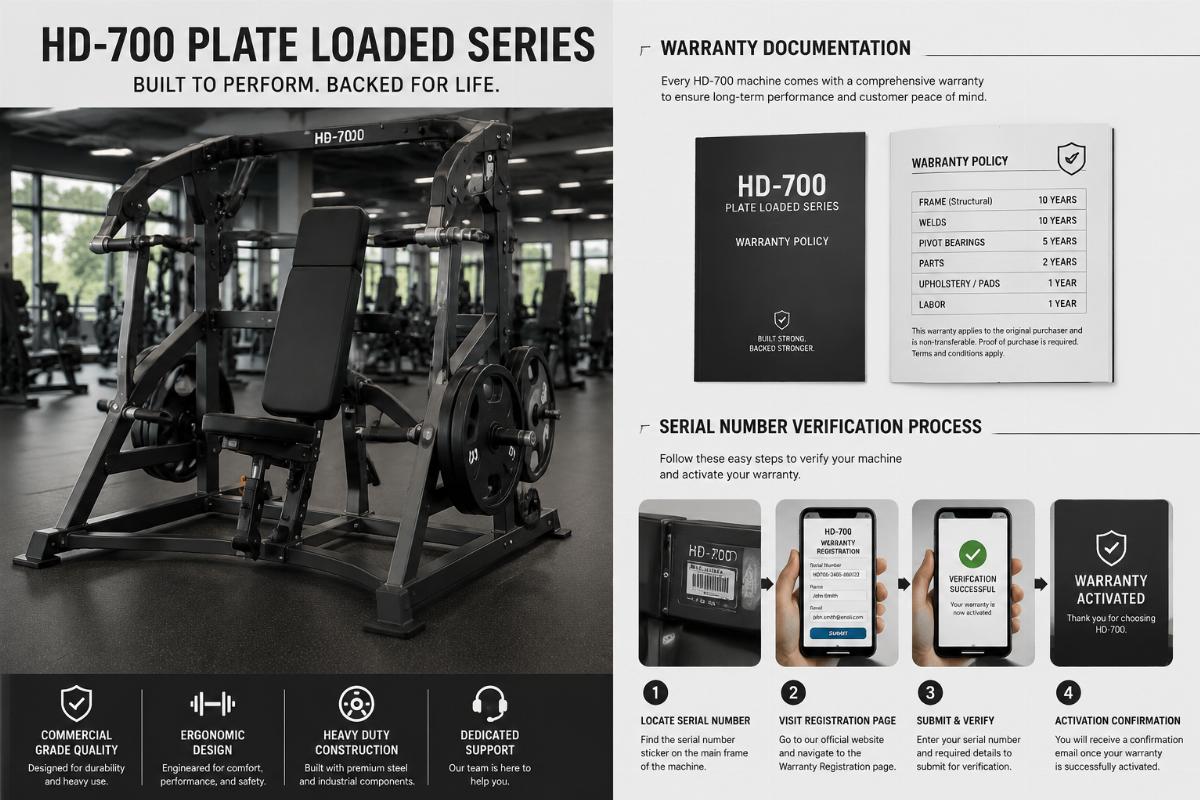
The HD-700 Plate Loaded warranty covers structural frames and welded joints for an extended period, while moving parts, cables, pulleys, and upholstery carry shorter coverage terms. Warranty activation depends on matching shipping documents with equipment serial numbers, and spare parts supply during the claim process requires clear agreements on international freight and customs responsibilities.
I still remember a full container of plate-loaded machines we shipped to a West African port years ago. The bill of lading coding didn’t align with the warranty card serial numbers at the destination. The cargo sat at the port for over a month, and the demurrage charges alone wiped out the entire profit margin of that shipment. Since then, I’ve treated every warranty clause as something that needs to be stress-tested against real-world port operations, customs inspections, and container handling procedures. Vague promises on paper become expensive arguments once the货 reaches the quay. [NEED_CITE: common causes of warranty disputes in international fitness equipment trade]
Let’s break down exactly what the HD-700 Plate Loaded warranty covers, how international shipment timing affects your claim eligibility, what documents you need on hand, and how spare parts actually get to you when something fails.
What Does the HD-700 Plate Loaded Warranty Actually Cover?
The HD-700 Plate Loaded warranty divides coverage into structural components, motion components, and wear items—each with distinct terms and exclusions.
The frame and welded structures of the HD-700 Plate Loaded series are built from heavy-gauge steel and carry the longest warranty period. These are the parts that almost never fail under normal commercial use, provided the equipment was assembled correctly and not subjected to overload beyond design specifications. [NEED_CITE: typical warranty tier structure for commercial plate-loaded strength equipment]
Motion components—including guide rods, linear bearings, pivot points, and weight horn sleeves—carry a moderate warranty term. These parts experience regular friction and load cycling, so their coverage reflects realistic wear expectations.
Then there are the consumables: cables, pulleys, grip surfaces, and upholstery. These items are explicitly excluded from long-term coverage because their lifespan depends entirely on usage intensity, maintenance frequency, and environmental conditions like humidity and temperature.
Here’s where most importers get caught off guard: the exclusion clauses. A distributor in the Middle East once received a batch of HD-700 Plate Loaded machines where the seat upholstery showed cracking within months. The buyer assumed this fell under warranty. But the warranty terms specified that upholstery defects caused by UV exposure, improper cleaning agents, or normal wear were not covered. The claim was rejected because the facility had placed the equipment near floor-to-ceiling windows without UV filtering. [NEED_CITE: common warranty exclusions for commercial gym equipment upholstery and cosmetic components]
| Component Category | Coverage Level | Typical Exclusions |
|---|---|---|
| Frame and Welded Structure | Full coverage | Improper assembly, modification, overload damage |
| Guide Rods and Bearings | Standard coverage | Lack of lubrication, corrosion from improper environment |
| Cables and Pulleys | Limited coverage | Normal wear, improper routing, overload |
| Upholstery and Grips | Minimal or none | UV exposure, cleaning damage, normal wear |
The lesson here is straightforward: read the exclusions before celebrating the warranty length. A longer warranty period means nothing if the failure mode you’re most likely to encounter is listed as an exclusion.

How Is the Warranty Period Calculated for International Shipments?
The warranty start date for the HD-700 Plate Loaded series must be explicitly defined in your purchase agreement—whether it begins at factory departure, port of loading, port of discharge, or installation completion.
This is one of those details that seems trivial during negotiations but becomes critical eighteen months later when you need to file a claim. Different manufacturers use different starting points, and the gap between them can be substantial when you’re dealing with ocean freight, customs clearance, and on-site assembly timelines.
Some suppliers calculate warranty from the date of ex-factory departure. This means the clock starts ticking before the container even reaches the port. For buyers in distant regions—Sub-Saharan Africa, Latin America, parts of Southeast Asia—the equipment could spend weeks or even months in transit and customs before it’s ever installed. By the time the machine is operational, a meaningful portion of the warranty period has already elapsed.
Others calculate from the date of arrival at the port of discharge. This is fairer for the buyer but requires clear documentation of when the container was discharged and cleared.
A third approach ties warranty activation to the completion of installation and commissioning. This is the most buyer-friendly model, but it requires the supplier to have technical support capable of verifying installation completion remotely or on-site.
[NEED_CITE: warranty period calculation methods in international commercial equipment trade]
I worked with a Southeast Asian hotel project that ordered multiple HD-700 Plate Loaded units. The construction timeline kept getting delayed, and the equipment sat in crates on-site for months before installation. Because the warranty was tied to the installation completion date rather than the shipping date, the buyer didn’t lose coverage time. That single clause saved them from a potential dispute when one unit developed a guide rod issue shortly after finally being put into service.
The risk of not clarifying this? You could be arguing about whether a claim is valid while the supplier points to a shipping date that predates your installation by half a year. Always get the warranty start trigger in writing, tied to a specific document—bill of lading date, customs clearance certificate, or installation sign-off report.

What Documents Are Required to File a Warranty Claim?
Filing a warranty claim for the HD-700 Plate Loaded series requires three core documents: the equipment serial number, the original bill of lading or shipping proof, and verifiable evidence of the defect—typically photographs or video.
Missing any one of these can delay or invalidate your claim entirely.
The serial number is non-negotiable. Every HD-700 Plate Loaded unit carries a unique identifier that ties it to the production batch, shipping manifest, and warranty registration. Without it, the supplier cannot verify whether the equipment is genuinely covered or whether it falls outside the production range included in your order.
I’ve seen claims stall for weeks because the buyer couldn’t locate the serial number plate, or because the number they provided didn’t match the shipping records. In one case involving a West African distributor, the serial number on the warranty card didn’t match the number physically engraved on the frame because the cards had been mixed up during packing. The claim was initially rejected until we could cross-reference the container loading list and confirm which serial numbers were actually in that specific shipment.
The bill of lading or shipping documentation serves a dual purpose: it proves the equipment was part of a legitimate order, and it establishes the timeline for warranty calculation. If your warranty starts from the port of discharge date, you need that discharge documentation. If it starts from installation, you need the installation completion record.
[NEED_CITE: standard documentation requirements for international fitness equipment warranty claims]
Evidence of the defect is where many claims fail. A vague description like "the guide rod is making noise" won’t get you far. You need clear photographs showing the specific issue, ideally with the serial number visible in the frame. For motion-related problems, a short video demonstrating the abnormal behavior is far more effective than written descriptions.
Here’s a practical checklist for any HD-700 Plate Loaded warranty claim:
- Clear photograph of the serial number plate on the affected unit
- Copy of the bill of lading or container discharge documentation
- Date-stamped photographs or video showing the defect
- Written description of the issue, including when it was first noticed and under what conditions
- Proof of proper installation and maintenance (if requested)
A distributor in Latin America learned this the hard way when their first warranty claim was rejected because they only sent a written description without photographic evidence. By the time they gathered proper documentation and resubmitted, several weeks had passed, and their end customer had already lost patience.

How Are Spare Parts Supplied During the Warranty Period?
Spare parts supply for the HD-700 Plate Loaded warranty involves not just whether parts are provided free of charge, but who bears the cost of international shipping, customs clearance, and last-mile delivery.
This is where the gap between "free warranty parts" and actual zero-cost service becomes painfully clear. Many suppliers advertise free spare parts during the warranty period, which is technically accurate—the parts themselves may not be invoiced. But the international freight, export customs documentation, import duties at the destination, and local delivery charges can add up to a significant expense that the buyer is expected to cover.
[NEED_CITE: cost allocation models for international warranty spare parts supply in commercial equipment]
The HD-700 Plate Loaded series benefits from a structured spare parts supply system that categorizes requests by urgency. Emergency parts—those needed to restore a machine to operational status and prevent revenue loss for a commercial gym—are prioritized for air freight. Standard replacement parts that don’t cause immediate downtime are shipped via sea freight in consolidated packages. Custom or non-standard components may require longer lead times depending on production scheduling.
A Middle East distributor once faced a situation where a popular HD-700 Plate Loaded model in a high-traffic gym developed a pulley issue. The gym was losing revenue every day the machine was down. Because the parts request was classified as emergency, the replacement pulley assembly was dispatched by air and arrived within days. The parts were free under warranty, but the air freight cost was borne by the distributor. They considered it a worthwhile trade-off because keeping the gym operational preserved their relationship with the end customer.
The key is to establish the spare parts supply agreement before you need it. Clarify:
- Which parts are classified as emergency versus standard
- What the typical lead times are for each category
- Who pays for international freight in each scenario
- Whether the supplier maintains regional spare parts inventory to reduce shipping times
Bick maintains a dedicated spare parts inventory for the HD-700 Plate Loaded series, ensuring that common replacement components are available for rapid dispatch. This reduces the risk of production-line delays affecting your warranty service timeline.

What After-Sales Support Is Available Beyond Warranty?
Post-warranty support for the HD-700 Plate Loaded series includes continued spare parts availability, technical consultation, and access to replacement components at cost—ensuring equipment remains serviceable throughout its operational lifespan.
The warranty period is just the beginning of the equipment’s service life. Commercial gym equipment in high-usage environments will eventually need repairs and replacements well beyond the warranty window. The question isn’t whether you’ll need post-warranty support—it’s whether the supplier will still be responsive and whether parts will still be available.
For the HD-700 Plate Loaded series, spare parts remain available for purchase after the warranty expires. This includes wear items like cables, pulleys, and upholstery, as well as structural components like guide rods and bearings should they eventually require replacement due to long-term use.
Technical support also continues beyond the warranty period. If your maintenance team encounters an unfamiliar issue or needs guidance on disassembly and reassembly procedures, remote technical consultation is available. This is particularly valuable for distributors who serve end customers across multiple countries and need reliable troubleshooting support without flying technicians to every site.
[NEED_CITE: long-term after-sales support models for commercial fitness equipment distributors]
A hotel chain in Southeast Asia that purchased HD-700 Plate Loaded equipment for multiple properties found this ongoing support invaluable. Years after the warranty expired, they needed to replace upholstery across several units due to normal wear. Because the supplier still had the exact specifications and materials on file, the replacement pads matched the originals perfectly. The hotel paid for the parts and shipping, but the consistency of the replacement components maintained the aesthetic standard across all their fitness facilities.
The sustainability of after-sales support depends on the supplier’s commitment to maintaining production records, spare parts inventory, and technical documentation over the long term. This is where established manufacturers with dedicated after-sales departments have a clear advantage over trading companies or short-term suppliers who may not maintain records beyond the immediate sale.

Conclusion
The HD-700 Plate Loaded warranty is only as strong as the documentation, clarity, and supply chain backing it up. Understanding coverage tiers, defining warranty start dates, preparing claim documentation, and negotiating spare parts logistics upfront will prevent disputes and keep your commercial gym equipment operational.