Hex Rubber Dumbbell Set Qatar Customs Docs | Bick OEM Wholesale
Minor invoice description mismatches cause more customs delays than product defects.
Clearing fitness equipment in Qatar requires precise alignment of HS codes, legalized Certificates of Origin, and accurate packing lists to avoid weeks of demurrage. The most critical documents are the Commercial Invoice, Packing List, Bill of Lading, and a Chamber of Commerce legalized Certificate of Origin formatted specifically for Gulf Cooperation Council requirements.
I still remember the humidity hitting my face at Doha port, standing next to a container that had been sitting there for twenty-one days. It was filled with commercial Smith machines and hex rubber dumbbell sets, all perfectly manufactured but completely stuck because the HS code on the invoice did not match the classification expected by the local clearing agent. The storage fees were accumulating daily, turning a profitable shipment into a financial headache. That incident forced me to stop looking at customs clearance as a mere administrative formality and start treating it as a technical specification as vital as the steel grade used in our weight racks. [NEED_CITE: common causes of cargo detention at GCC ports]
Understanding these requirements is not just about avoiding fines; it is about ensuring your gym equipment reaches the floor ready for use rather than trapped in bureaucratic limbo.
What Are the Critical Documents for Qatar Customs?
The Commercial Invoice, Packing List, Bill of Lading, and legalized Certificate of Origin are non-negotiable for entry.
Qatar customs authorities operate under strict regulatory frameworks that demand absolute consistency across all shipping documents. A discrepancy in weight, description, or value between the Bill of Lading and the Commercial Invoice can trigger a physical inspection, which often leads to significant delays. For fitness equipment importers, the Certificate of Origin is particularly sensitive. It is not enough to have a standard CO; it often requires legalization by the Chamber of Commerce and, in many cases, attestation by the Qatari Embassy in the country of export. [NEED_CITE: Qatar General Authority of Customs documentation requirements]
A regional distributor once shared how a single missing stamp on the Certificate of Origin delayed their entire container of cardio machines. The goods sat at the port while they arranged for emergency legalization, costing them time and credibility with their end clients who were waiting to open a new facility. This highlights why pre-shipment validation is essential. At Bick, our export team reviews these documents against current regulations before the container leaves the factory, ensuring that the descriptions on the invoice match exactly what is listed on the Bill of Lading.
Ensuring these documents are prepared correctly from the start prevents the need for costly corrections after the vessel has already departed.
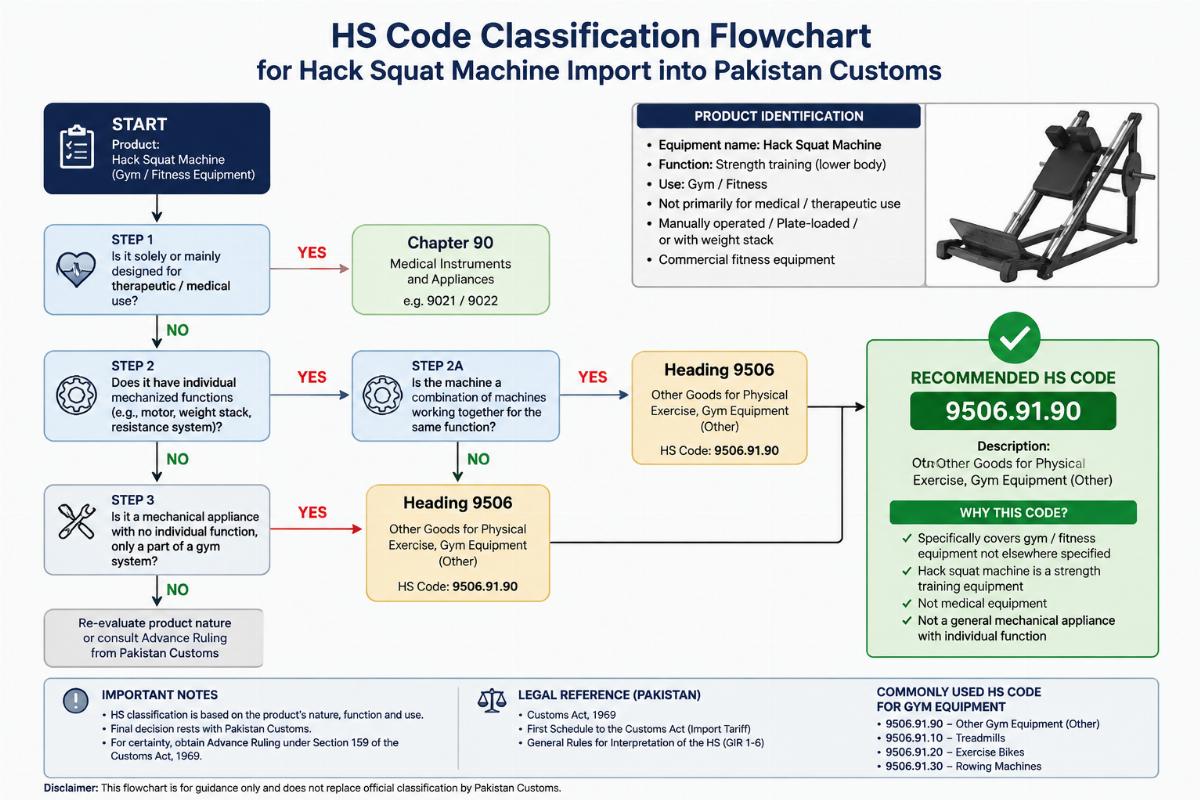
How to Determine the Right HS Code for Dumbbells?
Distinction between metal and rubber-coated dumbbells affects duty rates and classification accuracy.
Selecting the correct Harmonized System (HS) code is one of the most frequent sources of error for fitness equipment importers. Many assume that all dumbbells fall under a single category, but customs authorities distinguish between pure iron or steel weights and those coated with rubber or urethane. This distinction is crucial because it determines the applicable duty rate and whether additional standards certifications are required. [NEED_CITE: GCC Customs Union tariff classification guidelines]
For a hex rubber dumbbell set, the classification often hinges on the material composition. If the rubber coating is considered the primary characteristic for safety and floor protection, it may fall under a different subheading than bare metal weights. Misclassifying these items can lead to underpayment or overpayment of duties, both of which raise red flags during audits.
| Equipment Type | Material Composition | Classification Risk | Documentation Focus |
|---|---|---|---|
| Bare Iron Dumbbells | Pure metal | Low | Standard CO |
| Rubber Coated Dumbbells | Metal core with rubber layer | Medium | Material breakdown in Invoice |
| Mixed Containers | Various materials | High | Detailed itemized PL |
A buyer importing a mixed container of treadmills and free weights faced issues when the clearing agent could not find a single HS code that covered the entire shipment. The solution was to itemize each product type separately on the Commercial Invoice with its specific HS code. This level of detail allows customs officers to process each line item accurately, reducing the chance of the entire container being held for manual review.
Accurate HS coding ensures that your Qatar customs clearance fitness equipment process moves smoothly without unexpected tariff disputes.
Why Do Certificates of Origin Get Rejected?
Most rejections stem from formatting errors and missing legalization stamps rather than invalid origin.
A common misconception is that any Certificate of Origin issued by a local chamber is sufficient for Gulf countries. In reality, Qatar often requires specific formats, such as the Arab League format, or explicit embassy legalization. A CO that lacks the proper chain of authentication will be rejected outright, forcing the importer to either pay for express legalization services or wait for a new document to be issued and shipped. [NEED_CITE: Arab League Certificate of Origin requirements]
I recall a shipment where the CO was issued correctly but lacked the specific embassy attestation stamp required at that time. The clearing agent in Doha refused to accept it, citing internal guidelines that demanded full diplomatic legalization. The delay lasted several weeks, during which the client had to negotiate extended storage terms with the port authority. This experience underscored the importance of verifying the exact legalization requirements with the local clearing agent before the goods are shipped.
To avoid this, ensure that the Certificate of Origin includes:
- Clear mention of the exporting country and manufacturer.
- Consistent product description matching the Commercial Invoice.
- All required chamber of commerce stamps and signatures.
- Embassy legalization if mandated by current regulations.
Properly legalized documents prevent unnecessary hold-ups and ensure your Qatar customs clearance fitness equipment proceeds without administrative hurdles.
How to Prepare a "Customs-Proof" Packing List?
Aligning weights and descriptions with the Bill of Lading is critical to avoid fines and inspections.
The Packing List is often treated as an internal warehouse document, but for customs purposes, it is a legal declaration of contents. Discrepancies between the gross weight on the Bill of Lading and the actual scale weight of the container can trigger alarms. Customs authorities typically allow a minimal tolerance, often less than one percent, for weight variations. Exceeding this limit can result in fines and mandatory weighing procedures that delay release. [NEED_CITE: international shipping weight tolerance standards]
A "customs-proof" Packing List must include net and gross weights for each carton, not just the total for the container. This level of detail helps customs officers verify the contents quickly if a partial inspection is requested. For example, if a container holds multiple types of gym equipment, listing the weight per box for each item type allows for easier verification than a single aggregate figure.
Key elements for a robust Packing List include:
- Itemized description matching the Commercial Invoice.
- Net weight and gross weight per package.
- Total number of packages and total gross weight.
- Container number and seal number if available.
In one instance, a minor error in the total gross weight on the Packing List led to a full container scan. The scan revealed no contraband, but the delay cost the importer significant demurrage charges. By ensuring that the Packing List is meticulously prepared and cross-checked against the Bill of Lading, importers can minimize the risk of such interventions. Our team at Bick ensures that every packing list is generated directly from our production data, ensuring that the weights recorded are accurate to the kilogram.
Precision in documentation ensures that your Qatar customs clearance fitness equipment arrives on schedule and within budget.
Conclusion
Precise documentation is the backbone of successful fitness equipment imports in Qatar.
Avoiding customs delays requires meticulous attention to HS codes, legalized Certificates of Origin, and accurate Packing Lists. By treating these documents with the same rigor as product quality, importers can ensure smooth clearance and timely delivery. Proper preparation prevents costly demurrage and ensures that your Qatar customs clearance fitness equipment reaches its destination without unnecessary complications.