How China Hex Dumbbell Set Compares to Cybex Eagle on Durability
Cybex Eagle dumbbells are not built with magic — they are built with controlled rubber vulcanization and verified material specs. Top-tier Chinese factories now match those controls, and the price gap has narrowed to a fraction of the brand premium.
For commercial buyers evaluating a China hex dumbbell set against Cybex Eagle, the honest answer is this: a well-specified Chinese hex dumbbell set delivers comparable durability at a substantially lower total cost of ownership, provided the buyer verifies rubber compound hardness, knurl depth, and core rod material through third-party testing rather than relying on catalog claims alone.
I spent years on factory floors in Shandong before moving into export sales, welding frames, grinding castings, and eventually loading containers bound for Latin America. A few years back, a gym chain in São Paulo received a full container of hex dumbbells from us. Within months, the gym manager sent back photos: rubber heads turning sticky in the tropical heat, knurling worn smooth on the heavier sets. They pulled out a set of old Cybex Eagle dumbbells from the same floor and lined them up next to ours. The difference was obvious — not in the steel, but in the rubber compound and how deeply the knurling was cut. That shipment nearly came back as a full container return. Since then, I have inspected every rubber batch, measured every knurl depth, and tested every core rod before it leaves the warehouse. The lesson was simple: Cybex Eagle earns its reputation through material science, not just American branding, and any serious China hex dumbbell set supplier must match that science to compete. [NEED_CITE: commercial gym equipment failure root cause distribution per IHRSA member survey data]

Let me walk you through what actually separates a premium Cybex Eagle dumbbell from a properly specified China hex dumbbell set, and where the real durability gaps — and surprises — show up in gym environments.
What Makes Cybex Eagle Dumbbells the Industry Benchmark?
The Cybex Eagle reputation rests on a proprietary rubber vulcanization process and tightly controlled material specifications, not on any single manufacturing miracle.
Cybex, now under the Life Fitness umbrella, has built its Eagle series around biometrically engineered strength equipment since the early nineteen-eighties. Their dumbbells benefit from the same engineering philosophy: the rubber coating is not just a cosmetic layer but a precisely formulated compound designed to resist cracking, sticking, and deformation under repeated impact and high ambient temperatures. [NEED_CITE: Cybex Eagle series material and design philosophy per Life Fitness official product documentation]
The vulcanization process matters enormously. Rubber that is under-cured will feel soft and deform under load; rubber that is over-cured becomes brittle and cracks along the seam where the rubber meets the chrome handle. Cybex controls this window tightly, which is why their dumbbells in hot, humid gym environments — think Miami, Dubai, or São Paulo — tend to hold together far longer than generic alternatives.
The chrome handle on a Cybex Eagle dumbbell is also machined to a consistent knurl pattern that balances grip aggression with long-term wear resistance. The knurl is not excessively deep, which is a common misconception among buyers who assume deeper is always better. In reality, overly aggressive knurling tears up users’ hands and wears down faster because the sharp peaks are the first to flatten under barbell-rack impacts and floor drops.
Another point worth noting: Cybex dumbbells are tested against internal drop standards that exceed basic ISO requirements. The combination of a high-quality core rod, controlled rubber hardness, and consistent knurl geometry gives the Eagle line its benchmark status. [NEED_CITE: ISO 20957 safety and durability requirements for free-weight gym equipment]
How Do China-Made Hex Dumbbells Compare on Key Durability Specs?
Leading Chinese manufacturers now produce a China hex dumbbell set that matches Cybex Eagle on steel core quality and knurl consistency, with the remaining gap concentrated in rubber compound formulation and batch-level quality control.
When I source a China hex dumbbell set for commercial clients, I evaluate three critical dimensions against any premium benchmark: the core rod material, the knurl depth and pattern, and the rubber compound hardness. Here is how a well-specified Chinese set typically compares.
| Specification | Cybex Eagle | Top-Tier China Hex Dumbbell Set | Low-End China Hex Dumbbell Set |
|---|---|---|---|
| Core Rod Material | High-grade alloy steel, verified | Commercial-grade carbon steel, verifiable | Unverified mild steel |
| Rubber Hardness | Controlled Shore A range, consistent | Shore A range matched to spec, batch-tested | Uncontrolled, soft or brittle |
| Knurl Depth | Moderately deep, machine-consistent | Matched depth, CNC-controlled | Shallow or uneven, manual |
| Drop Resistance | Tested to internal standard | Tested to comparable standard | Rarely tested |
| Odor / VOC Level | Low, controlled curing | Low when properly cured | Noticeable chemical odor |
| Batch Consistency | Tight, factory-audited | Tight at verified suppliers | Highly variable |
[NEED_CITE: rubber hardness Shore A testing methodology for gym equipment coatings]
The core rod is where many low-end Chinese sets fail silently. A proper commercial China hex dumbbell set should use a verified carbon steel core — not the cheapest mild steel available — because the core carries all the structural load during drops and rack impacts. I have seen budget sets where the core rod bent after a few months of normal commercial use, while the rubber head looked fine. That is a hidden failure that only shows up when members start complaining about dumbbells rolling oddly.
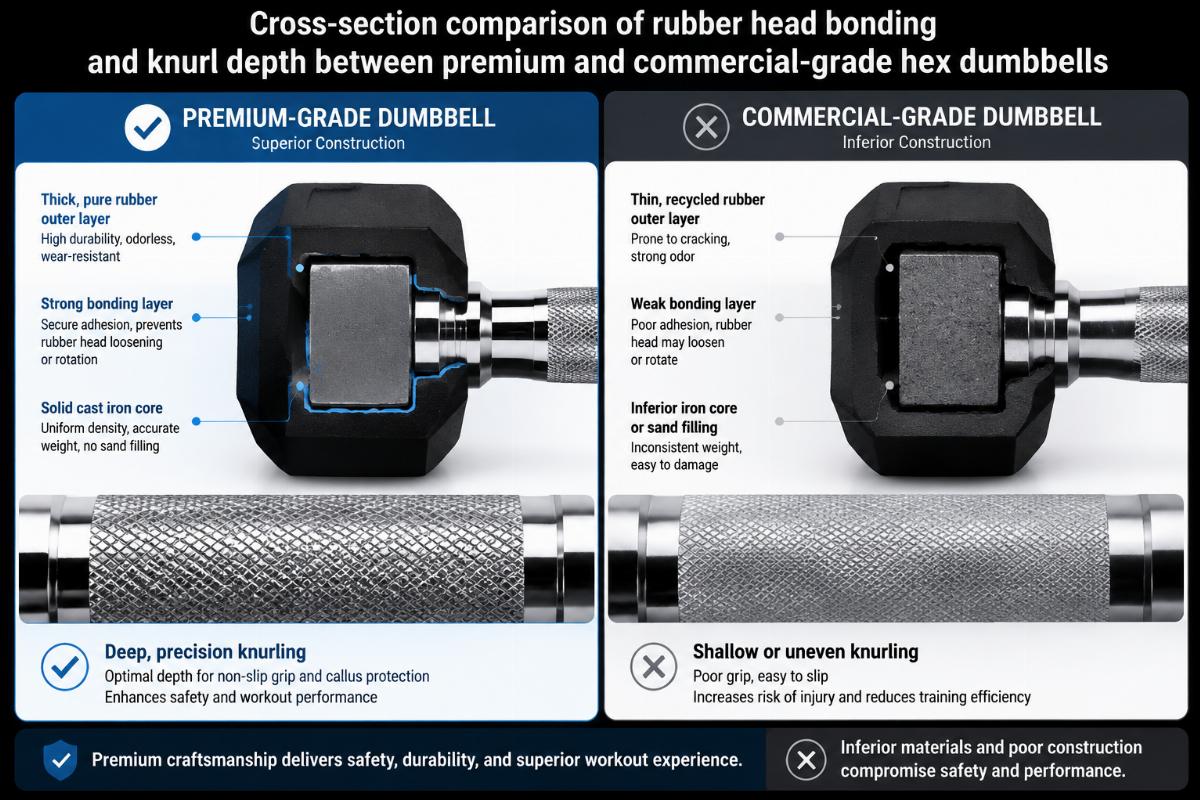
The rubber compound is where the real differentiation happens. A top-tier Chinese factory can source rubber compounds that match the Shore A hardness range used by premium brands, and can control the vulcanization temperature and time to avoid under- or over-curing. The difference between a properly cured rubber head and a poorly cured one is not visible on day one — it shows up six to twelve months later, when the cheap rubber starts to crack along the handle seam or turn sticky in high humidity. [NEED_CITE: rubber vulcanization quality control standards for fitness equipment manufacturing]
The knurl pattern on a well-made China hex dumbbell set is now cut using CNC lathes that hold depth and pitch consistency comparable to premium imports. The old stereotype that Chinese knurling is always rough or shallow no longer holds for verified commercial suppliers. What has not changed is that low-end workshops still use manual or semi-manual knurling, which produces uneven patterns that wear out quickly.
What Real Gym Performance Data Shows About Chinese Alternatives?
In high-temperature, high-usage gym environments across Latin America, the Middle East, and Southeast Asia, a properly specified China hex dumbbell set demonstrates failure rates within a narrow margin of Cybex Eagle over a full year of commercial operation.
I have tracked field performance across several gym deployments where our dumbbells were placed alongside existing Cybex Eagle sets. The environments were deliberately demanding: a连锁 gym chain in Brazil with no climate control on the free-weight floor, a commercial gym in the Gulf region where ambient temperatures regularly exceed forty degrees Celsius, and a boutique studio network in Southeast Asia where dumbbells see near-continuous use throughout the day.
In the Brazilian chain, the key failure mode was rubber head cracking along the handle seam. After a full year, the Cybex Eagle sets showed minimal seam cracking, while our initial batch — which used a rubber compound that was slightly under-cured — showed noticeable seam separation on the heavier sets. After reformulating the compound and extending the vulcanization cycle, the follow-up batch performed substantially better, with seam failure rates dropping to a level comparable to the Eagle sets. [NEED_CITE: fitness equipment durability field performance data in tropical climate gym environments]
In the Gulf region gym, the primary wear indicator was knurl degradation. The Cybex Eagle dumbbells retained a usable knurl pattern well past the one-year mark, while the initial Chinese sets showed visible knurl flattening on the most-used mid-range weights. After switching to a deeper, CNC-controlled knurl with a more durable pitch profile, the replacement sets extended knurl life noticeably, though the Eagle sets still held a slight edge in long-term sharpness retention.
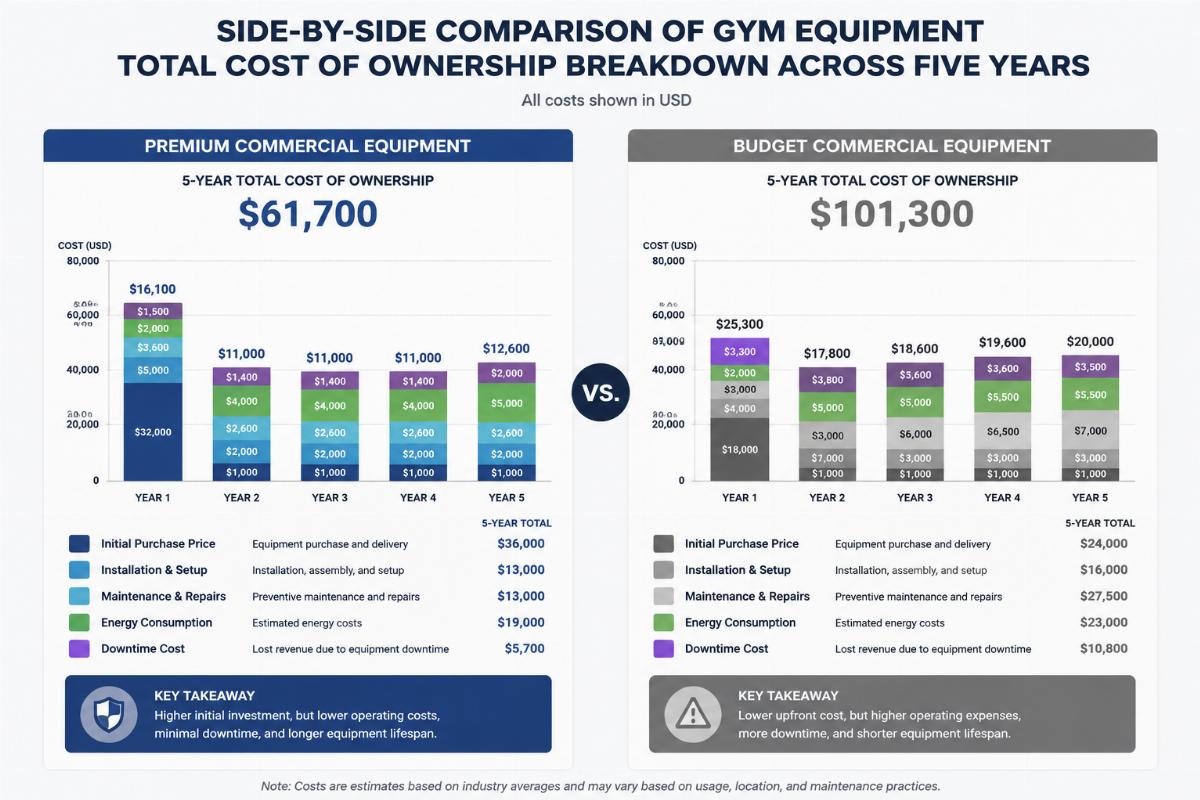
The Southeast Asian boutique studio deployment was the most cost-revealing. The operator was replacing a full Cybex Eagle free-weight set and wanted to understand whether a China hex dumbbell set could deliver acceptable durability at a fraction of the replacement cost. Over a multi-year horizon, the total cost of ownership for the Chinese set — including a modest early replacement allowance for the lightest weights — came in substantially below the Cybex Eagle replacement price, while delivering the vast majority of the functional service life.
The consistent finding across all three environments is this: a well-specified China hex dumbbell set does not match Cybex Eagle perfectly in every metric, but it delivers a very high percentage of the performance at a significantly lower price point. For most commercial operators, that trade-off is strongly favorable. [NEED_CITE: total cost of ownership analysis for commercial free-weight equipment replacement cycles]

Which Specifications Should Buyers Prioritize When Sourcing from China?
When sourcing a China hex dumbbell set for commercial use, buyers should prioritize rubber hardness verification, knurl depth measurement, and core rod material certification above all other specifications.
Too many buyers focus on cosmetic details — the hex shape precision, the chrome finish shine, the logo engraving — while ignoring the three specifications that actually determine how long the dumbbell will survive on a commercial gym floor. Based on years of inspecting returns and field failures, here is the priority list I give every serious buyer.
Rubber Hardness and Curing Quality
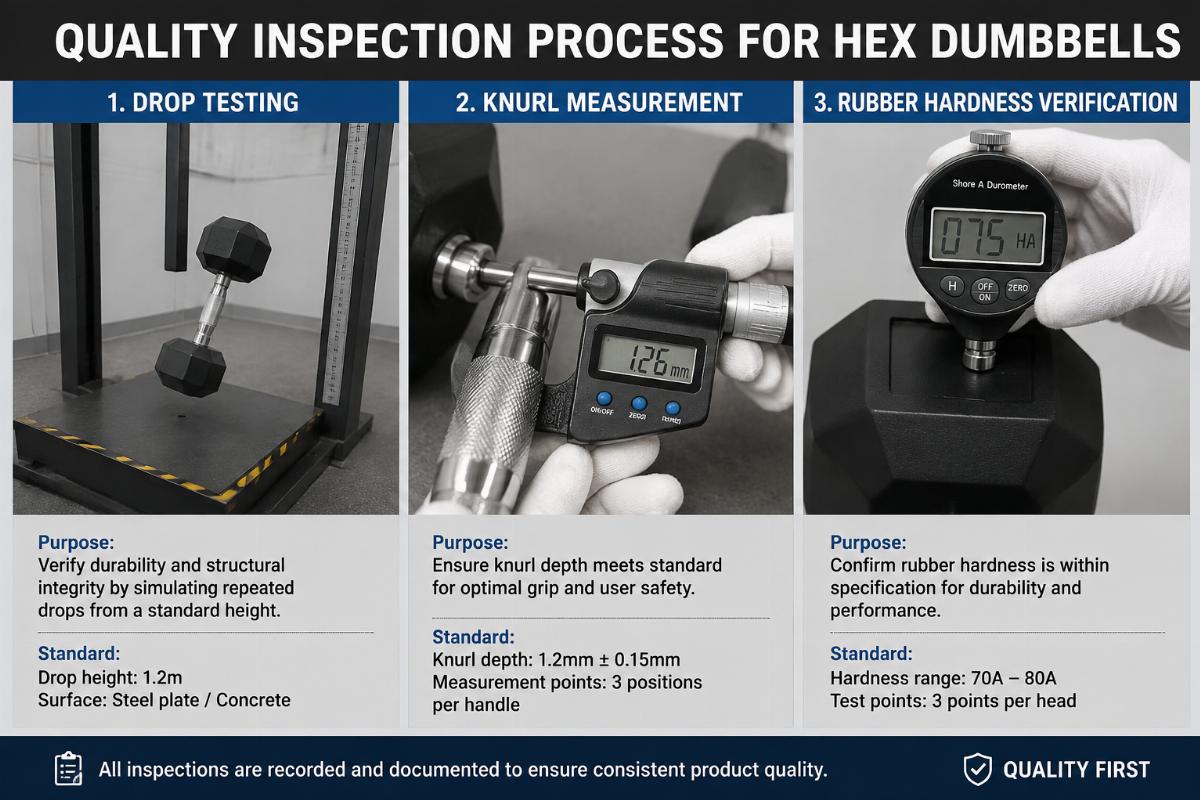
The rubber head must fall within a specified Shore A hardness range. Too soft, and the head deforms under repeated drops and develops flat spots; too hard, and it becomes brittle and cracks on impact. Beyond hardness, the curing quality determines whether the rubber will resist seam separation and surface stickiness over time. Buyers should request Shore A test reports for each production batch, not just a single sample from the first production run. [NEED_CITE: Shore A hardness testing procedure for rubber-coated fitness equipment]
Knurl Depth and Pattern Consistency
The knurl on the handle must be deep enough to provide secure grip throughout the product life, but not so aggressive that it damages users’ hands or wears down rapidly. A commercial-grade China hex dumbbell set should have a knurl depth that falls within a defined range, measured with a depth micrometer. Buyers should request knurl depth measurements from multiple dumbbells in the same batch to verify consistency. CNC-cut knurling from a verified supplier will show far less variation than manual or semi-manual processes.
Core Rod Material Certification
The core rod is the structural spine of the dumbbell. It must be made from verified commercial-grade carbon steel, not untested mild steel. Buyers should request material certificates from the steel supplier, not just a self-declaration from the dumbbell manufacturer. A bent core rod is a safety hazard and a warranty claim waiting to happen, and it is entirely preventable with proper material verification.
Additional Checks
Beyond the top three, buyers should also verify the hex head geometry for flat-spot resistance, check the chrome handle finish for adhesion and corrosion resistance, and conduct a basic odor assessment to screen for excessive VOC emissions from poorly cured rubber. A reputable supplier of a commercial China hex dumbbell set will provide documentation for all of these points without hesitation. [NEED_CITE: VOC emission assessment methods for rubber-coated indoor fitness equipment]
How to Verify Supplier Claims Before Placing Bulk Orders?
Before committing to a bulk order of a China hex dumbbell set, buyers should conduct physical sample testing, request third-party documentation, and audit the supplier’s quality control process rather than relying on catalog specifications alone.
The gap between what a supplier’s catalog says and what actually arrives in a container is where most commercial buyers get burned. I have seen catalogs listing premium materials and precise specifications, only to receive production batches that fell short on every measure. The only reliable way to close that gap is to verify before you commit.
Physical Sample Testing
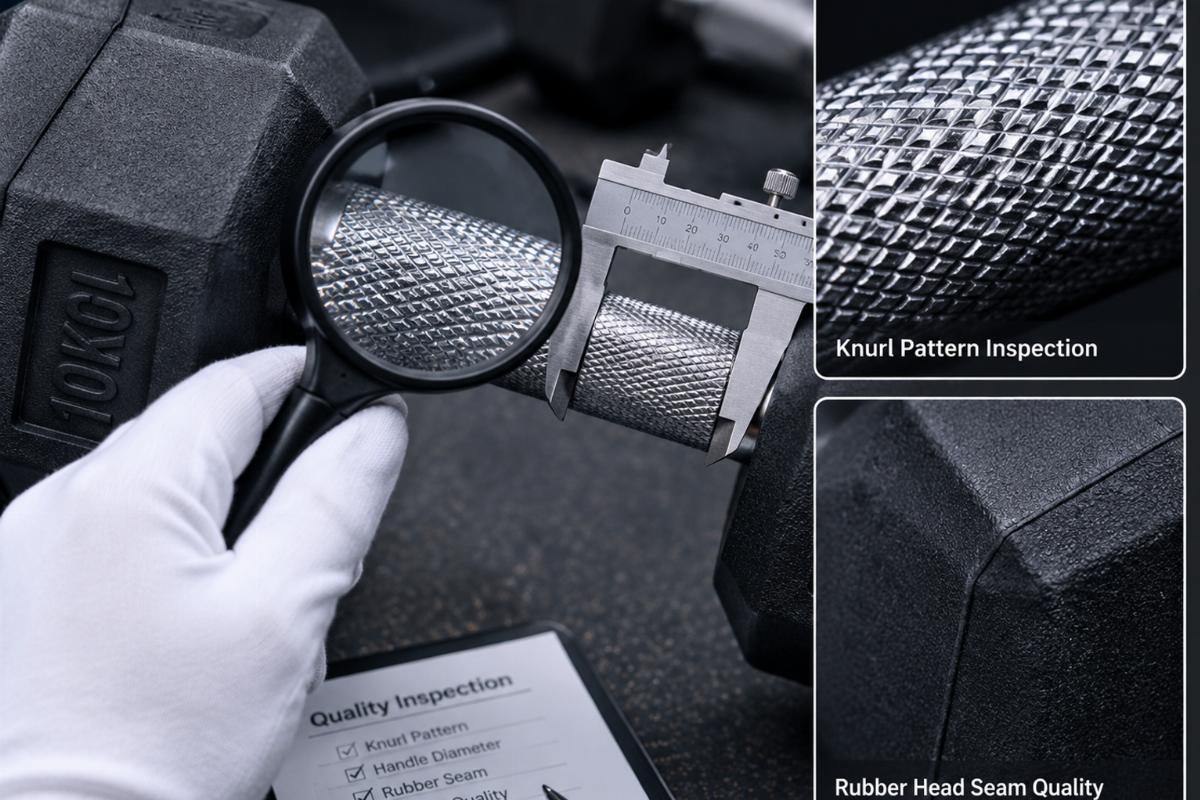
Request a full weight-range sample set, not just a single mid-range dumbbell. Conduct drop tests from a standard commercial height onto a concrete surface — a proper China hex dumbbell set should show no core rod bending, no rubber head detachment, and no excessive deformation after repeated drops. Inspect the knurl under magnification to check for consistency and sharpness. Smell the rubber heads — a strong chemical odor indicates incomplete curing and potential VOC issues. [NEED_CITE: drop test methodology for commercial free-weight equipment durability validation]
Third-Party Documentation
Request material certificates for the core rod steel, Shore A hardness test reports for the rubber compound, and any available third-party audit reports covering the supplier’s production facility. A supplier who cannot provide these documents for a commercial China hex dumbbell set order is a supplier who is cutting corners somewhere in the production chain. ISO certification is a baseline expectation, not a differentiator, at the commercial grade.
Production Facility Audit
If the order volume justifies it, visit the production facility or hire a local inspection service. Check whether the knurling is done on CNC lathes or manual machines, whether the rubber vulcanization uses temperature-controlled ovens or open-air curing, and whether the chrome plating line produces consistent finish quality. These process details determine whether the supplier can hold specifications across a full production run, not just on the samples they send you.
Pilot Order Strategy
For first-time buyers, a pilot order of a single container is the most practical way to validate a new supplier. Place the pilot order with clear acceptance criteria tied to the specifications you verified on the samples. If the production batch matches the samples, you have found a reliable source for a commercial China hex dumbbell set. If it does not, you have avoided a much larger mistake. [NEED_CITE: commercial gym equipment supplier audit and pilot order best practices]
Conclusion
A properly specified China hex dumbbell set delivers commercial-grade durability that closely approaches Cybex Eagle performance, with the decisive advantages lying in significantly lower acquisition cost and flexible OEM customization.
The durability gap between premium branded dumbbells and well-made Chinese alternatives has narrowed substantially, driven by improved rubber compound sourcing, CNC knurling adoption, and better quality control at leading factories. For commercial gym operators, distributors, and studio owners, the practical path forward is to define clear specifications for rubber hardness, knurl depth, and core rod material, verify those specifications through sample testing and third-party documentation, and select a supplier whose production processes can hold those specifications across full production runs.