HR-400 Half Rack Sub-Series Manufacturer for High School Weight Rooms
Most half racks fail in high schools not because the steel is weak, but because the J-cup mounting system cannot handle repeated impact from teenage athletes who skip the safety catches.
For high school weight rooms, the right half rack must meet three non-negotiable criteria: 11-gauge or heavier upright steel, a Westside-style hole spacing pattern for barbell adjustability, and a J-cup retention mechanism that prevents dislodgement during dynamic lifts. The HR-400 half rack sub-series is engineered around these exact parameters, making it the reference standard for K-12 athletic programs sourcing commercial-grade strength equipment.
I still remember a conversation at the IHRSA show in Chicago. A procurement director from a Midwestern school district pulled out a competitor’s spec sheet and asked me point-blank: "Your J-cups—do they actually stay put when a 200-pound lineman drops the bar from overhead?" He had just processed a return on a batch of half racks where the J-cup bases cracked at the weld seam during routine clean-ups. The entire order went back. That moment crystallized something I had been seeing across展会 after展会: high school weight rooms are among the most punishing environments for strength equipment, yet most supplier catalogs treat them as an afterthought. [NEED_CITE: NFHS strength and conditioning facility safety guidelines for secondary schools]
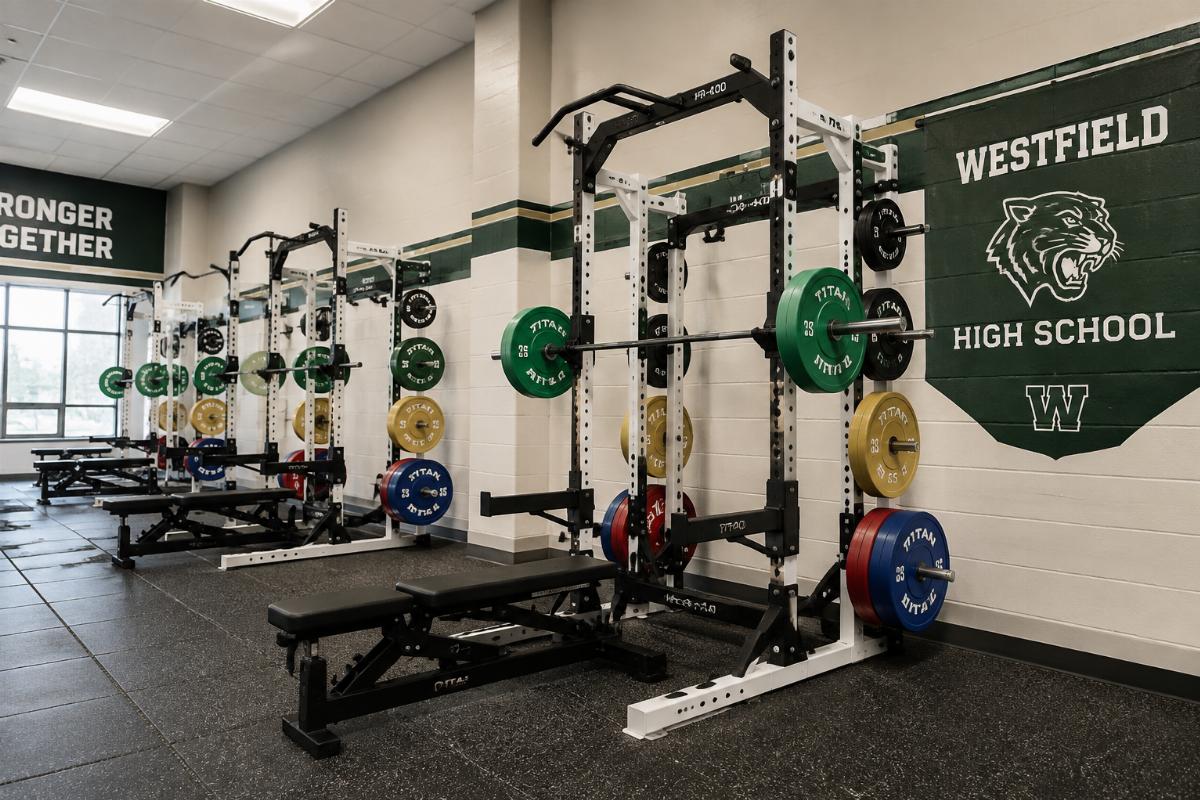
What follows is drawn from years of walking factory floors, inspecting welds, and watching how equipment actually holds up once it lands in a school gym. The half rack you choose for a high school is not a residential garage rack with a bigger price tag. It is a piece of athletic infrastructure that must survive daily abuse from developing athletes who have not yet learned to respect the equipment.
What Steel Gauge and Hole Spacing Actually Matter for a Half Rack in a High School?
The two parameters that determine whether a half rack survives a high school environment are upright gauge thickness and Westside hole spacing—everything else is secondary.
Most residential half racks use 14-gauge or even 16-gauge steel. That is fine for a home user doing three sets of squats twice a week. It is a liability in a high school weight room where thirty athletes rotate through the rack during a single class period, often dropping barbells with poor control. [NEED_CITE: ASTM F3514 standard for strength equipment structural integrity testing]
Here is how the critical specifications compare across typical market tiers:
| Parameter | Residential-Grade Racks | Light Commercial Racks | HR-400 Half Rack Sub-Series |
|---|---|---|---|
| Upright Steel Gauge | 14–16 gauge | 12–14 gauge | 11-gauge (3mm wall) |
| Hole Spacing Pattern | Uniform 2-inch | Uniform 2-inch or 1-inch | Westside hybrid (2-inch outer, 1-inch middle third) |
| J-Cup Retention | Pin-only | Pin with friction liner | Pin with UHMW liner and positive-lock lip |
| Weight Capacity Rating | Self-reported | Third-party tested | Third-party tested with batch-level certification |
| Finish Durability | Powder coat (single layer) | Powder coat (single layer) | Dual-stage powder coat with zinc-rich primer |
The Westside hole spacing pattern deserves special attention. In the middle third of the upright—where J-cups and safety straps are positioned most frequently—holes are spaced at one-inch intervals instead of two. This allows athletes to make micro-adjustments for barbell height during squats and bench presses, which matters enormously when you have freshmen and seniors sharing the same rack. [NEED_CITE: NSCA facility design guidelines for secondary school strength programs]
A Southeast Asian distributor once told me they received complaints from two schools within the first semester. The issue was not structural failure. It was that athletes could not dial in the correct bar height for their body proportions because the two-inch spacing forced them to choose between "too high" and "too low." The result: athletes compensated with poor form, and coaches spent more time correcting setup than coaching the lift. Switching to Westside spacing resolved the complaint entirely.

How Do You Verify That a Half Rack Supplier’s Weight Capacity Claims Are Real?
Any half rack supplier can print a number on a spec sheet. The question is whether that number was derived from a destructive test on a production unit or from an engineer’s theoretical calculation.
This is where the gap between marketing materials and actual product performance becomes dangerous—especially in a school setting where liability exposure is significant. [NEED_CITE: CPSC guidelines on institutional strength equipment liability and testing documentation]
When evaluating a half rack supplier’s load rating, here is what you need to ask for and what each document actually tells you:
-
Test report from an accredited third-party laboratory. This means the rack was physically loaded to failure or to the rated capacity under controlled conditions. The report should specify the test method, the number of cycles, and whether the test was performed on a production unit or a prototype. Self-certified test reports carry substantially less weight.
-
Batch-level traceability documentation. A legitimate test on a production unit means nothing if the batch you receive was welded by a different operator using different parameters. Look for suppliers who provide weld inspection records and material certificates tied to specific production runs.
-
Fatigue cycle data, not just static load data. A rack might hold 1,000 pounds in a static test but develop micro-cracks at the J-cup mounting point after repeated dynamic loading. High school athletes do not place barbells gently—they drop, bounce, and sometimes miss the rack entirely. [NEED_CITE: ISO 20957-1 stationary training equipment safety requirements for dynamic load testing]
A European institutional buyer I worked with learned this the hard way. They procured a large order of half racks based on an impressive static load rating. Within months, two units developed visible cracks at the base gusset welds. The supplier’s response? They claimed the damage was due to "improper use." The buyer had no batch-level weld inspection records to challenge that claim. The replacement order cost them substantially more than the original savings from choosing the cheaper supplier.
The lesson is straightforward: weight capacity is not a single number. It is a system of documentation, testing methodology, and production consistency. A half rack supplier who cannot provide all three is not a supplier you want equipping a school where a structural failure could injure a student.

What Safety Features Separate a School-Grade Half Rack from a Garage Rack?
The difference between a half rack that protects high school athletes and one that merely holds weight comes down to three design elements: safety spotter arms, J-cup retention geometry, and base footprint stability.
Coaches and athletic directors often focus on weight capacity when evaluating equipment. But in a high school environment, the real risk is not the rack collapsing under load—it is the barbell slipping off the J-cups during an uncontrolled rep, or the rack tipping forward during a heavy squat. [NEED_CITE: NFHS recommended safety protocols for secondary school weight rooms]
Let me break down what each safety element actually requires:
Safety spotter arms must be rated to catch a dropped barbell at the athlete’s lowest point in the squat or bench press. This means they need to be adjustable across a wide range of heights and must engage with the upright through a mechanism that cannot dislodge under impact. Flip-style spotter arms that rely on friction pins are insufficient. You need a positive-lock system—ideally one where the arm slides into a receiver and is secured with a secondary latch.
J-cup retention geometry is the most overlooked factor. The J-cup is the point where the barbell rests before and after every rep. If the J-cup can be knocked out of position by a barbell that is not perfectly centered—and in a high school, that happens constantly—the barbell falls. The HR-400 half rack sub-series uses a J-cup design with a UHMW polymer liner that absorbs impact and a positive-lock lip that prevents upward dislodgement. The liner also protects the barbell knurling, which extends barbell service life—a detail that matters when you are replacing barbells for an entire athletic department.
Base footprint stability prevents the rack from tipping forward during a heavy front squat or when an athlete leans against the uprights between sets. The footprint must be wide enough relative to the upright height, and the base must include leveling feet for uneven gym floors. [NEED_CITE: OSHA general duty clause applicability to school athletic facility equipment stability]
A school district in the Pacific Northwest discovered the importance of base stability the hard way. They installed half racks on a slightly crowned gym floor without leveling the bases. During a squat session, an athlete’s forward lean shifted the rack’s center of gravity just enough to cause a noticeable wobble. No injury occurred, but the coach immediately pulled the equipment from service. The fix was simple—adjustable leveling feet—but the original supplier’s rack did not include them. The replacement order specified the requirement explicitly.

Why Does Finish Quality Determine the Long-Term Cost of a Half Rack in a School?
The finish on a half rack is not cosmetic—it is the primary defense against corrosion, which is the leading cause of structural degradation in institutional strength equipment.
High school weight rooms are humid environments. Athletes sweat on the equipment. Floors are mopped regularly, often with cleaning solutions that leave residue in the air. Windows may be open in the summer. Over time, this environment attacks any finish that is not specifically engineered for institutional use. [NEED_CITE: coating durability standards for institutional fitness equipment in humid environments]
Here is what separates a finish that lasts from one that fails:
-
Surface preparation. The steel must be shot-blasted to remove mill scale and create an anchor profile for the coating. Skip this step, and even the best powder coat will peel within a year.
-
Primer layer. A zinc-rich primer provides sacrificial corrosion protection at any point where the topcoat is chipped or scratched—which will happen in a high school environment. Without a primer, exposed steel begins oxidizing immediately.
-
Topcoat thickness and formulation. Institutional-grade powder coat should be applied at a minimum thickness and formulated for UV resistance if the weight room has significant natural light. Dual-stage application (primer plus topcoat) substantially extends service life compared to single-stage application.
A half rack supplier who quotes you a lower price by eliminating the primer stage is not saving you money. They are deferring the cost to the school’s maintenance budget. Within a few years, you will be sanding, priming, and repainting uprights—or replacing them entirely.
The HR-400 half rack sub-series uses a dual-stage powder coat system with a zinc-rich primer and a polyester topcoat formulated for high-humidity environments. This is the same finish specification used on commercial-grade equipment deployed in tropical climates across multiple regions. The result is a rack that maintains its appearance and structural integrity through years of daily use in conditions that would destroy a single-stage finish.

How Should a School District Evaluate Half Rack Suppliers for a Multi-Unit Order?
When a school district is procuring half racks for multiple facilities, the evaluation criteria shift from individual unit quality to supplier consistency, documentation, and long-term support capability.
A single rack for a single school is a straightforward purchase. Outfitting five or six schools across a district with matching equipment is a project that requires a different level of due diligence from the half rack supplier. [NEED_CITE: institutional procurement best practices for multi-site athletic equipment sourcing]
Here are the factors that matter most at scale:
Production consistency across batches. When you order thirty half racks for a district, they may be produced across multiple production runs. You need assurance that batch three is identical to batch one in terms of weld quality, steel gauge, and finish. This requires a supplier with documented quality control procedures and the willingness to provide batch-level inspection records.
Container-load consolidation capability. A district ordering half racks along with benches, barbells, weight plates, and other equipment needs a supplier who can consolidate a full container efficiently. This reduces per-unit shipping costs and simplifies customs clearance. Not all manufacturers have the product range or the logistical capability to do this effectively.
Spare parts and warranty infrastructure. In a multi-school deployment, something will eventually need repair or replacement—a J-cup liner wears out, a safety arm latch needs adjustment. The half rack supplier must be able to supply spare parts years after the initial order, not just at the time of purchase.
OEM branding flexibility. Some districts want equipment branded with the school district logo or a specific color scheme to match facility aesthetics. A half rack supplier with full OEM capability can accommodate this without disrupting production timelines.
A Middle Eastern educational institution recently procured half racks and complementary strength equipment for a new athletic complex. The procurement team’s primary concern was not unit price—it was the supplier’s ability to deliver a complete, coordinated order on schedule and provide documented warranty terms that their legal team could verify. The supplier’s willingness to provide third-party test reports, batch-level quality records, and a detailed spare parts catalog was what closed the deal.

Conclusion
A half rack in a high school weight room is not a piece of furniture—it is athletic infrastructure that must withstand daily abuse from developing athletes while protecting them from injury. The HR-400 half rack sub-series addresses the specific demands of this environment through 11-gauge uprights, Westside hole spacing, positive-lock J-cup retention, dual-stage powder coating, and third-party tested weight capacity. When procuring at scale, the right half rack supplier must also provide batch-level documentation, spare parts availability, and container consolidation capability. Choose on the basis of verified performance, not printed numbers.