
Nautilus Functional Trainer OEM Cross-Reference for Government Procurement
Matching hardware specs alone will lose your bid. Government evaluators reject proposals missing traceable technical documentation, not inferior steel.
A Nautilus Functional Trainer OEM alternative for government tenders requires spec-by-spec parameter alignment across weight stack travel, pulley ratios, cable load ratings, and frame construction, paired with a complete traceable documentation package including CE/EN957 certification, material test reports, weld inspection records, and factory audit files. Factory-direct sourcing delivers cost advantages substantially below retail pricing, but success depends on assembling verifiable compliance archives rather than merely copying dimensions.
I learned this the hard way on a West African government fitness equipment tender a few years back. The procurement document specified alignment with the Nautilus 500 series functional trainer down to weight stack travel tolerance, pulley ratio configurations, cable breaking strength, and seat adjustment increment counts. We matched every parameter on paper and submitted pricing at roughly a third of the evaluation budget ceiling. The evaluation committee disqualified our bid—not because the equipment fell short mechanically, but because our documentation package lacked batch-level traceability on weld inspection records and material origin certificates. [NEED_CITE: government procurement documentation requirements for imported fitness equipment] That rejection reshaped how I approach every government tender since.

Let me walk you through what actually matters when positioning a Nautilus Functional Trainer OEM alternative for government procurement, and where most bidders quietly fail.
What Are the Key Specs to Cross-Reference Against Nautilus 500 Series Functional Trainer?
Four parameter categories determine whether your OEM equipment passes technical evaluation: weight stack travel range, pulley ratio configuration, cable assembly load rating, and main frame structural specifications.
Government procurement evaluators compare your submitted specification sheet line-by-line against the reference brand. Any deviation beyond stated tolerance triggers automatic disqualification in many tender systems. [NEED_CITE: fitness equipment procurement specification compliance standards]
| Parameter Category | Nautilus 500 Series Reference | OEM Cross-Reference Target | Documentation Required |
|---|---|---|---|
| Weight Stack Travel | Full range with controlled tolerance | Match travel distance within stated tolerance band | Dimensional inspection report |
| Pulley Ratio Configuration | Dual ratio capability | Identical ratio options available | Technical specification sheet |
| Cable Assembly Rating | Commercial-grade breaking strength | Meet or exceed rated load capacity | Material certification + load test report |
| Frame Construction | Heavy-gauge steel frame | Equivalent or superior steel gauge and weld quality | Weld inspection records + material test report |
| Adjustment Mechanisms | Multiple seat/pad position increments | Matching adjustment count and increment spacing | Dimensional verification report |
| Upholstery Specification | Commercial-grade vinyl thickness | Equivalent or superior material specification | Material composition certificate |
A Middle East government fitness facility procurement taught me that evaluators scrutinize the pulley system architecture more than buyers expect. The reference equipment uses a specific cable routing pattern that creates distinct resistance curves at different handle positions. Simply matching the external pulley count means nothing if the internal routing produces different mechanical advantage profiles. [NEED_CITE: cable machine pulley ratio mechanical advantage calculation methods]
The weight stack itself presents another hidden complexity. Beyond matching the total weight increment, you must verify that individual plate tolerance falls within acceptable range. Government evaluators who physically inspect sample units will measure plate-to-plate consistency. Variations beyond tolerance suggest poor manufacturing control and trigger deeper scrutiny of your entire submission.
Frame steel gauge matters, but weld quality matters more. A thicker frame with poor weld penetration fails load testing faster than a properly welded lighter-gauge frame. This is where your documentation package becomes critical—you need weld inspection records demonstrating penetration depth and continuity across all structural joints.

Why Do Government Procurement Bids Fail Even When Specs Match?
Technical specification compliance represents only the entry requirement. The actual evaluation battleground centers on traceable documentation proving every claim in your specification sheet.
Most bidders assume that matching parameters secures technical compliance. Government procurement evaluation systems operate differently. Evaluators require verifiable evidence chains connecting your claims to independent third-party validation. [NEED_CITE: government procurement technical evaluation documentation requirements]
A Southeast Asian dealer once approached me after losing three consecutive government fitness equipment tenders despite offering equipment that matched reference specifications. The rejection letters consistently cited "insufficient technical documentation" without specifying which documents were missing. After reviewing their submission packages, the pattern became obvious: they provided manufacturer specification sheets but lacked independent test reports, material origin certificates, and production batch traceability records.
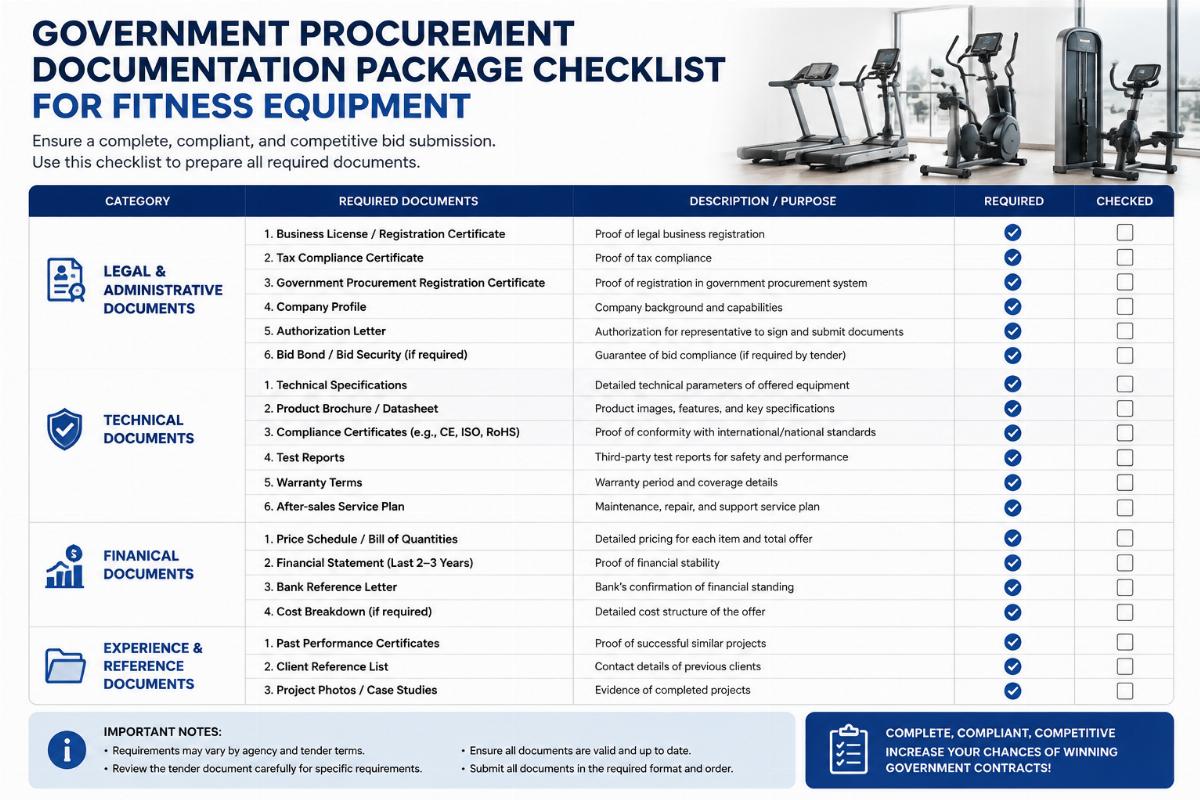
Government procurement evaluation committees typically require documentation across these categories:
-
Independent certification: CE marking alone proves nothing without the underlying test reports from accredited laboratories. Evaluators want to see the actual test data, not just the certification logo. [NEED_CITE: CE certification documentation requirements for fitness equipment exports]
-
Material traceability: Steel material certificates must trace back to specific mill batches. Generic "commercial-grade steel" statements carry zero weight in formal evaluation.
-
Production quality records: Weld inspection reports, load testing records, and dimensional verification reports must reference specific production batches, not generic quality claims.
-
Factory compliance documentation: ISO management system certificates, production facility audit reports, and quality control procedure documentation.
The Nautilus Functional Trainer OEM alternative that wins government tenders isn’t necessarily the one with the best equipment—it’s the one with the most complete documentation package. I’ve seen technically superior equipment lose to competitors with mediocre products but flawless documentation archives.
A West African procurement evaluation committee once spent extended time reviewing weld inspection records from competing bidders. The winning bidder’s documentation included ultrasonic testing reports on every structural weld, photographed and cataloged by serial number. The losing bidders provided only generic quality assurance statements. The equipment quality difference was negligible; the documentation difference was decisive.
How to Build a Compliant OEM Documentation Package for Government Tenders?
Start documentation preparation before production begins, not after. Government-compliant documentation packages require systematic evidence collection throughout the entire production process.
Most manufacturers treat documentation as an afterthought—something to assemble once the equipment is built and ready to ship. This approach fails government procurement requirements. Traceable documentation requires evidence collection at multiple production stages, and some evidence cannot be generated retroactively. [NEED_CITE: fitness equipment manufacturing quality documentation best practices]
The documentation package construction process follows this sequence:
Stage One: Raw Material Documentation
Obtain material certificates from steel suppliers for every batch used in production. These certificates must include chemical composition, mechanical properties, and mill identification. Store certificates organized by production batch number for later cross-referencing.
Stage Two: Production Process Records
Document weld procedures with qualified welder certifications. Conduct and record weld inspections—visual inspection minimum, ultrasonic testing for critical structural joints. Photograph weld conditions before and after coating application. Record dimensional measurements during frame assembly, not just final inspection.
Stage Three: Component Testing Records
Test cable assemblies to destruction and record breaking loads. Document pulley system rotation torque measurements. Record weight stack dimensional measurements and calculate tolerance deviations. Test adjustment mechanism operation cycles and record wear observations.
Stage Four: Final Assembly Verification
Conduct complete assembly inspection against specification requirements. Document every measurement with photographs showing measurement methods. Record serial numbers on all major components for traceability linkage.
Stage Five: Certification Package Assembly
Compile third-party test reports from accredited laboratories. Organize material certificates by equipment serial number. Create cross-reference matrices linking every specification claim to supporting documentation.
A government tender I supported required documentation for a substantial order of functional trainers. The procurement specification demanded that every piece of equipment shipped must have an individual documentation file traceable to that specific unit’s serial number. This meant material certificates, weld inspection records, load test reports, and final inspection records all organized by serial number—not by production batch or model type.
Building this documentation system requires upfront investment in production process controls. You cannot generate weld inspection records after welding is complete. You cannot create material traceability after steel has been cut. The manufacturers who succeed in government procurement treat documentation as a production process requirement, not a shipping department task.

What’s the Real Cost Advantage of China OEM vs. Nautilus for Government Projects?
Factory-direct sourcing delivers substantial cost advantages over branded retail pricing, but government procurement success requires budgeting time and resources for documentation preparation and sample verification cycles.
The cost comparison between Nautilus retail pricing and Chinese OEM factory-direct pricing shows dramatic differences. Government procurement budgets often reference branded equipment pricing as benchmarks, creating opportunities for OEM suppliers offering equivalent specifications at significantly lower price points. [NEED_CITE: fitness equipment OEM pricing comparison China vs branded manufacturers]
However, the actual cost structure for government procurement success includes elements beyond unit pricing:
Documentation Preparation Investment: Building compliant documentation packages requires dedicated resources. Third-party testing at accredited laboratories carries costs. Quality control system implementation for traceable documentation requires process changes and staff training. These costs amortize across orders but represent real upfront investment.
Sample Verification Cycles: Government procurement typically requires sample submission and approval before full order commitment. Multiple sample iterations may be necessary to achieve specification compliance and documentation alignment. Each iteration cycle carries costs for production, testing, shipping, and potential redesign.
Certification Maintenance: CE certification, EN standards compliance, and other required certifications require ongoing maintenance. Surveillance audits, recertification testing, and standard updates all carry recurring costs that must factor into pricing calculations.
Quality Control Infrastructure: Government procurement demands consistent quality across production runs. Maintaining this consistency requires investment in quality control personnel, testing equipment, and process documentation systems.
A Middle East government fitness facility project demonstrated how these cost elements interact. The initial unit pricing appeared highly competitive against branded alternatives. However, the documentation preparation, multiple sample iterations, and third-party testing requirements extended the project timeline substantially. The total project cost remained well below branded alternatives, but the timeline and resource requirements exceeded initial expectations.
The manufacturers who successfully compete in government procurement understand that documentation compliance and quality consistency represent cost centers, not overhead to minimize. Investing in these capabilities creates competitive advantages that extend beyond any single tender.

How to Verify an OEM Supplier Can Actually Deliver Nautilus-Equivalent Quality?
Request evidence of previous government procurement success, third-party test report originals, and production facility verification before committing to orders.
The fitness equipment OEM market contains manufacturers capable of producing government-compliant equipment alongside manufacturers producing only basic commercial quality. Distinguishing between these capability levels requires systematic verification rather than marketing claims. [NEED_CITE: fitness equipment OEM supplier qualification verification methods]
Verification should address three critical capability areas:
Previous Government Procurement Experience
Request specific examples of previous government procurement orders completed. Legitimate suppliers maintain records of government projects including procurement specifications, documentation packages submitted, and order fulfillment records. Suppliers without government procurement experience will struggle to demonstrate understanding of documentation requirements and evaluation processes.
Verify that claimed government projects actually required documentation similar to your tender requirements. A supplier experienced with basic government procurement may lack capability for tenders requiring extensive traceability documentation.
Third-Party Test Report Authenticity
Request original test reports from accredited laboratories, not copies or summaries. Verify that test reports reference specific product models and production batches. Contact testing laboratories directly to confirm report authenticity when necessary.
Examine test report scope carefully. Reports covering only basic safety requirements may not address the full range of specifications your government tender requires. Comprehensive test reports should cover structural integrity, material properties, functional performance, and safety requirements.
Production Facility Capability Verification
Request production facility documentation including equipment lists, quality control procedures, and staffing qualifications. If possible, arrange facility inspection either in person or through independent third-party inspection services.
Evaluate whether production facilities include capabilities for the documentation requirements your tender demands. Weld inspection requires qualified inspectors and appropriate testing equipment. Material traceability requires organized record-keeping systems. Dimensional verification requires calibrated measurement equipment.
A South American government procurement agency required supplier facility audits before approving vendor lists. The audit process revealed that several suppliers claiming government procurement capability lacked basic quality control infrastructure. Weld inspection procedures existed only on paper. Material traceability systems could not connect finished products to specific material batches. Dimensional measurement equipment lacked calibration records.
The suppliers who passed facility audits demonstrated integrated quality control systems where documentation generation occurred naturally through production processes rather than as separate administrative tasks. Welders maintained personal logs of completed welds. Material handlers recorded batch numbers at every transfer point. Quality inspectors documented measurements during production rather than after completion.
These capability differences become apparent only through systematic verification. Marketing materials and sales presentations cannot substitute for evidence of actual production and documentation capabilities.

Conclusion
Government procurement success with Nautilus Functional Trainer OEM alternatives depends on documentation completeness, not just specification matching.
Winning government fitness equipment tenders requires building traceable documentation packages that verify every specification claim through independent third-party validation. Factory-direct sourcing provides substantial cost advantages, but success demands investment in quality control infrastructure, certification maintenance, and systematic documentation processes throughout production. Suppliers capable of delivering government-compliant equipment demonstrate integrated quality systems where documentation generation occurs naturally through production processes, not as afterthought administrative tasks.


