
China Bench Press Bench vs PowerLine: Wholesale Price vs Value for Gyms
Cheap does not mean cut corners — it means no middlemen.
A China factory-direct bench press bench can match or exceed the structural durability of a PowerLine bench at substantially lower cost — provided buyers verify weld penetration, padding density, and frame gauge before signing a purchase order.
I still remember the first container I shipped to a Dubai gym chain. The buyer had pulled up a Life Fitness spec sheet and asked us to match it. Our quoted price was roughly a fraction of theirs. He placed the order, and within weeks he called me back — the stitching on the seat pad had split, and the weld seams on the frame were rough enough to cut skin. That batch had been outsourced to a small workshop to rush the timeline. I flew down, stood on the factory floor myself, and inspected every weld bead and every spray coat before the next shipment left. Since then, I have sat across the table from distributors in South America, hotel developers in Southeast Asia, and gym chain owners in the Middle East, and the question is always the same: where exactly does the price gap come from, and where does it bite? This article breaks that down using a bench press bench as the case study, comparing PowerLine’s entry-level commercial positioning against China factory-direct alternatives.
Let me walk you through what you are actually paying for, where the cost really drops, and how to verify quality spec by spec.
What Exactly Are You Paying For in a PowerLine Bench?
PowerLine positions itself as an entry-level commercial bench, and its retail price reflects brand overhead, distribution layers, and compliance documentation — not necessarily heavier steel.
When a gym buyer in Latin America or the Middle East opens a catalog and sees a PowerLine bench press bench priced at a certain level, the number on the page is not just the cost of the steel tubes and the foam pad. A meaningful portion of that price covers brand licensing, regional distributor margins, warehousing in the destination country, and the compliance paperwork that comes with a recognized label [NEED_CITE: typical cost structure breakdown of branded fitness equipment including distribution markup]. In my experience sourcing across multiple Chinese manufacturing hubs, the raw material cost — the steel frame, the padding, the upholstery — typically represents a minority share of the final retail price for branded benches. The rest is channel cost.
This is not a criticism of PowerLine. They offer a consistent product, accessible warranty channels, and the peace of mind that comes with a recognizable name. For a single-unit home buyer, that trade-off makes perfect sense. But for a gym chain outfitting fifty stations, or a distributor filling a container for resale, that channel cost compounds into a mid-five-figure premium over a factory-direct bench press bench built to the same structural spec.
The key insight: the price gap is not driven by thicker steel or better foam. It is driven by the number of hands the product passes through before it reaches your loading dock.

China Factory-Direct Bench: Where Does the Cost Actually Drop?
Factory-direct pricing saves on distribution layers, not on material — and buyers who understand this can source a bench press bench that meets commercial durability standards at a fraction of branded cost.
The misconception I encounter most often is that a lower price automatically means thinner tubes or weaker welds. In reality, a well-run Chinese factory producing a bench press bench for commercial export uses the same grade of steel, the same density of high-resilience foam, and the same powder-coat process as the factories supplying mid-tier Western brands. The cost advantage comes from three structural factors: the factory owns the production line rather than licensing the brand, the buyer orders direct rather than through a regional distributor, and the compliance documentation is scoped to the buyer’s actual market requirements rather than bundled for global retail [NEED_CITE: factory-direct fitness equipment cost advantage analysis excluding material cost differences].
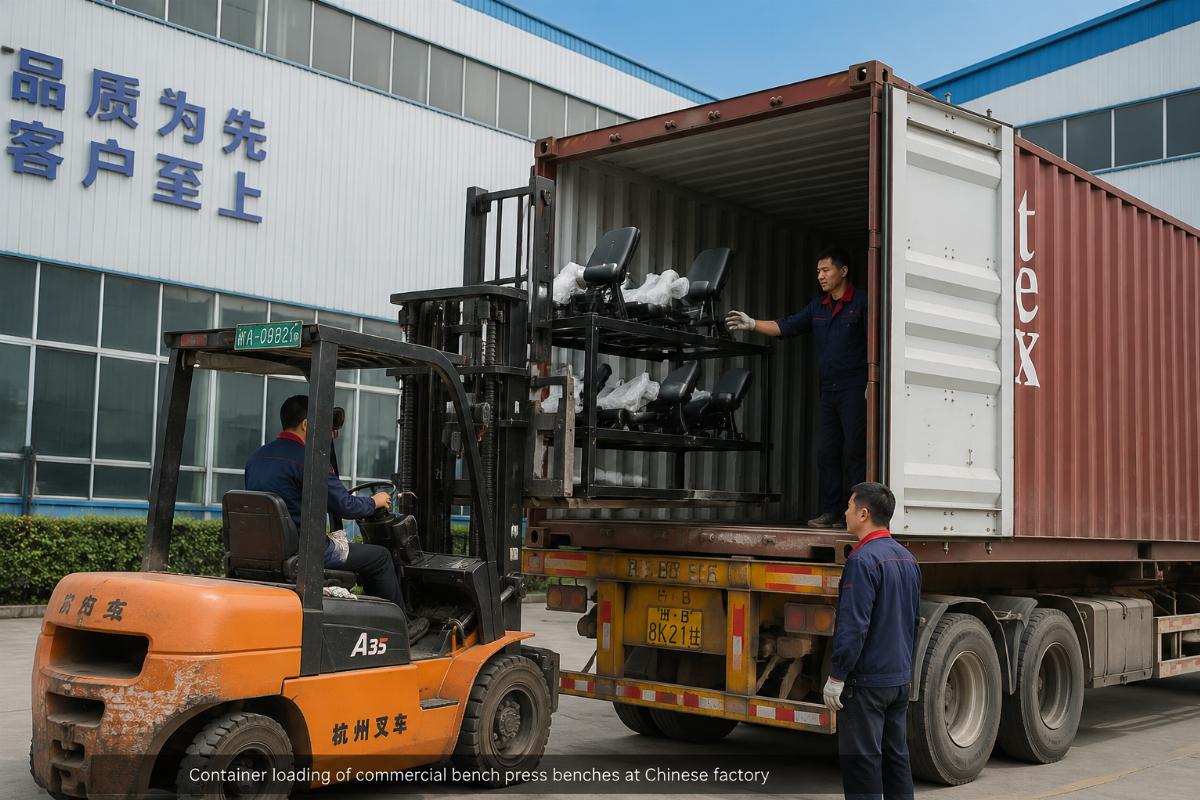
I have worked with a South American distributor who compared a factory-direct flat bench against a PowerLine equivalent. The factory upgraded the frame tube wall thickness from a standard residential gauge to a heavier commercial-grade gauge, used full-penetration welds instead of spot welds, and specified high-density molded foam for the pad. Even with those upgrades, the per-unit landed cost — including ocean freight and customs — came in substantially lower than the PowerLine wholesale price. The distributor then applied his own branding and sold into the regional market at a healthy margin.
The catch is that not every factory operates this way. The price advantage only holds when the buyer knows which specifications to verify and which corners are commonly cut.
Spec-by-Spec Comparison: Weld, Padding, Frame & Finish
The difference between a bench that lasts ten years and one that fails in six months comes down to four verifiable specifications — and none of them require trusting a brand name.
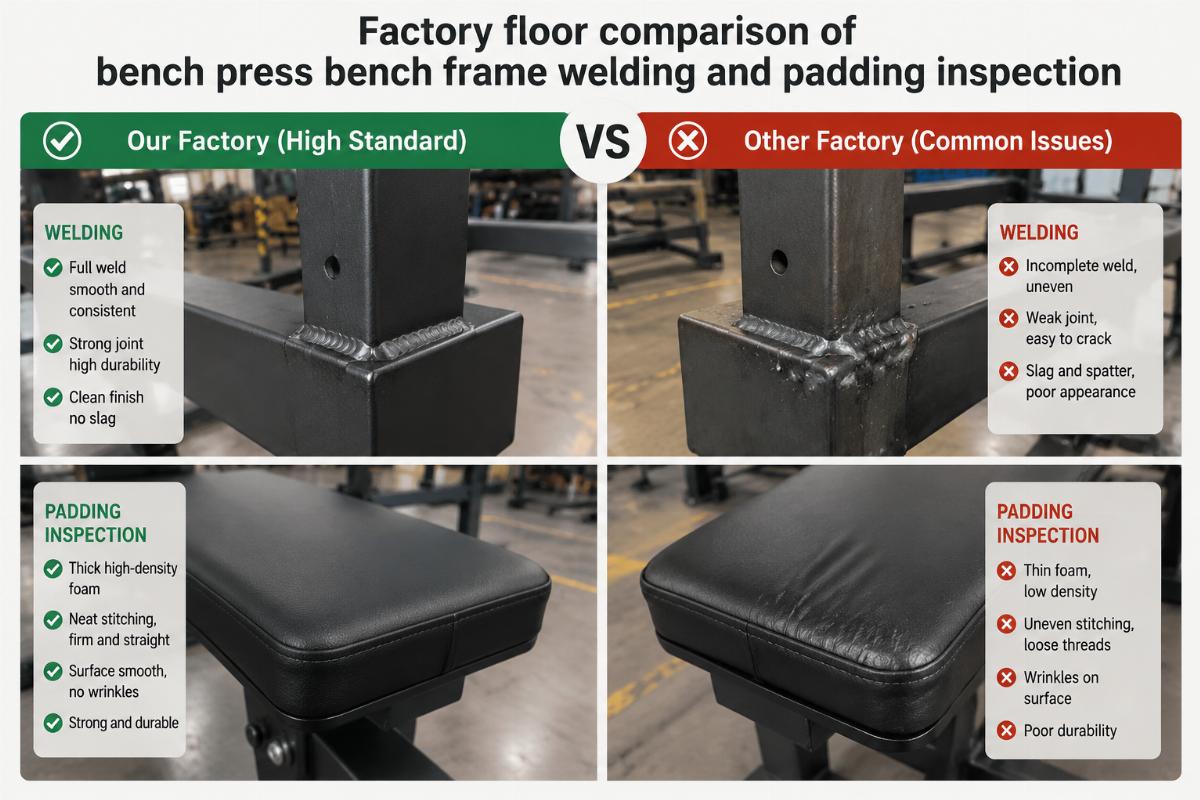
When I inspect a bench press bench on the production line, I check four things first: the weld quality, the padding density, the frame tube thickness, and the surface finish. These four factors determine whether the bench survives years of heavy commercial use or starts cracking, sagging, and rusting within months. Below is a comparison matrix showing how a typical PowerLine-class bench stacks up against a well-specified China factory-direct bench press bench.
| Specification | PowerLine-Class Branded Bench | China Factory-Direct Commercial Grade | Budget Factory-Direct (Unverified) |
|---|---|---|---|
| Frame Tube Wall Thickness | Standard commercial gauge | Upgraded commercial gauge available | Thin residential gauge |
| Weld Type | Machine weld, consistent | Full-penetration weld, hand-finished | Spot weld, visible gaps |
| Padding Foam Density | Medium-high density | High-density molded foam available | Low-density cut foam |
| Surface Finish | Powder coat, even | Powder coat, even | Spray paint or thin coat |
| Upholstery Stitching | Reinforced | Double-stitched, vinyl-grade | Single-stitched, prone to splitting |
| Compliance Documentation | Full retail package | Scoped to buyer market | Minimal or generic |
[NEED_CITE: commercial fitness equipment weld quality standards and inspection criteria]
The weld is where I see the most dangerous cost-cutting. A spot weld looks acceptable from a distance, but under repeated heavy loading — think a lifter racking a loaded barbell hundreds of times a week — the stress concentrates at the weld points and cracks propagate. A full-penetration weld that has been ground smooth distributes the load across the entire joint. I have seen unverified factory benches fail at the weld seam within months of commercial deployment, while properly welded benches from the same country run for years without issue.
Padding is the second trap. Low-density foam feels soft and comfortable on day one, but it compresses permanently within weeks under commercial use. High-density molded foam — the kind that meets commercial gym standards — retains its shape and support over extended service life [NEED_CITE: high-density foam durability standards for commercial fitness upholstery]. The density difference is not visible to the naked eye, which is why buyers must request the foam density specification from the factory before ordering.

Real Orders Gone Wrong: What Happens When You Choose Wrong
The cost of a bad bench purchase is never just the refund — it is the downtime, the replacement shipping, and the damaged reputation with your gym members.
I have seen three recurring failure patterns across the orders I have been involved with, and each one traces back to a specification that was not verified before production.
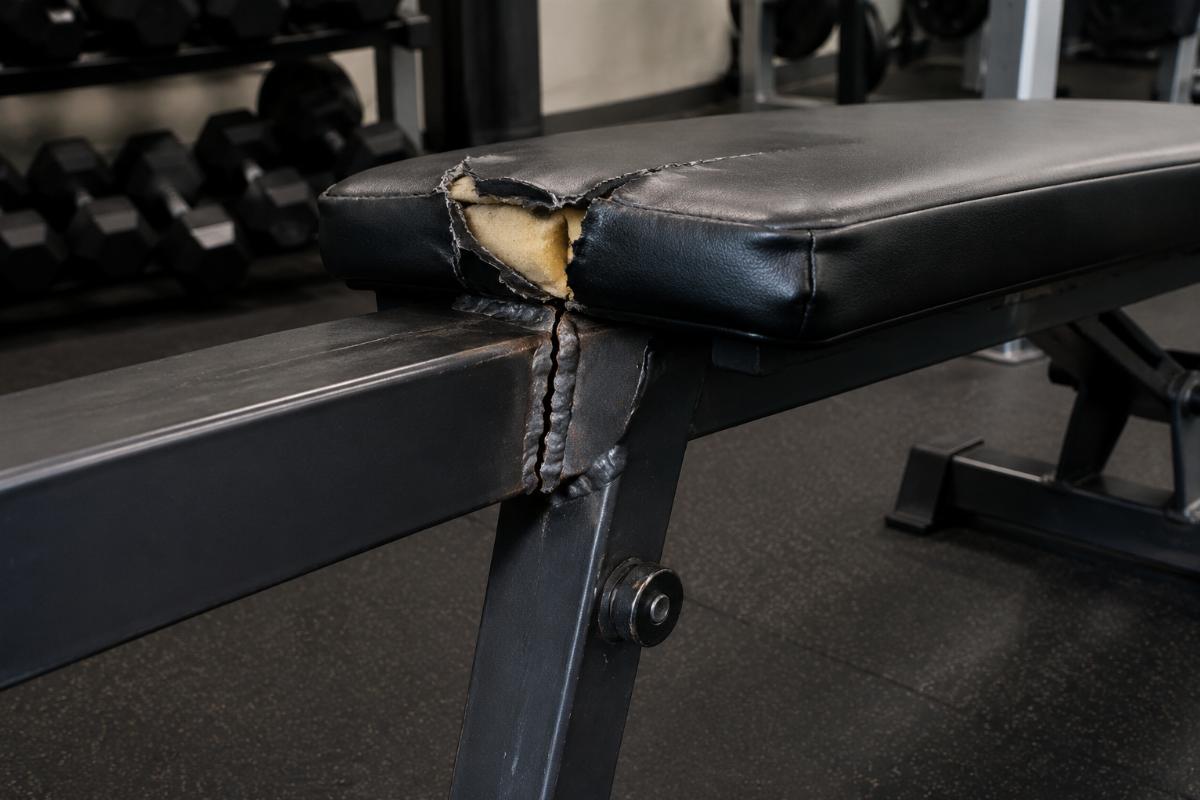
The first case involved a Middle East gym chain that placed an initial order through a trading company rather than directly with a factory. The benches arrived looking acceptable, but within weeks the seat pad stitching began splitting under normal use. The vinyl was thin, the thread was not reinforced, and the foam underneath was low-density. The gym had to pull the benches from the floor, arrange return logistics, and wait for replacements — losing revenue and member trust in the process. The root cause was not the country of origin; it was the lack of direct factory oversight [NEED_CITE: common failure modes in commercial fitness equipment upholstery and padding].
The second case was a hotel fitness center project in Southeast Asia. The developer selected the lowest-priced bench press bench available, and the frames arrived with visible weld spatter and rough edges. More critically, the welds had not been ground or finished — they were as-welded. Within months, stress cracks appeared at the joint intersections. The hotel had to replace the entire set, and the project budget was blown.
The third case was a distributor in South America who learned from the first two. He requested weld cross-section photos, foam density certificates, and a pre-shipment inspection report before placing his order. He paid slightly more per unit than the cheapest option, but his return rate dropped to near zero. He now orders full containers on a repeat basis.
How to Source a Bench That Matches Brand Quality at Factory Price
The buyers who get brand-level quality at factory-direct pricing follow a verification checklist — and they do not skip the pre-shipment inspection.
Based on years of sourcing and production oversight, here is the verification process I recommend for any buyer evaluating a China factory-direct bench press bench against a branded alternative like PowerLine.
First, request the frame tube specification. Ask for the wall thickness and the steel grade. Commercial-grade benches should use a heavier wall thickness than residential models [NEED_CITE: commercial fitness equipment frame tube thickness standards]. If the factory cannot provide this in writing, move on.
Second, ask about the weld process. Request photos of the weld joints — both before and after grinding. A full-penetration weld that has been ground smooth will look like a continuous, even bead. A spot weld will show distinct dots with gaps between them. If the factory hesitates to share weld photos, that is a red flag.
Third, verify the padding. Ask for the foam density specification. Commercial-grade padding should use high-density molded foam that resists permanent compression [NEED_CITE: commercial fitness upholstery foam density requirements]. If the factory quotes a density figure that seems low, request a sample pad and test it yourself.
Fourth, confirm the surface finish. Powder coating is the commercial standard. Spray paint is not. Ask about the coating thickness and the pre-treatment process — proper phosphating or sandblasting before coating is what prevents rust from forming underneath.
Fifth, arrange a pre-shipment inspection. Either hire a third-party inspection service or send your own representative to the factory. Check a random sample of units from the production batch — not the pre-production sample that was carefully hand-built. Verify weld quality, padding firmness, upholstery stitching, and finish evenness across the sample [NEED_CITE: third-party fitness equipment inspection protocols and checklists].
Finally, clarify the compliance documentation you actually need. If you are selling into a market that requires specific safety certifications, confirm that the factory can provide them. If you are outfitting your own gym chain and do not need retail packaging or global certification bundles, tell the factory — this is another area where cost can be trimmed without affecting product quality.

Conclusion
The price gap between a branded bench press bench and a China factory-direct alternative is real — but it reflects distribution cost, not material cost.
Buyers who verify weld quality, padding density, frame thickness, and surface finish before placing an order consistently receive commercial-grade durability at substantially lower cost. The factories capable of producing this quality exist; the task is knowing which specifications to demand and which inspection steps to enforce before the container leaves the port.


