PL-3000 Leg Press Wholesale Supplier & Warranty Guide
Most buyers think a longer warranty means better protection. The real leverage lies in spare parts response speed, freight allocation clauses, and serial number registration before the container doors even open.
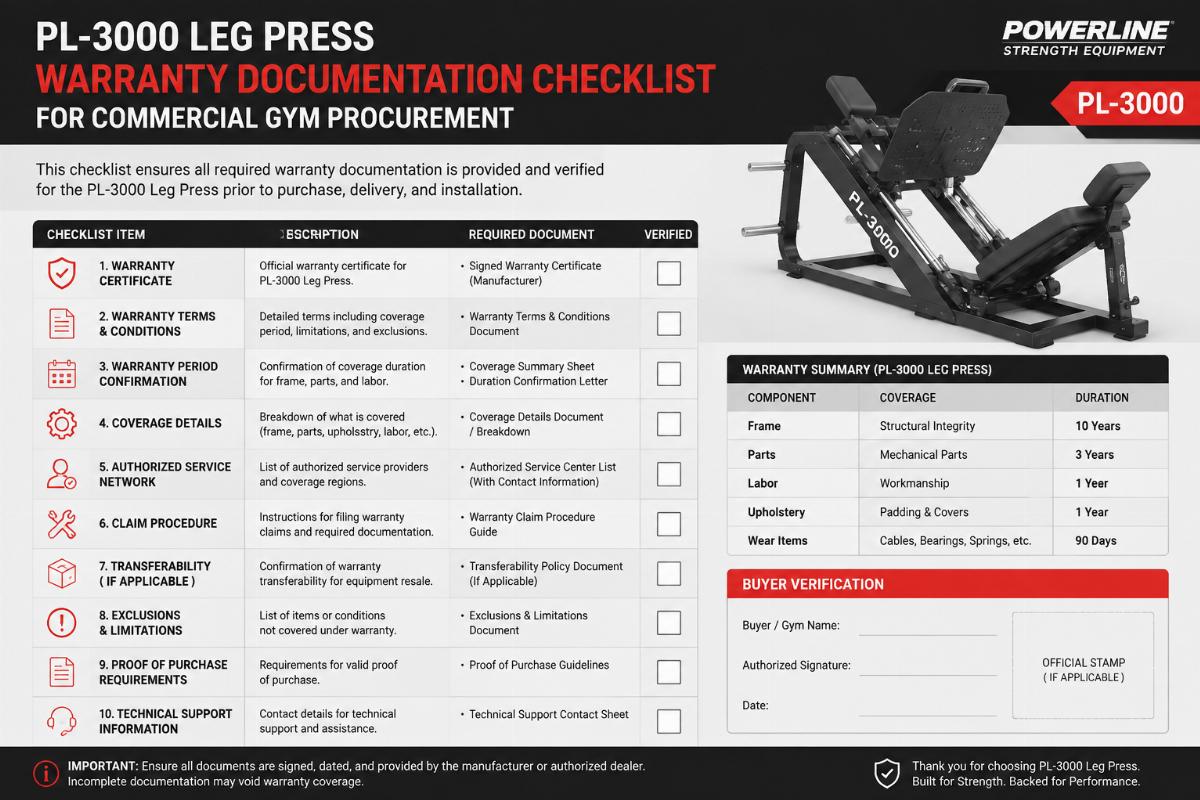
The PL-3000 leg press warranty covers the main frame and welded structural components for a long-term period, moving parts such as guide rods and pivot bearings for a moderate period, and excludes consumables like pedal pads, grip sleeves, and cable belts entirely. Claims require arrival inspection photos, serial number registration within a defined window, and clear freight-sharing terms. Spare parts for commercial-grade machines are typically dispatched via express logistics, with post-warranty procurement available through pre-locked spare parts lists. The PL-3000 leg press warranty is not about whether the manufacturer pays — it is about who pays for freight, how fast parts arrive, and how备件 inventory is secured before failure happens.
I still remember a full container of plate-loaded machines bound for Lagos. The bill of lading description did not match the HS code the clearing agent expected. The cargo sat at the port for over a month. Storage fees devoured most of the margin. The client kept calling. The lesson was simple: the paperwork details decided the cost, not the product quality. Since then, I read every warranty clause the way I used to read customs declarations — line by line, looking for the trap. [NEED_CITE: international trade contract conventions on warranty claim documentation]
When you source a PL-3000 leg press wholesale supplier, the warranty document is not a marketing brochure. It is a risk allocation contract. And most buyers only read it after something breaks.
Let me walk you through what actually matters.
What Does the PL-3000 Leg Press Warranty Actually Cover?
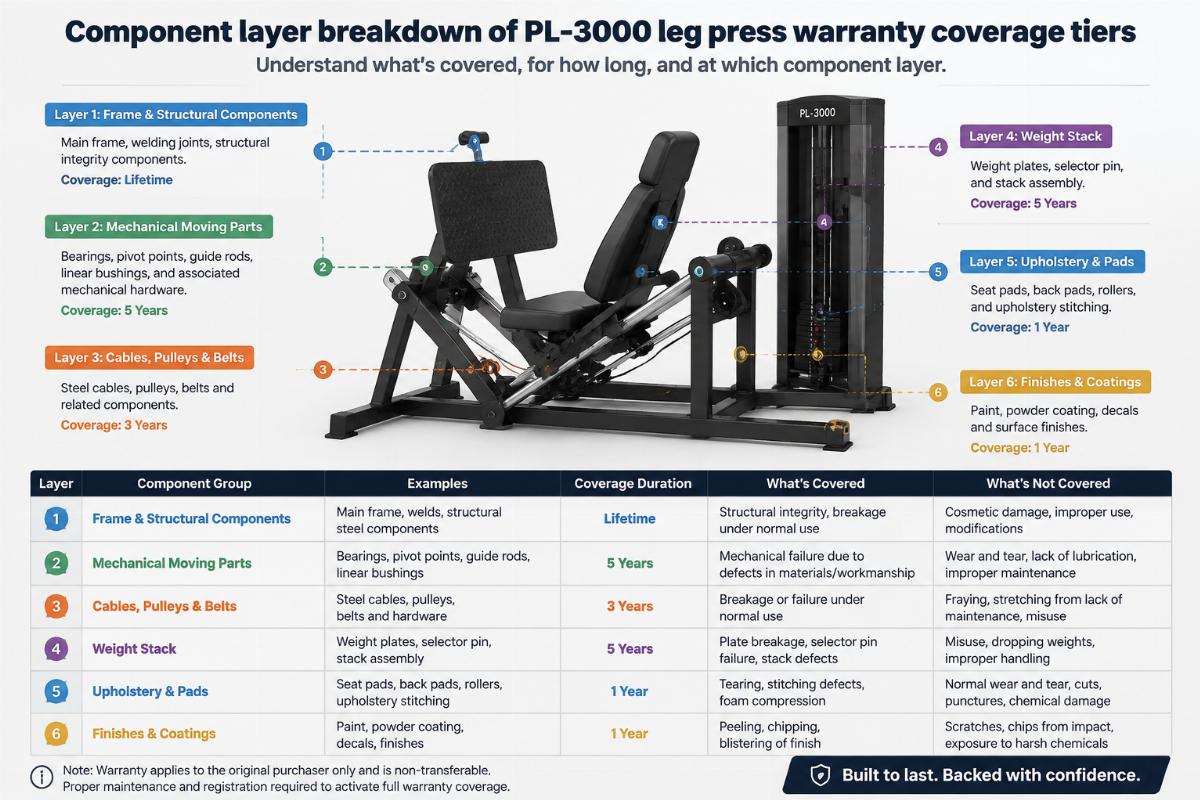
Warranty coverage is layered, not blanket. The frame and welded structure receive the longest protection, guided movement components receive moderate coverage, and wear-prone consumables are excluded by default.
Here is how commercial leg press warranty terms are typically structured across the industry:
| Component Category | Typical Coverage Tier | What Is Included | What Is Excluded |
|---|---|---|---|
| Main Frame & Welded Structure | Full batch-level structural warranty | Steel frame cracks, weld failures under normal use | Damage from unauthorized modification, improper anchoring |
| Guide Rods & Linear Bearings | Standard moving parts warranty | Surface pitting, premature wear under rated load | Lack of lubrication, contamination from gym floor debris |
| Pivot Bearings & Bushings | Standard moving parts warranty | Manufacturing defects in bearing races | Normal wear from high-frequency commercial use |
| Pedal Pads, Grip Sleeves, Belt Straps | Consumable — no warranty | Not covered | Surface wear, tearing, compression set |
| Upholstery & Foam | Consumable — no warranty | Not covered | Sweat damage, cutting, abrasion |
| Hydraulic Components (if applicable) | Conditional warranty | Seal leaks under rated pressure | Over-pressurization, fluid contamination |
[NEED_CITE: commercial fitness equipment warranty tier standards per ISO training equipment guidelines]
The critical point: pedal pads and pivot bearings are the parts that fail first in high-traffic commercial gyms. And they are almost never covered under the core warranty. A Middle East gym chain operator once told me their PL-3000 units saw heavy daily use — multiple shifts of athletes pressing heavy loads. The pedal bearings started showing play within the first year. The manufacturer agreed the bearings were defective and shipped replacements at no charge. But the freight cost became a negotiation. Who pays for express shipping of bearing kits to Dubai? The warranty document said "free replacement parts." It did not say who pays for DHL.
That is the gap most buyers miss. "Free parts" does not mean "free delivery."
How Do You File a Warranty Claim Without Getting Stuck in Disputes?
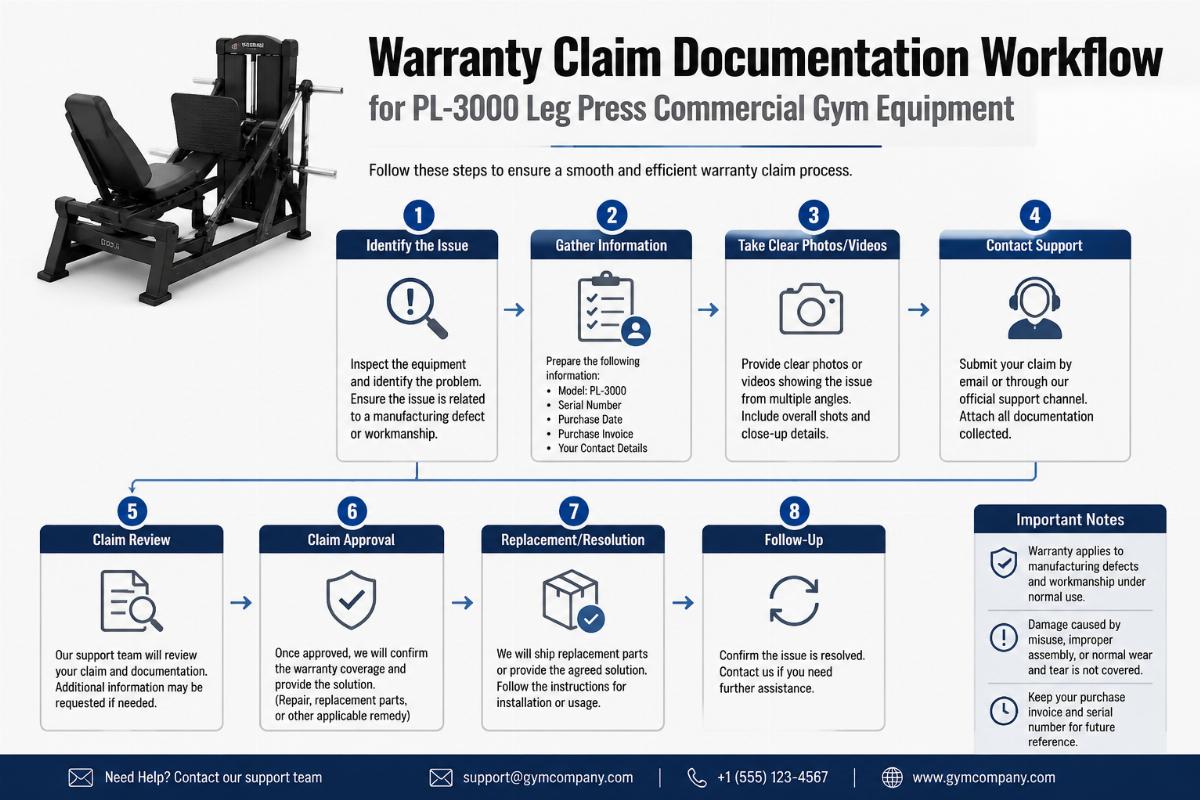
A valid claim depends on three things done before the machine is even used: arrival inspection with timestamped photos, serial number registration with the manufacturer, and written confirmation of freight allocation terms.
Most claim disputes do not happen because the part actually failed. They happen because the buyer cannot prove the condition at arrival. Here is the claim workflow that minimizes friction:
-
Container Unloading & Visual Inspection. Before the forklift moves a single unit, photograph every machine with the container number visible in frame. Document any dents, scratched powder coating, or shifted packaging. This is your baseline evidence. [NEED_CITE: cargo arrival inspection best practices for imported gym equipment]
-
Serial Number Logging. Every PL-3000 leg press carries a unique serial number on the main frame. Register these numbers with the PL-3000 leg press wholesale supplier within the window specified in your purchase contract — typically a defined number of days after bill of lading date. Unregistered units may face claim delays or denial.
-
Failure Documentation. When a component fails, photograph the defect with the serial number tag visible. Include a close-up of the broken part and a wider shot showing the machine context. Video evidence of the failure mode in action is even stronger.
-
Freight Allocation Confirmation. Before shipping any defective part back — or before receiving a replacement — confirm in writing who bears the freight cost. Some suppliers absorb outbound freight for replacements but require the buyer to cover return shipping of defective parts. Others split costs. Get it in email, not over a voice call.
-
Replacement Dispatch Tracking. Obtain a tracking number for the replacement shipment. Confirm the logistics method — express air for urgent downtime situations, sea freight for non-critical components.
An African distributor once received a full container of plate-loaded machines. One unit had a hydraulic rod leaking on arrival. The distributor filed a claim. But the serial number on the warranty form did not match the serial number on the machine — a paperwork error from the packing list. The claim cycle stretched considerably. The machine sat idle. The end user was unhappy. The root cause was not the leak. The root cause was the serial number mismatch.
How Fast Can You Get Spare Parts When Something Breaks?
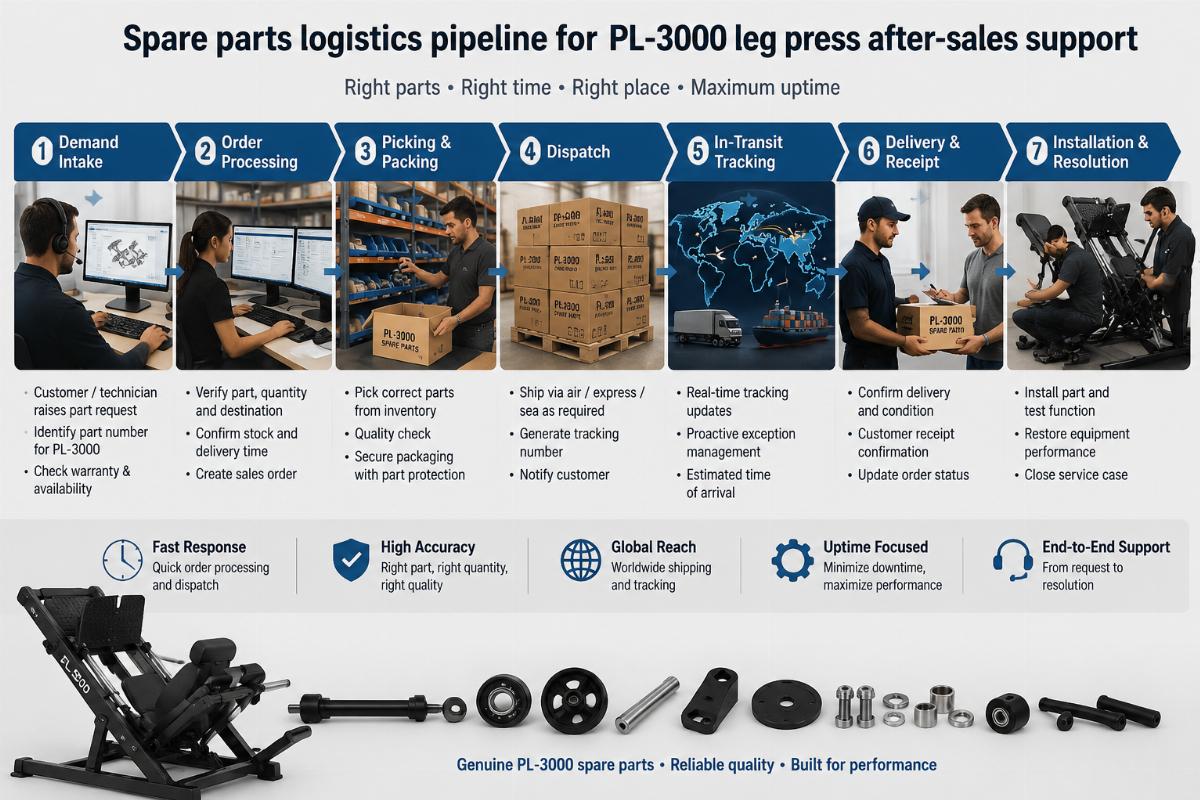
Spare parts availability depends on whether the supplier maintains standing inventory for your model, whether your region has a local parts buffer, and whether you pre-locked a spare parts list at the time of the original order.
For a PL-3000 leg press wholesale supplier operating at commercial scale, the typical spare parts supply chain works like this:
-
Standard wear parts (pivot bearings, guide rod sleeves, cable pulleys) are held in regular stock. Dispatch is typically arranged within a short processing window after claim approval. Express air freight reaches most major global hubs within days.
-
Structural or custom-machined parts (replacement seat frames, specific bracket assemblies) may require production scheduling. Lead time extends noticeably. These are not off-the-shelf items.
-
Post-warranty procurement is available but requires the buyer to initiate the order. If you wait until a bearing seizes to ask for a replacement, you are already in downtime. The smart move is to include a spare parts list in your original container order — a small batch of high-wear items shipped alongside the machines.
A South American hotel project purchased a set of strength machines for their fitness center. The warranty period passed without incident. Then a guide rod started showing wear. The hotel procurement team contacted the supplier for replacement parts. But they had never pre-ordered any spare components. The replacement had to be manufactured, shipped, and cleared through customs. The machine was out of service for an extended period. The hotel lost guest satisfaction scores. The cost of that downtime far exceeded the cost of a few spare guide rods shipped in the original container.
[NEED_CITE: spare parts inventory strategy for commercial gym equipment operators]
The lesson: a PL-3000 leg press wholesale supplier who offers "spare parts supply" is only half the equation. The other half is whether you, the buyer, actually locked in that supply before you needed it.
What Hidden Traps in the Warranty Clause Cause the Most Pain?
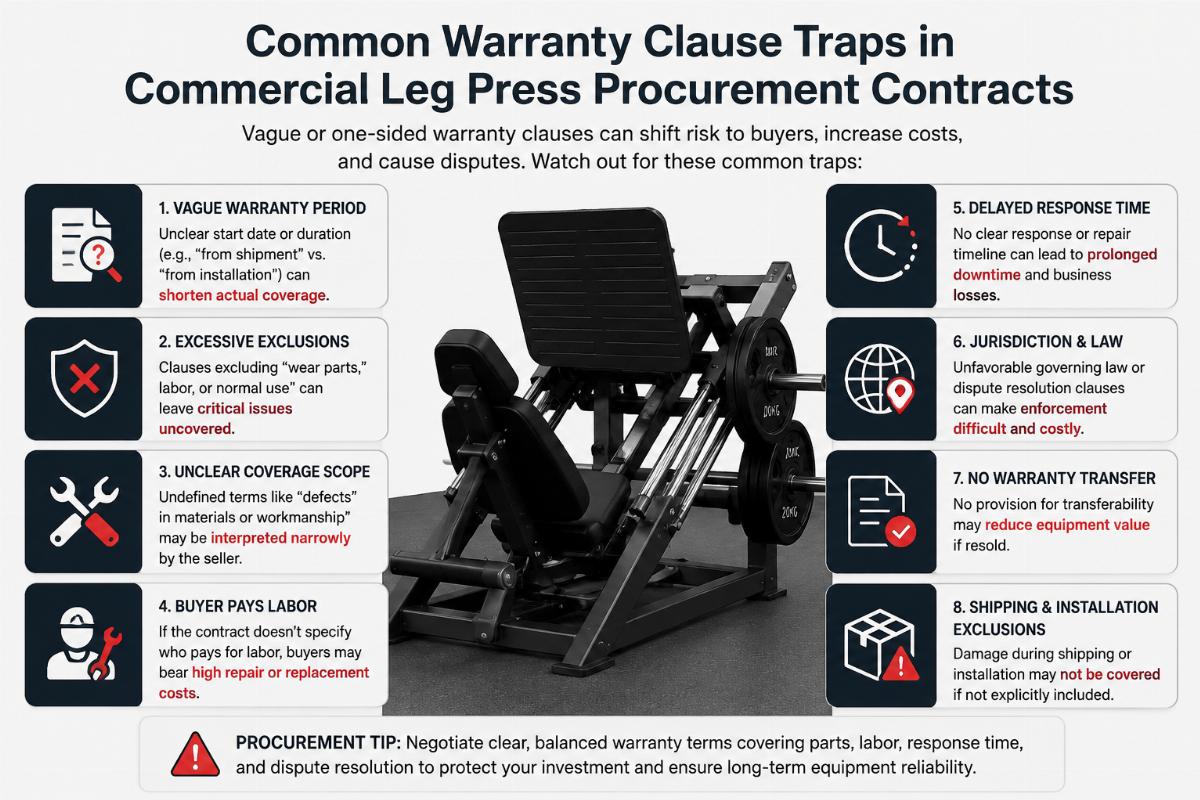
The three most common warranty traps are: bill of lading description mismatches that void claim eligibility, usage scenario exclusions that invalidate coverage, and unauthorized disassembly clauses that release the manufacturer from all obligation.
Here is what to watch for:
Bill of Lading & HS Code Alignment. Your commercial invoice, packing list, and bill of lading must describe the product consistently. If the warranty references a specific product model code, that code must appear on the shipping documents. A mismatch can delay customs clearance — and some warranty terms tie the claim eligibility window to the arrival date, not the shipment date. Every day stuck at port is a day lost from your claim window. [NEED_CITE: shipping document consistency requirements for fitness equipment export contracts]
Usage Scenario Limitations. The PL-3000 leg press is rated for commercial gym environments. If you install it in an uncontrolled setting — an outdoor fitness park, an unsupervised apartment gym with no usage guidelines — and a component fails, the manufacturer may argue the operating environment exceeded the design parameters. The warranty assumes indoor, supervised, commercially managed use.
Unauthorized Disassembly. If your local maintenance technician opens a sealed bearing housing or modifies the guide rod assembly without written authorization from the PL-3000 leg press wholesale supplier, the warranty on that component is void. Period. This clause exists because improper reassembly introduces alignment errors that cause cascading failures. The manufacturer will not accept liability for damage caused by unapproved intervention.
Environmental Exclusions. Coastal locations with high salt-air exposure, high-humidity environments without climate control, and facilities with excessive rubber floor dust can accelerate corrosion and contamination. Some warranty terms explicitly exclude failures attributable to environmental conditions outside standard indoor gym parameters.
A Southeast Asian distributor once had a client complain about guide rod surface corrosion within months of installation. Investigation revealed the gym was located near a coastal area with high humidity and no dehumidification system. The guide rods were not defective — they were operating outside the environmental assumptions built into the warranty. The claim was denied. The distributor had to cover the replacement cost out of pocket.
How Do You Lock in After-Sales Leverage Before You Place the Order?
The most effective after-sales strategy is not reactive — it is built into the purchase contract before the first container is loaded. Pre-negotiate freight terms, pre-lock spare parts lists, and pre-register serial number protocols.
When you are evaluating a PL-3000 leg press wholesale supplier, the conversation should not end at unit price. It should extend to the operational details that determine your total cost of ownership:
-
Freight Allocation Clause. Negotiate explicitly who pays for replacement part shipping — both outbound from the factory and return of defective components. Some suppliers include a defined number of free express shipments per year. Others require the buyer to cover all logistics. Get it in writing.
-
Pre-Shipped Spare Parts Package. At the time of your initial order, add a spare parts package to the container. Pivot bearing kits, guide rod sleeves, cable sets, pedal pad sets — the components that wear first. The marginal cost of shipping these in a full container is minimal. The cost of emergency air-shipping them later is substantial.
-
Serial Number Registration Protocol. Agree on the registration process before the container arrives. Who logs the serial numbers? What is the deadline? What format does the manufacturer require? Build this into your receiving warehouse SOP.
-
Technical Support Access. Confirm whether the PL-3000 leg press wholesale supplier provides remote technical guidance — video calls for troubleshooting, assembly instruction support, maintenance scheduling advice. For distributors managing multiple end clients, this support layer reduces your own service burden significantly.
-
Post-Warranty Parts Pricing Lock. Ask whether the supplier can provide a spare parts price list valid for an extended period. Knowing your replacement bearing cost two years from now helps you budget accurately and avoid surprise expenses.
The buyers who treat warranty as a procurement negotiation point — not an afterthought — are the ones who keep their gym floors running without interruption. The buyers who just sign whatever document the supplier sends are the ones calling in panic when a machine goes down and nobody knows who pays for the replacement bearing.

Conclusion
The PL-3000 leg press warranty is a risk allocation document, not a promise of free repairs. Coverage is layered by component type, claims require documented evidence and serial number registration, and spare parts speed depends on pre-order planning — not post-failure begging. Lock your freight terms, pre-ship your wear parts, and read the exclusions before you sign.