PR-800 Power Rack Sub-Series Comparison: Wholesale Supplier & OEM Factory Direct Pricing for Commercial Gyms
Most buyers assume all PR-800 Power Rack sub-series share the same uprights, hole spacing, and attachment interfaces. They do not — and mixing them inside one container is the single most expensive mistake in commercial rack procurement.
The PR-800 Power Rack family is divided into distinct sub-series based on upright wall thickness, hole spacing standards (Westside vs. standard), maximum static and dynamic load ratings, and attachment interface tolerances. Selecting the wrong sub-series leads to bolt misalignment, J-cup incompatibility, and full-container rejection at destination. Buyers must verify each parameter line by line before placing a container order.
I still remember the first time a buyer opened a container at a Northern European port and found half-racks and full power racks bolted together in the same shipment. The horizontal beam hole spacing was off by roughly twenty millimeters. Not a single bolt could pass through. The entire container was refused. The return freight and rework alone wiped out a large share of the margin on that deal. That was early in my career, when I was still working on the factory floor in the Ningjin manufacturing zone near Qingdao, before I moved into direct overseas buyer communication. I had quoted a "commercial-grade deep squat rack" without breaking down which PR-800 Power Rack sub-series the uprights, crossmembers, and attachment plates actually belonged to. Since then, I have made it a rule to put hole spacing, load capacity, and attachment compatibility on the table first, so the buyer can see the differences with their own eyes. [NEED_CITE: root cause distribution of commercial gym equipment return claims by specification mismatch]
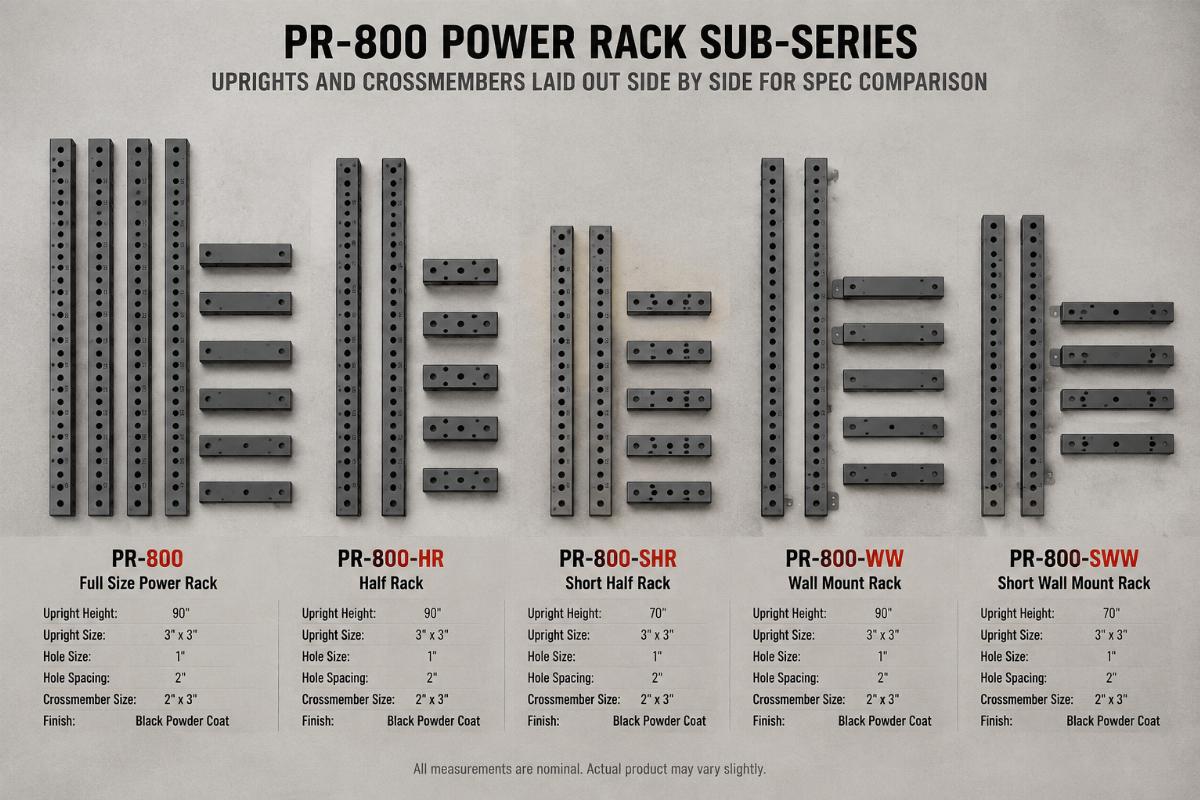
The rest of this article walks through the real spec gaps between PR-800 Power Rack sub-series, which training scenarios each one is built for, where attachments cross-fit and where they do not, and the mistakes that trigger the costliest container returns.
What Are the Key Spec Differences Across PR-800 Power Rack Sub-Series?
Wall thickness, hole spacing pattern, and load rating tier are the three parameters that actually separate PR-800 Power Rack sub-series — not the overall footprint or the number of uprights.
When buyers first open a spec sheet, they tend to focus on the outer dimensions of the uprights — say, a standard square tube side length. What they often miss is that two sub-series can share the same outer dimension while using noticeably different wall thicknesses, which directly changes both the static load rating and the dynamic behavior under heavy eccentric loading. [NEED_CITE: influence of upright wall thickness on power rack dynamic stability under eccentric loading]
| Parameter | Entry Sub-Series | Mid Sub-Series | Heavy-Duty Sub-Series |
|---|---|---|---|
| Upright wall thickness | Standard gauge | Reinforced gauge | Heavy-duty gauge |
| Hole spacing standard | Standard spacing | Westside spacing | Westside spacing |
| Static load rating | Basic commercial tier | Mid commercial tier | High commercial tier |
| Dynamic load behavior | Suitable for controlled lifts | Handles moderate eccentric loads | Built for high-impact drops |
| Attachment interface tolerance | Standard | Tightened | Tightened with reinforced holes |
| Powder coating thickness | Standard range | Standard range | Extended endurance range |
A distributor in the Middle East once placed a first trial order of a PR-800 Power Rack sub-series without confirming which hole spacing pattern was used. When the J-cups and safety straps arrived on site, the attachment pins did not line up with the upright holes. The mismatch was not about quality — the parts were all within their own tolerances — but about mixing a standard-spacing sub-series with Westside-pattern attachments. The replacement parts had to be shipped by air, adding weeks of delay and a noticeable cost on top of the original order. [NEED_CITE: attachment interface compatibility issues across power rack hole spacing standards]
The takeaway is simple: the outer silhouette of a PR-800 Power Rack can look identical across sub-series, while the internal spec layer — wall thickness, hole pattern, and interface tolerance — is what actually determines whether your attachments, your training style, and your long-term maintenance cost will work together.

Which Sub-Series Fits Which Training Scenario?
Choosing a PR-800 Power Rack sub-series is not about picking the highest load rating on paper — it is about matching the sub-series to the actual impact level of the training that will happen on it.
Many buyers default to the heaviest sub-series, assuming it will cover every possible use case. In practice, over-specifying a rack for low-impact work ties up capital in steel and coating that the training will never stress. Under-specifying, on the other hand, is what leads to visible upright sway during high-impact CrossFit-style drops and, eventually, a second round of procurement when the original rack has to be upgraded.
| Training Scenario | Recommended PR-800 Power Rack Sub-Series | Reasoning |
|---|---|---|
| Light commercial gym, controlled barbell work | Entry sub-series | Sufficient static rating, standard hole spacing, lower unit cost |
| Mid-tier commercial gym, mixed strength and hypertrophy | Mid sub-series | Westside spacing for precise bar height, better dynamic behavior |
| CrossFit box, frequent bar drops and high-impact movements | Heavy-duty sub-series | Reinforced uprights, tightened attachment interfaces, higher dynamic tolerance |
| Hotel or apartment fitness room, low-traffic use | Entry sub-series | Compact footprint, standard accessories, cost-efficient |
A CrossFit gym owner in Southeast Asia once ordered the entry-level PR-800 Power Rack sub-series for a high-impact training zone. During the first months of use, the uprights showed noticeable sway during heavy clean-and-jordrops. The gym later upgraded to the heavy-duty sub-series, which effectively doubled the procurement cost for that zone. The lesson was not that the entry sub-series was defective — it was that it was never designed for that impact class. [NEED_CITE: dynamic stability comparison of power rack sub-series under repeated eccentric loading]
When you map training intensity to sub-series, the PR-800 Power Rack family stops being a confusing list of similar-looking SKUs and becomes a clear ladder: entry for controlled work, mid for mixed commercial use, and heavy-duty for anything involving repeated high-impact loading.

How Do Attachments Cross-Fit Between PR-800 Power Rack Sub-Series?
Attachments do not automatically cross-fit across PR-800 Power Rack sub-series — interface dimensions and hole spacing together decide compatibility, not the brand name on the upright.
This is the point that causes the most confusion at the ordering stage. A buyer will see that a J-cup, a safety strap, or a monolift is listed as "compatible with PR-800 series" and assume it will fit every sub-series within that family. In reality, the interface pin diameter, the hole shape (round vs. laser-cut slot), and the hole spacing pattern must all align at the same time. A change in any one of these three parameters breaks compatibility.
| Attachment Type | Compatibility Rule Across PR-800 Power Rack Sub-Series |
|---|---|
| J-cups and hook-based attachments | Must match both pin diameter and hole spacing pattern |
| Safety straps and slip-in attachments | Sensitive to upright outer dimension and hole shape |
| Monolift and pivot king pins | Require tightened interface tolerance, typically mid or heavy-duty sub-series |
| Pulley and cable crossover add-ons | Dependent on pre-drilled mounting plates, sub-series specific |
A European gym chain once tried to move a set of PR-800 Power Rack attachments from an older standard-spacing sub-series to a newer Westside-spacing sub-series in another location. The pin diameter was correct, but the hole spacing did not match. The attachments could not be mounted without drilling new holes, which would void the coating warranty and weaken the upright structure. The chain ended up ordering a new set of attachments specifically for the Westside sub-series, rather than trying to modify the existing ones. [NEED_CITE: attachment interface tolerance stack-up in modular power rack systems]
The practical rule is to treat each PR-800 Power Rack sub-series as its own attachment ecosystem. If you plan to move accessories between sites or add new stations later, confirm the exact interface drawing for the sub-series you are ordering, not just the family name.

What Mistakes Cause the Costliest Container Returns?
The three most expensive mistakes in PR-800 Power Rack procurement are mixing sub-series in one container, ignoring hole spacing differences, and underestimating the dynamic load class of the training environment.
These mistakes rarely come from bad intent. They come from spec sheets that look similar at first glance, and from a habit of ordering by family name rather than by sub-series code. The financial impact, however, is very concrete: return freight, customs re-entry, rework at destination, and in some cases, a second container of replacement parts shipped by air.
| Mistake | What Actually Happens | Typical Consequence |
|---|---|---|
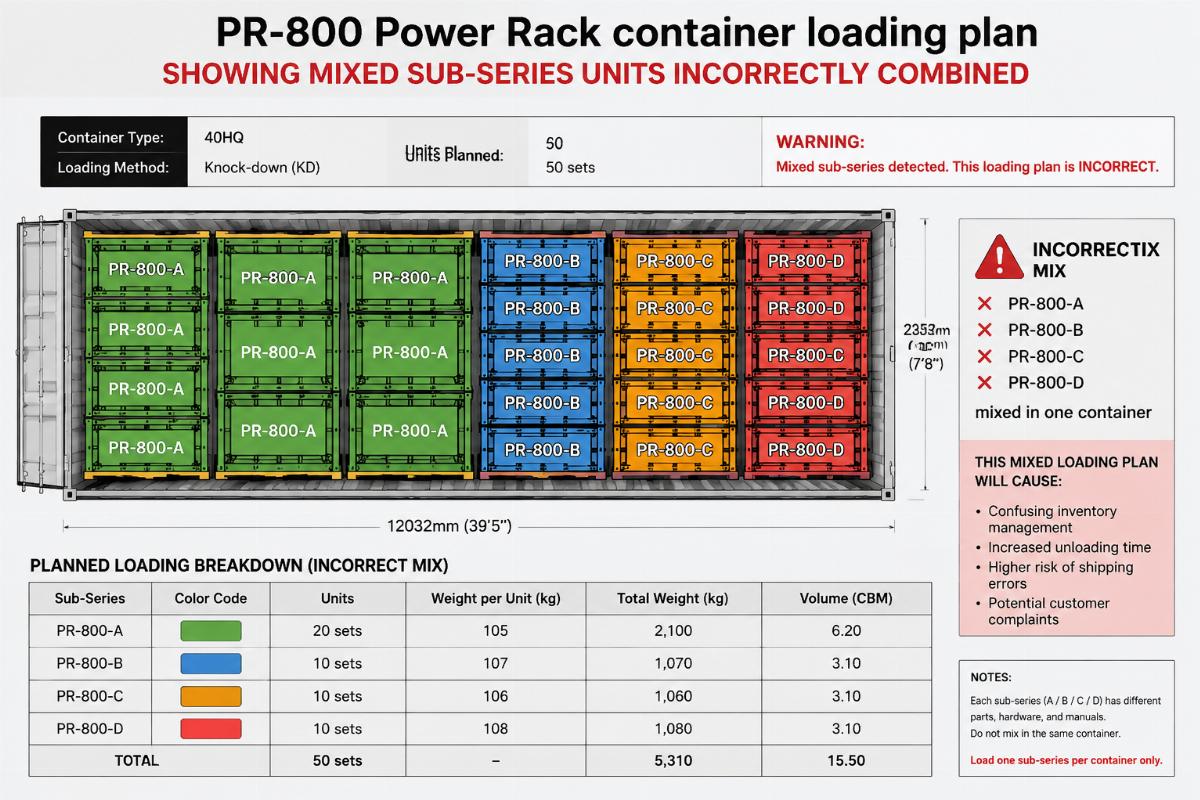
| Mixing sub-series in one container | Uprights and crossmembers from different sub-series cannot bolt together | Full container rejection at destination |
| Ignoring hole spacing pattern | Attachments do not align with upright holes | Air-freight of replacement parts, weeks of downtime |
| Underestimating dynamic load class | Uprights sway or deform under repeated impact | Premature upgrade, duplicated procurement cost |
A buyer in Eastern Europe once combined half-rack and full-rack units from two different PR-800 Power Rack sub-series in a single container to save on freight. When the shipment arrived, the horizontal beam hole spacing between the two sub-series was offset by roughly twenty millimeters. Not one crossmember could be bolted in place. The buyer refused the container, and the cost of returning and reworking the shipment consumed a large portion of the profit originally expected from the entire deal. [NEED_CITE: commercial gym equipment container return case studies by specification mismatch]
The pattern is always the same: the spec sheet looked close enough, but the sub-series code was not checked line by line. The fix is not more trust in the supplier — it is a structured spec matrix that forces every parameter to be confirmed before the container is sealed.
How to Verify Specs Before Placing a Container Order?
The only reliable way to avoid PR-800 Power Rack specification mistakes is to require a complete spec matrix and interface drawing for every sub-series in the order, and to check each line before the container is loaded.
This step is where many deals go wrong, not because the factory is hiding anything, but because the buyer has not asked for the right documents in the right format. A general "commercial power rack" description is not enough. You need a side-by-side table that lists upright wall thickness, hole spacing standard, static and dynamic load ratings, attachment interface dimensions, and powder coating specification for each sub-series you are considering. [NEED_CITE: commercial power rack procurement checklist per ISO gym equipment standards]
The verification process can be broken down into a short sequence:
- Request a sub-series spec matrix from the supplier, covering every PR-800 Power Rack sub-series you are considering, not just the one you think you will order.
- Ask for interface drawings for each attachment type you plan to use, with pin diameter, hole shape, and spacing pattern clearly marked.
- Cross-check the hole spacing standard (Westside vs. standard) against your existing or planned accessories.
- Confirm the dynamic load class of the training environment with the end user, and match it to the sub-series rating.
- Require the supplier to mark each sub-series clearly on the packing list and on the uprights themselves, so container loading can be checked against the order before sealing.
At Bick, we support this process by providing a full PR-800 Power Rack sub-series comparison table and interface drawings as part of the pre-order package, with OEM and ODM marking options so that each sub-series is clearly identified on the uprights and in the packing list. This is not an extra service — it is the baseline we use to make sure that what is loaded into the container is exactly what was approved on paper. [NEED_CITE: OEM ODM power rack documentation package for commercial gym buyers]

Conclusion
The PR-800 Power Rack family only looks uniform from a distance — at the spec level, each sub-series is a distinct system with its own upright thickness, hole spacing, load rating, and attachment interface. Matching the right sub-series to the right training scenario, and verifying every parameter against a complete spec matrix before the container is sealed, is what separates a smooth rollout from a costly return.