Preacher Curl Bench Bulk Order Container Loading Configuration | Wholesale Supplier
Leaving dead space inside a 40HQ is the single biggest hidden cost in fitness equipment importing, and it has nothing to do with product price.
For a bulk order of preacher curl benches, a standard 40HQ container typically accommodates between 80 and 120 units depending on whether the product is shipped fully assembled, flat-packed, or knocked-down with detachable pads. The actual loading number hinges on three variables: the outer carton dimensions including pallet overhang, the stacking pattern dictated by pad thickness, and whether the benches are mixed with other strength equipment in a consolidated shipment. A well-planned loading configuration for a preacher curl bench supplier operation should target a weight utilization above 85% and a volume fill rate that leaves less than a single pallet gap at the rear door.
I still remember a shipment bound for Santos that taught me more about cubic efficiency than any logistics textbook. We were loading preacher curl benches alongside a batch of Smith machines and adjustable benches for a gym chain in southern Brazil. The factory handed me a loading plan based on bare-machine drawings, not the actual palletized outer dimensions. By the time the container was sealed, there was a gap wide enough to slide a standard Euro-pallet through sideways. The consignee ended up paying demurrage while waiting for a supplementary LCL shipment to fill the void. That kind of mistake does not just hurt margins; it damages credibility with buyers who calculate landed cost per unit down to the cent [NEED_CITE: demurrage cost structure at Brazilian port terminals]. Since then, I have drawn every loading diagram myself, verifying gross outer dimensions, stacking orientation, and weight distribution before a single carton touches the container floor.
Getting the numbers right before the container arrives at the gate is what separates a profitable shipment from a costly lesson. Let me walk you through the configuration logic I use for every bulk order.
How Do Outer Carton Dimensions Dictate the Loading Count?
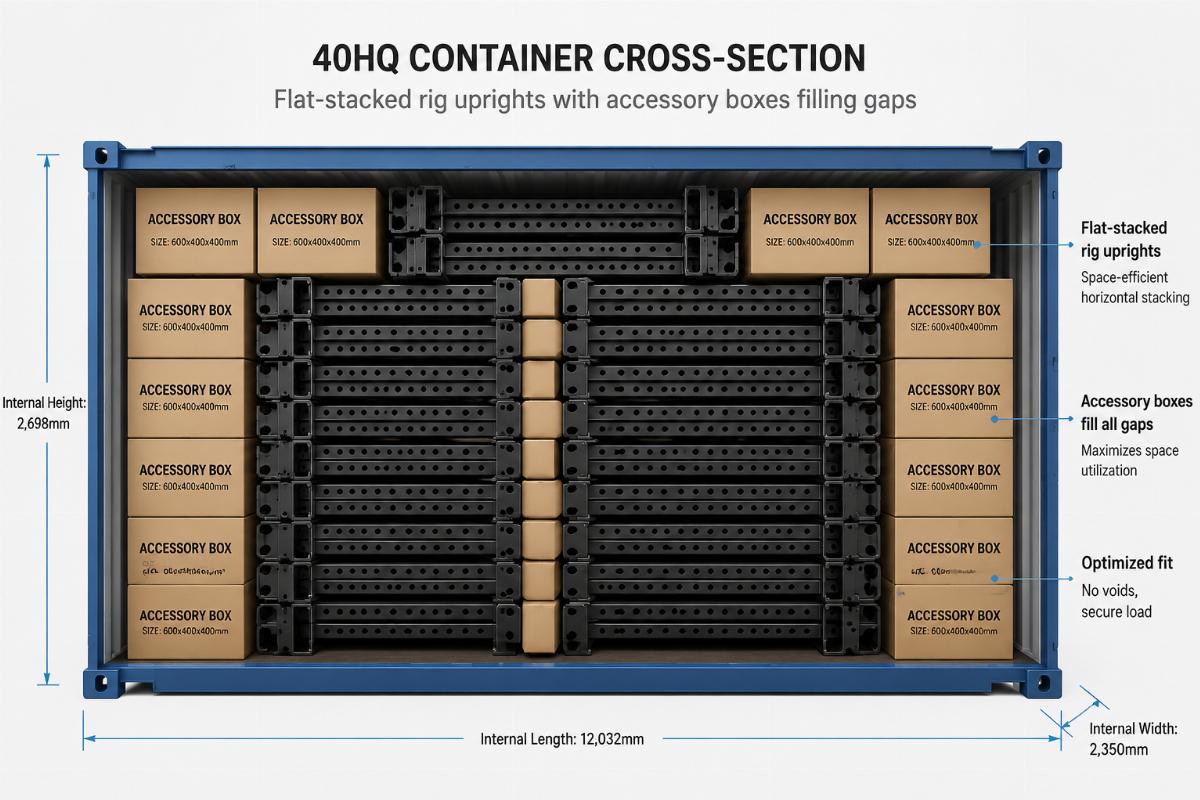
The outer carton, not the machine itself, determines how many preacher curl benches fit inside a container. Manufacturers often quote product dimensions based on the assembled frame, but the shipping carton adds padding, foam inserts, corner protectors, and sometimes a wooden crate. For a typical commercial-grade preacher curl bench, the assembled footprint might measure around 90 cm by 60 cm, but the outer carton with full protective packaging can push the length past 110 cm and the width past 70 cm. A standard 40HQ internal length is approximately 12.03 meters with an internal width of 2.35 meters and a height of 2.69 meters [NEED_CITE: standard ISO 40-foot high cube container internal dimensions].
Here is a comparison of how packaging choices affect the loading configuration:
| Packaging Method | Approximate Outer Carton Footprint | Stacking Layers | Estimated Units per 40HQ |
|---|---|---|---|
| Fully Assembled, No Disassembly | Substantially larger footprint | Single layer only | Lowest count, floor-loaded |
| Flat-Packed, Pad Detached | Moderate footprint, stackable | Two to three layers | Moderate count |
| Knocked-Down, Frame Separated from Pad | Compact footprint, high stackability | Three to four layers | Highest count |
A buyer in the Middle East once ordered a full container of preacher curl benches in the fully assembled configuration because his end users wanted zero assembly on-site. The loading count dropped to roughly half of what a knocked-down configuration would have allowed. He absorbed the freight cost per unit that came with it. The lesson here is straightforward: if your market accepts some assembly, the knocked-down option from your preacher curl bench supplier will always deliver better freight economics.
I always request the actual outer carton drawings from the production floor, not the marketing brochure dimensions. A discrepancy of even a few centimeters per carton, multiplied across dozens of units, can eliminate an entire row from the loading plan.
What Is the Correct Stacking Pattern for Mixed Containers?
Stacking orientation and weight distribution matter as much as the raw unit count when mixing preacher curl benches with other equipment. A container loaded with only preacher curl benches is a straightforward geometry problem. But in practice, most buyers consolidate multiple SKUs into a single shipment to meet minimum order thresholds and reduce per-unit freight. That is where the loading plan gets complicated.
The core principle I follow is heavy items low and centered, lighter items filling the periphery and upper layers. Preacher curl benches have a steel frame that concentrates weight along the base, so they should go on the floor layer, positioned with the heaviest side toward the container centerline. Adjustable benches, dumbbell racks, and plate-loaded accessories fill the second and third layers. Foam pads, resistance bands, and small accessories go in whatever gaps remain near the door end.
A South American distributor once asked me to load preacher curl benches on top of a layer of Olympic plates to save floor space. The plates shifted during ocean transit because the bench frames did not provide enough downward pressure to lock them in place. The resulting damage claim covered both the scratched benches and the dented plates. Since then, I follow a strict rule: dense, rigid items form the base layer; anything with a flat, stable surface goes on top; and void fillers or air bags secure the gaps [NEED_CITE: cargo securing guidelines for mixed container loads].
When building the loading plan, I also account for the door-end sequence. The last items loaded are the first items unloaded. If the buyer needs the preacher curl benches for immediate display at a trade show or a gym opening, those units go in last, nearest the doors. This sequencing decision does not change the total count, but it changes the unloading workflow on arrival.
How Does Pallet versus Floor-Loading Affect the Configuration?
The decision between palletized loading and floor-loading directly controls both the unit count and the unloading speed at destination. Palletized shipments are faster to unload at the warehouse, but pallets consume floor space and add height that reduces the number of stackable layers. Floor-loaded shipments maximize the unit count but require manual unloading labor at destination, which can be costly or impractical depending on the consignee’s facilities.
For a typical preacher curl bench order, here is how the two approaches compare:
| Loading Method | Container Floor Utilization | Unloading Labor at Destination | Suitability |
|---|---|---|---|
| Palletized | Noticeably reduced due to pallet overhang | Low, forklift-ready | Large distribution centers with dock equipment |
| Floor-Loaded | Maximized, cartons placed wall-to-wall | High, manual handling required | Warehouses without forklift access or smaller gyms |
I worked with a buyer in Southeast Asia who insisted on palletized loading for a consolidated container that included preacher curl benches, cable crossover machines, and rubber flooring rolls. The pallets added roughly a tenth to the total cubic footprint, and we lost the ability to fit the final batch of flooring. The buyer had to arrange a separate LCL shipment for the flooring, which cost several times what the pallet convenience saved in unloading time.
If your consignee has forklift access and values speed, palletized is the right call. If the destination is a boutique gym with a freight elevator and no dock, floor-loading with slip sheets may be the more practical choice. Your preacher curl bench supplier should be able to accommodate both configurations, but the loading count will differ noticeably between them.
One detail that catches many first-time importers off guard: pallet height counts against the container’s internal height. A standard pallet loaded with stacked cartons of preacher curl bench components can reach close to the container ceiling, leaving no room for a second layer. If you need two-tier stacking, you must use low-profile pallets or eliminate pallets entirely.
What Documentation and Markings Prevent Delays at Destination?
Correct shipping marks and documentation are as critical as the physical loading configuration for a smooth delivery. A container can be packed perfectly, but if the customs paperwork does not match the physical contents or if the carton markings are illegible, the shipment will sit at the port while authorities sort out the discrepancy.
For preacher curl bench shipments, the commercial invoice must list each SKU with its corresponding HS code, quantity, unit price, and total value. The packing list must match the physical carton count and indicate the loading sequence if the buyer has requested door-end priority for specific items. The bill of lading should reflect the correct container number, seal number, and gross weight including packaging [NEED_CITE: standard shipping documentation requirements for fitness equipment exports].
I always insist on three sets of shipping marks on every carton: the buyer’s company name and PO number on the two long sides, the SKU and carton number on the two short sides, and the gross weight and "This Side Up" arrows on the top. For mixed containers, I also add a color-coded label system so the unloading crew can sort items by destination zone without opening every carton.
A buyer in North Africa once received a container where the shipping marks were printed in a font size too small to read from a distance. The warehouse crew spent an entire day opening cartons to verify contents against the packing list. The delay triggered storage fees at the terminal. Since then, I specify a minimum font height for all carton markings and verify them with photos before the container is sealed.
Another common pitfall is the fumigation certificate. If wooden pallets or crates are used, they must comply with ISPM-15 standards and bear the appropriate stamp. Without it, customs at many ports will hold the container for inspection or reject the pallets outright, forcing the buyer to arrange disposal or re-palletization at destination [NEED_CITE: ISPM-15 international standards for wood packaging material].
Conclusion
A well-configured container load is the difference between a profitable shipment and a costly surprise at destination. The loading count for preacher curl benches depends on outer carton dimensions, stacking orientation, pallet versus floor-loading decisions, and the sequencing of mixed SKUs. Every centimeter of dead space and every kilogram of misallocated weight translates directly into higher per-unit landed cost. Work with your preacher curl bench supplier to verify actual packed dimensions, agree on the packaging configuration that matches your destination infrastructure, and confirm all documentation before the container leaves the factory floor.