RD-Rubber Dumbbell Sub-Series Brazil Wholesale Supplier Guide
Rubber dumbbells are not just cast iron wrapped in a black coating. The compound formula and vulcanization curve determine whether the product survives a 45-day sea crossing to Santos or turns into a chalky, foul-smelling mess before the gym even opens.
For buyers sourcing rubber dumbbells for Brazil’s humid tropical climate, the critical answer is this: standard recycled-rubber dumbbells will fail at an alarming rate during transoceanic shipping unless the supplier uses climate-targeted antioxidant packages, controlled-voltage vulcanization, and moisture-sealed container packing. A rubber dumbbell supplier for Brazil must demonstrate verifiable anti-aging protocols, not just quote a lower FOB price.
I learned this the hard way. A full container of hex rubber dumbbells I once shipped to a distributor in São Paulo arrived with the rubber coating visibly blooming white and emitting a sharp, acrid odor. The client rejected the entire lot. Root cause analysis pointed to two compounding failures: the rubber compound lacked sufficient antioxidant load for prolonged exposure to container micro-climates exceeding 60°C, and the vulcanization time had been shortened to rush production. [NEED_CITE: relationship between vulcanization duration and rubber thermal aging resistance per ISO 188] Since that loss, I have restructured every sourcing conversation around material chemistry and shipping environment, not just weight and price.
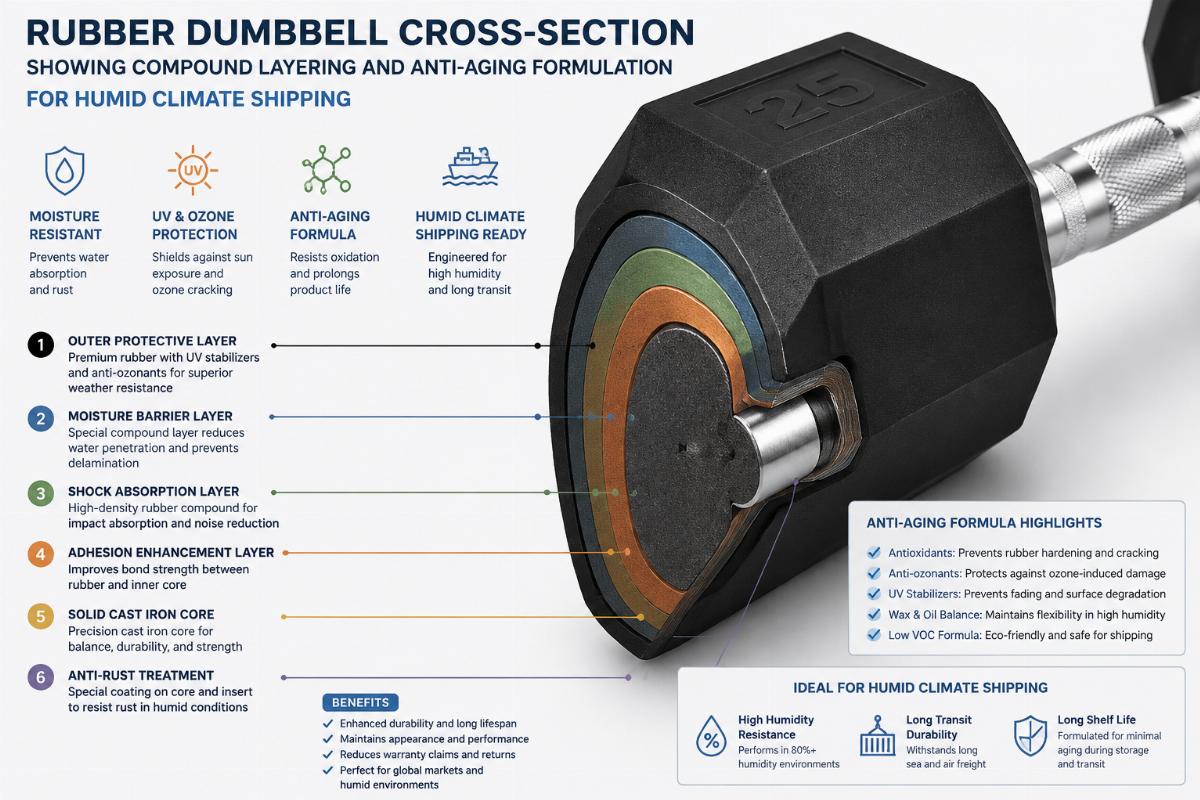
Let me walk you through the material science, the verification process, the specification matrix, and the logistics realities that separate a reliable rubber dumbbell supplier for Brazil from one who simply repaints cast iron cores.
Why Does Brazil’s Climate Demand a Dedicated Rubber Formula?
Brazil’s combination of high ambient humidity, intense UV exposure in open-air gyms, and prolonged container transit creates an aging environment that standard rubber compounds cannot withstand. The average transoceanic voyage from Qingdao or Shanghai to Santos spans well over a month, during which the sealed steel container acts as a solar oven. Internal temperatures routinely spike far beyond ambient, accelerating oxidative degradation of unprotected rubber.
Most buyers assume rubber is rubber. In reality, the polymer base—whether natural rubber, SBR, or reclaimed rubber from tire stock—determines the baseline aging resistance. Reclaimed rubber, while cost-effective, contains residual vulcanization agents and carbon black that have already been partially depleted during their first life cycle. When exposed to sustained heat and humidity, these compounds oxidize faster, leading to surface chalking, micro-cracking, and the release of volatile organic compounds that create the notorious "new rubber smell" that lingers for months. [NEED_CITE: oxidative degradation mechanisms in reclaimed rubber under tropical humidity conditions]
A rubber dumbbell supplier for Brazil who simply ships the same product sent to Northern Europe or North America is setting the buyer up for failure. The formulation must include elevated levels of non-staining antioxidants and antiozonants, adjusted sulfur-to-accelerator ratios to optimize cross-link density without over-curing, and a rubber hardness profile that balances grip comfort with structural integrity. [NEED_CITE: Shore A hardness range optimization for commercial gym rubber dumbbells]
I have seen shipments where the rubber coating on 20 lb and 25 lb dumbbells remained intact, while the 50 lb and above units showed severe cracking. The reason is not weight—it is the cooling rate during vulcanization. Thicker rubber layers on heavier dumbbells retain heat longer, and if the curing cycle is not adjusted for mass, the outer layer over-cures while the inner layer under-cures, creating internal stress points that propagate cracks under thermal cycling.

How Do You Verify a Supplier’s Anti-Aging Capability?
Request third-party aging test reports, audit the vulcanization parameters, and demand a detailed container packing protocol—any supplier who hesitates on these three points is not equipped for the Brazilian market.
The verification process should follow a structured sequence. First, ask for SGS or TÜV accelerated aging test reports conducted under conditions that simulate tropical humidity and elevated temperature. The report should show weight change, hardness shift, and tensile retention after extended exposure. [NEED_CITE: accelerated aging test methodology for rubber fitness equipment per ASTM D573 or equivalent] If the supplier only provides in-house test data with no third-party validation, treat it as unverified.
Second, inquire about the vulcanization process. Ask specifically about curing temperature, pressure, and cycle duration. A supplier running flat-mold vulcanization at inconsistent temperatures across the mold plate will produce dumbbells with uneven cross-link density. The correct approach involves plate-level temperature uniformity within a tight band, monitored by embedded thermocouples. [NEED_CITE: vulcanization temperature uniformity requirements for consistent rubber physical properties]
Third, examine the container packing protocol. For Brazil-bound shipments, the supplier should specify desiccant quantities per container volume, ventilation plug settings, and moisture barrier wrapping for individual pallets. I have reviewed packing lists where the desiccant load was calculated for a 20-foot container but applied to a 40-foot high-cube—leaving the additional air volume completely unprotected. [NEED_CITE: desiccant calculation methodology for moisture-sensitive rubber goods in ocean freight]
A Mid-East distributor once shared that they switched rubber dumbbell suppliers after the third consecutive container arrived with visible mold growth on the rubber surfaces despite no visible water damage to the carton. The previous supplier had wrapped the dumbbells in polyethylene bags but sealed them before the rubber had fully outgassed, trapping residual volatiles and moisture inside. The correct approach is to allow a post-vulcanization resting period in a climate-controlled warehouse before bagging, combined with perforated bags that allow slow moisture equilibration rather than trapping it.

What Are the RD Series Specifications and How Do They Match Brazil’s Requirements?
The RD series rubber dumbbells are engineered with a climate-adaptive compound and a vulcanization protocol specifically calibrated for long-haul tropical shipping, available across the full commercial weight range with flexible MOQ for market testing.
The specification matrix below compares the key parameters across weight segments. The critical differentiator for Brazil is not the weight itself but the compound formulation and the packaging configuration that accounts for humidity ingress during transit.
| Weight Range | Rubber Compound | Shore A Hardness | Anti-Aging Package | Packaging for Humid Climate | MOQ Flexibility |
|---|---|---|---|---|---|
| 5–20 lb | Virgin SBR blend | Medium | Full antioxidant load | Perforated poly bags + desiccant | Low MOQ available |
| 25–50 lb | Virgin SBR blend | Medium-High | Full antioxidant load | Perforated poly bags + desiccant | Low MOQ available |
| 55–90 lb | Reinforced compound | High | Enhanced antioxidant load | Individual wrapping + pallet moisture barrier | Standard MOQ |
| 100 lb+ | Reinforced compound | High | Enhanced antioxidant load | Individual wrapping + pallet moisture barrier | Standard MOQ |
[NEED_CITE: Shore A hardness selection criteria for rubber-coated free weights by weight class]
The RD series differs from generic offerings in three structural ways. First, the rubber compound uses a virgin SBR base rather than reclaimed tire rubber, eliminating the variability of unknown prior processing history. Second, the antioxidant package is dosed at levels calibrated for extended tropical exposure, not minimum compliance thresholds. Third, the vulcanization cycle is mass-adjusted—heavier dumbbells receive proportionally longer curing times to ensure uniform cross-link density through the full rubber thickness.
For a Latin American importer building a private-label program, the RD series supports full OEM branding including custom color coding, laser-etched weight markings, and Portuguese-language packaging. The manufacturer’s production facilities in Shandong maintain dedicated mold sets for the entire weight range, allowing mixed-weight container loading that optimizes both cubic utilization and weight distribution for Brazilian port handling.

What Are the Logistics and Customs Realities for Shipping to Brazil?
Transit time, in-container temperature management, and Portuguese-language labeling compliance are the three variables that determine whether a rubber dumbbell shipment clears Brazilian customs in sellable condition.
The ocean transit from major Chinese ports to Santos typically spans a range of weeks, during which the container passes through equatorial shipping lanes where deck-level solar exposure drives internal temperatures to extreme levels. A rubber dumbbell supplier for Brazil must account for this thermal profile in both the product formulation and the packing method.
Container loading configuration matters more than most buyers realize. Loading dumbbells to maximum payload without accounting for air circulation creates hot spots where rubber degradation accelerates. The recommended approach is to leave deliberate air channels between pallet rows and to position desiccant units at multiple heights within the container, not just at floor level. [NEED_CITE: container loading best practices for temperature-sensitive rubber products]
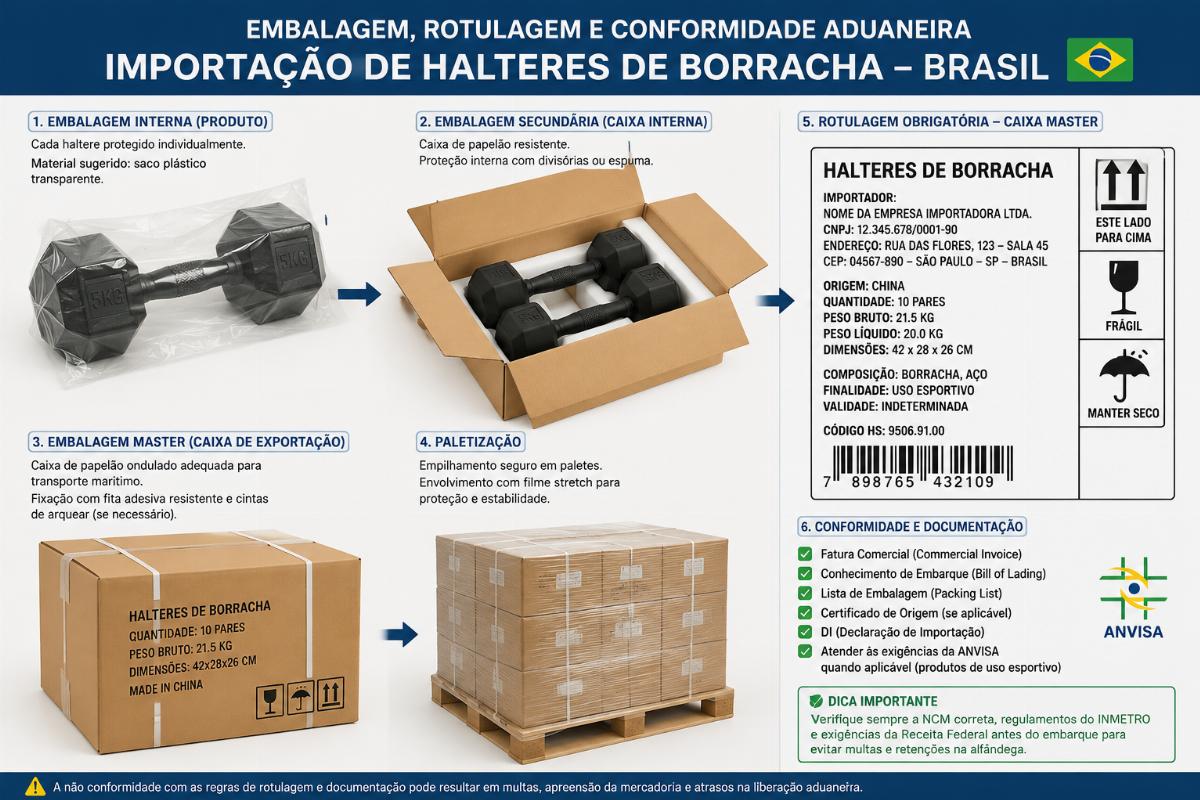
Brazilian customs requires all imported fitness equipment to carry Portuguese-language labeling indicating country of origin, material composition, weight specifications, and importer registration details. Non-compliant labeling results in customs holds that can extend container dwell time at port by weeks—during which the product sits in a humid, unventilated yard environment that accelerates any marginal rubber aging. A rubber dumbbell supplier for Brazil should provide labeling artwork review as part of the pre-production process, not as an afterthought.
I have worked with a South American importer whose previous supplier shipped dumbbells with English-only labels and generic "Made in China" stickers. The customs hold lasted long enough that the rubber on the bottom-layer pallets developed surface tackiness from prolonged humidity exposure, even though the product had been correctly formulated. The lesson: labeling compliance is not just a paperwork issue—it directly affects product condition at delivery.
Conclusion
Sourcing rubber dumbbells for Brazil is a materials science challenge wrapped in a logistics problem. The climate-targeted compound, the mass-adjusted vulcanization cycle, and the humidity-aware container packing protocol must all align—otherwise the product fails before it reaches the gym floor. Verify the supplier’s anti-aging credentials through third-party reports, audit the production parameters, and treat Portuguese labeling compliance as a product preservation measure, not just a regulatory checkbox.