RD Rubber Dumbbell Sub-Series Technical Data Sheet Wholesale Supplier
Most buyers treat the rubber dumbbell technical data sheet as a sales brochure — it is actually the single most important document for preventing field failures in tropical and high-humidity gym environments.
The complete RD rubber dumbbell technical data sheet covers rubber compound formulation, Shore A hardness range, VOC emission classification, weight tolerance band, rubber layer thickness per weight class, and operating temperature-humidity envelope — each parameter directly determines whether the dumbbell survives its first year on a commercial gym floor.
I once walked into a commercial gym in Jakarta and saw an entire wall of rubber dumbbells peeling apart. The rubber surface had turned sticky, hairline cracks ran through the coating, and the smell was strong enough that members were complaining to the front desk. That was the first batch of RD-series dumbbells we shipped to Southeast Asia — formulated with a recycled rubber compound that was never tested for sustained tropical heat and humidity. Within a few months, the entire floor had to be replaced. I spent the next several months inside the production facility studying how each sub-series compound behaved under different climate conditions, eventually moving from the quality inspection floor into trade — because I never wanted another buyer to pay for a lesson we should have learned ourselves. When I sit down with purchasers now, the rubber dumbbell technical data sheet is the first thing I open. [NEED_CITE: root cause distribution of rubber dumbbell field failures by climate zone and compound type]

That experience shaped how I approach every wholesale inquiry today. Let me walk you through how to actually read the rubber dumbbell technical data sheet — not as a marketing document, but as a selection tool.
How Do Rubber Compound Formulations Differ Across RD Sub-Series?
The rubber compound formulation is the single most consequential line on the rubber dumbbell technical data sheet — it determines odor intensity, surface durability, heat resistance, and long-term elasticity far more than rubber layer thickness ever will.
Most buyers assume "rubber coated" means all rubber is equivalent. It is not. The RD sub-series are built on fundamentally different compound bases: virgin natural rubber, recycled rubber, and SBR-based blends. Each has a distinct behavioral profile. [NEED_CITE: comparative VOC emission and durability profiles of virgin versus recycled rubber compounds in fitness equipment applications]
Virgin natural rubber sits at the top tier. It delivers the lowest VOC emission, the highest elasticity retention under repeated impact, and the strongest resistance to oxidative aging in warm environments. Recycled rubber is cost-effective but carries a noticeably higher odor profile and is significantly more vulnerable to heat-induced surface degradation. SBR blends occupy the middle ground — acceptable for temperate climates with moderate usage, but not ideal for high-traffic tropical floors.
The rubber dumbbell technical data sheet should clearly state which compound class each sub-series uses. If it does not, treat that as a red flag.
| Compound Class | Odor Profile | Heat Resistance | Climate Suitability | VOC Emission Level |
|---|---|---|---|---|
| Virgin Natural Rubber | Noticeably reduced | Robust | Tropical and humid | Substantially reduced |
| SBR Blend | Standard | Standard | Temperate | Standard |
| Recycled Rubber | Vulnerable | Vulnerable | Controlled indoor only | Uncontrolled |
A distributor in Southeast Asia once placed a full container order of recycled-compound dumbbells for a hotel fitness center in Bangkok. The gym was air-conditioned during operating hours but shut down overnight — meaning the dumbbells cycled through high humidity and temperature swings daily. Within the first year, the rubber surface began emitting a persistent odor and the coating softened under routine drops. The hotel requested a full replacement — and the cost of that replacement ran several times the original order value. [NEED_CITE: rubber compound degradation mechanisms under cyclic temperature and humidity exposure]
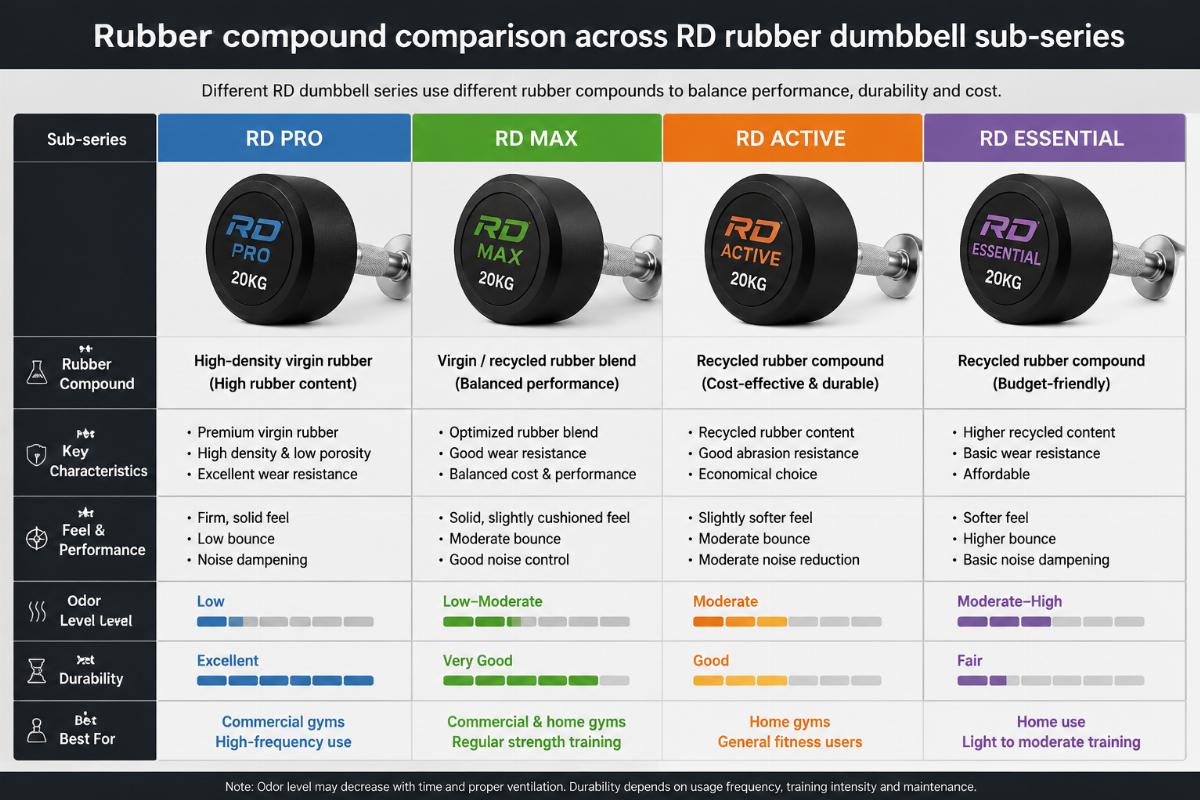
The lesson: the rubber dumbbell technical data sheet must specify compound class — and the buyer must match that class to the destination climate before signing the purchase order.
How Do Shore Hardness and Rubber Density Affect Field Performance?
Shore A hardness and rubber density together determine impact absorption, surface wear resistance, and long-term structural integrity — and the rubber dumbbell technical data sheet should report both, not just one.
Many buyers focus exclusively on rubber layer thickness when evaluating dumbbell durability. Thickness matters — but only in combination with hardness calibration. A thick layer of low-density rubber will compress and deform under repeated drops far faster than a thinner layer of properly calibrated high-density rubber. [NEED_CITE: relationship between Shore A hardness, rubber density, and impact absorption cycle life in fitness equipment]
The RD sub-series are calibrated across a Shore A hardness range designed to match different usage intensities. Lower Shore A values deliver softer impact absorption — appropriate for boutique studios and light-traffic environments. Higher Shore A values resist surface indentation and deformation — necessary for commercial gyms where dumbbells are dropped hundreds of times daily.
The rubber dumbbell technical data sheet should list the Shore A range for each sub-series alongside the corresponding rubber density classification. If a supplier cannot provide both values, the data sheet is incomplete.
A 24/7 commercial gym operator in the Middle East reported premature rubber shell degradation on a batch of fixed-weight dumbbells. The rubber layer thickness was within specification — but the Shore A hardness was at the lower end of the range, calibrated for light-usage environments. Under the gym’s daily drop volume, the rubber surface began showing compression marks and micro-tears well before the expected service life cycle. The root cause was not rubber thickness — it was hardness-density mismatch. [NEED_CITE: Shore A hardness calibration standards for commercial fitness equipment rubber components]
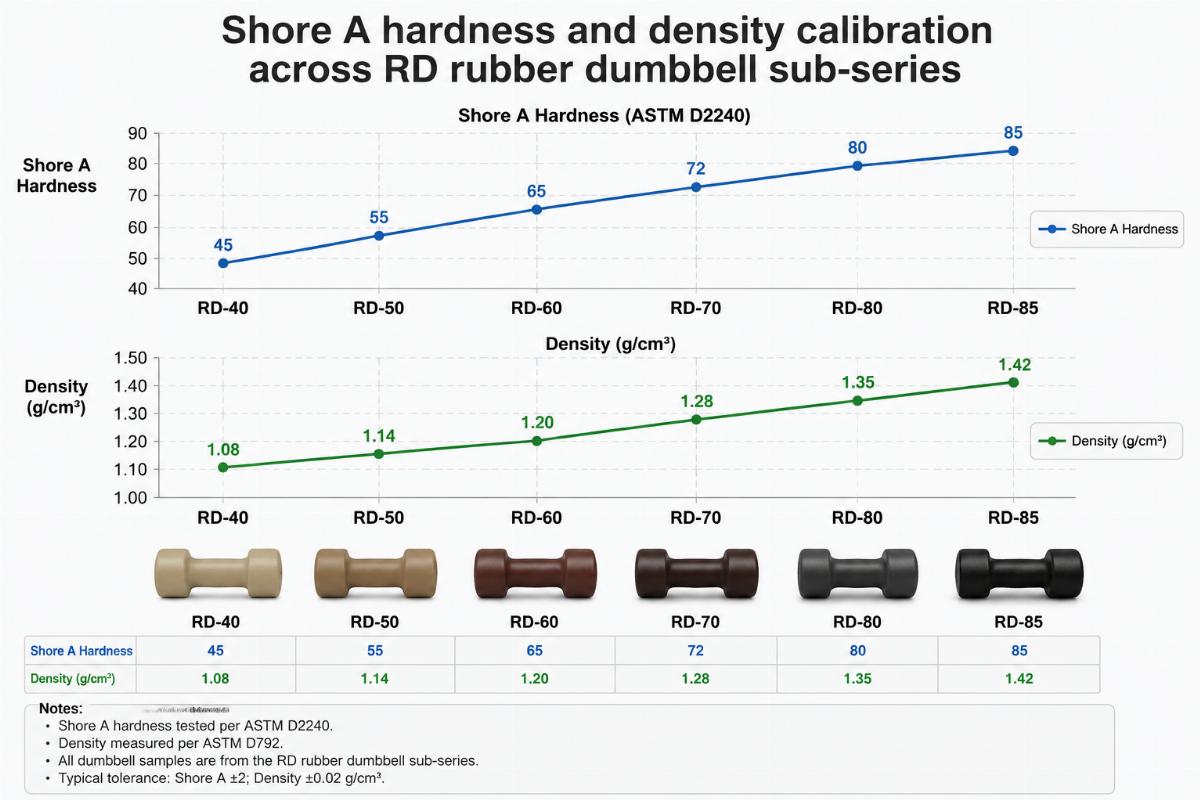
Reading the rubber dumbbell technical data sheet correctly means understanding that hardness and density are not optional details — they are the parameters that determine whether the dumbbell survives its intended usage environment.
How Do Weight Tolerance and Rubber Layer Thickness Vary by Sub-Series?
Weight tolerance and rubber layer thickness are not uniform across the RD sub-series — the rubber dumbbell technical data sheet specifies distinct tolerance bands and thickness ratios for each weight class, and these ratios are not simply proportional.
A common misconception among buyers is that heavier dumbbells simply receive a proportionally thicker rubber layer. In practice, the relationship is more nuanced. The rubber dumbbell technical data sheet defines calibrated thickness-to-weight ratios that account for the increased impact force generated by heavier weight classes. [NEED_CITE: weight tolerance and rubber layer thickness specification standards for commercial rubber-coated free weights]
Across the RD sub-series, weight tolerance is held within a defined band — and this band varies by sub-series grade. Higher-grade sub-series maintain tighter tolerance control, which matters for gyms where dumbbells are loaded on standardized racks and where weight accuracy affects training programming.
Rubber layer thickness follows a corresponding but non-linear progression. Lighter weight classes carry a proportionally thicker rubber envelope relative to their iron core — because the rubber must absorb impact energy that the smaller mass concentrates on a smaller surface area. Heavier classes use a calibrated density-thickness balance rather than raw thickness addition.
| Weight Class | Weight Tolerance Band | Rubber Thickness Ratio | Tolerance Control Level |
|---|---|---|---|
| Light (lower range) | Standard | Proportionally thicker | Standard |
| Mid-range | Standard | Calibrated | Standard |
| Heavy (upper range) | Controlled | Density-calibrated | Controlled |
A wholesale distributor in Latin America received a container where rubber thickness and weight deviation varied noticeably across sub-series within the same shipment. The rubber dumbbell technical data sheet had specified tolerance bands — but the batch-level QC documentation did not align with those bands for several weight classes. The distributor caught the discrepancy during incoming inspection and flagged it before the product reached end users. [NEED_CITE: batch-level QC sampling protocols for rubber-coated free weight tolerance verification]

This is why the rubber dumbbell technical data sheet must be read alongside batch-level QC records — not as a standalone document, but as the reference standard against which every shipment is verified.
How to Match RD Sub-Series Specifications to Destination Climate and Usage Conditions?
The most valuable function of the rubber dumbbell technical data sheet is climate-usage matching — selecting the sub-series whose compound, hardness, and environmental tolerance envelope align with the destination gym’s operating conditions.
This is where most procurement mistakes happen. Buyers select based on price and weight range alone — then discover that the dumbbells fail in their specific environment. The rubber dumbbell technical data sheet exists to prevent exactly that outcome. [NEED_CITE: environmental operating range parameters for rubber fitness equipment components by climate classification]
Tropical and humid environments demand higher-grade rubber compounds with lower VOC emission and stronger heat resistance. The rubber dumbbell technical data sheet should specify the operating temperature and humidity envelope for each sub-series — and buyers in Southeast Asia, the Middle East, and coastal Latin America should treat these parameters as non-negotiable selection criteria.
Temperate and climate-controlled environments have more flexibility — SBR blend sub-series perform adequately where temperature swings are limited and air conditioning maintains stable conditions. But even in temperate zones, high-traffic commercial gyms should prioritize higher Shore A hardness and virgin or high-grade compound sub-series to withstand sustained drop impact.
The Bick RD sub-series range is structured to cover these different climate and usage profiles. Each sub-series carries its own rubber dumbbell technical data sheet — provided as standard with wholesale inquiries — so buyers can match compound class, hardness range, and environmental tolerance to their specific installation before committing to an order.
A gym chain operator in Indonesia initially selected a mid-grade sub-series based on budget. After reviewing the rubber dumbbell technical data sheet against the local climate profile — sustained high humidity, limited air conditioning during off-hours — the selection was upgraded to a higher-grade virgin compound sub-series. The incremental cost was modest relative to the replacement cost that would have followed a field failure. [NEED_CITE: rubber compound selection guidelines for fitness equipment in tropical climate zones]

The rubber dumbbell technical data sheet is not a formality — it is the selection instrument that protects the buyer from expensive post-delivery failures.
What Verification Documents Should Buyers Request Alongside the Technical Data Sheet?
The rubber dumbbell technical data sheet must be supported by third-party test reports and batch-level QC documentation — without these, the data sheet is an unverified claim, not a procurement specification.
Any serious wholesale buyer should treat the rubber dumbbell technical data sheet as the starting point of verification — not the endpoint. The document states what the product is supposed to be; the supporting documentation proves it. [NEED_CITE: third-party testing standards and certification requirements for rubber fitness equipment materials]
The essential verification package includes:
- Third-party test reports from recognized laboratories covering rubber compound composition, VOC emission levels, and Shore A hardness validation.
- Material safety data sheets confirming the chemical composition meets indoor air quality requirements for commercial gym environments.
- Batch-level QC records documenting weight tolerance verification, rubber layer thickness measurement, and visual inspection results for the specific production run being shipped.
Without these documents, the buyer has no way to confirm that the product in the container matches the product described in the rubber dumbbell technical data sheet.
Bick provides the full verification package — third-party test reports, material safety data sheets, and batch-level QC documentation — as a standard part of the wholesale procurement process. This is not an optional add-on; it is how the rubber dumbbell technical data sheet transitions from a specification document into a verifiable procurement record.
A distributor in Africa received a sample shipment where the rubber dumbbell technical data sheet specified a particular VOC emission class. The accompanying third-party test report confirmed the classification. When the full container order arrived, the batch-level QC records matched the data sheet parameters exactly — giving the distributor confidence to release the product to end users without additional independent testing. [NEED_CITE: batch-level QC documentation standards for rubber-coated free weight wholesale shipments]

The rubber dumbbell technical data sheet, supported by independent verification documentation, is the foundation of a defensible procurement decision.
Conclusion
The rubber dumbbell technical data sheet is the most important selection tool a wholesale buyer has — and treating it as anything less is how expensive field failures happen. Every parameter it contains — compound formulation, Shore A hardness, weight tolerance, rubber thickness, and climate envelope — directly determines whether the dumbbell performs or fails in its installation environment. Read it carefully, match it to your destination conditions, and verify every claim with supporting documentation.