Squat Rack Export to Austria | CE Certified Manufacturer for Sale
Most buyers think a Certificate of Origin is just a formality. Austrian customs disagrees.
A Certificate of Origin for squat rack export to Austria is a mandatory customs document that proves where the equipment was manufactured. It must be prepared alongside CE technical files before shipment, with manufacturer details, product descriptions, and transport routes matching exactly across all documents. Missing or mismatched CO paperwork routinely causes clearance delays, warehouse surcharges, and even cargo rejection at European ports.
I still remember a container that sat in a São Paulo warehouse for weeks because the importer’s broker had typed the wrong port of loading on the origin paperwork. The rack itself was perfect—thick gauge steel, clean welds, powder coat without a single bubble—but the paper said "Santos" while the bill of lading said "Paranaguá." Customs would not release it. That was my first real lesson: in international trade, the paper is the product until it clears. Later, when I moved from the installation floor to the sales side and started handling European enquiries, I found the same pattern repeating. Buyers from Vienna, Munich, and Zurich all asked the same first question: "Can I see your CE file and CO template before we sign?" A Certificate of Origin for squat rack export to Austria is no different—it is the document that unlocks the gate.
For any manufacturer shipping strength equipment into the European Union, understanding how this document works—and how it interacts with CE compliance—is not optional. Let me walk you through what Austrian customs actually checks, where most shipments go wrong, and how to prepare everything correctly.
What Is a Certificate of Origin and Why Does Austria Require It?
A Certificate of Origin is an official trade document that certifies the country where goods were wholly obtained, produced, or manufactured. For non-preferential trade between China and the European Union, this is typically a general CO issued by China Customs or the China Council for the Promotion of International Trade (CCPIT) [NEED_CITE: CCPIT non-preferential CO issuance scope and legal basis]. Austria, as an EU member state, applies the Union Customs Code, which requires origin documentation for tariff classification, trade statistics, and certain trade policy measures [NEED_CITE: EU Union Customs Code provisions on non-preferential origin].
Here is what most first-time exporters do not realize: Austria does not grant tariff preferences to Chinese-origin fitness equipment under any free trade agreement, so the CO here serves a non-preferential function. Its primary roles are:
- Confirming the origin for correct tariff classification under the EU Common Customs Tariff
- Supporting customs valuation and statistical reporting
- Serving as a companion document during CE market surveillance checks
When Austrian customs officers inspect a shipment of commercial squat racks, they do not just glance at the CO and wave it through. They cross-reference the manufacturer name and address on the CO against the same fields in the CE Declaration of Conformity and the technical construction file [NEED_CITE: EU market surveillance coordination between customs and product compliance authorities under Regulation 2019/1020]. If the names do not match—say, the CO lists a trading company while the CE file lists the actual factory—the shipment can be held for verification.
I once worked with a European distributor who had been importing plate-loaded machines for years without issues. When they added a new squat rack model to their order, the CO was issued under their sourcing agent’s name rather than the manufacturer’s. Austrian customs flagged the discrepancy against the CE file, and the container was held until a corrected CO was submitted. The delay cost them warehouse fees and rescheduled gym opening dates.
How to Apply for a CO Certificate for Fitness Equipment Export?
The application process for a non-preferential Certificate of Origin from China involves enterprise registration, online submission, document review, and self-printing or collection. Since the rollout of China Customs’ integrated online platform, qualified exporters can apply for and print general COs directly, significantly shortening the turnaround [NEED_CITE: China Customs online platform for certificate of origin application and self-printing pilot program].
Here is the typical workflow for a fitness equipment manufacturer preparing a Certificate of Origin for squat rack export to Austria:
-
Enterprise Registration with the Issuing Authority — The manufacturer must be registered with China Customs or CCPIT as an authorized applicant. This requires a valid business license, foreign trade operator registration, and completion of the origin applicant filing process.
-
Online Application Submission — The applicant logs into the relevant platform and fills in the CO form, including exporter and consignee details, transport route, product description, quantity, weight, and the origin criterion (typically "WO" for wholly obtained or "WP" for wholly produced for manufactured goods like squat racks) [NEED_CITE: non-preferential CO form field requirements under Chinese visa regulations].
-
Document Review and Approval — The issuing authority reviews the submission. For routine industrial goods like commercial gym equipment, approval is often completed within a short processing window when documentation is complete.
-
Printing and Stamping — Once approved, the CO can be printed on security paper with the official stamp, or issued electronically where the system supports it. The original must accompany the shipment or be sent to the importer ahead of arrival.
A critical point here: the transport route field on the CO must match the actual departure port and shipping line details on the bill of lading. I have seen shipments delayed because the CO said "Shanghai" while the goods actually departed from Qingdao—a common scenario for Shandong-based fitness equipment factories. Austrian customs treats this as a document inconsistency and may require amendment before release.
What Information Must Match Between CO and CE Documents?
Austrian customs and market surveillance authorities cross-check the Certificate of Origin against the CE technical file, and any mismatch in key fields triggers inspection or detention. This is the area where most fitness equipment exporters stumble, because the CO and CE documentation are often prepared by different teams or even different companies in the supply chain.
The following fields must be identical across the CO, the EC Declaration of Conformity, and the CE technical construction file:
-
Manufacturer Name — The legal entity name must be consistent. If the CO lists the factory but the CE declaration lists a brand owner or trading company, authorities will ask for clarification on the relationship between the entities.
-
Manufacturer Address — The registered production address must match. Even minor differences in formatting (e.g., abbreviated province names vs. full names) can cause confusion during manual checks.
-
Product Description — The CO description should align with the product category and model references in the CE technical file. A CO that says "steel frames" while the CE file specifies "power racks and squat stands" creates ambiguity about whether the correct goods are covered.
-
Country of Origin — This must be stated as "China" or "People’s Republic of China" consistently, matching the origin claim in the CE documentation.
[NEED_CITE: product compliance documentation requirements under EU Regulation 2019/1020 for customs verification]
I recall a case where a gym chain in Central Europe ordered a full container of squat racks and cable machines. The CO was prepared by their freight forwarder, who listed the forwarder’s own company as the exporter. Meanwhile, the CE technical file correctly named the actual manufacturer in Shandong. When the goods arrived in Austria, customs officers noted the exporter mismatch and requested additional evidence to confirm the origin claim. The importer had to provide a supplier’s declaration and a letter explaining the commercial relationship—documents that should never have been needed if the CO had been prepared correctly from the start.
To avoid this, responsible manufacturers prepare a pre-shipment compliance checklist that verifies alignment between the CO draft, the CE declaration, the test reports, and the commercial invoice before any document is finalized.
Common Mistakes That Cause Customs Delays in Austria
The majority of customs holds for fitness equipment shipments into Austria stem from preventable documentation errors, not product quality issues. Based on patterns observed across multiple export cycles, the following mistakes appear most frequently:
-
Transport Route Mismatch — As mentioned earlier, the departure port on the CO must match the bill of lading. This error often occurs when shipments are consolidated or rerouted after the CO has already been issued.
-
Exporter Name Inconsistency — When a trading company or agent applies for the CO on behalf of the factory, the exporter field on the CO may not match the manufacturer field on the CE documents. Austrian customs views this as a potential origin circumvention risk.
-
Late Application or Post-Arrival Correction — Some exporters treat the CO as an afterthought and apply for it only after the vessel has departed. If errors are discovered after arrival, amending the CO requires resubmission, re-approval, and courier delivery of the original to Austria—a process that adds substantial time and cost.
-
Missing or Incomplete CE Companion Documents — The CO alone is not sufficient. Austrian customs expects to see the CE Declaration of Conformity, test reports from a notified body or accredited laboratory (where applicable), user manuals in German, and the technical construction file available for inspection [NEED_CITE: Austrian market surveillance practice for fitness equipment under EN ISO 20957 series standards]. A shipment with a perfect CO but incomplete CE paperwork will still be held.
-
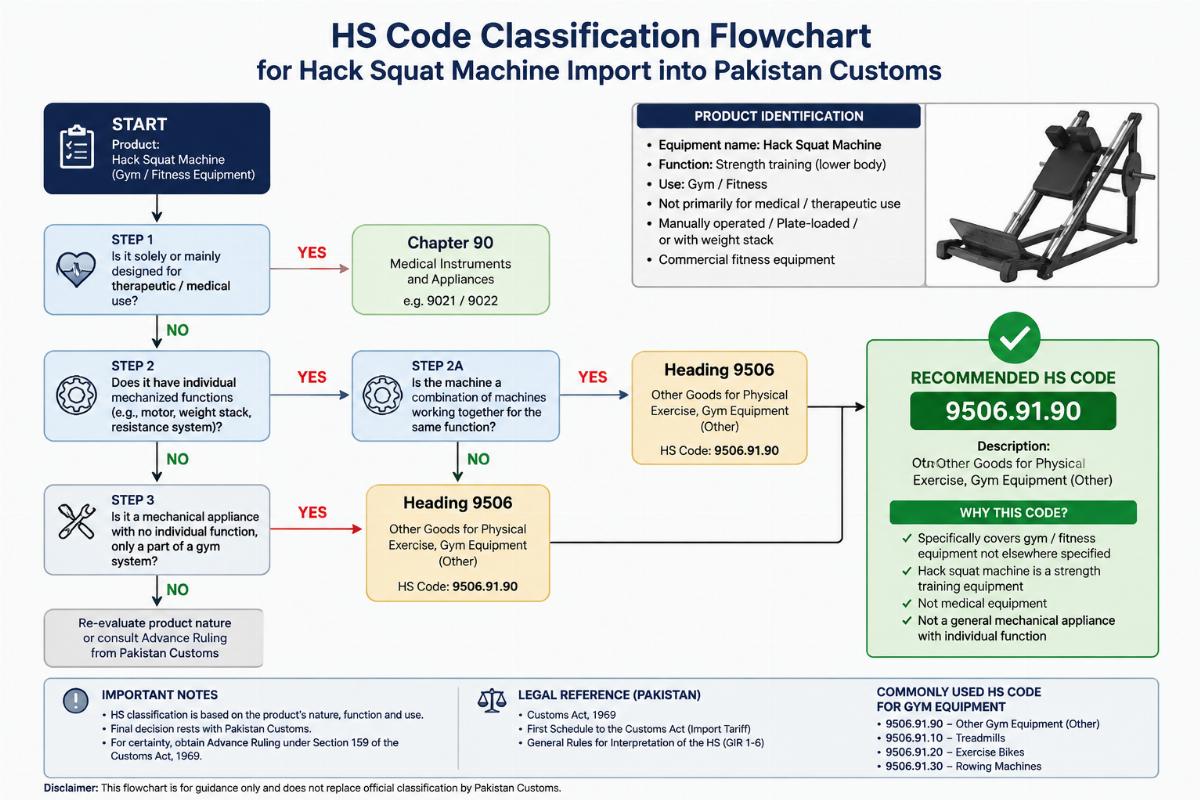
Incorrect HS Code Classification — While the CO itself does not determine the HS code, the product description on the CO should be consistent with the tariff classification used on the customs declaration. Squat racks typically fall under specific headings for strength training equipment, and misclassification can trigger duty disputes.
Each of these errors is avoidable with proper pre-shipment coordination. The key is to treat the CO not as an isolated document but as one component of an integrated export compliance package.
How to Ensure Smooth Clearance for Your Gym Equipment Shipment?
Successful customs clearance for squat rack shipments into Austria depends on preparing all required documents as a unified package before the goods leave the factory. This means the CO, CE technical file, commercial invoice, packing list, and bill of lading should be reviewed together for internal consistency.
Here is a practical pre-shipment clearance checklist for fitness equipment exporters targeting the Austrian market:
-
Confirm that the CO applicant is the same legal entity listed as the manufacturer in the CE technical file, or prepare a supplementary declaration explaining the commercial relationship.
-
Verify that the departure port on the CO matches the port of loading on the bill of lading and the shipping booking confirmation.
-
Ensure the product description on the CO is specific enough to identify the goods (e.g., "commercial squat racks, model SR-200, steel construction") rather than vague terms like "gym equipment" or "metal products."
-
Check that the CE Declaration of Conformity references the correct harmonized standards (such as EN ISO 20957-1 and EN ISO 20957-2 for strength training equipment) and that test reports are from accredited laboratories [NEED_CITE: EN ISO 20957 series standards for stationary training equipment safety requirements].
-
Prepare German-language user manuals and safety warnings, as Austrian authorities expect product documentation in the official language of the market.
-
Arrange for the original CO to be couriered to the importer ahead of the vessel’s arrival, or confirm that the electronic version is acceptable to the Austrian customs broker.
Working with a manufacturer that has extensive export experience simplifies this process significantly. A factory that regularly ships to European markets understands the interplay between CE compliance and origin documentation, and can provide all required files as a coordinated package rather than leaving the importer to reconcile discrepancies between separate suppliers.
For gym owners and distributors importing into Austria, the message is straightforward: do not treat the Certificate of Origin as a minor administrative task. It is a foundational document that, when prepared correctly, ensures your squat racks clear customs without delay and reach the gym floor on schedule. When prepared incorrectly, it becomes the single most expensive piece of paper in the entire shipment.
Conclusion
A Certificate of Origin for squat rack export to Austria is a non-negotiable customs requirement that must be prepared in full alignment with CE technical documentation. Exporters who treat it as an afterthought risk clearance delays, warehouse charges, and frustrated end customers. By ensuring consistency across the CO, CE declaration, test reports, and shipping documents—and by working with experienced manufacturing partners who understand European compliance requirements—importers can move their equipment from the port to the gym floor without unnecessary friction.