Wholesale Functional Trainer MOQ 10 Factory Direct
MOQ 10 is not a factory profit trick — it is a logistics survival threshold.
For commercial gym buyers, ordering functional trainers below MOQ 10 almost always means LCL shipping, which triggers 3x longer customs clearance, significantly higher per-unit freight, and a damage rate that can wipe out your entire margin before the machines reach the gym floor.
I spent three days crouching in the Apapa port yard in Lagos, waiting for a container of functional trainers to clear customs. The client had ordered only 5 units — not enough to fill a container — so the machines were stuffed into an LCL shipment alongside loose weight plates and adjustable dumbbell racks. When the doors finally opened, the frames were cracked, the pulley cables had snapped under compression, and the client refused the entire lot. I came up through documentation and customs brokerage, so I know exactly how differently LCL and FCL cargo are treated at destination ports. Now, whenever a buyer asks about MOQ, my first question is always: are you shipping FCL or LCL? MOQ is not a number pulled from thin air — it reflects loading plans, ocean freight economics, and whether that machine arrives at the gym intact. There are plenty of functional trainer factories in Shandong, but finding one who can align your MOQ with a real logistics strategy is a different story.
Let me walk you through what MOQ 10 actually means, why LCL destroys your margins and your machines, and how smart buyers turn this threshold into a cost advantage.
What Does MOQ 10 Mean for Functional Trainer Buyers?
MOQ 10 for functional trainers is a logistics-driven threshold designed to make FCL shipping viable, not an arbitrary factory minimum.
When a factory sets MOQ 10 for functional trainers, the number comes from container space math, not profit greed. A standard functional trainer, fully packaged, occupies roughly the same footprint as a small power rack. Load ten of them into a 20GP alongside adjustable benches and a few sets of dumbbells, and you fill the container to near-maximum CBM utilization. Drop to five units, and you are paying LCL rates — which means your cargo shares container space with strangers’ goods, gets handled multiple times at CFS warehouses, and faces stacking pressure from heavier freight. [NEED_CITE: LCL damage rate comparison with FCL for heavy gym equipment per international freight handling guidelines]
The real cost of going below MOQ 10 is not the unit price — it is the hidden freight structure. LCL shipments carry origin terminal handling charges, destination CFS unpacking fees, and consolidation surcharges that do not exist in FCL. A buyer ordering 6 functional trainers via LCL often ends up paying more per unit in freight and handling than a buyer who ordered 10 via FCL, even before factoring in damage claims.
A boutique studio owner in West Africa once ordered 5 functional trainers through a trading company. The machines shipped LCL, mixed with cast iron plates and rubber flooring rolls. At destination, four of the five units showed frame deformation — the plates had shifted during transit and crushed the trainer frames. The replacement order cost the client nearly double the original freight spend, and the gym opening was delayed by weeks. That is what happens when MOQ is treated as a suggestion rather than a logistics reality.
How Does LCL vs FCL Shipping Impact Functional Trainer Delivery?
FCL shipping reduces functional trainer damage rates dramatically and cuts per-unit freight costs by a noticeable margin compared to LCL.
The difference between LCL and FCL for functional trainers is not just about container size — it is about cargo integrity from factory floor to gym door. In FCL, your machines are loaded once, sealed, and not touched again until destination. In LCL, your cargo is consolidated at origin, deconsolidated at destination, potentially re-handled at an inland depot, and stacked under freight that may weigh several times more than your equipment. [NEED_CITE: FCL vs LCL cargo handling frequency and damage incidence per international shipping association guidelines]
Functional trainers are particularly vulnerable in LCL environments. The upright frames, cable pulley systems, and weight stack guides are precision-aligned components. When a forklift driver at a CFS warehouse drops a pallet of kettlebells on top of your trainer packaging, no amount of foam padding can save the internal alignment. I have seen LCL shipments where the outer cartons looked fine, but the internal steel frames were bent beyond repair — the damage was invisible until assembly.
A distributor in the Middle East consolidated 20 functional trainers with Smith machines and plate-loaded equipment in a 40HQ container. The per-unit freight cost dropped noticeably compared to his previous LCL orders, and the transit damage rate was zero. More importantly, customs clearance at Jebel Ali took days instead of weeks, because FCL shipments go directly to the consignee’s broker without CFS deconsolidation delays. [NEED_CITE: FCL customs clearance time advantage over LCL at major Middle East ports]
The lesson is clear: if you are ordering functional trainers for commercial use, FCL is not a luxury — it is a necessity. And FCL only becomes economically viable when you hit the MOQ threshold that fills the container efficiently.
What Are the Hidden Costs of Ordering Below MOQ?
Ordering below MOQ 10 for functional trainers triggers a cascade of hidden costs: higher handling fees, longer clearance times, and damage claims that erase any perceived unit price savings.
Most buyers focus on the per-unit factory price when comparing suppliers. But the true landed cost of a functional trainer includes ocean freight, origin and destination terminal charges, customs brokerage, inland transport, and — critically — the cost of damage or delay. When you order below MOQ and ship LCL, every single one of these cost categories works against you.
LCL terminal handling charges at origin are calculated per revenue ton (the greater of weight or CBM), and functional trainers are bulky relative to their weight. You pay for air space. At destination, CFS unpacking fees are charged per cubic meter, and if your cargo is at the back of the container, you may face "priority unloading" surcharges to get your goods out first. Customs clearance for LCL shipments requires the CFS to issue a delivery order before your broker can even file the entry — this adds days, sometimes weeks, to the process. [NEED_CITE: LCL terminal handling charge structure and CFS delivery order timeline per international freight forwarding standards]
A hotel chain in Southeast Asia ordered 8 functional trainers from a supplier who quoted an attractive unit price but did not explain the MOQ logistics. The machines shipped LCL. At destination, the CFS warehouse charged a volumetric surcharge because the trainers occupied more space than their weight justified. Customs held the shipment for additional inspection because LCL cargo with mixed consignees triggers higher scrutiny. By the time the machines reached the hotel, the total landed cost per unit exceeded what a full FCL order of 10 units would have cost — and two of the eight trainers needed frame realignment before they could be installed.
The hidden cost structure of below-MOQ ordering is not obvious on a proforma invoice. It only reveals itself at destination, when the damage report and the freight final account arrive together.
How Can Buyers Optimize Container Loading for Functional Trainers?
Smart container loading — nesting functional trainers with racks, benches, and free weights — maximizes space utilization and turns MOQ 10 into a cost advantage.
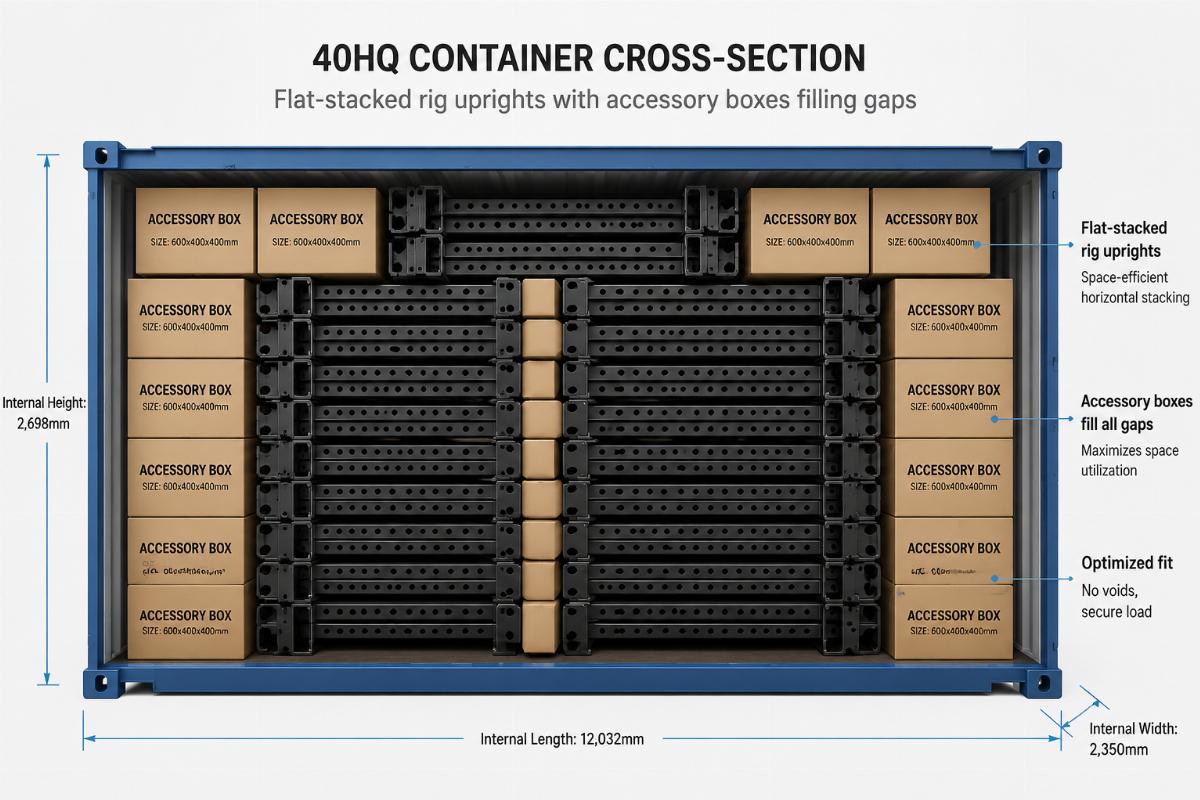
Functional trainers are not standalone shipments. Their steel frame architecture allows them to nest efficiently with power racks, adjustable benches, dumbbell racks, and plate storage systems. A well-designed loading plan can fill a 20GP with 10 functional trainers plus complementary equipment, achieving near-maximum CBM utilization while keeping per-unit freight at FCL rates. [NEED_CITE: Container loading optimization principles for mixed gym equipment per freight consolidation best practices]
The key is understanding the volumetric profile of each product category. Functional trainers are tall but relatively narrow. Power racks are wide but can be disassembled for flat stacking. Adjustable benches fold flat. Dumbbells and plates are dense and heavy — perfect for filling the floor layer of a container. When you combine these product types in a single container, you are not just meeting MOQ — you are building a complete gym package that ships at the lowest possible per-unit cost.
This is where a manufacturer’s loading expertise matters. A factory that understands container geometry can design a loading plan that maximizes every cubic meter. At Bick, we provide turnkey gym packages that include container-load consolidation services — our engineering team designs the loading plan before production begins, ensuring that your functional trainers, strength machines, and free weights arrive as a single, optimized FCL shipment. Every package is CE-certified, and the loading plan accounts for weight distribution, frame protection, and destination handling requirements.
A fitness equipment distributor in Latin America worked with us to consolidate a full gym setup: 10 functional trainers, 4 Smith machines, 20 adjustable benches, and multiple sets of dumbbells and plates, all in a single 40HQ. The space utilization was optimized to the point where the per-unit freight cost for the functional trainers dropped noticeably compared to his previous LCL orders. More importantly, the gym opened on schedule, with zero transit damage.
Conclusion
MOQ 10 for functional trainers is a logistics threshold, not a factory constraint — respect it, and you protect your margin, your machines, and your project timeline.
Ordering below MOQ forces LCL shipping, which multiplies handling costs, extends clearance times, and exposes your equipment to damage. Ordering at or above MOQ enables FCL shipping, which protects cargo integrity, reduces per-unit freight, and allows you to build complete gym packages through smart container loading. The difference between a successful gym outfitting project and a costly logistics failure often comes down to whether you understood this threshold before placing the order.