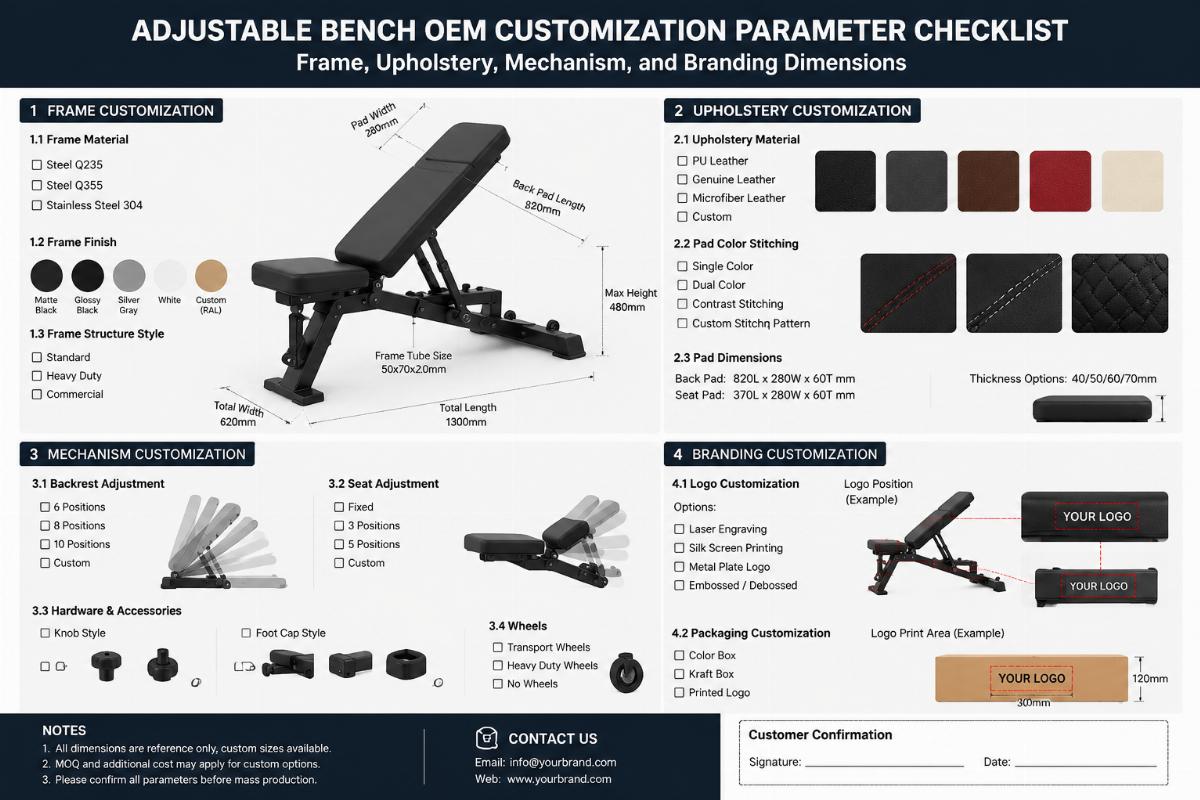
AB-Adjustable Bench Sub-Series Wholesale Supplier & Warranty Guide
Longer warranty does not mean better coverage. The real risk lies in whether warranty terms are broken down by sub-series and whether consumable parts are clearly excluded.
AB adjustable bench sub-series warranty terms differ significantly across commercial, light-commercial, and home-use models. Structural frames typically carry multi-year coverage, while adjustment mechanisms, pins, bushings, and seat rails are classified as wear parts with limited or no warranty. Wholesale buyers must request a detailed warranty schedule per sub-model before placing orders, and confirm spare parts availability and response tiers in writing.
I used to spend my days at Qingdao port checking shipping documents for fitness equipment—bills of lading, packing lists, container manifests stacked on my desk. When I moved into direct buyer communication, I thought I had the product knowledge locked down. Then came a commercial gym project in Lagos. A full container of adjustable benches landed, and within months the buyer’s emails were flooding in: adjustment pins loosening under heavy daily use, seat rails developing metallic grinding noises, requests for full-batch replacement. I pulled up the contract and realized the AB adjustable bench sub-series warranty terms were written in vague generalities. The buyer was running the benches at commercial frequency, but our warranty schedule had not separated structural coverage from adjustment mechanism wear. Since that order, every quotation I send includes a warranty breakdown sheet—sub-model by sub-model, coverage period by coverage period, consumable list by consumable list. Now when buyers ask about bench selection and after-sales, I lay the warranty terms on the table first. No ambiguity, no disputes later.
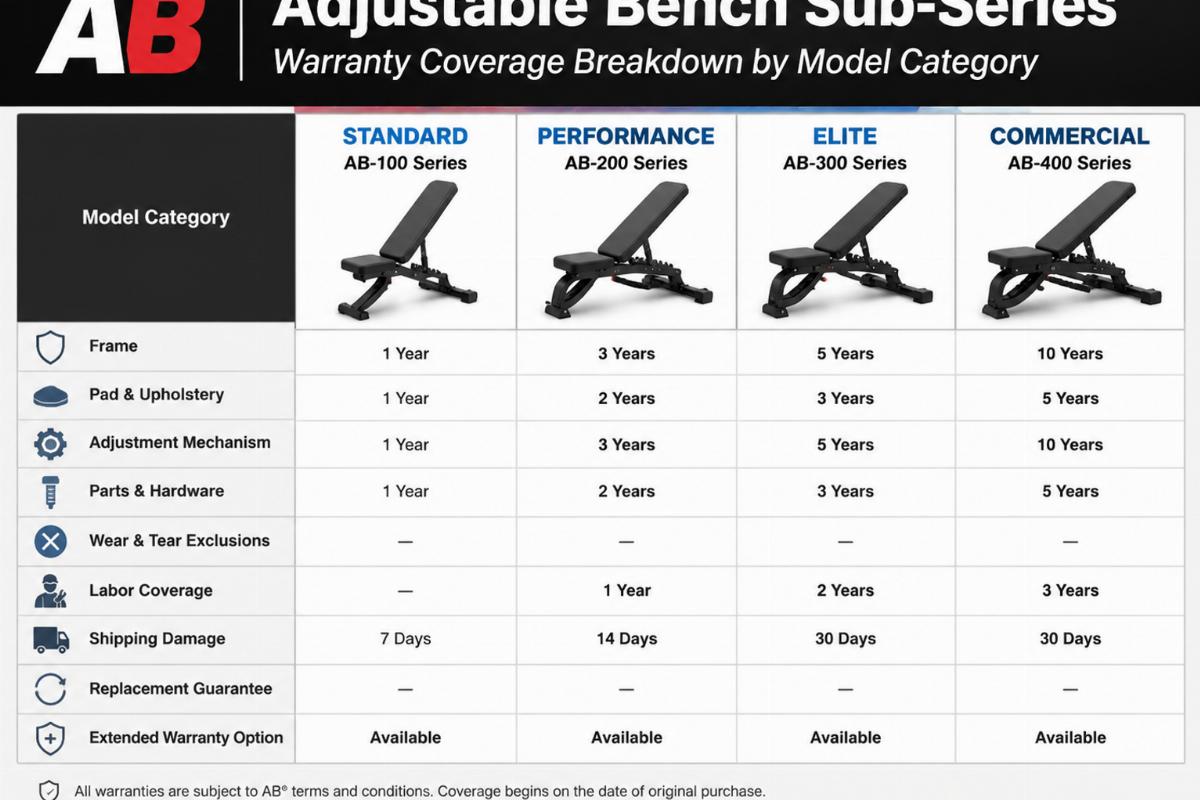
Let me walk you through how AB adjustable bench sub-series warranty terms actually work across different usage scenarios, what falls inside and outside coverage, how after-sales response is structured, and how to lock these terms into your purchase contract.
How Do Warranty Periods Differ Across AB Adjustable Bench Sub-Series?
Warranty duration is not uniform across the AB line. It splits by intended usage environment, and the gap between top-tier and entry-tier sub-models is substantial.
The AB adjustable bench sub-series is engineered for three distinct deployment scenarios: heavy commercial gym floors, light-commercial or boutique studio environments, and home-use setups. Each scenario subjects the bench to fundamentally different stress cycles, and manufacturers structure warranty periods accordingly [NEED_CITE: fitness equipment warranty classification standards by usage category].
For heavy commercial sub-models—those designed for high-traffic gym floors with continuous multi-user daily operation—the structural frame and main weldments typically receive the longest coverage window. These benches use heavier-gauge steel tubing, reinforced gusset plates at adjustment pivot points, and higher-grade surface treatment. The warranty reflects this build quality. Adjustment mechanisms on commercial sub-models, however, are treated differently. The pop-pin assemblies, ladder-bar adjustment slots, and backrest pivot bushings experience thousands of articulation cycles per month. Even with precision machining, these components are classified as wear items.
Light-commercial sub-models occupy a middle ground. They serve personal training studios, hotel fitness rooms, and small gym operations where daily usage intensity is moderate. Frame warranty periods are shorter than heavy commercial counterparts, and adjustment mechanism coverage is more restricted. The steel gauge is lighter, the adjustment ladder has fewer reinforcement points, and the expected service life under continuous commercial use is meaningfully shorter.
Home-use sub-models carry the shortest warranty windows across all categories. These benches are engineered for one to two users, intermittent daily use, and lower total load cycles. The frame tubing is thinner, adjustment mechanisms use simpler latch designs, and surface treatment may involve fewer coating layers. When a wholesale buyer purchases home-grade sub-models and deploys them in a commercial setting, warranty claims are almost always denied—and rightly so, because the usage environment exceeds the design parameters.
| Sub-Series Category | Frame Warranty | Adjustment Mechanism Warranty | Wear Parts Coverage |
|---|---|---|---|
| Heavy Commercial | Longest tier | Limited, conditional | Excluded |
| Light Commercial | Moderate tier | Restricted | Excluded |
| Home Use | Shortest tier | Minimal or none | Excluded |
A distributor in the Middle East once placed a trial order mixing two AB adjustable bench sub-series for different client segments. When the end-user gym requested unified extended warranty across all units, the distributor faced a difficult conversation. The commercial sub-models could support longer coverage; the light-commercial units could not absorb the same liability without significant cost restructuring. The lesson: warranty period differences are not arbitrary marketing tiers—they reflect real engineering and material cost gaps.

Which Components Are Covered and Which Are Classified as Consumables?
The single most common source of warranty disputes is the boundary between structural components and consumable wear parts. This line must be drawn explicitly before shipment.
In the AB adjustable bench sub-series, components are divided into two categories: structural/welded assemblies and adjustable mechanism components. Understanding this division is critical for any wholesale buyer negotiating warranty terms [NEED_CITE: fitness equipment component classification and warranty exclusion standards].
Structural components include the main frame tubing, base stabilizer bars, welded gusset plates, and the fixed seat platform base. These parts are manufactured from heavy-gauge steel, undergo full-penetration welding at critical joints, and receive multi-layer electrostatic powder coating. Failures in these components are rare under normal usage and typically indicate a manufacturing defect—porosity in welds, coating delamination from inadequate surface prep, or tubing that does not meet specified wall thickness. When such defects are confirmed, warranty coverage applies fully, including replacement parts and shipping.
The adjustable mechanism category is where disputes arise. This includes the backrest adjustment ladder bar, pop-pin assemblies, seat slide rails, pivot bushings, and adjustment handle springs. These components are subject to repetitive mechanical action—insertion and extraction of pins, sliding contact between rail surfaces, rotational friction at pivot points. Even with controlled nitrogen infusion in heat treatment and precision-ground contact surfaces, these parts will eventually show wear under sustained commercial use. Manufacturers classify them as consumables.
Specifically, the following are almost universally excluded from warranty coverage across AB adjustable bench sub-series:
- Pop-pin detent springs and retaining clips
- Seat rail sliding bushings and liner inserts
- Adjustment ladder notch wear surfaces
- Pivot point friction washers and thrust pads
- Rubber or polymer foot pads and floor contact points
- Upholstery vinyl, foam padding, and seam stitching
A hotel fitness center in Southeast Asia reported seat rail grinding noise on a batch of adjustable benches. The on-site technician disassembled the rail assembly and found that the polymer liner inserts had compressed unevenly after extended use in a humid coastal environment. The solution was not a warranty claim for rail replacement—it was swapping out the liner inserts, a low-cost consumable part that took minutes to replace on-site. The buyer had initially assumed the entire rail assembly was under warranty. The reality: only the welded rail housing was covered; the internal consumable liners were not.
When you receive a warranty document from your supplier, check whether it lists specific excluded components. If the document only states "structural frame warranty" without defining what falls outside structural coverage, you are setting yourself up for a dispute. Request an explicit consumable parts list as a contract attachment.

How Does the After-Sales Response Process Work?
After-sales support follows a tiered escalation model: remote guidance first, spare parts shipment second, and on-site intervention only for complex structural failures. Understanding this sequence prevents unrealistic expectations.
When a warranty issue surfaces on an AB adjustable bench sub-series, the response process follows a defined escalation path. This is not arbitrary—it is designed to resolve the majority of issues at the lowest cost and fastest speed, while reserving expensive interventions for genuine structural failures [NEED_CITE: fitness equipment after-sales service tiered response framework].
The first tier is remote technical guidance. The buyer’s maintenance personnel or on-site technician provides photos, video, and a description of the symptom. The manufacturer’s technical team diagnoses whether the issue is a consumable wear problem, an adjustment mechanism misalignment, or a structural defect. For adjustment mechanism issues—loose pop-pins, misaligned ladder bars, squeaking pivot points—remote guidance often includes step-by-step instructions for on-site adjustment, lubrication, or simple part swaps. A significant proportion of reported issues are resolved at this stage without any parts being shipped.
The second tier is spare parts shipment. If remote diagnosis confirms a component failure that cannot be resolved through adjustment, the manufacturer ships replacement parts. For consumable items like rail liner inserts, pivot bushings, or pop-pin springs, these are low-cost, lightweight components that can be dispatched via express courier. For structural components like replacement frame sections or welded assemblies, the parts are heavier and may require freight shipping. The manufacturer’s spare parts inventory strategy determines how quickly these ship—this is where a supplier with dedicated spare parts warehousing and established logistics channels provides a meaningful advantage [NEED_CITE: spare parts availability and fulfillment speed as a supplier evaluation criterion].
The third tier is on-site technical support. This is reserved for cases where the issue involves complex structural assessment, where remote diagnosis is insufficient, or where a batch-level quality concern has been identified. On-site dispatch is costly and time-consuming, so it is deployed only when lower tiers cannot resolve the issue.
A wholesale buyer in West Africa received a shipment of commercial-grade adjustable benches. Within the first several months, multiple units developed backrest adjustment play. The buyer immediately demanded full-batch replacement. The manufacturer’s technical team requested video footage and guided the buyer’s technician through a pin-and-bushing inspection. The diagnosis: the pop-pin detent springs had lost tension due to high-frequency adjustment cycles in a high-temperature environment. The solution was shipping replacement spring kits—a fraction of the cost and time of full-batch replacement. The issue was resolved within a single escalation cycle.
Buyers should confirm with their supplier: what is the typical response time for remote guidance? What is the spare parts dispatch timeline? Under what conditions is on-site support triggered? These answers should be documented before the order is placed.

How Should Warranty Terms Be Locked Into the Purchase Contract?
A verbal warranty promise is worthless. Every coverage detail must be written into the contract as an attached warranty schedule, with sub-model specificity, excluded parts lists, and response time commitments.
The most critical step in protecting your investment in AB adjustable bench sub-series inventory is formalizing warranty terms at the contract stage. This is not a post-shipment negotiation—it must be completed before the purchase order is signed [NEED_CITE: best practices for fitness equipment procurement contract warranty clauses].
The quotation document should include, as a mandatory attachment, a warranty schedule that specifies:
- Each sub-model covered under the order, identified by model number and series designation
- Warranty period for structural frame components per sub-model
- Warranty period for adjustment mechanism components per sub-model, or explicit statement of exclusion
- Complete list of consumable and wear parts excluded from all warranty coverage
- Spare parts availability commitment—how long the supplier guarantees spare parts supply after the model is discontinued
- Response time commitments for each tier of after-sales support
A professional supplier will provide this warranty schedule proactively as part of the quotation package. If your supplier does not offer this level of detail, request it explicitly. The absence of a detailed warranty schedule is a red flag—it suggests the supplier has not formalized their after-sales commitment and may handle claims on an ad-hoc basis.
In addition to the warranty schedule, the contract should address:
- The process for submitting a warranty claim (documentation required, response timeline from the supplier)
- Whether replacement parts are shipped at the supplier’s cost or the buyer’s cost during the warranty period
- The procedure for handling batch-level quality issues that may require full-batch inspection or replacement
- The jurisdiction and dispute resolution mechanism if warranty disagreements arise
When evaluating suppliers, compare their warranty documentation quality alongside their product specifications. A supplier who provides a comprehensive, sub-model-specific warranty schedule demonstrates operational maturity and after-sales infrastructure investment. A supplier who offers only vague "quality guarantee" language without specifics is transferring risk to the buyer.

Conclusion
Warranty clarity prevents disputes. Sub-model specificity, consumable exclusion lists, and documented response tiers are non-negotiable in any adjustable bench procurement contract.
AB adjustable bench sub-series warranty terms vary by usage category, and the boundary between covered structural components and excluded consumables is where most disputes originate. Buyers who insist on detailed warranty schedules attached to their purchase contracts, confirm spare parts availability, and understand the tiered after-sales response process will avoid the costly misunderstandings that plague poorly documented orders. The bench itself is only half the transaction—the warranty framework around it determines whether the partnership holds up under real-world use.