SM-500 Smith Machine Sub-Series Container Loading and MOQ Reference
Most buyers assume lower MOQ always means lower risk. The reality is the opposite: scattered low-MOQ shipments packed without proper loading logic consistently generate higher per-unit freight costs and far more in-transit damage than consolidated full-container orders.
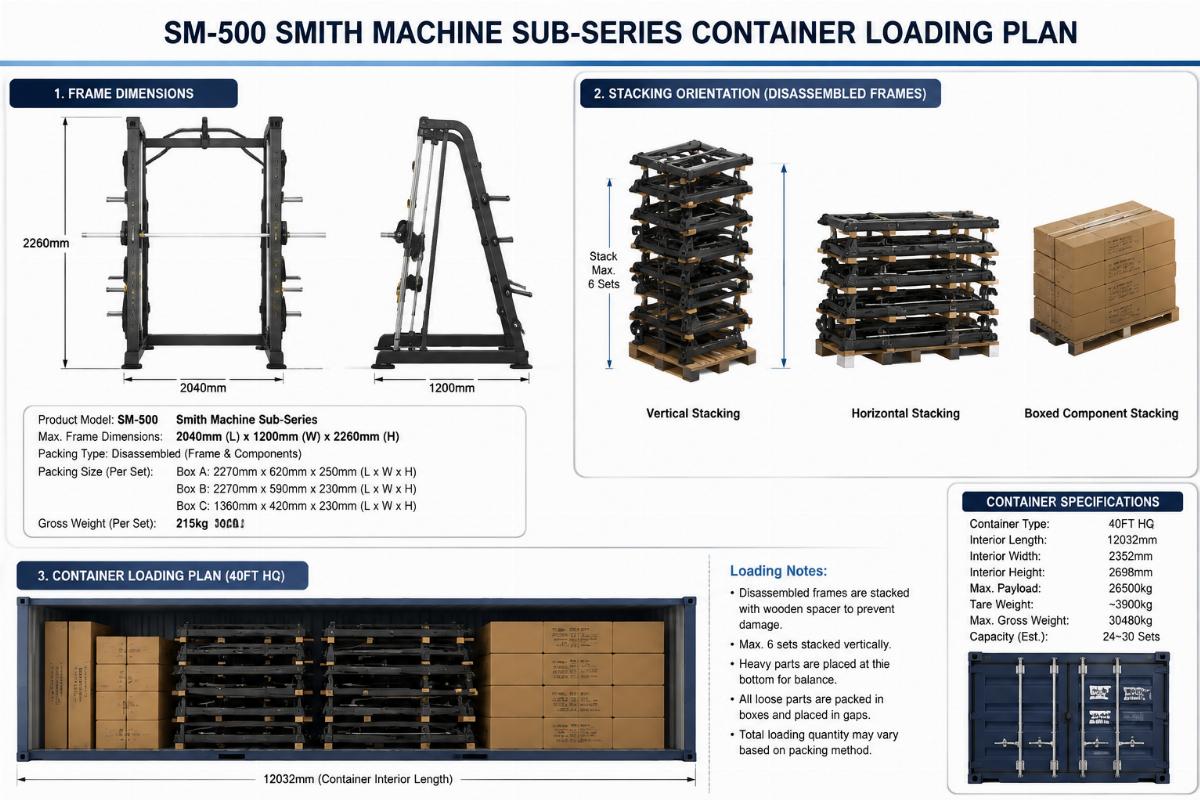
The SM-500 Smith Machine series includes multiple sub-models with distinct frame dimensions and cubic volumes, which directly determine how many units fit inside a standard container, what the realistic MOQ threshold is, and whether mixed-item consolidation with other gym equipment is physically viable. A well-planned container loading scheme—not just aggressive price negotiation—is what actually reduces landed cost and eliminates arrival damage.
Working the factory floor before moving into trade, I spent years inspecting guide rail tolerances and electroplated weight plate finishes. What I learned quickly is that a machine’s build quality means nothing if it arrives at the port with a bent rail or scratched powder coating. A Middle East studio owner once ordered SM-500 main frames and accessories separately, each hitting their individual MOQ, then tried to consolidate them himself at the warehouse. He stacked a cable crossover frame horizontally across the container doors because it "looked like it fit." Two guide rails arrived warped beyond straightening. The replacement cycle stretched across months, and the client relationship was damaged permanently [NEED_CITE: root causes of gym equipment transit damage per ISO container loading standards]. That incident pushed me to obsess over every sub-series dimension, stacking orientation, and MOQ combination logic.
Let me walk through the exact loading parameters, MOQ structures, and mixed-container rules that determine whether your SM-500 Smith Machine order arrives intact and economically viable.
What Are the Dimensional and CBM Differences Across SM-500 Sub-Series?
Each SM-500 sub-model carries a different footprint and cubic volume, and knowing these figures is the non-negotiable first step before any container loading calculation.
The SM-500 line is not a single monolithic product. It branches into several configurations: the standard full-size Smith machine with integrated cable crossover attachment, the compact studio version with shortened guide rails, the half-rack Smith hybrid, and the dual-adjustable pulley Smith combination. Each variant changes the overall length, width, and height of the packaged unit, which cascades into completely different loading math.
The standard full-size SM-500 Smith Machine, once crated, occupies a notably large cubic volume. Its guide rail assembly is the longest single component in the entire sub-series, and this single measurement dictates whether the unit stands upright or must be laid horizontally inside the container. When guide rail length exceeds the container door’s internal height clearance, horizontal placement with reinforced bracing becomes mandatory [NEED_CITE: internal dimensions of ISO standard 20GP and 40HQ dry containers]. Many first-time importers miss this entirely and specify upright loading, only to discover at the port that the rails simply will not clear the door frame.
The compact studio variant reduces overall frame length substantially, which drops its per-unit CBM noticeably. This makes it far more container-friendly: more units fit per container, and the guide rails often clear the door height threshold, allowing upright placement with proper internal blocking. For buyers outfitting boutique studios or hotel fitness rooms, this sub-model frequently becomes the default choice not because of price alone, but because the loading efficiency dramatically changes the MOQ economics.
The half-rack Smith hybrid and the dual-adjustable combination models sit between these two extremes. Their CBM values differ from both the standard and compact versions, and their weight distribution patterns require specific floor-loading calculations to avoid exceeding container weight limits before volume limits are reached.
| Sub-Series Variant | Relative Footprint | Guide Rail Orientation in Container | Relative CBM per Unit |
|---|---|---|---|
| Standard Full-Size | Largest | Horizontal mandatory | Highest |
| Compact Studio | Noticeably reduced | Upright viable | Moderately low |
| Half-Rack Hybrid | Intermediate | Case-dependent | Intermediate |
| Dual-Adjustable Combo | Intermediate-to-large | Case-dependent | Intermediate-to-high |
A distributor in West Africa once ordered a full container of standard SM-500 units alongside a batch of compact variants. By mixing the two sub-models strategically—placing compact units in the residual spaces beside and above the standard frames—the container reached near-maximum volume utilization. The total unit count per container exceeded what a pure standard-order or pure compact-order would have achieved individually [NEED_CITE: container volume utilization optimization principles in heavy equipment logistics]. This kind of mixed sub-series loading is where real cost savings emerge, but it requires knowing exact CBM figures before placing orders.

How Is SM-500 MOQ Determined, and Which Option Actually Costs Less?
The MOQ for SM-500 Smith Machine orders is flexible, but the true cost comparison between scattered small orders and consolidated container loads reveals that lower MOQ frequently increases total landed expense rather than reducing it.
Manufacturers typically set MOQ thresholds based on production batch efficiency, not arbitrary sales targets. For the SM-500 series, MOQ flexibility extends from single-unit sample orders up to full-container commitments. However, the per-unit price difference between a single-unit order and a container-load order is only one slice of the total cost picture.
When buyers place multiple small orders across different sub-models—say, a few standard Smith machines here, a handful of compact units there, plus a separate batch of accessories—each shipment incurs its own inland transportation, customs clearance, port handling, and documentation fees. These fixed costs do not scale down proportionally with order size. A single-unit LCL shipment to the Middle East can carry per-unit freight and handling charges that are multiples of what the same unit would cost inside a full container [NEED_CITE: LCL versus FCL cost structure comparison in international fitness equipment trade].
Beyond freight, there is the damage exposure. LCL shipments involve multiple handoffs: factory to domestic warehouse, warehouse to CFS consolidation point, CFS to container, ocean transit, destination deconsolidation, and final delivery. Each handoff is a risk point. I have seen guide rails bent at the CFS stage because forklift operators handling consolidated cargo had no visibility into which crates contained precision-ground rails versus generic steel frames. A full-container order, by contrast, moves from factory floor directly into a sealed container with minimal intermediate handling.
The practical MOQ recommendation depends on the buyer’s project scope. For a commercial gym outfitting an entire facility, committing to a full container of mixed SM-500 sub-models plus complementary strength equipment delivers the lowest per-unit landed cost. For a boutique studio needing only a few machines, the MOQ is still achievable, but buyers should consolidate their Smith machine order with other equipment categories—benches, weight plates, functional accessories—to fill the container rather than shipping the Smith machines as standalone LCL.
A hotel project buyer in Southeast Asia initially wanted to order only compact SM-500 units at the lowest possible MOQ. After reviewing the total landed cost breakdown, they expanded the order to include plate-loaded machines and adjustable benches, filling a full container. The per-unit cost across all items dropped noticeably, and the damage rate on arrival was effectively zero compared to their previous LCL experiences [NEED_CITE: damage rate comparison between FCL and LCL shipments in commercial equipment imports].

Can Smith Machines Be Mixed with Other Equipment in One Container?
Yes, the SM-500 Smith Machine can share a container with other gym equipment, but successful mixed loading follows strict priority rules based on weight distribution, fragility, and dimensional compatibility.
Mixed-container consolidation is standard practice in gym equipment importing, and the SM-500 series is frequently loaded alongside power racks, cable crossovers, plate-loaded machines, dumbbell racks, and free weight sets. The key is understanding which items go where inside the container and why.
The foundational rule is heavy and dense items on the bottom, lighter and bulkier items on top. Smith machines, particularly the standard full-size SM-500, carry substantial steel frame weight. They belong on the container floor, positioned against the sidewalls to create a stable base layer. Plate-loaded machines and selectorized equipment, which are heavy but more compact, nest beside or in front of the Smith frames. Dumbbell racks and weight plate containers fill the mid-level spaces. Benches, resistance band sets, and packaged accessories occupy the upper zones and any residual gaps.
The second rule concerns fragility. Guide rails on the SM-500 Smith Machine are precision-ground steel components with tight tolerances. They cannot bear point loads or impact from shifting cargo. Any item stacked adjacent to or above a Smith machine crate must be secured to prevent lateral movement during ocean transit. Wooden bracing, ratchet straps anchored to container lashing points, and foam padding between contact surfaces are not optional—they are mandatory for preserving rail straightness [NEED_CITE: cargo securing requirements per CTU Code for containerized gym equipment].
The third rule addresses dimensional logic. The container’s internal width and height create a three-dimensional puzzle. Smith machine crates are typically the widest and tallest single items. They go in first, against the rear wall and along both sidewalls, creating a frame within the frame. Everything else loads into the remaining central corridor and upper spaces. Attempting to load smaller items first and then fit Smith machines around them almost always results in wasted volume or impossible geometry at the final stage.
A distributor in Latin America regularly ships mixed containers combining SM-500 Smith machines, functional trainers, and complete free weight sets. Their loading sequence has been refined over multiple shipments: Smith frames first along the walls, functional trainers in the central zone, weight sets in sealed crates filling every remaining gap. The result is consistent near-full volume utilization across every container, with no arrival damage reported over an extended shipping history [NEED_CITE: best practices for mixed gym equipment container loading per industry trade guidelines].

What Are the Most Common Loading Mistakes and How Do They Cause Arrival Damage?
The majority of SM-500 Smith Machine arrival damage traces back to a small set of recurring loading errors: incorrect guide rail orientation, insufficient bracing, and improper weight distribution during mixed loading.
Guide rail orientation is the single most consequential decision in the entire loading process. As noted earlier, when the rail assembly’s length exceeds the container door’s internal height, horizontal placement is the only viable option. I have reviewed damage claims where the rails were forced upright against the door frame, causing the tips to bend inward during container sealing. The bend was subtle enough to pass visual inspection at the factory but became apparent once the client attempted to install the carriage assembly. The rails were unusable.
The fix is straightforward: measure the guide rail length against the container door height before finalizing the loading plan. If horizontal placement is required, the rails must be supported along their full length with timber cradles, not just at the endpoints. A rail supported only at two points will sag under its own weight during the vibration and rolling motions of ocean transit, producing a permanent bow.
Insufficient bracing is the second major failure mode. Even when orientation is correct, cargo that shifts laterally during transit will strike container walls, adjacent crates, or the doors themselves. Smith machine frames have exposed weld joints and powder-coated surfaces that chip and scratch on contact. More critically, lateral force applied to the guide rail assembly can bend the rail or misalign the linear bearing mounting points, rendering the smooth carriage motion that defines a quality Smith machine completely non-functional. Every Smith machine crate inside a container must be secured with ratchet straps connected to the container’s internal lashing rings, with timber blocking preventing any fore-aft or lateral movement [NEED_CITE: cargo restraint standards for precision machinery in containerized shipment].
Improper weight distribution during mixed loading creates a different category of damage. When heavy items like plate-loaded machines are stacked above Smith machine crates, the concentrated load can deform the crate structure and transmit force to the frame beneath. I have inspected containers where the bottom-layer Smith frames showed visible bending in the upright posts—damage that only became apparent after uncrating at destination. The root cause was always the same: heavy cargo loaded without load-spreading platforms above the Smith machine layer.
The prevention protocol is systematic. Before loading begins, the team maps every item’s weight and dimensions, assigns floor positions based on the weight distribution rules, and pre-fabricates timber cradles and bracing members to the exact measurements needed. There is no improvisation at the container door. Every piece of cargo is secured before the next piece enters. This disciplined approach eliminates the vast majority of transit damage across all SM-500 sub-series variants.

How Do You Obtain a Custom SM-500 Loading Plan and Quotation?
Providing your target sub-model list and project quantities to the supply team unlocks a tailored container loading scheme with precise CBM calculations, MOQ optimization, and mixed-container recommendations specific to your order.
The process begins with a straightforward exchange: the buyer shares which SM-500 sub-series variants they need, the quantities per variant, and whether complementary equipment—power racks, cable machines, free weights, flooring—should be included in the same container or shipped separately. With this information, the team calculates the total CBM, determines how many units fit per container type, identifies whether a full container or consolidated approach delivers the best per-unit cost, and flags any loading constraints specific to the sub-model combination.
This is not a generic catalog response. Each sub-series variant has distinct packaging dimensions, and the loading plan accounts for guide rail orientation requirements, weight distribution across the container floor, and bracing specifications. For mixed-container orders, the plan sequences the loading order item by item, ensuring that the heaviest and most fragile components receive appropriate positioning and protection.
Buyers who provide their complete equipment list upfront—including not just the Smith machines but the benches, racks, and accessories—receive the most accurate and cost-effective loading方案. Partial information leads to suboptimal plans that may require revision after the full scope becomes clear, delaying shipment timelines.
The team handling SM-500 series orders has direct access to factory production schedules and container loading crews, which means the loading plan is not theoretical—it reflects actual crate dimensions, current production packaging standards, and real container availability. This operational connection between planning and execution is what separates a workable loading方案 from one that looks correct on paper but fails at the container door.

Conclusion
Smart container loading and MOQ consolidation for the SM-500 Smith Machine series depend on understanding sub-model dimensions, respecting guide rail orientation constraints, and following weight-based loading priorities—these factors collectively determine whether your shipment arrives intact and economically optimized. Every loading decision, from rail orientation to bracing placement to mixed-item sequencing, directly impacts both cost and cargo integrity on arrival.