
Buy Multi-Station Gym Commercial Grade | Wholesale Supplier
More stations do not mean more value — structural rigidity does.
When sourcing commercial multi-station gym equipment, the buying decision should center on frame steel gauge, guide rod tolerance, pulley assembly durability, and container-load efficiency — not the number of cable attachments or color options. A machine that looks impressive in a catalog but warps under daily multi-user abuse becomes a liability within months.
I still remember a full-container shipment bound for a gym chain in the Middle East. The client had specified dimensions copied from a well-known American brand’s drawings. Everything measured right on paper. But when we started assembly on-site, the weight stack guides on the cable crossover units were binding — the stacks would drop halfway, then jam. The root cause was a guide rod tolerance issue that only showed up under real load cycling. We spent days pulling stacks apart, shimming, realigning. The gym owner was not happy, and the margin on that order evaporated in rework labor. [NEED_CITE: ISO 20957-1 stationary training equipment safety requirements cover structural integrity and guide system performance] That job reshaped how I evaluate every multi-station unit before it leaves the factory floor.
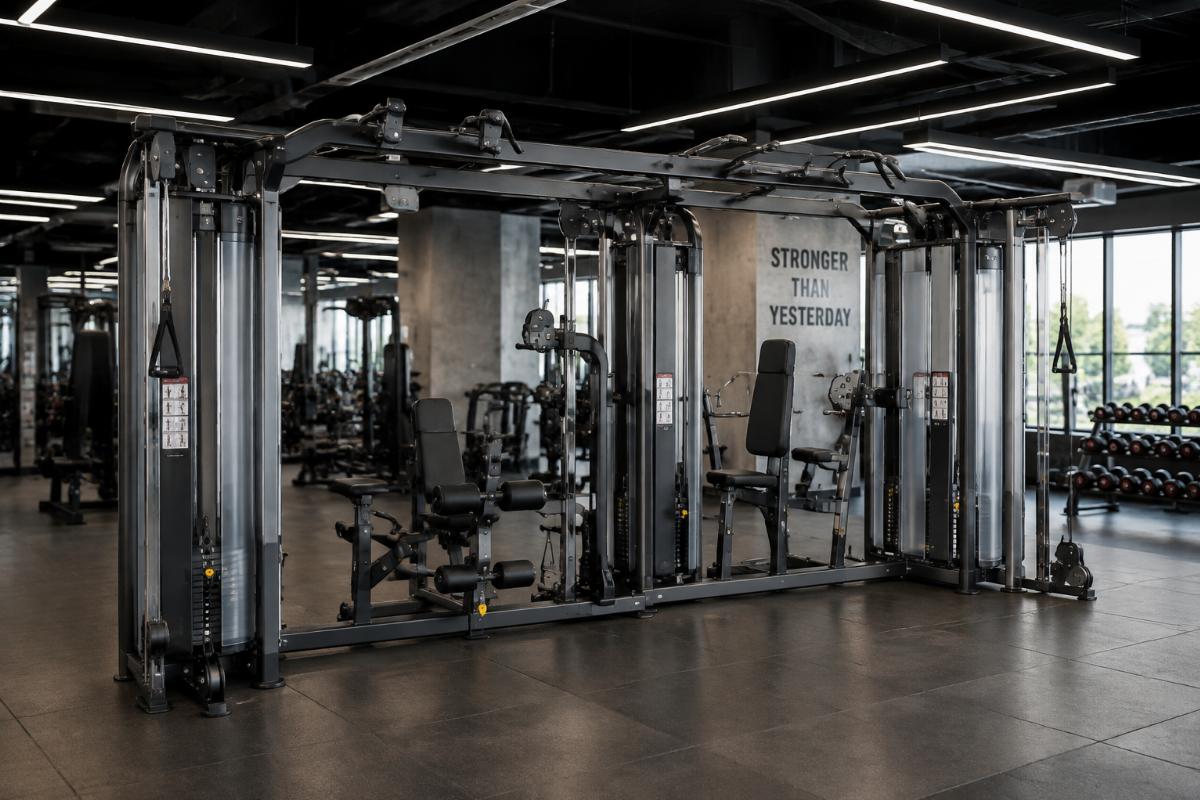
The lessons from that installation — and dozens like it across hotels, commercial gyms, and distributor warehouses — form the backbone of this guide. If you are a gym owner, a hotel developer, or a regional importer loading full containers, here is how to separate genuine commercial-grade build quality from catalog speculation.
What Defines "Commercial Grade" in Multi-Station Gyms?
Commercial grade is not a marketing adjective — it is a measurable combination of frame steel specification, guide rod precision, pulley assembly construction, and weight stack engineering.
Many suppliers label their equipment "commercial" simply because it is heavier than a home unit. Real commercial-grade construction means the frame can withstand continuous multi-user loading without perceptible flex, the guide rods allow weight stacks to travel smoothly through tens of thousands of cycles, and the pulley assemblies resist groove wear under heavy cable loads.
Here is a comparison framework I use when evaluating a multi-station strength equipment supplier against another:
| Evaluation Factor | Basic Tier | Commercial Tier | Verified Commercial Tier |
|---|---|---|---|
| Main Frame Steel Wall Thickness | Thin-wall, unspecified | Heavy-wall, stated gauge | Heavy-wall oval tube, verified by caliper |
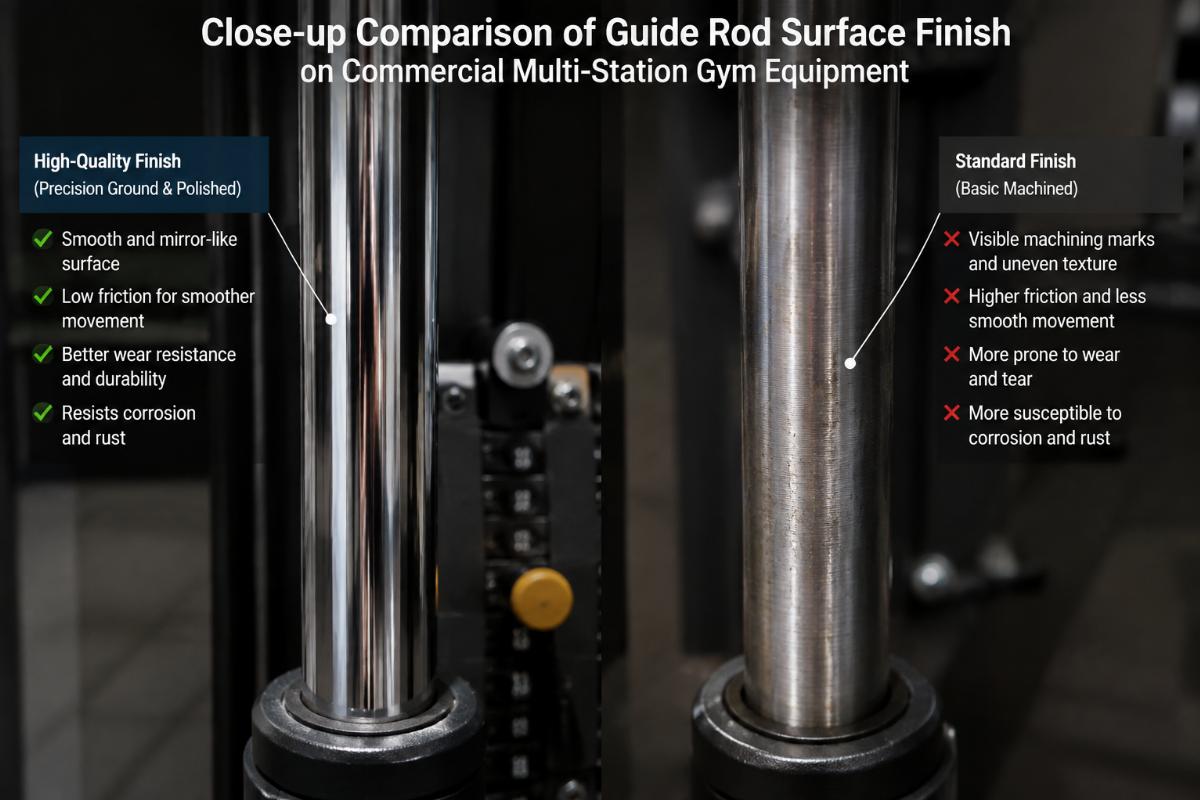
| Guide Rod Surface Treatment | Uncoated or painted | Chrome-plated | Precision-ground, chrome-plated |
| Pulley Assembly | Nylon, single bearing | Aluminum, sealed bearing | Aluminum, double-sealed bearing, cable groove matched |
| Weight Stack Plate Coating | Basic paint | Powder coat | Powder coat with guided pin system |
| Weld Quality Inspection | Visual only | Sample-level | Full batch-level, ground and smoothed |
| Certification | None | Self-reported | Verifiable, third-party tested |
[NEED_CITE: EN ISO 20957-1 and ASTM F2276 define structural and safety performance benchmarks for commercial stationary strength equipment]
A Middle East gym chain once received a quote from two different sources for a twelve-station circuit. One supplier quoted a noticeably lower price. When we pulled the spec sheets, the cheaper option used round tube frames with wall thickness that fell below what sustained commercial use demands. The guide rods were uncoated steel — they would rust and pit within a year in a humid coastal gym environment. The pulleys were single-bearing nylon units that would develop play and noise quickly.
The slightly higher-priced option used oval tube main frames, precision-ground chrome guide rods, and double-sealed bearing pulleys. Over a multi-year deployment, the total cost of ownership — factoring in warranty claims, part replacements, and member complaints — told the real story.
The takeaway: when you search for a multi-station strength equipment supplier, request the actual steel tube dimensions and material grade, not just the word "heavy-duty." Ask for guide rod surface treatment specifications. Request pulley assembly drawings. These are not obscure requests — any legitimate manufacturer will provide them.
How to Compare Multi-Station Specs Without Getting Misled?
Compare structural rigidity first, feature count second — a rigid four-station unit will outlast a flimsy eight-station unit every time.
The most common mistake buyers make is sorting multi-gym machine for sale listings by the number of exercise positions or cable attachments. More stations sound like more value. But each additional station adds load points to the frame. If the frame is not engineered to distribute those loads, the structure flexes, welds fatigue, and alignment drifts.
Here is a structured comparison approach:
Step One — Frame Geometry Assessment
Examine the main upright and base frame tube cross-section. Oval tubes resist torsional flex better than round tubes of equivalent weight. Check the junction points where multiple stations converge — these should have reinforced gusset plates or boxed joints, not simple butt welds. [NEED_CITE: structural engineering principles for fitness equipment frames prioritize torsional rigidity at multi-load junctions]
Step Two — Guide System Evaluation
Run the weight stack manually through its full travel. It should move smoothly with consistent resistance, no sticking points, no metallic scraping. Measure lateral play at the top and bottom of the stack travel — any perceptible wobble indicates guide rod diameter mismatch or insufficient bearing surface in the stack carriage.
Step Three — Cable and Pulley Path Inspection
Trace every cable path from the weight stack to the attachment point. Each direction change should use a dedicated pulley — never a bare frame edge. Pulleys should be sized proportionally to cable diameter; undersized pulleys accelerate cable fraying. Check that all pulley axles use sealed bearings, not simple bushings.
Step Four — Attachment and Adjustment Mechanism Review
Seat adjustment pins, selector pins, and cable attachment points should engage positively with no play. Quick-adjust mechanisms should hold firm under load without creeping. Test these under actual weight stack resistance, not just unloaded.
A hotel fitness center project in Southeast Asia illustrates why this sequence matters. The developer initially selected a six-station unit based on its attractive feature list and compact footprint. During our pre-shipment inspection, we found that the seat adjustment mechanism on the lat station used a spring-detent system rather than a positive pin lock. Under repeated heavy use, the detent would slip, creating a safety concern. The guide rods on the chest press station showed visible lateral play. We flagged both issues, and the manufacturer corrected them before shipment. The alternative would have been field complaints within months and costly on-site service calls.

What Should You Verify at the Factory Before Placing Orders?
Conduct three non-negotiable checks before committing to a bulk order: guide rod tolerance measurement, weld quality spot inspection, and container trial loading — skipping any one of these risks expensive field failures.
Factory verification is where deals are won or lost. Catalog photos and spec sheets tell part of the story. The production floor tells the rest.
Check One — Guide Rod Tolerance and Travel Test
Bring a dial indicator or feeler gauge to the production line. Measure the clearance between the weight stack carriage bushing and the guide rod at multiple points along the rod’s length. The clearance should be minimal and consistent. Then cycle the weight stack through its full range of motion multiple times. Listen for any clicking, grinding, or uneven resistance. A properly machined and aligned guide system moves silently and smoothly. [NEED_CITE: precision guide rod systems in commercial fitness equipment require controlled clearance to prevent binding and premature wear]
Check Two — Weld Quality Spot Inspection
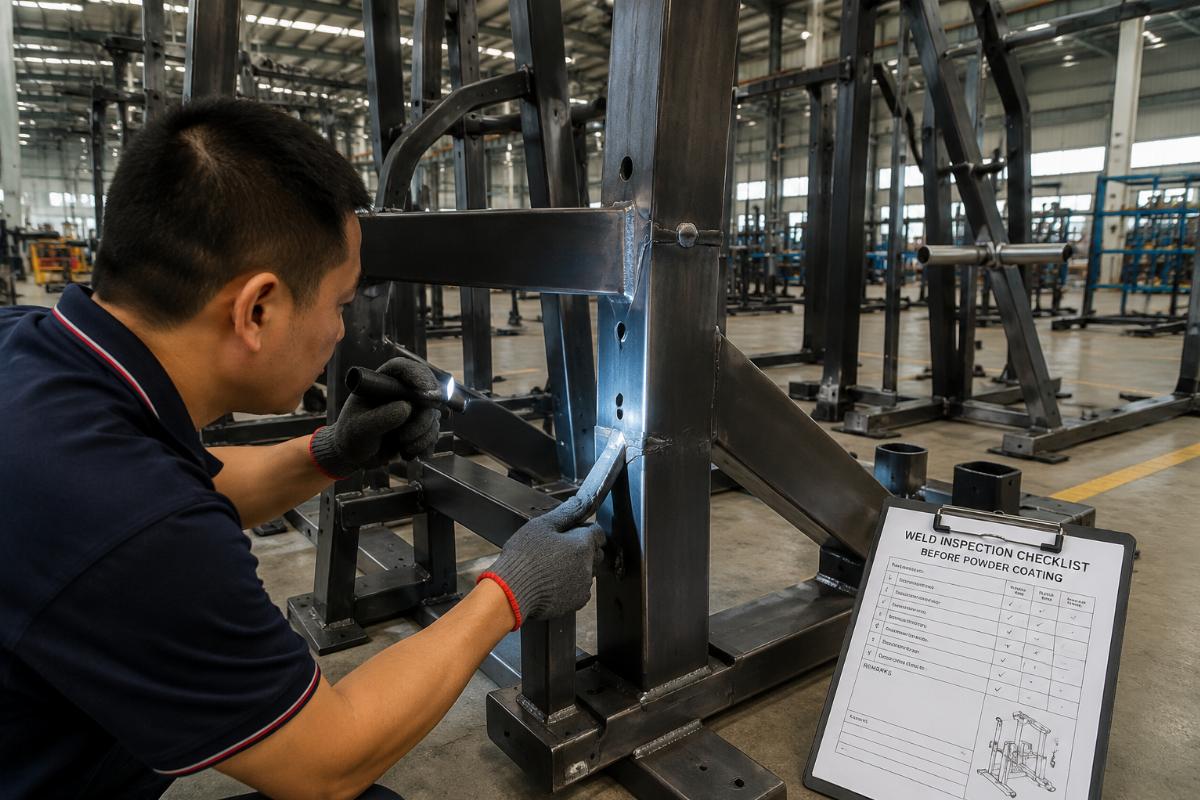
Request access to frames at various production stages — raw welded, pre-grind, and finished. Examine weld beads at high-stress junctions: base-to-upright connections, cross-member joints, and pulley mount brackets. Welds should be uniform, fully fused, with no visible porosity, undercut, or cold lap. At the finished stage, welds should be ground smooth and flush — not just covered with filler and paint.
Check Three — Container Trial Loading
Before finalizing an order for a wholesale multi-station gym equipment shipment, confirm that the supplier can demonstrate a realistic container loading plan. Ask them to physically stage the equipment in a loading area and show how units nest, whether frames must be partially disassembled, and how many complete units fit per container. This step prevents the unpleasant surprise of arriving at the port and discovering that the loading plan was theoretical, not tested.
A distributor in West Africa learned this lesson the hard way. They ordered a large quantity of multi-station units based on the supplier’s stated "units per container" figure. When the goods arrived at the loading port, the actual packed count fell well short because the supplier had not accounted for the protective packaging and bracing required for ocean freight. The distributor had to pay for an additional partial container, erasing the margin on the entire order.
When we work on container-load orders, we stage the actual production units in our loading area and photograph the loaded container before sealing. The buyer sees exactly what ships. This practice eliminates guesswork and builds trust across the supply chain.
How to Plan Container-Load Orders for Maximum ROI?
Maximize container utilization by designing the loading plan around disassembly feasibility, protective packaging requirements, and destination-side reassembly labor costs — not just raw unit dimensions.
Ordering a commercial multi-station gym equipment shipment by the container is a significant capital commitment. The difference between a well-planned load and a poorly planned one can mean thousands of dollars in wasted freight, damaged goods, or unexpected assembly costs at the destination.
Step One — Map the Destination Assembly Reality
Before finalizing the order configuration, understand the labor cost and skill level available at the destination for assembly. If on-site assembly labor is expensive or scarce, prioritize units that ship with minimal disassembly — perhaps only the weight stacks and pulley covers removed. If assembly labor is affordable, you can specify more aggressive knock-down packaging to fit more units per container.
Step Two — Calculate True Landed Unit Count
Work with the supplier to determine the actual number of complete, saleable units per container, accounting for all packaging materials, bracing, dunnage, and accessorial items. Request a loading diagram before production begins. If the supplier cannot provide one, treat that as a red flag.
Step Three — Evaluate Mixed-Container Strategies
For buyers outfitting complete facilities, a mixed container approach often delivers better economics than single-product loads. Combine multi-station units with complementary strength equipment, free weight sets, and flooring materials. The key is ensuring that heavier items are positioned for proper weight distribution and that delicate components are protected from shifting during transit. [NEED_CITE: container load planning for fitness equipment requires balancing weight distribution, volume utilization, and product protection per international shipping best practices]
Step Four — Confirm Spare Parts Inclusion
Every container-load order should include a spare parts package proportional to the order size. Guide rod bushings, cable assemblies, pulley bearings, selector pins, and seat adjustment components are the items most likely to need replacement in the field. Shipping these with the initial order costs almost nothing in freight terms but saves significant time and cost when field replacements are needed later.
A gym chain operator in the Gulf region placed an order for multiple containers of strength equipment. We included a comprehensive spare parts kit with each container — cables, pulleys, bushings, pins, and fasteners. Within the first year of operation, two guide rod bushings on a cable crossover unit showed wear from the high usage volume. Because the replacement parts were already on-site, the gym’s maintenance team swapped them in under an hour. Zero downtime. Zero international shipping wait. The cost of those spare parts kits was a fraction of a single emergency air-freight shipment.

Conclusion
Commercial-grade multi-station equipment is defined by structural integrity, precision engineering, and field-proven durability — not by feature count or catalog appearance.
Purchasing wisely means looking past marketing language to verify steel specifications, guide system quality, pulley construction, and real container loading efficiency. Factory verification before order commitment and thoughtful container planning protect your investment from costly surprises. The right multi-station strength equipment supplier will welcome these scrutiny steps — because genuine quality does not need to hide from inspection.


