
Cardio Zone Equipment Package: Treadmill Bike Elliptical Wholesale Supplier
Most buyers assume heavier flywheels always mean smoother rides, but a heavy flywheel paired with the wrong resistance system actually accelerates bearing wear and drives up noise complaints.
A complete cardio zone equipment package for commercial gyms should include treadmills, ellipticals, and exercise bikes in a ratio determined by daily foot traffic and floor space constraints. The three parameters that determine whether these machines survive high-frequency use are flywheel weight matched to resistance type, frame steel gauge, and motor duty rating. Sourcing the entire cardio zone equipment package as a bundled order from a single factory-direct supplier typically cuts per-unit costs substantially compared to buying machines individually from retail brands, while ensuring visual consistency and unified warranty terms.
I still remember walking the floor at a European trade show years ago when a gym chain owner from the Middle East showed me photos of a brand-new cardio zone that had been in operation for barely a month. The ellipticals were shaking violently at peak stride, the treadmills were throwing error codes, and members were already complaining. He had spec’d the machines based on a glossy brochure, never asking about flywheel position, pedal Q-factor, or motor continuous horsepower versus peak horsepower. [NEED_CITE: root cause distribution of commercial cardio equipment failures per ISO 20957 safety standards]. That mid-six-figure mistake reshaped how I approach every cardio zone equipment package discussion — start with structural parameters, not marketing photos.
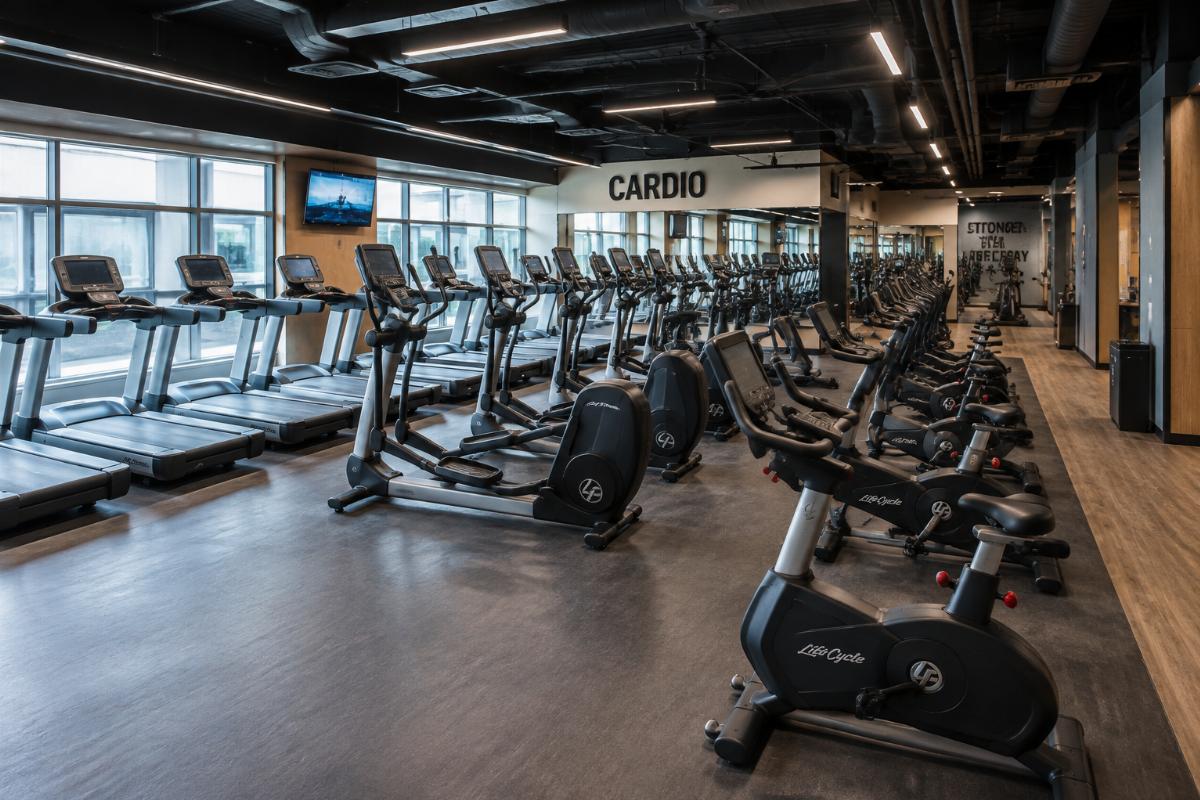
Let me walk you through how to spec, compare, budget, and verify a cardio zone equipment package that actually holds up under real-world commercial abuse.
What Equipment Should a Cardio Zone Package Include?
A standard commercial cardio zone is built around three core machines: treadmills, ellipticals, and exercise bikes — with rowing machines added as a secondary category depending on member demographics.
The ratio between these machines is not arbitrary. Based on traffic patterns I have observed across multiple gym openings in different regions, treadmills typically dominate demand, followed by ellipticals, then bikes. A common starting ratio for a full-service commercial gym is roughly four treadmills to three ellipticals to two exercise bikes for every ten cardio stations. Boutique studios and hotel fitness centers often compress this further, sometimes running a three-two-one split to save floor space. [NEED_CITE: equipment utilization rate benchmarks published by IHRSA for commercial fitness facilities].
When building a cardio zone equipment package for a hotel or apartment complex, space efficiency becomes the overriding constraint. Compact commercial treadmills with shorter deck lengths and front-drive ellipticals with reduced stride lengths can shrink the total footprint noticeably while still meeting commercial durability requirements. Noise control also matters in these settings — machines with poly-V belt drives and enclosed flywheel housings keep decibel output within acceptable ranges for mixed-use buildings.
For distributors loading full containers, the composition of the cardio zone equipment package directly affects container utilization. Mixing treadmills with ellipticals and bikes in a single container requires careful dimension planning, since treadmills are the bulkiest items. A well-planned mixed load can fit significantly more total units than a single-product container, which is where per-unit freight cost drops substantially.
| Equipment Type | Primary User Profile | Space per Unit | Noise Level | Maintenance Frequency |
|---|---|---|---|---|
| Treadmill | General cardio, runners | Large | Moderate to High | Moderate |
| Elliptical | Low-impact, joint-sensitive | Moderate | Low | Low |
| Exercise Bike | Rehab, HIIT, casual | Compact | Low | Low |
| Rower | Full-body, CrossFit-style | Moderate | Low to Moderate | Moderate |
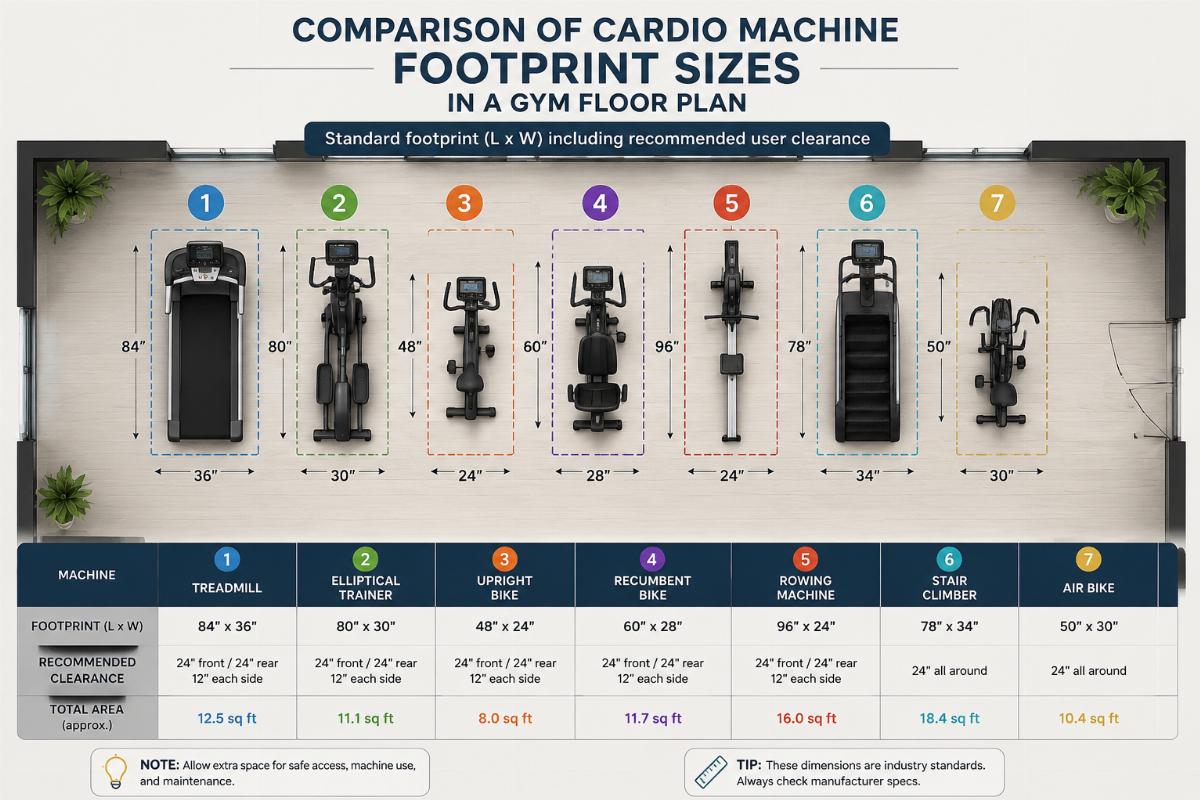
The key takeaway is that your cardio zone equipment package composition must reflect actual member behavior, not catalog appeal. A treadmill-heavy zone in a boutique cycling studio wastes capital; an elliptical-only hotel gym frustrates runners.
Which Specs Actually Matter for Commercial-Grade Cardio Equipment?
Four parameters separate machines that last a decade in a busy gym from those that need major repairs within the first year: flywheel weight matched to resistance type, frame steel tube gauge, motor continuous horsepower rating, and bearing quality.
Let me address the flywheel misconception head-on. Many buyers fixate on flywheel weight alone, assuming heavier is always better. The reality is more nuanced. A heavy flywheel paired with magnetic resistance creates unnecessary rotational inertia that stresses the drive belt and bearings. Conversely, a light flywheel with friction pad resistance will feel jerky at high cadence. The correct approach is to match flywheel mass to the resistance system type. [NEED_CITE: biomechanical smoothness requirements for commercial cycling equipment per EFIMA guidelines].
Frame steel gauge is another area where cost-cutting hides in plain sight. Commercial-grade cardio frames should use rectangular steel tubing with wall thickness in the heavy-duty range. Lighter gauge frames flex under dynamic loads, causing wobble at the console and accelerated wear at pivot points. When I inspect a new cardio zone equipment package sample, the first thing I do is check the weld quality at the main frame junctions and measure tube wall thickness with a caliper.
For treadmills specifically, the distinction between continuous horsepower and peak horsepower is critical. Some manufacturers advertise peak horsepower figures that look impressive on paper but tell you nothing about sustained performance under a heavy runner. Continuous horsepower is the rating that matters for commercial use. [NEED_CITE: motor duty cycle testing methodology per IEC standards for fitness equipment].
| Specification | Commercial Grade | Light Commercial | Consumer Grade |
|---|---|---|---|
| Flywheel and Resistance Match | Precisely matched | Partially matched | Often mismatched |
| Frame Tube Wall | Heavy-duty gauge | Standard gauge | Light gauge |
| Treadmill Motor Rating | Continuous HP rated | Mixed rating | Peak HP only |
| Bearing Type | Sealed industrial | Standard sealed | Basic |
| Console Durability | Commercial membrane | Consumer membrane | Basic LCD |
I once reviewed a cardio zone equipment package quote where the supplier listed impressive peak horsepower numbers and heavy flywheel weights, but when I asked for the continuous horsepower rating and the steel tube wall thickness measurement, the answers were vague. That is a red flag. A reliable supplier providing a cardio zone equipment package should be able to furnish specific structural data without hesitation.

How to Compare Commercial vs. Home-Grade Cardio Machines?
Commercial and home-grade cardio machines differ fundamentally in bearing design, deck construction, pedal spindle geometry, and electronics enclosure — mixing them in a commercial setting leads to cascading maintenance failures.
The most common mistake I see among new gym operators is buying a few commercial treadmills and filling the rest of the cardio zone with consumer-grade ellipticals and bikes because the price difference looks attractive. The problem is that consumer machines are engineered for roughly one to two hours of daily use by a single household. In a commercial gym, that same machine may see ten to fourteen hours of continuous use by dozens of different users. [NEED_CITE: expected service life comparison between commercial and residential fitness equipment per industry durability testing protocols].
The pedal bearing system on commercial ellipticals uses a wider spindle spacing — often called a low Q-factor in marketing terms — which keeps the user’s feet closer to the machine’s center line and reduces lateral knee stress. Consumer ellipticals typically have a wider Q-factor that feels awkward during extended use and generates more lateral force on the bearings, accelerating wear.
Treadmill deck construction tells a similar story. Commercial decks use thicker, reversible running boards with phenolic resin coatings that reduce friction and heat buildup. Consumer decks are thinner, non-reversible, and degrade noticeably faster under commercial foot traffic volumes. When a consumer-grade treadmill deck wears through, the belt damages rapidly, and the motor draws excessive current — a cascade failure that costs several times the original price difference between commercial and consumer units.
| Failure Mode | Commercial Machine | Consumer Machine in Commercial Use |
|---|---|---|
| Bearing Wear | Substantially extended service life | Premature failure |
| Belt and Deck Wear | Reversible deck, slow degradation | Non-reversible, rapid wear |
| Electronics Failure | Sealed commercial enclosure | Vulnerable to sweat and dust |
| Frame Flex | Resistant under dynamic load | Noticeable flex over time |

A gym owner in Southeast Asia once called me about a cardio zone equipment package he had assembled from mixed sources. The commercial treadmills were running fine, but the consumer-grade bikes and ellipticals were generating a steady stream of complaints — squeaking pedals, wobbly consoles, broken resistance knobs. The replacement parts and technician visits ended up costing more than the initial savings. When you are building a cardio zone equipment package, uniformity of grade is not a luxury — it is a maintenance strategy.
How to Build a Cardio Zone Equipment Package Within Budget?
The most effective path to reducing per-unit cost on a full cardio zone is bundling the entire order through a single factory-direct supplier, optimizing container load mix, and eliminating retail brand markup — this approach typically delivers savings of forty to fifty percent compared to buying equivalent machines from recognized commercial brands.
The math is straightforward. Recognized commercial fitness brands carry substantial overhead — global marketing campaigns, showroom networks, multi-layer distributor margins — all of which inflate the per-machine price. A factory-direct supplier offering a cardio zone equipment package without the brand premium can deliver machines built to comparable structural specifications at a fraction of the cost. [NEED_CITE: global commercial fitness equipment market pricing structure analysis from industry trade reports].
Container load optimization is where experienced buyers separate themselves from first-time importers. If you order only treadmills, you fill a container by unit count relatively quickly, but the per-unit freight cost stays high because you are paying for unused vertical space. By mixing treadmills, ellipticals, and bikes in a single container, you nest smaller machines into the gaps around larger ones, fitting more total units per shipment. This is the real lever for driving down landed cost per machine in a cardio zone equipment package.
OEM branding adds another dimension. Distributors loading full containers for regional markets can apply their own brand identity, custom color schemes, and localized console languages through the factory’s OEM program. The minimum order quantity for custom branding on a cardio zone equipment package is often far more flexible than buyers expect — you do not always need to commit to hundreds of units of a single SKU.
I worked with a distributor in Africa who was loading his first full container of cardio equipment. He initially planned to order only treadmills because they were the highest-demand item. By restructuring the order into a mixed cardio zone equipment package — adding ellipticals and spin bikes — he increased the total unit count per container substantially, reduced his per-unit freight cost noticeably, and gave his retail customers a complete product range instead of a single-category offering.

The budget conversation for a cardio zone equipment package should always start with total landed cost per station, not per-machine invoice price. Freight, customs, assembly labor, and first-year warranty claims all factor into the real number. A factory-direct bundled order almost always wins on total cost of ownership.
What Should You Verify Before Placing a Bulk Cardio Order?
Before committing to a large cardio zone equipment package order, require the supplier to provide third-party safety test reports, real-time production video of your specific batch, critical component close-up photographs, and a written warranty framework with spare parts availability guarantees.
Third-party certification is non-negotiable. CE marking for the European market and relevant ISO fitness equipment safety standards verify that the machines have passed structural load testing, electrical safety testing, and emergency stop function validation. [NEED_CITE: mandatory safety certification requirements for commercial fitness equipment in major import markets per ISO and EN standards]. Ask to see the actual test report, not just a certificate logo on a brochure — the report should reference the specific machine model and production batch.
Production transparency is equally important. A reliable supplier assembling your cardio zone equipment package should be willing to share video footage of the welding stations, assembly lines, and final testing area. I always ask to see the flywheel balance test, the treadmill belt tracking adjustment, and the console function test on at least one unit from the production run. If a supplier hesitates or offers only polished marketing videos, that is a warning sign.
Spare parts availability is the most overlooked element of the pre-order verification process. Every commercial gym operator knows that downtime on a popular machine drives member complaints. Your supplier should provide a spare parts catalog with part numbers, confirm stock availability for wear components like drive belts, deck lubrication kits, and bearing assemblies, and commit to a response timeline for warranty claims.
A buyer from a hotel development group in the Gulf region once received a cardio zone equipment package where the ellipticals looked perfect on arrival. Six months later, a pedal crank bearing failed, and the supplier could not provide a replacement for weeks because the specific bearing was not in their standard spare parts inventory. The hotel had to source the bearing locally at a premium and pay a technician to install it. That single incident erased most of the cost savings the buyer had achieved by going factory-direct.

Build your verification checklist before you sign the purchase agreement, not after the machines arrive at your dock.
Conclusion
Specifying a cardio zone equipment package is a structural engineering exercise, not a catalog shopping exercise. Flywheel-resistance matching, frame gauge, motor duty rating, and bearing quality determine whether your machines survive commercial use or become a maintenance drain. Bundle your order through a single factory-direct source, optimize container mix, verify certifications and spare parts availability before payment, and your cardio zone will perform consistently for years.


