Commercial Hack Squat Machine for Functional Training Studios | OEM Supplier
Wiping down the seat pad after the last client leaves is not cleaning — it is the bare minimum, and it is already too late if you see foam discoloration.
A structured cleaning and sanitizing protocol for a commercial hack squat machine must cover three tiers: daily surface sanitation of all contact points with pH-neutral disinfectant, weekly degreasing and lubrication of guide rails and bushings, and monthly deep cleaning of upholstery with enzyme-based solutions plus bolt torque verification — skipping any tier accelerates corrosion, foam degradation, and premature bushing wear in high-traffic functional training studios.
I still remember walking into a studio in a humid Gulf city and finding the hack squat machine’s guide rails coated in a chalky white residue — oxidized sweat that had seeped past the bushing seals over months of "daily wipe-downs" that never touched the rail housing. The owner was replacing bushings every few months and blaming the manufacturer. The real culprit was a cleaning routine that stopped at the vinyl pad. [NEED_CITE: sweat composition and its corrosive effect on steel and linear bearing surfaces per exercise equipment maintenance literature]

That visit reshaped how I think about maintenance documentation. Below is the tier-by-tier breakdown I now recommend to studio operators sourcing commercial-grade equipment.
Why Does Regular Cleaning Matter Specifically for Hack Squat Machines?
Hack squat machines concentrate sweat, chalk residue, and skin oils on a smaller set of high-contact surfaces than most cardio equipment, making them disproportionately vulnerable to corrosion and upholstery breakdown if cleaning is superficial.
Unlike a treadmill belt or a cable crossover tower, a hack squat machine forces the user’s hands, shoulders, back, and feet into fixed contact points that receive repetitive load and moisture exposure session after session. The shoulder pads, back pad, foot platform, and handle grips form a closed loop of contamination. Sweat does not evaporate cleanly from vinyl seams — it wicks into the foam core through stitch channels, where it creates an environment that surface-level disinfectant cannot reach. [NEED_CITE: bacterial colonization patterns in gym upholstery foam per hygiene studies]
A functional training studio I consulted for in Southeast Asia had replaced the hack squat pad twice within the first year. The vinyl was cracking along the stitch lines, and the foam underneath had turned a greyish color with a faint sour smell. The operator assumed it was a material quality issue. It was not — it was sweat residue trapped below the surface because the cleaning protocol only addressed visible contact areas.
Three failure modes dominate when cleaning is neglected:
- Guide rail corrosion: Sweat drips onto the rail housing during heavy sets. Without weekly degreasing, salt deposits bond to the rail surface, increasing friction and accelerating bushing wear.
- Foam saturation: Moisture penetrating stitch holes degrades foam cell structure, causing the pad to flatten and lose rebound — well before the vinyl itself shows visible damage.
- Cross-contamination: Functional training studios often run back-to-back sessions with minimal turnover. Without between-user sanitizing, the hack squat becomes a vector for skin and respiratory pathogens. [NEED_CITE: pathogen transmission risk on shared gym equipment per public health guidelines]

Understanding these failure modes is what separates a reactive replacement cycle from a preventive maintenance routine.
What Supplies Do You Need Before Starting?
The correct cleaning agent matters as much as the cleaning frequency — using bleach-based or high-alcohol disinfectants on vinyl upholstery will degrade the material faster than sweat alone, while pH-neutral and enzyme-based products sanitize without accelerating wear.
Most studio operators buy whatever disinfectant is cheapest or most readily available. This is a costly mistake. Gym equipment upholstery is typically made from commercial-grade vinyl with a plasticizer layer that maintains flexibility. Bleach strips that plasticizer. Alcohol-based solutions above a certain concentration do the same. Over months, the vinyl becomes brittle, cracks at stress points, and exposes the foam underneath to moisture and bacteria. [NEED_CITE: chemical compatibility of disinfectants with vinyl gym upholstery per equipment manufacturer guidelines]
Here is the supply list I recommend, organized by function:
| Supply Category | Recommended Type | Purpose |
|---|---|---|
| Surface disinfectant | pH-neutral quaternary ammonium compound wipes or spray | Daily sanitation of handles, pads, foot platform without material damage |
| Degreaser | Mild industrial degreaser, non-acidic | Weekly guide rail and bushing housing cleaning |
| Lubricant | Silicone-based spray lubricant | Weekly rail and bushing maintenance after degreasing |
| Upholstery cleaner | Enzyme-based foam and vinyl cleaner | Monthly deep cleaning of pad surfaces and stitch lines |
| Applicators | Microfiber cloths, soft-bristle brush, lint-free wipes | Prevent scratching and residue buildup |
| Inspection tools | Torque wrench, flashlight | Monthly bolt verification and rail condition check |
The quaternary ammonium compound category is worth highlighting. These are EPA-registered disinfectants widely used in healthcare and fitness facility hygiene protocols. They kill bacteria and viruses on contact without the material degradation caused by bleach or high-concentration alcohol. Many commercial equipment manufacturers explicitly recommend this class in their maintenance manuals. [NEED_CITE: EPA-registered disinfectant categories suitable for fitness equipment per facility hygiene standards]

One more point: avoid aerosol sprays directly on electronic components if your hack squat machine has any integrated digital displays or sensors. Spray onto the cloth first, then wipe.
How to Perform Daily Cleaning and Sanitizing Between Users?
Daily cleaning of a commercial hack squat machine must address every surface a user touches — shoulder pads, back pad, handles, foot platform, and adjustment pins — using pH-neutral disinfectant applied to a microfiber cloth, with special attention to stitch seams and textured grip areas where sweat accumulates invisibly.
The daily routine should take no more than a few minutes per machine, but it must be systematic rather than haphazard. The most common mistake I see is operators wiping the top of the seat pad and calling it done, while the underside of the foot platform, the adjustment pin holes, and the stitch lines along the pad edges receive no attention at all.
Follow this sequence:
-
Shoulder and back pads: Spray pH-neutral disinfectant onto a microfiber cloth — never directly onto the pad, as excess liquid can seep into stitch channels. Wipe the entire surface, pressing firmly along stitch lines to extract trapped moisture. Flip the cloth to a dry side and buff the surface to remove residual dampness.
-
Handle grips: Wipe all handle surfaces, paying attention to knurling or texture patterns where sweat and chalk residue embed. A soft-bristle brush can dislodge chalk from textured grips before wiping.
-
Foot platform: This is the most overlooked surface. Users stand on it with sweaty socks or bare feet. Wipe the entire platform surface, the edge lip, and the adjustment mechanism underneath. [NEED_CITE: foot contact surface hygiene in shared gym equipment per sanitation guidelines]
-
Adjustment pins and selector points: Wipe each pin and its insertion hole. Sweat dripping onto pins causes corrosion that makes adjustment stiff over time — a complaint operators often misattribute to manufacturing defects.
-
Frame contact points: Anywhere the user’s body or clothing touches the frame — side supports, stabilizer bars — should receive a wipe-down.

In a high-volume functional training studio running back-to-back sessions, this daily protocol should be executed between user groups, not just at closing time. The investment in wipe supply is marginal compared to the cost of premature pad replacement or member complaints about hygiene.
How to Conduct Weekly Rail and Bushing Maintenance?
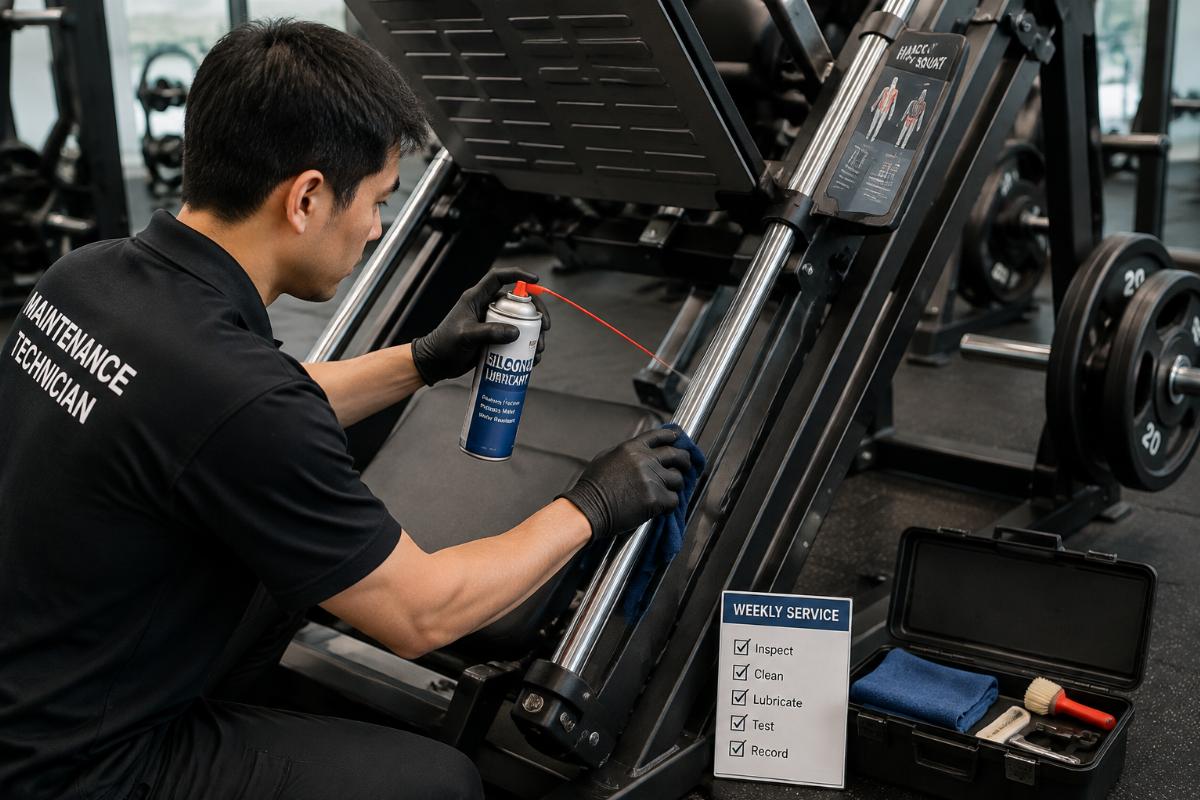
Weekly guide rail maintenance on a hack squat machine requires degreasing the rail surface to remove accumulated sweat salt and dust, inspecting bushing condition for play or scoring, and applying a silicone-based lubricant to restore smooth travel — this is the single most skipped step that leads to premature bushing failure and rough sliding motion.
The guide rail system is the mechanical heart of a hack squat machine. It determines how smoothly the carriage travels under load. When rail maintenance is neglected, the carriage develops a gritty, uneven feel that users immediately notice — and they blame the machine’s build quality rather than the lack of lubrication.
Here is the weekly procedure:
-
Degrease the rail: Apply a mild non-acidic degreaser to a lint-free cloth and wipe the full length of each guide rail. You will likely see grey or yellowish residue on the cloth — this is a combination of oxidized sweat, dust, and degraded old lubricant. Allow the rail to dry completely before proceeding.
-
Inspect bushing condition: Visually check each bushing for signs of scoring, cracking, or excessive play. Run the carriage by hand through its full range of motion. Any grinding sensation or lateral wobble indicates bushing wear that needs attention. [NEED_CITE: linear bushing wear indicators and maintenance intervals per strength equipment engineering standards]
-
Apply lubricant: Spray a thin, even coat of silicone-based lubricant along each rail. Move the carriage through its full travel several times to distribute the lubricant evenly. Wipe off any excess to prevent dust attraction.
-
Check rail mounting bolts: Verify that all rail mounting bolts are torqued to specification. Loose bolts cause rail misalignment, which accelerates bushing wear on one side — a failure pattern that looks like a manufacturing defect but is actually a maintenance issue.
I have seen studios in humid coastal climates go through bushing sets multiple times a year because they never performed this step. The rail surface develops a rough, pitted texture from salt corrosion, and no amount of lubrication can fully compensate for that damage once it occurs. Catching it early through weekly degreasing prevents the corrosion from bonding to the rail in the first place.
Equipment sourced from manufacturers who machine guide rails to tight tolerances and use standard-size, widely available bushings makes this maintenance far simpler — replacement bushings can be sourced locally rather than waiting for proprietary parts shipped overseas. This is a sourcing consideration that directly impacts long-term maintenance cost. [NEED_CITE: importance of standard-size bushing specifications in commercial strength equipment for serviceability]
What Does a Monthly Deep Cleaning Checklist Look Like?
Monthly deep cleaning of a hack squat machine goes beyond surface sanitation — it includes enzyme-based upholstery treatment to break down trapped organic residue in foam, full bolt torque verification across the frame, bushing wear measurement, and documentation for warranty compliance.
The monthly cycle is where preventive maintenance either pays off or reveals accumulated neglect. This is the tier that catches problems before they become failures.
The monthly checklist covers the following:
-
Enzyme upholstery treatment: Apply an enzyme-based cleaner to all vinyl pad surfaces. Enzyme cleaners work by breaking down protein-based organic matter — sweat, skin cells, bacteria — that pH-neutral disinfectants sanitize on the surface but do not fully decompose. Allow the enzyme solution to dwell on the surface for the manufacturer-specified contact time, then wipe clean with a damp microfiber cloth. This step extends pad life significantly by preventing the slow accumulation of organic residue inside the foam. [NEED_CITE: enzyme cleaner efficacy on organic residue in gym foam upholstery per cleaning chemistry literature]
-
Full frame bolt torque check: Using a torque wrench, verify every structural bolt on the frame — base mounting bolts, rail mounting bolts, pad mounting bolts, handle attachment bolts, foot platform bolts. Vibration from heavy use gradually loosens fasteners. A single loose rail bolt can cause misalignment that destroys a bushing set within weeks.
-
Bushing wear assessment: Remove each bushing if accessible, or measure play with the carriage loaded. Compare against the manufacturer’s wear tolerance specification. Bushings showing visible scoring, deformation, or measurable play beyond tolerance should be replaced proactively — not after they fail.
-
Frame inspection for stress cracks: Visually inspect all welds and high-stress frame junctions under good lighting. Hairline cracks near weld zones can develop over time in heavily used machines. Early detection allows for repair before structural failure.
-
Documentation: Record the maintenance date, findings, and any parts replaced. Many equipment warranties require documented preventive maintenance to remain valid. Studios without records risk voiding warranty coverage on otherwise legitimate defect claims. [NEED_CITE: warranty maintenance documentation requirements per commercial fitness equipment industry standards]

A studio operator in Northern Europe told me they implemented this monthly checklist across their entire functional training floor and saw pad replacement intervals extend substantially — from roughly annual to well beyond two years. The enzyme treatment alone made a visible difference in foam firmness retention.
Conclusion
Cleaning a commercial hack squat machine is not a single action — it is a layered maintenance system spanning daily sanitation, weekly rail care, and monthly deep servicing, each tier addressing failure modes the others cannot reach.
Studio operators who treat cleaning as a surface-level chore will continue replacing pads, bushings, and rails on an accelerated cycle. Those who implement a structured, tiered protocol using the correct chemical agents and inspection routines will extend equipment life, reduce downtime, and maintain the hygiene standard that functional training studio members expect. The difference between reactive spending and preventive maintenance is almost always a documented routine — not a better machine.