FW-500 Free Weight Series Container Loading & MOQ Wholesale Supplier
Stacking heavy plates at the bottom of a container feels right — until an emergency brake sends the entire load shifting forward.
The MOQ for the FW-500 Free Weight Series is not a single fixed number; it is tiered by shipment mode — full container load (FCL), less-than-container load (LCL), or mixed consolidation — and the loading plan you choose directly determines your damage rate, freight cost, and customs clearance speed.
I still remember a shipment we sent to a chain gym operator in the Middle East a few years back. They ordered a full 40HQ: dumbbells, bumper plates, barbells, and a couple of power racks, all mixed together. We loaded the way most factories default to — plates on the floor, racks along the walls, dumbbells stuffed wherever there was space. When the container arrived at Jebel Ali, the stevedores opened the doors and found a half-pallet of bumper plates crushed under shifted barbell collars. The client refused the damaged goods. The claim, the re-packing, the replacement freight — it ate into the margin of the entire order. [NEED_CITE: cargo damage root causes in mixed gym equipment shipments per ISO 17363] That was the turning point. Since then, every FW-500 Free Weight Series container leaving Qingdao port gets a loading plan drawn before a single piece touches the forklift.
What follows is the loading logic and MOQ structure we now use — built from real export runs through Qingdao, not from a brochure.
What Is the Real MOQ for FW-500 Free Weight Series?
The MOQ depends entirely on whether you are booking FCL, LCL, or a mixed consolidation — and each tier has a different cost-to-risk profile.
For a full 40HQ dedicated to the FW-500 Free Weight Series alone — say, only dumbbells and weight plates — the MOQ sits at a relatively accessible level because the container is homogeneous and easy to stack. But most overseas buyers do not fill a 40HQ with plates alone. A commercial gym opening needs racks, benches, cable machines, and free weights in one shipment. That is where the MOQ conversation gets complicated. [NEED_CITE: MOQ tier structures for mixed fitness equipment exports from Shandong manufacturing belt]
Here is how the tiers break down in practice:
| Shipment Mode | Typical MOQ Structure | Complexity Level | Damage Risk |
|---|---|---|---|
| FCL — Single SKU Category | Low threshold, standard pallet count | Low | Noticeably reduced |
| FCL — Mixed FW-500 SKUs | Moderate threshold, zone-loading required | Medium | Standard |
| FCL — Free Weights + Strength Machines | Higher threshold, weight distribution planning needed | High | Vulnerable without plan |
| LCL / Consolidation | Flexible piece-level MOQ, but handling surcharges apply | High | Vulnerable |
A distributor in West Africa once asked us to ship just a few pallets of dumbbells and plates via LCL. The per-unit freight looked attractive on paper. But once we factored in the consolidation warehouse handling fee, the multiple forklift transfers, and the risk of mixed-cargo contamination from other shippers’ goods, the real landed cost crept up noticeably. We ended up advising them to consolidate their order to fill a shared 20GP with two other buyers in the same region — the per-unit cost dropped, and the cargo stayed on a single bill of lading, which simplified customs at the destination port. [NEED_CITE: LCL consolidation cost structure for heavy fitness equipment from Chinese ports]
The counterintuitive truth: a lower MOQ is not always cheaper. When the order is too small to fill even a shared container, the handling complexity multiplies — more touches, more transfers, more paperwork. That is where damage claims and clearance delays quietly eat your margin.

How to Load a 40HQ with Mixed Free Weights Without Damage?
The key is horizontal weight distribution by density zone — not vertical stacking by weight.
Most people assume the heaviest items go on the floor and the lightest on top. That logic works in a warehouse rack. Inside a shipping container, it is a recipe for disaster. When a vessel encounters heavy seas or a truck slams its brakes at the port terminal, a vertically stacked load — all the dense plates concentrated at the bottom center — creates a pendulum effect. The center of gravity shifts, and the entire cargo mass slides laterally. [NEED_CITE: container cargo shifting mechanics per ISO 17363 and CTU Code guidelines]
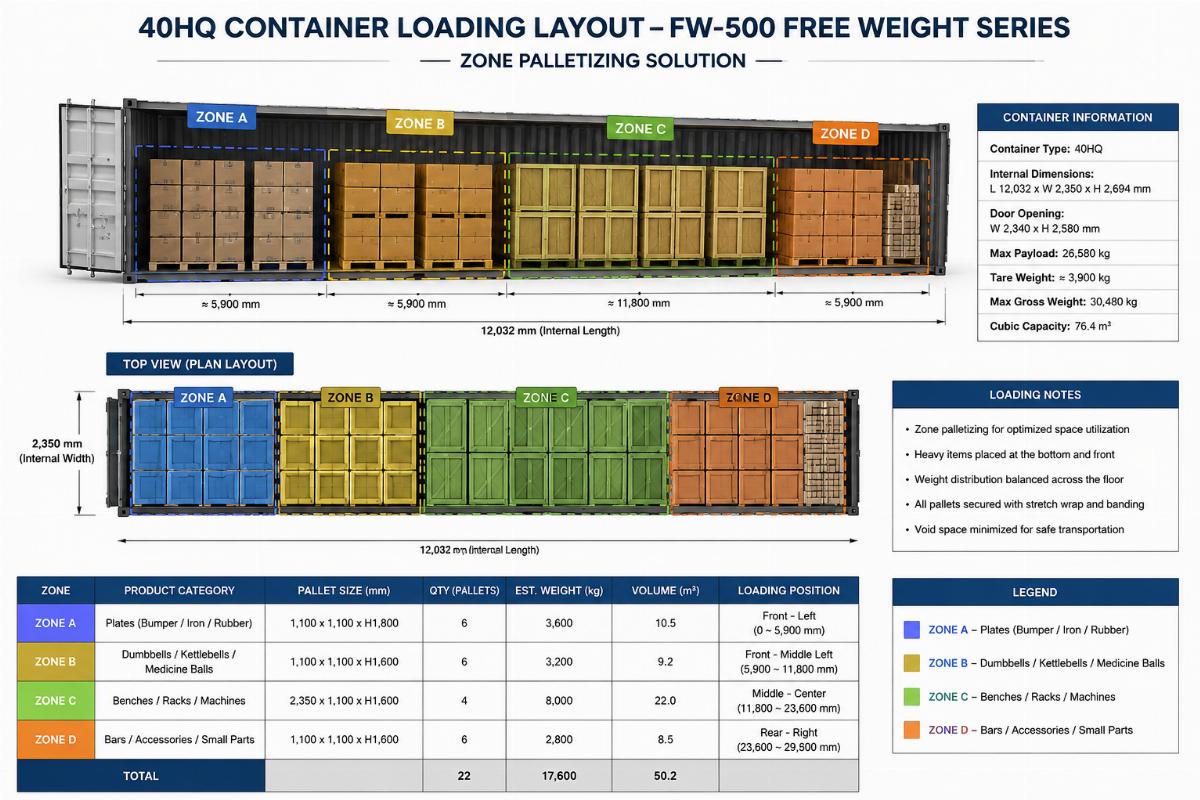
The correct approach for the FW-500 Free Weight Series is to divide the container floor into density zones:
Step 1 — Map the cargo by weight density. Bumper plates and competition plates are the densest. Rubber-coated dumbbells are medium. Adjustable benches and small accessories are the lightest.
Step 2 — Distribute density zones laterally, not vertically. Place the heaviest pallets along the container’s centerline axis, not clustered at one end. Medium-density cargo flanks them. Light cargo fills the door-end zone and any voids near the walls.
Step 3 — Palletize with rated timber or steel-base pallets. Each pallet gets wrapped in multiple layers of stretch film, with corner guards on all vertical edges. The pallets must be rated for the stacked load — we have seen non-rated pallets crack under a double-stacked plate load mid-transit. [NEED_CITE: pallet load rating standards for heavy fitness equipment per ISO 8611]
Step 4 — Secure with dunnage and lashing. Air bags between pallet columns, timber bracing along the door end, and ratchet straps anchored to the container’s internal lashing rings. The goal is zero visible movement when the doors are opened at destination.
We applied this method on a repeat order for a gym chain in Southeast Asia — a 40HQ loaded with FW-500 plates, dumbbells, and two half-racks. The damage rate on arrival was effectively zero. The client’s receiving supervisor photographed the container interior before unloading and noted that every pallet was exactly where it had been placed at origin. That consistency is not luck — it is the loading plan doing its job.

Can I Mix FW-500 with Strength Machines in One Container?
Yes — but only if you follow the "heavy along the axis, light at the edges" loading logic.
This is the question we get most often from buyers outfitting a new commercial gym. They need the full package: free weights, plate-loaded machines, cable crossovers, power racks, and benches — all in one or two containers to keep freight costs manageable. The FW-500 Free Weight Series is almost always part of that mix.
The challenge is that strength machines have irregular shapes and fragile components — linear bearings, cable pulleys, upholstery — while free weights are dense, compact, and unforgiving if they shift. You cannot simply load them side by side without a plan.
Here is the sequence we follow:
First, the heaviest and most compact items — weight plates, dumbbell sets, barbells — are palletized and positioned along the container’s longitudinal centerline, close to the floor. This keeps the center of gravity low and centered.
Second, the strength machines — plate-loaded stations, cable crossovers — are loaded next, flanking the free-weight pallets. Their frames are bolted to pallets with the structural posts disassembled where possible. The upholstery and cable assemblies are wrapped separately. [NEED_CITE: mixed cargo loading best practices for gym equipment per industry port handling guidelines]
Third, the lighter items — benches, accessory bars, resistance bands, flooring rolls — fill the remaining voids: above the machine pallets, between the machines and the container walls, and at the door end.
Fourth, everything is cross-braced. Timber braces run diagonally from the container floor anchors to the top of the machine pallets. Foam inserts protect any exposed chrome or painted surfaces.
A buyer in Latin America received a mixed 40HQ containing FW-500 free weights and six plate-loaded machines. The unloading team at the destination noted that not a single cable was frayed and no upholstery was punctured — a result the buyer explicitly credited to the loading sequence and bracing plan we provided before shipment.

What Documents Are Needed for Smooth Customs Clearance?
The packing list must match the physical load exactly — and the container loading photos must prove it.
Customs clearance delays for fitness equipment imports are rarely about the product itself. They are about documentation inconsistencies. A packing list that says "48 pallets" when the container actually holds 46. A commercial invoice that lists "rubber-coated dumbbells" when the goods are vinyl-coated. A certificate of origin that does not match the shipper on the bill of lading. [NEED_CITE: common documentation errors causing customs delays for fitness equipment imports]
For the FW-500 Free Weight Series, the standard document set includes:
- Commercial invoice with unit-level pricing and HS codes for each SKU category
- Packing list with pallet count, gross weight, and net weight per item
- Bill of lading matching the shipper and consignee details exactly
- Certificate of origin, issued by the relevant chamber of commerce
- Fumigation certificate for timber pallets and packaging materials
- Container loading photos — taken at three stages: empty container inspection, mid-load, and fully loaded with doors about to close
That last item — the loading photos — is the one most buyers overlook. We now include a photo set with every FW-500 Free Weight Series shipment as standard. The photos serve two purposes: they give the buyer a pre-arrival verification tool, and they provide customs brokers at the destination with visual proof that the cargo matches the declared packing list. On more than one occasion, these photos have resolved a customs query within hours instead of dragging into days.

How to Request a Custom Loading Plan from the Factory?
Provide your destination port’s unloading conditions and your preferred container type — the factory can return a loading diagram within a short turnaround.
Most buyers assume the loading plan is entirely the factory’s responsibility. It is not. The most efficient loading plans come from a two-way exchange: the buyer shares constraints, and the factory translates them into a physical layout.
Here is what we need from the buyer before drawing a loading plan for the FW-500 Free Weight Series:
First, the container type — 20GP, 40GP, or 40HQ. The internal dimensions differ, and the payload capacity varies. A 40HQ gives you roughly a third more cubic space than a 20GP, but the maximum payload is constrained by road weight limits at the destination, not just the container’s structural rating.
Second, the destination port’s unloading infrastructure. Does the receiving warehouse have a forklift with a rated capacity for double-stacked plate pallets? Is there a loading dock, or will the container be ground-unloaded? These details determine whether we can double-stack pallets or must keep everything single-level. [NEED_CITE: destination port unloading infrastructure impact on container loading design]
Third, the product mix and priority. If the FW-500 dumbbells are needed first for an opening-day setup, they go near the door end — loaded last, unloaded first. If the plates are the priority, the sequence reverses.
Once we have this information, our loading team produces a top-view diagram showing pallet positions, weight distribution zones, bracing points, and the loading sequence. The buyer reviews it, confirms, and we execute. This process eliminates the guesswork that leads to the damage scenarios I described earlier.

Conclusion
A well-planned FW-500 Free Weight Series shipment is measured not by the unit price on the invoice, but by the condition of the cargo when the container doors open at destination. The MOQ tier you choose, the loading sequence you follow, and the documentation you prepare together determine whether your gym project opens on schedule or stalls in a customs yard. Plan the load before the cargo moves — and the cargo will arrive the way you expect.