SS-150 Selectorized Chest Sub-Series Warranty and After-Sales Guide | Wholesale Supplier
Most selectorized chest machine failures traced to warranty claims are not manufacturing defects—they are environment and maintenance mismatches.
The SS-150 selectorized chest warranty covers the main frame and structural welds for an extended period, guide rails and pulley systems for a medium-term period, and excludes consumables such as cables, grip sleeves, and upholstery from standard coverage [NEED_CITE: typical warranty segmentation for commercial selectorized strength equipment per industry association guidelines]. Understanding these boundaries, combined with disciplined routine maintenance, is what actually keeps the machine running in a high-traffic commercial gym.
I still remember the first time I opened up a selectorized chest press in a gym in Lagos. The owner stood right next to me, arms crossed, watching me pull out a cable that had started fraying within half a year of installation. Members were complaining. He kept asking whether the machine was defective. It was not. The room had no dehumidifier, the coastal humidity sat well above the comfort zone for steel cables, and nobody had ever lubricated the guide rails. Back at the factory in Shandong, that same batch of machines had been tested on the floor for weeks with zero issues. The problem only showed up once the environment changed. Since then, I have started attaching a pictorial maintenance sheet to every container we ship, printed in the local language where possible. What I learned is simple: a warranty document is only as useful as the operator’s ability to keep the machine within its designed conditions.
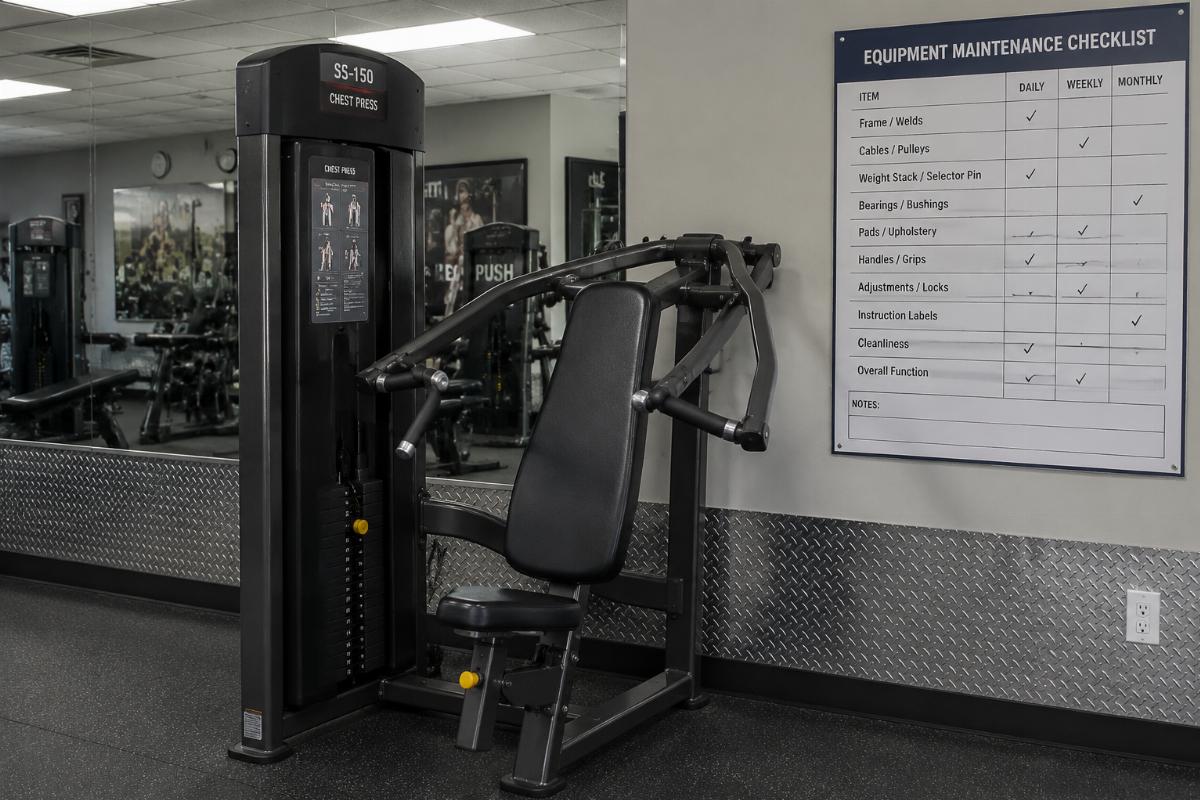
Let me walk you through how the warranty actually works, what breaks first in tough environments, and how to set up a maintenance rhythm that keeps claims to a minimum.
What Components Does the SS-150 Selectorized Chest Warranty Actually Cover?
Warranty coverage is split into three tiers: structural frame, motion system, and consumable wear parts, each with different terms and conditions.
When buyers first receive the SS-150 selectorized chest warranty document, they often scan only the headline number—how many years of coverage. That is a mistake. The real value lies in what is included under each tier and what is explicitly excluded.
The structural tier covers the main frame, the seat support bracket, and all factory welds. These are the parts that almost never fail unless the machine is overloaded beyond its rated stack weight or physically abused. Under normal commercial use, this tier is rarely tested.
The motion system tier covers the guide rails, the pulley assembly, and the selectorized weight stack mechanism. This is where most real-world disputes happen, because the boundary between "wear" and "defect" is not always obvious to a gym operator [NEED_CITE: warranty dispute patterns in selectorized strength equipment based on after-sales service records].
The consumable tier is typically excluded from standard warranty. This includes the cable, the grip sleeves on the handle, the foam on the seat and back pad, and the adjustment pin clip. These items are expected to wear with use, and their lifespan depends heavily on how the machine is used and maintained.
A distributor in West Africa once called to claim that a batch of chest presses had defective guide rails because the weight stack was sticking. After a video inspection, we found the rails had never been lubricated since installation, and the gym was running in a space with open windows facing the ocean. The rails were not defective—they were corroded from salt air and lack of maintenance. That claim was rejected under the warranty terms, but the relationship was preserved because we walked the operator through a corrective maintenance plan.
| Tier | Typical Components | Coverage Nature |
|---|---|---|
| Structural | Main frame, welds, seat bracket | Extended, defect-based |
| Motion System | Guide rails, pulleys, stack selector | Medium-term, condition-dependent |
| Consumables | Cables, grips, upholstery, clips | Excluded from standard warranty |

The takeaway here is that the SS-150 selectorized chest warranty is not a blanket promise—it is a conditional commitment that assumes the machine is operated within its design environment and maintained on a reasonable schedule.
How Do You Prevent Cable Fraying in High Humidity Environments?
Cable failure in humid coastal gyms is almost always an environmental and maintenance issue, not a material defect, and it can be largely prevented with a simple inspection and lubrication routine.
Steel cables on selectorized machines are designed for dry or climate-controlled indoor use. When the ambient humidity stays high for extended periods, moisture penetrates the cable sheath and begins to corrode the individual wire strands from the inside. The first visible sign is usually a slight fuzziness on the cable surface—what operators call "fraying." By the time you see it, the internal damage has already started.
In a hotel fitness center we supplied in Southeast Asia, the general manager reported cable issues on multiple machines within the first year. The property was located less than two hundred meters from the beach, and the gym air-conditioning ran only during guest hours. The rest of the day, the room was essentially a humid box. The cables on the SS-150 selectorized chest units were no exception.
The preventive steps are straightforward:
- Weekly visual inspection: Run a clean cloth along the full length of the cable. If you feel roughness or see discoloration, mark the cable for closer evaluation.
- Bi-weekly light lubrication: Use a dry PTFE-based lubricant sprayed onto the cloth and wiped along the cable. Never use wet oil—it attracts dust and creates a grinding paste inside the sheath [NEED_CITE: recommended lubricant types for fitness equipment cables per maintenance best practices].
- Monthly tension check: With the weight stack at rest, the cable should sit centered in the pulley groove. If it drifts to one side, the pulley alignment needs adjustment.
- Environmental control: If the gym cannot maintain climate control around the clock, consider installing a small dehumidifier in the room. This single step extends cable life substantially.
A common mistake is to wait until the cable snaps and then file a warranty claim. By that point, the failure is classified as wear, not defect, and the claim is denied. The cost of a replacement cable is modest, but the downtime and member dissatisfaction cost far more.
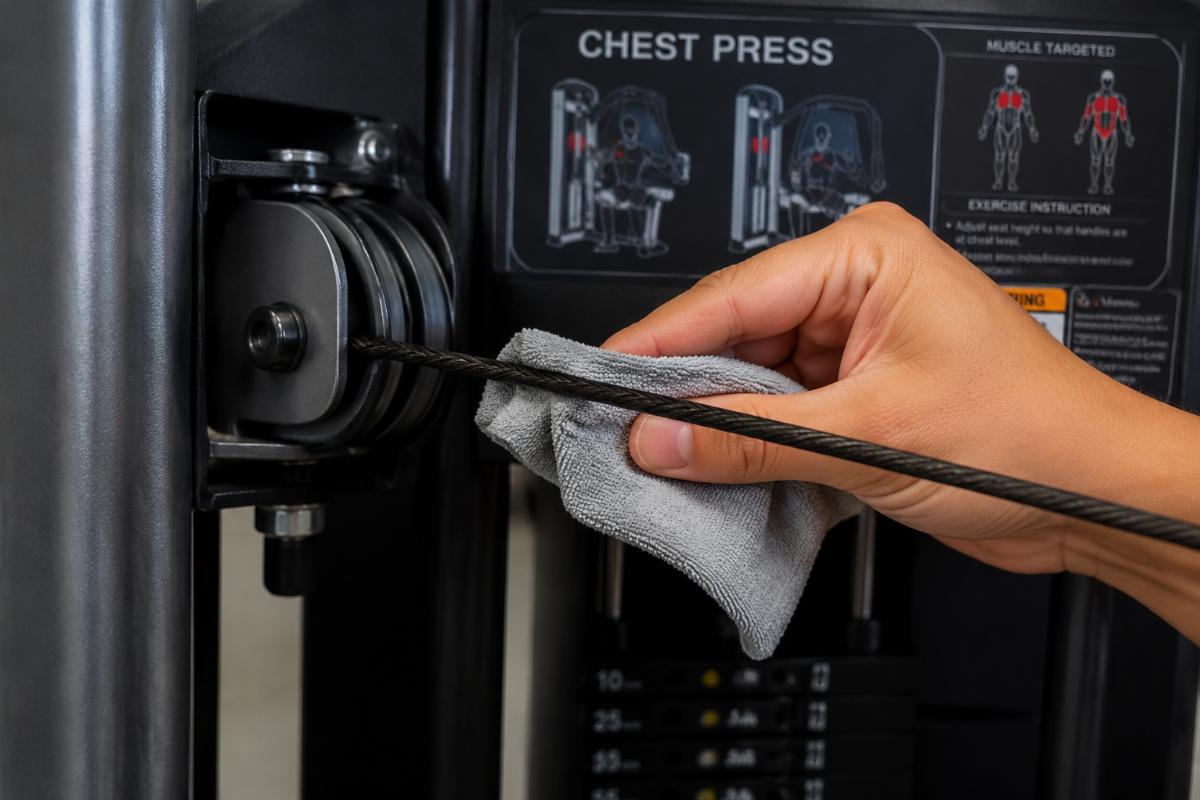
The SS-150 selectorized chest warranty does not cover cables under normal wear, but it does cover premature failure if the root cause can be traced to a manufacturing defect such as improper crimping or a flawed sheath seal. The burden of proof, however, rests on showing that the machine was maintained and operated correctly.
What Is the Correct Routine for Guide Rail and Pulley Maintenance?
Guide rail sticking and pulley misalignment are the two most common service calls on selectorized chest machines, and both are preventable with a scheduled cleaning, lubrication, and alignment routine.
Guide rails on the SS-150 selectorized chest series are precision-ground steel surfaces that allow the weight stack to move smoothly up and down. When they are clean and lightly lubricated, the stack glides. When they are not, the stack sticks, jerks, or makes noise—and members notice immediately.
The root cause of rail problems is almost always the same: dust and sweat accumulate on the rail surface, mix with residual oil, and form a gummy residue. Over time, this residue hardens and creates friction points. In humid environments, light surface rust can also form if the rail is left unprotected.
The maintenance procedure is as follows:
- Clean the rails: Wipe both guide rails with a lint-free cloth dampened with isopropyl alcohol. Remove all visible residue. Do this monthly at minimum, more frequently in high-traffic or humid locations.
- Apply lubricant: Use a silicone-based or dry PTFE spray designed for fitness equipment. Apply a thin, even coat along the full length of each rail. Avoid petroleum-based greases—they attract dust and worsen the problem over time [NEED_CITE: lubricant compatibility guidelines for selectorized machine guide rails].
- Cycle the stack: Move the weight stack through its full range of motion several times to distribute the lubricant evenly.
- Inspect pulleys: Check each pulley for lateral play and for wear on the groove surface. A pulley that wobbles or has a visible groove wear pattern needs replacement. Misaligned pulleys cause the cable to track improperly, which accelerates cable wear and can void warranty coverage on the cable.
- Verify alignment: The cable should run straight from the stack attachment point, through each pulley, to the handle, with no lateral deviation at any point. If deviation is visible, adjust the pulley mounting bracket until the cable tracks true.
In a gym we supplied in the Middle East, the owner noticed that one of the chest presses felt rough compared to the others. A technician discovered that the pulley bracket had been bumped during a move and was now slightly tilted. The cable was rubbing against the bracket edge, fraying from the inside. The fix took a few minutes—loosen the bracket, realign, retighten. But without that check, the cable would have failed within weeks.
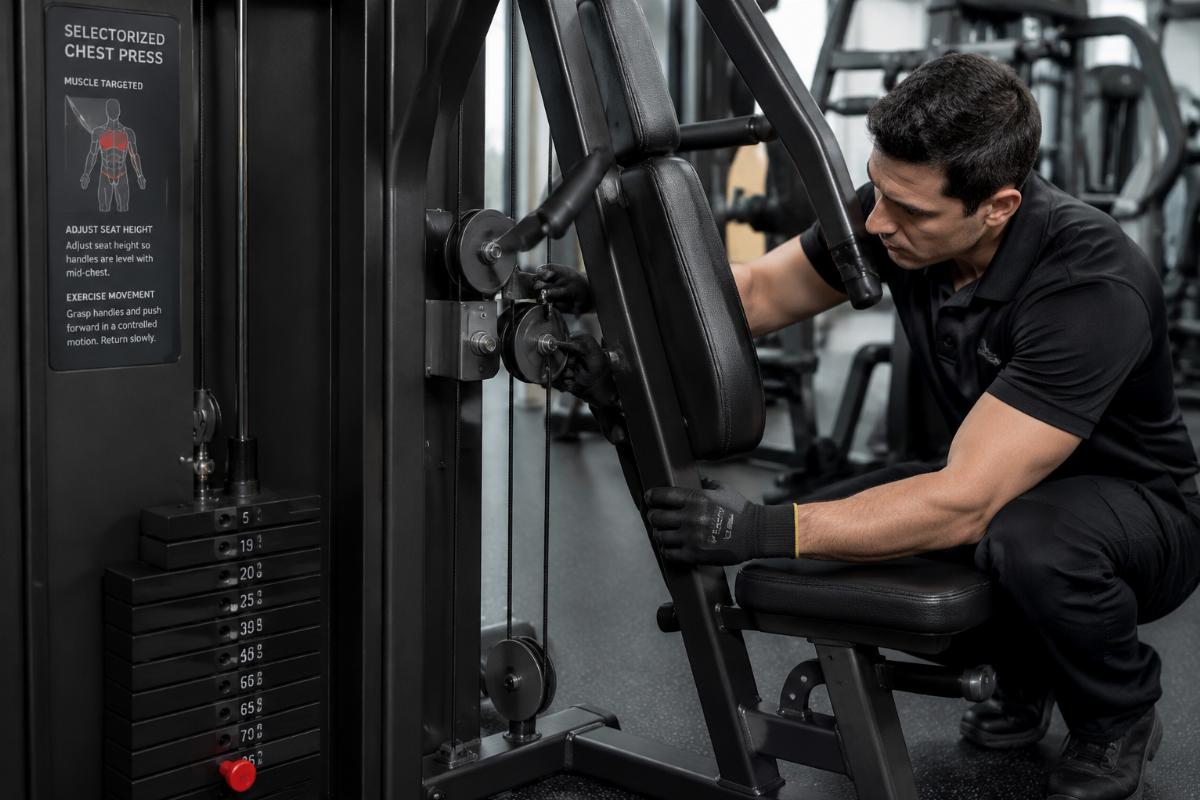
Keeping the SS-150 selectorized chest warranty valid on the motion system components depends on showing that this kind of routine maintenance was performed. We recommend that gym operators keep a simple log—date, initials, what was done—so that if a claim ever arises, the history is clear.
How Do You Get Fast After-Sales Support When Something Goes Wrong?
The speed of after-sales resolution depends less on the warranty document and more on how clearly the issue is reported and how well the local operator can execute remote-guided troubleshooting.
Even with perfect maintenance, things occasionally go wrong. A pulley fails. A cable snaps despite proper care. A weld shows a hairline crack after years of heavy use. When that happens, the quality of the after-sales process determines whether the machine is back in service in days or weeks.
The most effective way to get fast support on the SS-150 selectorized chest warranty is to follow a structured reporting process:
- Document the issue visually: Take clear photos or a short video showing the problem. For a cable issue, show the full cable path. For a rail issue, show the stack moving through its range. For a structural concern, show the weld area from multiple angles.
- Provide the machine identification: Every SS-150 unit has a serial number plate. Include this in your report. It allows the after-sales team to pull the exact production batch, check for any known issues, and identify the correct spare parts.
- Describe the operating environment: Mention whether the gym is coastal, high-humidity, air-conditioned, or open-air. This context helps the team determine whether the issue is environmental or product-related.
- Execute remote-guided steps: In many cases, the after-sales team will walk the local operator through a troubleshooting sequence—checking alignment, testing tension, inspecting a specific weld. If the operator can follow these steps with basic tools, the issue is often resolved without shipping any parts.
We maintain a spare parts inventory for the SS-150 series and can dispatch cables, pulleys, guide rail covers, and other wear components quickly. For distributors who order full gym packages, we include a recommended spare parts list so that the most common wear items are already on hand locally.
We also provide technical documentation in multiple languages, including pictorial maintenance guides designed for operators who may not read English fluently. For markets in Africa and the Middle East, we have developed region-specific versions of these guides that address the most common environmental challenges—humidity, dust, and temperature swings.

The SS-150 selectorized chest warranty is backed by a responsive after-sales structure, but its effectiveness depends on the operator’s ability to communicate the issue clearly and participate in the resolution process. A well-documented claim moves fast. A vague phone call with no photos and no serial number moves slowly.
Conclusion
The SS-150 selectorized chest warranty is a conditional commitment that rewards operators who understand its boundaries and maintain their equipment accordingly.
Structural coverage is broad, motion system coverage is condition-dependent, and consumables are excluded. Cable fraying in humid environments is preventable with inspection and lubrication. Guide rail and pulley issues are resolved through a simple scheduled routine. And when problems do arise, fast resolution depends on clear reporting and local execution of remote-guided steps. The warranty document matters, but the*