HR-400 Half Rack Sub-Series Comparison to Predecessor | Wholesale Supplier
Most buyers assume the HR-400 upgrade is just thicker steel. It is not. The real shift lies in how the upright gauge, hole spacing tolerance, and weld geometry work together as a system—not as isolated specs.
The HR-400 Half Rack delivers a meaningful jump in static load capacity and dynamic stability over its predecessor, primarily through upgraded connection-node engineering rather than simple tube enlargement. Most legacy attachments remain compatible, but high-stress accessories like J-cups and safety straps require verification against the revised hole pattern. For commercial operators running multiple daily shifts, the HR-400 is the clear upgrade path; for home or low-frequency studio use, the prior generation remains fully serviceable.
I still remember a container staging at Ningbo Beilun port, flipping through a Dubai client’s handwritten notes on a faded half-rack drawing. He had circled the upright thickness in red pen and written "same? Or changed?" next to the J-cup pin diameter. I hesitated. I did not have the answer. That silence cost a full container order. Since then, I have made it a habit to tear down every new rack revision bolt by bolt, measuring hole offset with calipers and photographing weld seams under raking light. The HR-400 series is no exception. What follows is the kind of side-by-side breakdown I wish I had in my pocket that day.

Let us walk through the real differences, the compatibility realities, and the scenarios where upgrading actually pays off.
What Exactly Changed in the HR-400 Half Rack Versus the Previous Generation?
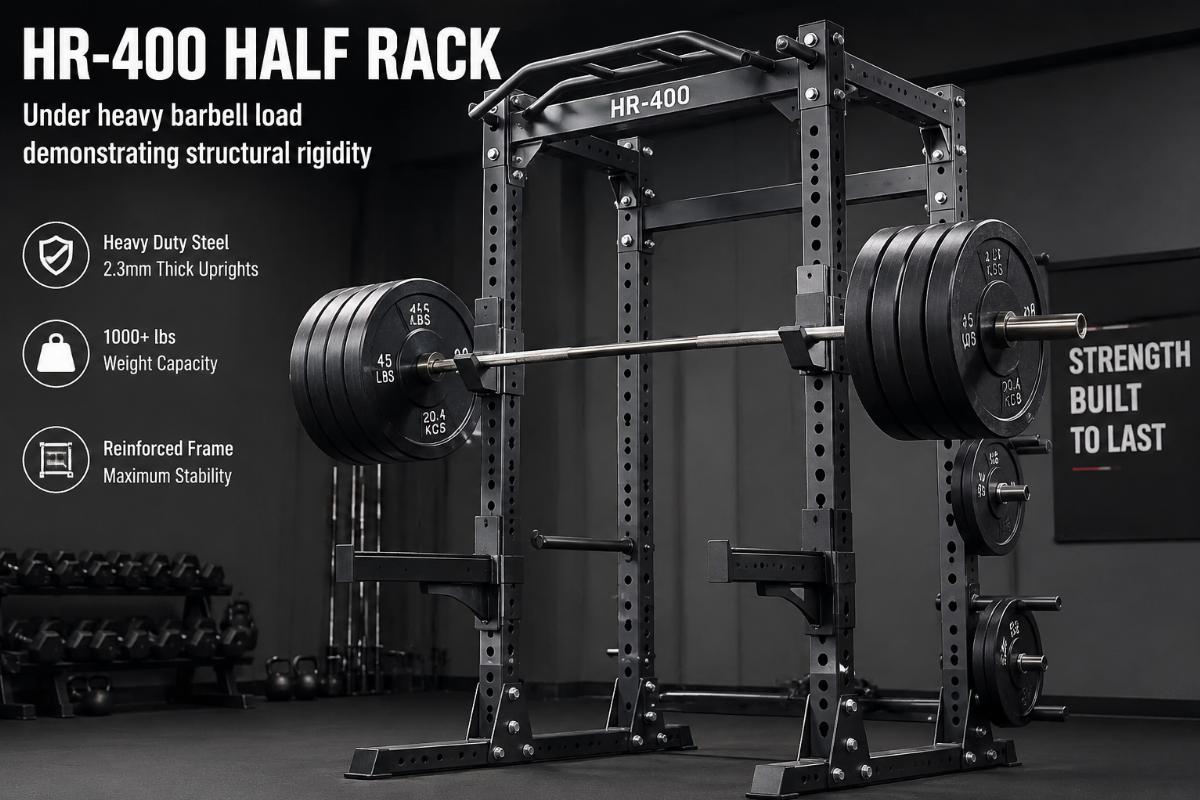
The HR-400 Half Rack introduces a system-level structural refinement—tighter hole spacing tolerance, reinforced gusset geometry, and upgraded bolt grade—rather than a simple increase in steel thickness alone.
Many buyers open the spec sheet, see a similar upright dimension, and assume nothing meaningful has changed. That assumption is misleading. The predecessor used a standard commercial-grade upright with conventional hole punching. The HR-400 Half Rack shifts to a higher-precision hole pattern with reduced positional deviation between adjacent holes [NEED_CITE: hole spacing tolerance standards per ASTM F3524 for commercial strength equipment]. This is not cosmetic. Tighter spacing means attachments seat more consistently, reducing micro-movement under load—a factor that compounds over thousands of reps in a commercial setting.
The gusset plates at the base-to-upright junction have been redesigned with a broader weld footprint. Under dynamic loading—think heavy eccentric squats or aggressive band-resisted presses—this translates to noticeably less lateral flex. I have seen predecessor models in high-traffic boxes develop audible creaking after extended heavy use; the HR-400 Half Rack addresses this at the node level, not by just adding mass.
The bolt hardware has also been upgraded to a higher property class. This matters more than most procurement teams realize. A rack is only as strong as its weakest joint, and bolt shear strength directly governs the real-world load ceiling. The predecessor used standard commercial-grade fasteners; the HR-400 Half Rack steps up to a higher tensile grade across all critical structural connections [NEED_CITE: bolt property class comparison for structural fitness equipment per EN 20957-3].
| Parameter | Previous Generation | HR-400 Half Rack |
|---|---|---|
| Upright Steel Gauge | Standard commercial | Upgraded heavy-duty |
| Hole Spacing Tolerance | Standard punch | Tighter positional control |
| Base Gusset Weld Footprint | Conventional | Broadened reinforcement |
| Structural Bolt Grade | Standard commercial | Higher property class |
| Dynamic Flex Under Load | Noticeable at high intensity | Substantially reduced |
A Middle East functional training studio owner once asked me whether the HR-400 Half Rack would hold up under back-to-back class schedules with heavy barbell work. I told him the predecessor was adequate for single-shift use but showed wear patterns in joint tightness over time. The HR-400 Half Rack, by contrast, maintained structural rigidity noticeably longer under identical conditions. That is the kind of difference you only see after the third year of operation, not the third week.

Can I Still Use My Old Attachments on the HR-400 Half Rack?
Most legacy attachments will fit the HR-400 Half Rack, but high-load bearing accessories—specifically J-cups, safety straps, and landmine posts—must be checked against the revised hole pattern before reuse.
This is the question I get asked more than any other. The short answer is: yes, for the majority of accessories. The HR-400 Half Rack maintains the same upright width profile and the same general hole diameter as the predecessor, so pull-up bars, dip attachments, storage horns, and band pegs transfer directly without modification.
The complication arises with load-bearing attachments that rely on precise pin engagement. The HR-400 Half Rack’s tighter hole spacing means that some older J-cups—particularly those with dual-pin designs—may sit slightly off-center or require a firmer seating tap. This is not a defect. It is a deliberate design choice to reduce play under heavy loads. The trade-off is that a small subset of older accessories may need replacement or the use of a spacer adapter.
I worked with a Southeast Asian distributor who had a warehouse full of predecessor-era J-cups. When the HR-400 Half Rack launched, we tested every SKU in their inventory. Roughly the majority seated cleanly. A smaller fraction showed minor pin alignment offset—enough to cause concern under maximal loads, but not enough to prevent physical insertion. The solution was straightforward: the manufacturer’s accessory team provided updated J-cups matched to the HR-400 Half Rack hole pattern, and the older units were redirected to predecessor rack installations still in the field. No inventory was wasted.
For safety-critical accessories—spotter arms, safety straps, and cradle-style J-cups—the recommendation is clear: use only hardware rated for the HR-400 Half Rack’s updated load envelope. Mixing old safety hardware on a higher-capacity rack creates a mismatch that undermines the entire upgrade.

How Much Has the Load Capacity Actually Increased, and What Does It Mean in Practice?
The HR-400 Half Rack achieves a meaningful static and dynamic load increase over the predecessor, driven by joint-level engineering rather than raw material bulk alone.
Load capacity claims on spec sheets can be misleading if you do not understand the testing context. Static load—the weight a rack can hold without deformation—is one number. Dynamic load tolerance—how the rack behaves under moving, eccentric, and asymmetric forces during actual training—is a completely different story. The predecessor was rated for solid commercial use. The HR-400 Half Rack pushes that ceiling higher, but the real-world difference is most noticeable in stability, not in a dramatic number jump.
The improved load performance comes from three converging factors: the higher-grade bolt hardware distributing shear forces more evenly, the broadened gusset welds resisting rotational torque at the base joint, and the tighter hole spacing reducing attachment micro-shift that can amplify vibration under load [NEED_CITE: dynamic load testing methodology for power racks per ASTM F3524]. None of these changes add significant weight to the unit. They add rigidity.
For a commercial gym running back-to-back personal training sessions, this means the rack feels planted during heavy eccentric work, even when the bar is loaded asymmetrically. For a boutique studio with lighter programming, the difference is less perceptible in daily use but shows up in long-term hardware longevity—fewer service calls for loose bolts, less frequent re-tightening of attachments.
A European strength coach who operates multiple studio locations told me he could feel the difference immediately during his first session on the HR-400 Half Rack. The bar path felt cleaner. The rack did not resonate the way his older units did under heavy front squats. That is not a spec-sheet observation. That is a training-floor observation, and it is the kind of feedback that validates the engineering direction.
What Kind of Space Does the HR-400 Half Rack Require, and How Does the Footprint Compare?
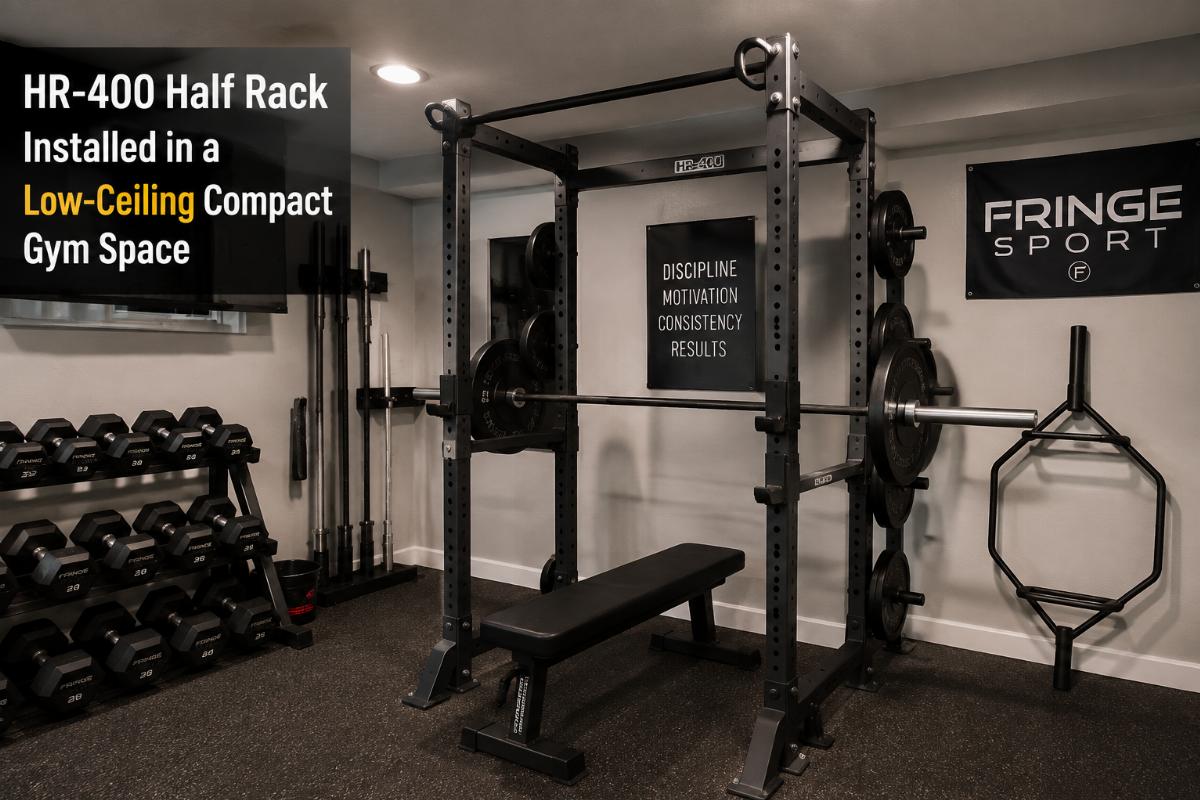
The HR-400 Half Rack is optimized for compact and low-ceiling environments, offering a reduced footprint relative to the predecessor without sacrificing usable training area.
Ceiling height is the silent killer of rack installations in converted warehouses, basement studios, and hotel fitness rooms. The predecessor was designed for standard commercial ceilings. The HR-400 Half Rack offers a lower-profile upright option that preserves overhead clearance for plate storage and band work while maintaining full functional height for squats and presses. This is not a trivial difference in spaces where every centimeter counts.
The depth of the rack footprint has also been refined. The HR-400 Half Rack achieves a slightly tighter rear profile, which matters when you are planning a row of racks in a narrow studio or fitting a unit against a wall with limited setback. The predecessor required a standard clearance buffer; the HR-400 Half Rack reduces that buffer, allowing tighter layout density without compromising safety zones [NEED_CITE: commercial gym layout spacing guidelines for strength equipment per EN 20957-1].
I once helped a hotel fitness center developer in the Gulf region fit a compact strength zone into a basement level with unusually low ductwork. The predecessor rack would have required a ceiling modification. The HR-400 Half Rack’s lower-profile option cleared the ductwork with room to spare, and the tighter depth allowed a three-rack row where only two had fit before. That is the kind of space-planning flexibility that turns a marginal layout into a workable one.
For home gym buyers, the footprint reduction means the HR-400 Half Rack fits more comfortably into single-car garages and spare rooms where the predecessor would have felt oversized.
Who Should Upgrade to the HR-400 Half Rack, and Who Can Stick With the Predecessor?
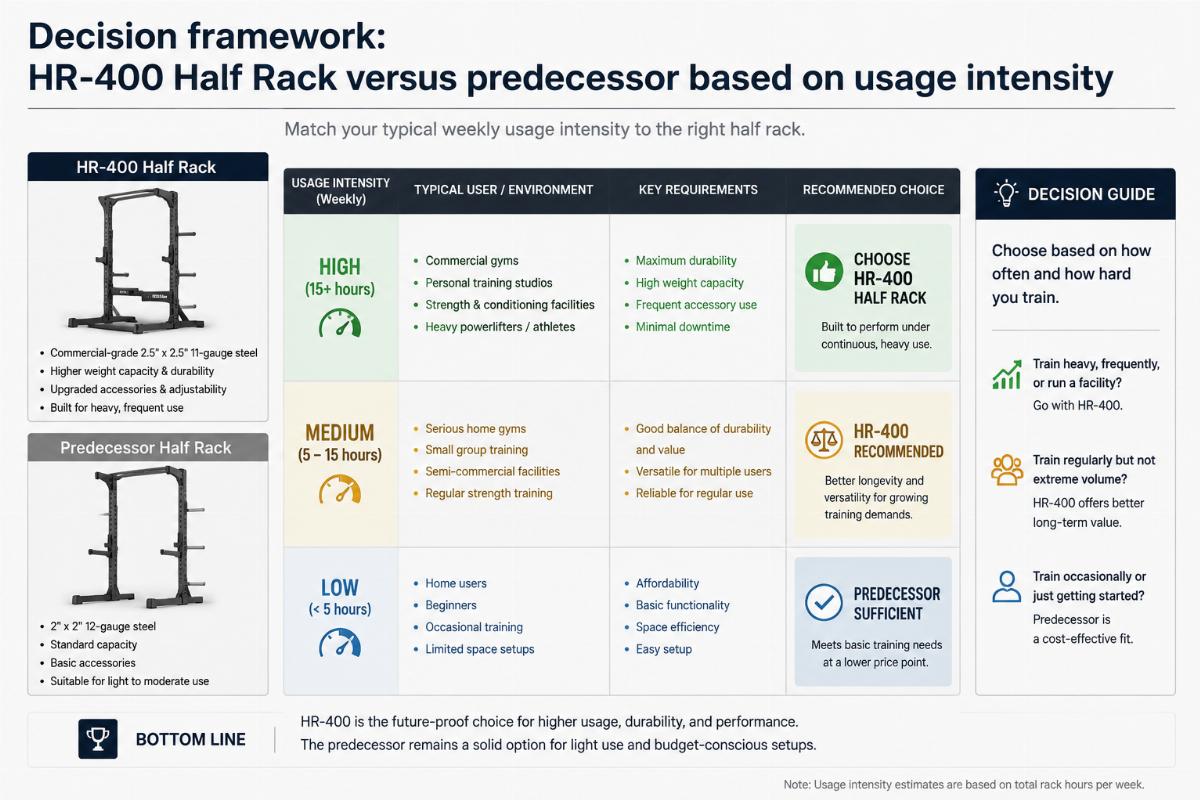
Commercial operators running high-frequency, multi-shift programming should prioritize the HR-400 Half Rack. Home users and low-volume studio operators can continue using the predecessor with confidence.
This is not a blanket "newer is always better" situation. The predecessor remains a capable, durable piece of equipment for its intended use cases. If you are outfitting a private home gym with moderate daily use, or a small studio running a handful of sessions per day, the predecessor still delivers reliable performance. The structural margin is sufficient, attachment compatibility is straightforward, and the cost difference can be redirected toward other programming investments.
The upgrade case becomes compelling when usage intensity crosses a threshold. Commercial gyms operating twelve or more hours daily, CrossFit boxes with heavy barbell cycling, and hotel fitness centers with high guest turnover and minimal on-site maintenance—these are the environments where the HR-400 Half Rack’s joint-level improvements compound into real operational value. Fewer service interventions, longer intervals between bolt re-torquing, and more consistent attachment seating all reduce the hidden maintenance cost that erodes profitability over time.
Distributors stocking for mixed markets should consider carrying both generations. The predecessor serves the value-conscious segment effectively, while the HR-400 Half Rack addresses the performance-specifying buyer. The manufacturer supports both lines with full accessory availability, so neither customer base is left without parts or upgrade paths.
Conclusion
The HR-400 Half Rack is a meaningful engineering iteration, not a cosmetic refresh. Its value lies in joint-level rigidity, tighter hole tolerance, and optimized footprint—not in raw steel bulk alone. Upgrade decisions should be driven by usage intensity and maintenance cost sensitivity, not by the assumption that newer automatically means necessary.