Abdominal Machine for Gym Setup | Wholesale Supplier OEM Factory Direct
Thicker seat padding does not prevent lower back injuries—poor cam curve design does.
The single most important factor when selecting an abdominal machine for gym setup is the cam curve profile paired with weight stack travel distance. These two parameters determine whether resistance stays linear through the full range of motion, which directly controls lumbar compensation and member retention. Seat padding, leather feel, and frame color are secondary.
I still remember standing at a FIBO booth in Cologne years ago, running my hand along a selectorized ab crunch frame. Back when I was doing quality inspections at the factory, I used to check weld seams for porosity and slide rail tolerances by touch. Later, moving into trade, I kept seeing European boutique studio buyers sit on an abdominal machine for gym setup, press the seat cushion with their thumb, nod at the leather softness, and sign the purchase order. One buyer from a精品 studio chain in Western Europe ordered a full batch of ab machines based purely on seat comfort. Within months, member complaints about lumbar strain poured in. The cam curve on that model was poorly engineered—resistance felt loose at the start of the crunch, then suddenly spiked near peak contraction, forcing the lumbar spine to compensate. The entire batch was returned. That single decision cost the buyer several times the original equipment savings in reverse logistics and replacement units [NEED_CITE: biomechanical analysis of cam-driven resistance profiles in torso flexion equipment].
This is not an isolated story. Across trade shows in Hannover, Chicago, and Las Vegas, the pattern repeats: buyers fixate on tactile comfort while ignoring the mechanical parameters that actually govern training safety. Let me walk you through what really matters when you are evaluating an abdominal machine for gym setup.
Why Do Members Complain About Lower Back Pain After Using Ab Machines?
The root cause is almost always a mismatched cam curve, not weak core muscles or poor member form.
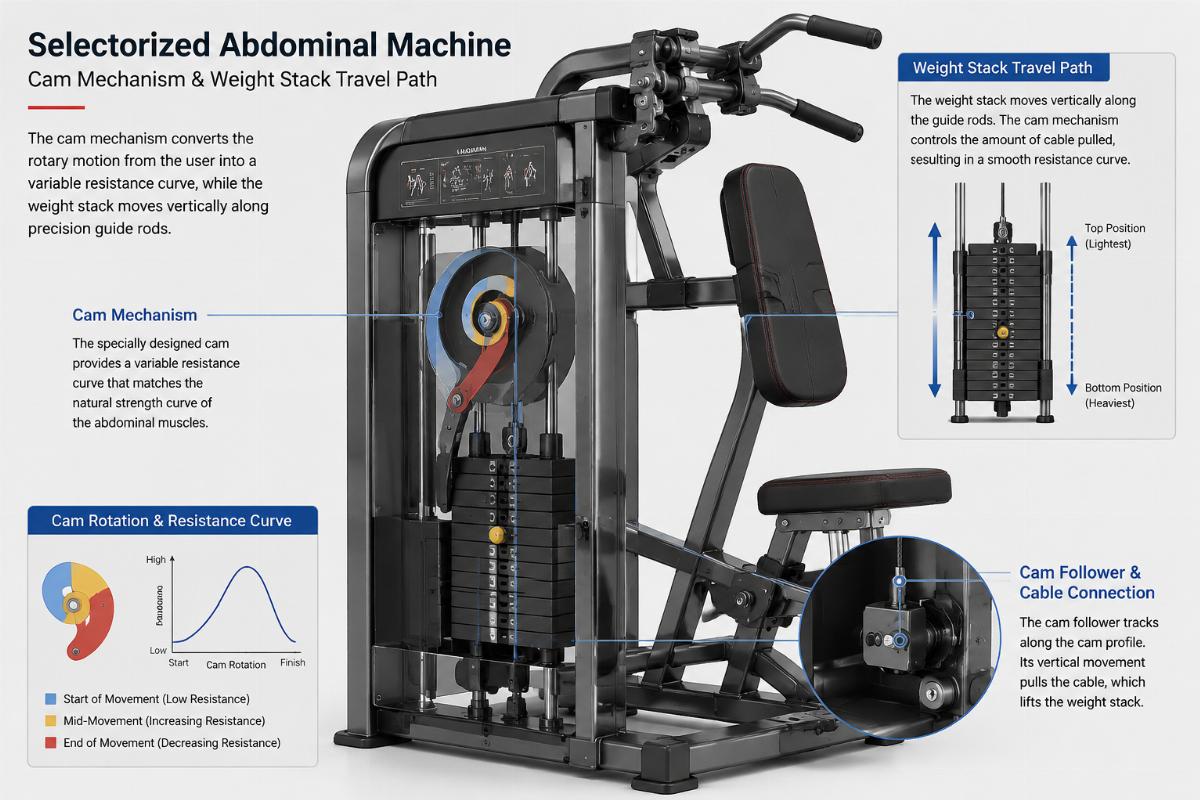
When a member performs a crunch on a selectorized machine, the resistance should follow the natural strength curve of the rectus abdominis. The abdominals are relatively weak at the stretched position and become stronger as the torso flexes toward contraction. A properly designed cam compensates for this by providing lighter resistance at the start and progressively heavier resistance through the peak. When the cam curve is flat or linear, the member faces disproportionately heavy resistance at the weakest point of the movement. The body instinctively recruits the hip flexors and lumbar erectors to compensate. Over repeated sets, this creates cumulative shear force on the lumbar discs [NEED_CITE: lumbar disc loading patterns during resisted torso flexion movements].
I once reviewed a complaint file from a Middle East gym chain. Their members—many of them experienced lifters—consistently reported lower back tightness after using the ab machine. The manufacturer had used a simple linear cam to cut production costs. The resistance felt "smooth" during a slow demo rep, but under real training loads, the early-phase resistance was far too aggressive. The gym eventually replaced the entire fleet, and the replacement cost represented a significant portion of their initial equipment budget.
The key takeaway: an abdominal machine for gym setup must feature a cam profile specifically mapped to the abdominal strength curve. Progressive or compound cam designs are non-negotiable for commercial environments where member safety drives long-term retention.

What Specs Should You Check Before Ordering Abdominal Machines?
Weight stack travel, cam ratio, and seat adjustment range are the three parameters that separate a reliable abdominal machine for gym setup from a liability.
Let me break these down based on what I have learned from inspecting dozens of models across multiple manufacturing facilities.
Weight Stack Travel Distance
The total vertical distance the weight stack moves during one full repetition determines the usable resistance range. A short travel distance means the stack bottoms out before the member reaches full contraction, creating a dead zone where resistance drops to zero. This is especially problematic for taller users or those with longer torsos. When comparing two otherwise similar abdominal machines, the one with longer stack travel will accommodate a wider range of body types and deliver resistance through the entire movement arc [NEED_CITE: ergonomic guidelines for selectorized strength equipment stack travel requirements].
Cam Ratio Design
The cam ratio defines how the weight stack displacement maps to the pivot arm rotation. A well-engineered cam ratio ensures that the resistance felt by the user matches the muscle’s force output at every joint angle. Some manufacturers use a single-radius cam, which is cheap to produce but mechanically inadequate. Compound cams with variable radius sections deliver a more anatomically accurate resistance curve. When you test a machine at a trade show, perform slow, controlled reps and pay attention to whether the resistance feels consistent or if there are sudden jumps or drop-offs.
Seat Adjustment Range
Commercial gyms serve members ranging from compact builds to tall athletes. The seat adjustment mechanism must accommodate this spread without compromising the pivot alignment. A narrow adjustment range forces shorter users to overreach or taller users to compress their range of motion, both of which degrade the exercise quality and increase injury risk. Look for abdominal machines for gym setup that offer multi-position seat rails or telescoping seat posts with clear increment markings [NEED_CITE: anthropometric data ranges for commercial fitness equipment seat adjustment].
Here is a qualitative comparison of what to look for:
| Parameter | Poor Design | Acceptable Design | Optimal Design |
|---|---|---|---|
| Cam Profile | Single-radius, linear resistance | Basic progressive curve | Compound cam matched to abdominal strength curve |
| Stack Travel | Short, bottoms out early | Moderate, covers mid-range | Full range, accommodates tall users |
| Seat Adjustment | Fixed or two-position | Multi-position with basic rail | Telescoping post with fine increment markings |
| Pivot Alignment | Fixed, one-size-fits-all | Limited adjustability | Aligns with user’s anatomical axis across sizes |

This is where I should mention that the Bick selectorized abdominal series was engineered with exactly these parameters in mind. The cam profile on their ab crunch machines uses a compound curve designed around the torso flexion strength pattern, and the weight stack travel is sized to accommodate users across a broad height range. The seat adjustment system uses a telescoping mechanism with clearly marked increments, which is the kind of detail that matters when your gym serves a diverse membership base.
How to Match Ab Machines to Different Gym Types?
The right abdominal machine for gym setup depends entirely on your facility type, member profile, and usage intensity.
Over the years, I have supplied equipment to commercial chains, boutique studios, hotel fitness centers, and distributor warehouses across multiple regions. Each environment has distinct requirements.
Commercial Gyms and Fitness Chains
High-traffic facilities need machines built for continuous, heavy-duty use. The frame must handle hundreds of repetitions daily without developing play in the pivot bearings or cable system. Selectorized machines with enclosed weight stacks are the standard here—they offer quick weight changes, member safety, and lower maintenance compared to plate-loaded alternatives. The cam curve must be robust enough to serve both beginners and advanced lifters, which means a compound progressive design is essential. Durability certifications and commercial-grade construction are baseline expectations [NEED_CITE: durability testing standards for commercial selectorized strength equipment].
Boutique Studios and PT Clinics
These spaces often prioritize compact footprints and specialized functionality. A boutique studio might prefer a plate-loaded ab machine that allows finer load increments and a more focused range of motion for corrective training. The member base here tends to be more knowledgeable, so they appreciate equipment that offers precise biomechanical alignment. However, the cam curve still matters—poor resistance profiling will drive away discerning clients just as quickly as it causes injuries in a commercial setting.
Hotel and Resort Fitness Centers
Hotel gyms face a unique challenge: the user base is transient, ranging from complete beginners to serious athletes, often with no staff supervision. The abdominal machine for gym setup in this context must be extremely intuitive, with clear adjustment markings and a forgiving resistance curve. A machine with an aggressive cam profile or narrow seat adjustment will generate complaints and, worse, injury incidents that reflect poorly on the property. Simplicity and safety outweigh advanced features here.

What Red Flags Should Buyers Watch for at Trade Shows?
Sitting on a machine and judging it by the seat cushion is the single biggest mistake buyers make at equipment expos.
I have watched this happen at nearly every major trade show I have attended. A buyer walks up to an abdominal machine for gym setup, sits down, does two quick reps, pats the seat, and asks about the price. This approach misses every mechanical parameter that actually determines whether the machine will perform safely under real-world conditions.
Here are the specific red flags I look for when evaluating machines on the show floor:
Red Flag One: Resistance Feels Uneven During Slow Reps
Perform five slow, controlled repetitions. If you feel the resistance suddenly lighten or spike at any point in the range, the cam profile is poorly designed. A quality machine should feel smooth and progressive from start to finish.
Red Flag Two: Weight Stack Hits the Bottom Before Full Contraction
Load a moderate weight and perform a full rep. If the stack bottoms out while you still have significant range of motion left, the travel distance is insufficient. This will frustrate taller members and limit the exercise’s effectiveness.
Red Flag Three: Seat Adjustment Feels Flimsy or Limited
Pull the adjustment pin and slide the seat. If it moves with excessive play or only offers two or three positions, the machine will not accommodate your full membership base. Commercial-grade equipment should offer smooth, precise adjustment with a wide range.
Red Flag Four: No Visible Information on Cam Design or Stack Travel
If the manufacturer cannot or will not provide technical specifications on cam profile type and weight stack travel distance, that is a major warning sign. Reputable manufacturers document these parameters because they understand their importance. If a supplier evades these questions, move on to the next booth [NEED_CITE: technical documentation requirements for commercial strength equipment procurement].

I once saw a buyer from a Southeast Asian hotel chain sign an order for a full gym package without checking any of these points. Six months later, they contacted me because two members had reported lower back strain, and the hotel’s management was demanding the equipment be replaced. The replacement cost was a significant fraction of the original purchase price. The original supplier offered no technical support and no willingness to address the design flaw.
Conclusion
Cam curve design and weight stack travel are the true determinants of member safety and equipment longevity—not seat padding or cosmetic finish.
When selecting an abdominal machine for gym setup, prioritize mechanical parameters over tactile impressions. Verify the cam profile matches the abdominal strength curve, confirm the stack travel accommodates your tallest users, and ensure the seat adjustment range covers your full membership demographic. Whether you are outfitting a high-traffic commercial chain, a specialized boutique studio, or a transient hotel fitness center, these fundamentals remain constant. Trade shows are useful for initial screening, but real due diligence happens when you demand technical specifications and test the machine under controlled, slow repetitions. The cost of getting this wrong—measured in member complaints, injury incidents, and premature equipment replacement—far exceeds the effort of proper evaluation upfront.