Commercial CrossFit Box Gym Equipment Package | Wholesale Supplier
Most buyers think a heavier rig means a tougher rig. The real difference sits in the weld seam and the salt-spray test report, not the steel weight.
A complete CrossFit gym equipment package is not a pile of metal—it is a system reverse-engineered from training flow, load-bearing zones, and container-loading logic, so that what arrives at the port is what the floor plan actually demands.
I still remember a柜 that sat at Jeddah port for weeks. The client, a private-studio owner in Riyadh, messaged me every other day. When we finally opened the crates, the J-hooks on the functional rigs had already bloomed with rust. The welds had never passed a proper salt-spray cycle. We ended up re-shipping fasteners and touch-up paint, and the freight bill alone wiped out the margin on that order. [NEED_CITE: root cause distribution of corrosion failures in marine-transit fitness equipment per ISO 9227]. That single container taught every person on our packing line to treat surface treatment as seriously as the steel itself. Since then, I have loaded and spec’d enough complete CrossFit gym equipment package orders to know that the bottleneck is never the catalog—it is the details between the catalog and the container door.
Let me walk you through how a real turnkey box is built, spec by spec, crate by crate.
What Exactly Goes Into a Turnkey CrossFit Box Package?
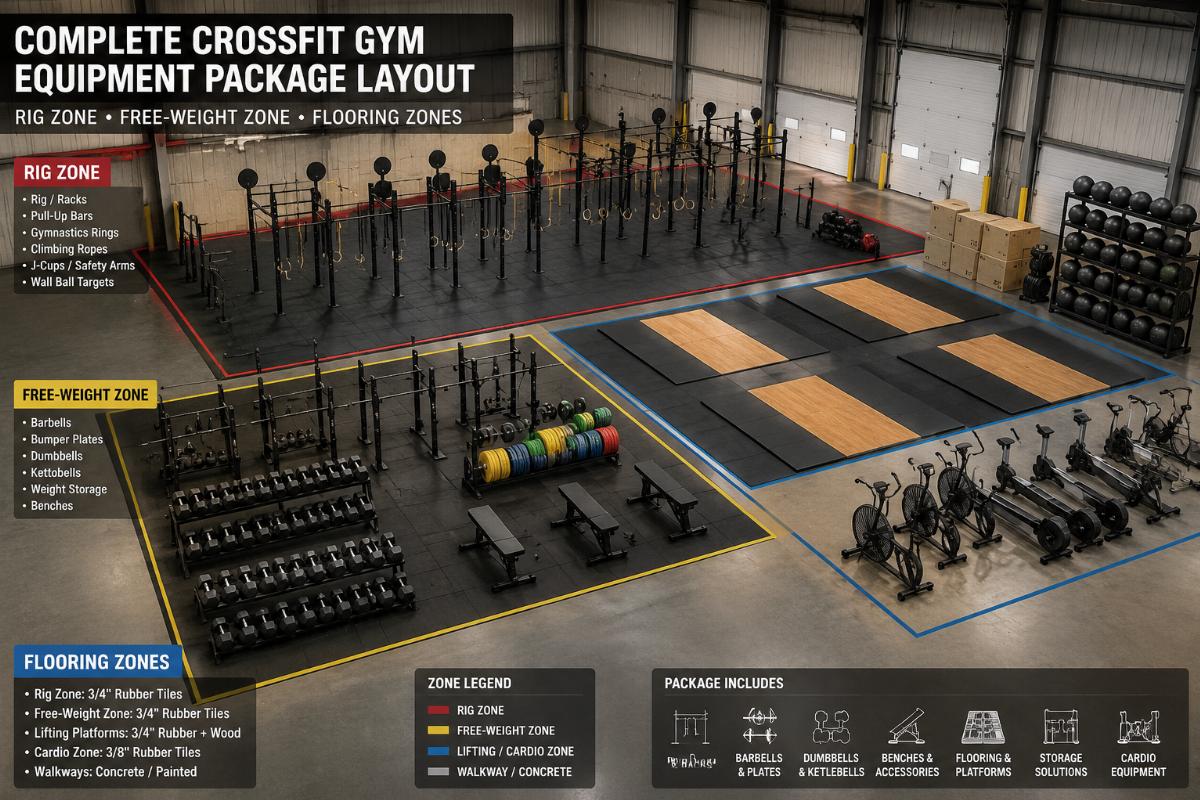
A functional CrossFit facility is divided into four movement domains, and each domain pulls a different slice of the complete CrossFit gym equipment package.
The industry has settled on a rough zoning logic: warm-up and conditioning along the entry wall, Olympic lifting in the center with the highest ceiling clearance, gymnastics and pull-up stations against the long wall, and metabolic conditioning tucked into the remaining perimeter. [NEED_CITE: recommended zoning patterns for functional training facilities per CrossFit affiliate layout guidance]. A buyer who skips this zoning and just orders "everything in the catalog" usually ends up with a box that feels cramped even though the square footage is fine.
For a typical mid-size affiliate, the rig and rack family takes up the largest share of both floor space and budget. This includes multi-station functional rigs with pull-up bars, dip stations, and monolift attachments, plus a set of half-racks or full power racks for barbell work. Free weights form the second pillar: competition-grade barbells, calibrated or technique plates, bumper plates, dumbbells in a graduated set, kettlebells, and medicine balls. The third pillar is accessories—plyo boxes of three heights, slam balls, battle ropes, rowing machines, and air bikes for the metabolic corner. The fourth pillar, often under-quoted, is flooring: heavy-duty rubber tiles under the rigs, thicker impact-absorbing rolls in the lifting platform zone, and a softer walkway layer around the perimeter.
A distributor I worked with in Latin America once tried to save on freight by cutting the flooring line from the order. The rig went in fine, the barbells looked great, but three months later the concrete sub-floor in the lifting zone started cracking. He ended up buying flooring locally at a price that dwarfed the original quote. A complete CrossFit gym equipment package has to include the floor, not as an afterthought but as a load-bearing component of the system.

How to Layout a CrossFit Box for Maximum Training Flow?
The layout is decided before the first purchase order is written, because the rig footprint dictates the rest.
Start with the rig wall. A standard functional rig runs along the longest unbroken wall, with bay spacing matched to the barbell length plus clearance—usually around the two-meter mark per station. [NEED_CITE: minimum bay spacing and ceiling height standards for functional training rigs]. The rig wall becomes the spine of the box. Everything else is arranged around it.
The lifting platform zone sits directly in front of the rig, because athletes will pull the bar off the rig and drop it within the same movement. This zone needs the thickest flooring and the most headroom. The gymnastics zone—pull-up bars, rope climbs, ring stations—extends from the rig wall itself, so no extra footprint is wasted. The metabolic zone, with rowers, bikes, and ski ergs, lines the opposite wall so that athletes can transition between strength and cardio without crossing the lifting platform.
A Southeast Asian box owner came to me after expanding from a single rig wall to a full four-wall layout. His original plan had the rigs on two parallel walls and the lifting platforms in the middle. The problem was that during a class of twenty, athletes doing wall-balls and thrusters were constantly in each other’s swing path. We re-ran the layout: rigs on one long wall, lifting platforms as a central island, metabolic machines on the short walls, and a clear circulation loop around the island. Class throughput went up without adding a single square meter. That is what layout logic does inside a complete CrossFit gym equipment package—it turns the same floor into a faster floor.

What Are the Critical Specs to Verify Before Ordering?
The three numbers that separate a commercial-grade complete CrossFit gym equipment package from a garage-grade one are upright steel gauge, weld quality, and salt-spray endurance.
Upright steel thickness is the first filter. For commercial rigs that will see hundreds of pull-ups, muscle-ups, and kipping drills every day, the uprights need to sit in the heavy-gauge range, not the light residential tier. Thicker steel does not just mean higher static load—it means the rig will not flex during high-rep gymnastics transitions, which is where most user complaints originate. [NEED_CITE: structural load requirements for commercial functional training rigs per EN ISO 20957].
Weld quality is the second filter, and it is the one most buyers never see until something breaks. The critical welds are the J-hook base plate, the safety strap anchor, and the pull-up bar joint. A visually clean weld is not enough; the weld must be ground smooth, stress-relieved, and then coated. If the coating fails, the weld is the first place rust will appear—exactly what happened on that Jeddah shipment.
Salt-spray endurance is the third filter, and the one I now check before I check the price. A commercial-grade finish should survive extended salt-spray exposure without red rust appearing on the weld zones. [NEED_CITE: salt-spray test duration thresholds for commercial fitness equipment coatings per ISO 9227]. Many suppliers quote a powder-coat thickness number and call it a day, but thickness without proper pre-treatment and cure is just paint waiting to chip.
The table below shows how these three filters play out across supplier tiers:
| Verification Point | Commercial-Grade | Mid-Tier | Budget Tier |
|---|---|---|---|
| Upright Steel Gauge | Heavy-gauge, verified | Standard gauge | Light-gauge |
| Weld Treatment | Ground, stress-relieved, sealed | Ground, partially sealed | As-welded |
| Salt-Spray Endurance | Extended endurance, certified | Standard endurance | Not tested |
| J-Hook Load Rating | Verifiable commercial rating | Self-reported | Not provided |
A buyer in the Middle East once sent me photos of two rigs side by side after one year of use. One was ours, one was a cheaper alternative. The cheaper rig had rust bleeding through the powder coat at every weld joint. Ours looked the same as the day it was uncrated. That is the difference a complete CrossFit gym equipment package makes when the spec sheet is actually enforced on the production floor.

How to Optimize Container Loading for a Full Gym Shipment?
The real cost of a complete CrossFit gym equipment package is not the FOB price—it is what arrives at the other end, and that is decided inside the container.
Container loading is a balancing act between heavy cargo and bulky cargo. Barbells, plates, and rig uprights are dead weight that hits the container’s payload limit long before the volume is full. Rubber flooring, plyo boxes, and battle ropes are volume-heavy but weight-light. A well-planned complete CrossFit gym equipment package mixes the two so that the container is both weight-full and space-full. If you load only heavy items, you pay for air. If you load only bulky items, you hit the cube limit and still need a second container for the plates.
Disassembly strategy is the second lever. Rigs should be shipped knocked-down, with uprights, cross-members, and hardware packed separately. A fully assembled rig wastes enormous cube and is far more vulnerable to transit damage. Every bolt hole should be sleeved, every painted surface wrapped, and every hardware bag vacuum-sealed with desiccant. [NEED_CITE: best practices for marine-transit packaging of welded fitness equipment].
The third lever is fastener isolation. On that Riyadh job, the rust did not start on the rig uprights—it started inside the fastener bags, which had been packed loose in the same crate as the uprights. Moisture condensed inside the bag, the fasteners rusted, and the rust transferred to the upright surfaces they were touching. Since then, every hardware kit in a complete CrossFit gym equipment package is vacuum-sealed individually, with its own desiccant pack, and placed in a separate compartment of the crate.
A European distributor once asked me to consolidate his rig order with a separate flooring order from another supplier into one 40HQ. The other supplier’s flooring was palletized in loose rolls with no edge protection. We re-packed the flooring into edge-protected bundles and interleaved them between the rig crates, turning what would have been wasted cube into structural bracing. The container arrived with zero damage claims across both product lines. That is the kind of loading logic that turns a complete CrossFit gym equipment package from a procurement line item into a logistics advantage.

What After-Sales Support Should a Turnkey Supplier Provide?
The after-sales package is not a brochure—it is the difference between a one-time buyer and a repeat distributor.
A serious complete CrossFit gym equipment package should ship with three things beyond the hardware itself: a full set of installation drawings scaled to the specific rig configuration, a spare-parts kit sized to the order volume, and a direct technical contact who can walk the buyer through assembly over video call if needed. [NEED_CITE: recommended after-sales documentation standards for commercial fitness equipment imports].
The spare-parts kit is the most under-valued component. It should include replacement J-hook liners, spare pull-up bar grips, extra safety strap clips, and a handful of every bolt size used in the rig. The cost of this kit is negligible compared to the cost of air-shipping a single missing bolt three months later. A gym owner in Australia once told me he stopped buying from a supplier after a single missing clip took weeks to resolve—because by then his members had already formed a negative impression of the facility.
Technical support should be real, not a generic email address. When a buyer in South America was setting up a new box, our technical lead spent an hour on video walking his local installer through the rig assembly sequence and the torque specs for the main bolts. That one call prevented what would have been a costly re-work. A complete CrossFit gym equipment package that includes this level of support turns the supplier into a partner, not a vendor.
Warranty terms should be transparent and written in plain language: what is covered, what is excluded, how claims are processed, and what the response timeline looks like. A warranty that sounds generous but has no clear process is worse than a modest warranty with a clear one.

Conclusion
A complete CrossFit gym equipment package is won or lost in the details that never make the catalog page.
From the salt-spray test on a weld seam to the desiccant pack inside a fastener bag, from the rig bay spacing on the floor plan to the spare clip in the warranty kit—these are the elements that separate a facility that runs smoothly for years from one that generates complaints before the first competition. Spec the zones, verify the coatings, balance the container, and make sure the support is real. The rest takes care of itself.