Bumper Plate Set for 24-Hour Gym Chains in Japan | Wholesale Supplier Bick
Most gym owners in Japan don’t fail because their bumper plates crack. They fail because the rubber smells.
For 24-hour gym chains in Japan, the right bumper plate set must meet three non-negotiable criteria: zero volatile organic compound emission after 72 hours of off-gassing, Shore A hardness between 78 and 85 for controlled drop resistance without floor damage, and color-coded weight rings compliant with JIS-compliant visual zoning standards. A reliable bumper plate set supplier must provide third-party SVHC test reports, batch-level density consistency, and a replacement protocol that covers odor-related complaints within the first year of deployment.
I still remember a shipment that nearly ended a client relationship in Tokyo. A 24-hour unmanned fitness operator had asked me to source a bumper plate set for their new Shibuya location. I recommended a standard virgin rubber compound we had been shipping to Southeast Asian markets for years. The plates looked right, the weight tolerance checked out, and the color coding was clean. What I didn’t account for was the ventilation system in a compact Tokyo basement gym running on recirculated air. Within hours of opening, members were complaining of headaches. The operator had to rip out an entire set overnight. That single container cost them several times what the plates were worth in reputational damage and labor. Since then, I never approve a bumper plate set for the Japanese market without a smell test, a drop test on the actual flooring substrate, and a written confirmation of the venue’s air exchange rate [NEED_CITE: ventilation requirements for indoor fitness facilities per Japanese building code standards].

The lesson was expensive, but it reshaped how I evaluate every bumper plate set that leaves the factory floor for Japan. What follows is a breakdown of what actually matters when sourcing for this market, and why most spec sheets miss the point entirely.
Why Do Standard Bumper Plates Fail in Japanese 24-Hour Gyms?
The failure mode is almost never structural. It is environmental incompatibility.
Japanese 24-hour gym chains operate under constraints that most global suppliers do not design for. These venues are typically compact, often located in basement or semi-basement commercial spaces, and run on minimal fresh air exchange to control HVAC costs. The equipment inside must perform around the clock without generating complaints that trigger health department inquiries or tenant disputes.
A standard bumper plate set designed for well-ventilated big-box gyms in North America or open-plan warehouses in the Middle East will often pass every durability test and still fail in Japan. The reasons cluster into three categories:
| Failure Mode | Standard Plate Response | Japan 24-Hour Gym Requirement |
|---|---|---|
| Odor emission after installation | Acceptable within first weeks | Must be negligible within 72 hours |
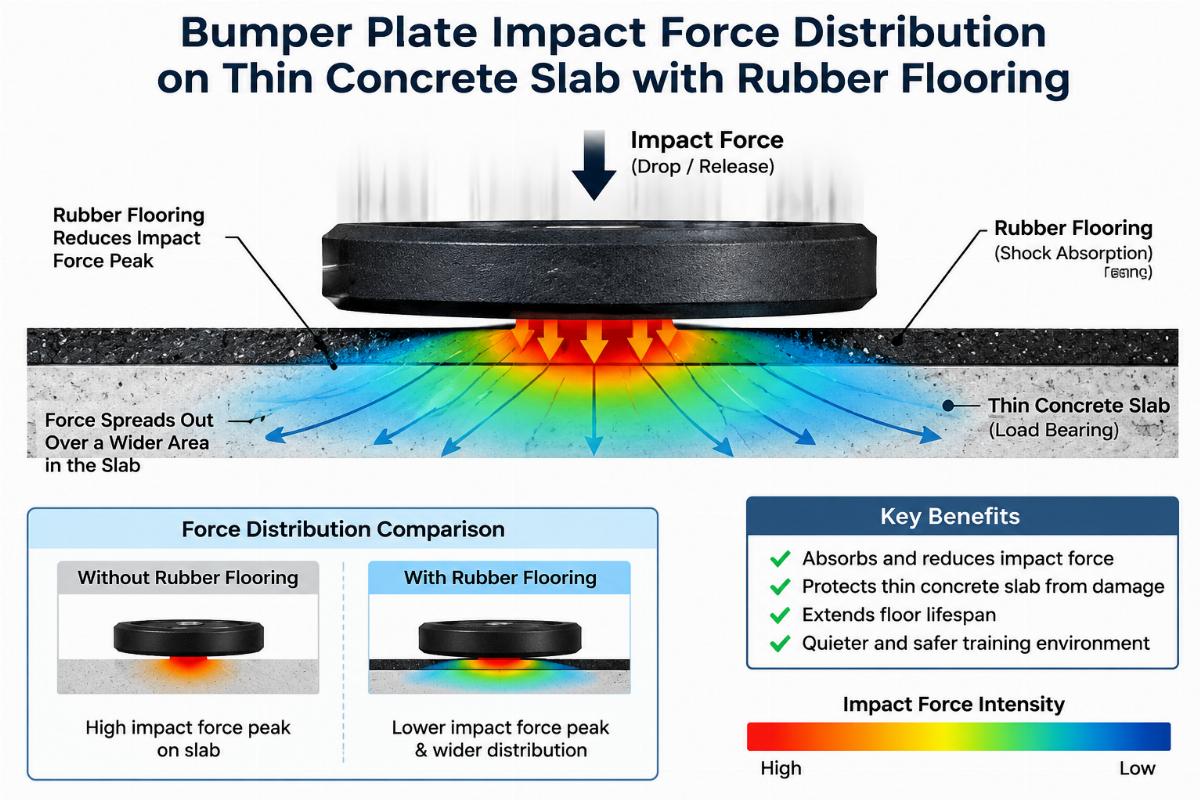
| Floor impact on thin concrete slabs | Acceptable with full rubber flooring | Must protect substrate with minimal flooring buildup |
| Color visibility in low-ceiling lighting | Acceptable in high-bay environments | Must be readable under standard commercial LED panels |
The odor issue deserves particular attention. Recycled rubber compounds, while cost-effective, release volatile organic compounds at rates that are perfectly acceptable in a ventilated CrossFit box but become a liability in a sealed basement studio running at night with no staff present to air out the space [NEED_CITE: VOC emission thresholds for indoor fitness environments per Japanese indoor air quality guidelines]. A bumper plate set supplier serving this market must either use virgin rubber or a certified low-emission recycled compound with documented off-gassing curves.
The floor impact issue is equally specific. Many Japanese commercial buildings use post-tensioned concrete slabs with limited load-bearing tolerance for repeated impact. A bumper plate set with a Shore A hardness above 85 will transmit excessive force through thin rubber flooring into the slab, causing micro-cracking over time. Conversely, plates that are too soft deform excessively and lose dimensional accuracy after repeated drops. The 78 to 85 Shore A range is the functional sweet spot, but very few spec sheets disclose this parameter honestly [NEED_CITE: Shore A hardness testing methodology for rubber fitness equipment per ASTM D2240].
How to Verify a Bumper Plate Set Supplier’s Quality Claims
Request the test report, not the marketing sheet.
When evaluating a bumper plate set supplier, the gap between what is promised and what is delivered often hides in the documentation. Most suppliers will provide a product brochure listing weight tolerance, material type, and available color options. Very few will provide the underlying test data that proves those claims hold across production batches.
Here is the verification sequence I follow when onboarding a new bumper plate set for the Japanese market:
-
Smell test on arrival. Open the carton within the first hour. If there is any noticeable chemical odor, the batch fails immediately. No amount of airing out justifies the risk. This is a qualitative gate, but it eliminates the majority of problematic compounds before any instrument testing begins.
-
Weight tolerance check across a sample set. Pull plates from different positions in the pallet. Weigh each one. The acceptable range for commercial-grade bumper plates is within a narrow margin of the stated weight, and consistency across the sample matters more than the absolute accuracy of any single plate [NEED_CITE: weight tolerance standards for competition-grade rubber bumper plates per IWF equipment specifications].
-
Drop test on actual venue flooring. Ship sample plates to the installation site before the full order. Drop them from overhead bar height onto the exact flooring system the gym will use. Inspect both the plates and the floor after a controlled number of repetitions. Look for edge chipping, steel insert loosening, and any visible floor indentation.
-
Batch density consistency check. Cut a sample plate from a previous batch and one from the current shipment. Compare the cross-section density. Inconsistent density indicates poor mixing or filler variation, which leads to uneven wear and unpredictable drop behavior over time [NEED_CITE: density uniformity testing for molded rubber fitness products].
-
Color fastness under venue lighting. Install sample plates under the gym’s actual lighting conditions for a set period. Some color pigments fade or shift under continuous LED exposure, which defeats the purpose of weight-zone color coding in a 24-hour environment where lighting never changes.
A US-based distributor once shared their experience with a supplier who provided flawless samples but shipped a full container with noticeably inconsistent rubber density. The plates from the bottom of the pallet were heavier per unit volume than those from the top, indicating a filler mixing issue during production. The entire order had to be sorted and partially rejected. This is the kind of problem that only surfaces when you verify beyond the spec sheet [NEED_CITE: common manufacturing defects in molded rubber fitness equipment and detection methods].

What Specifications Actually Matter for 24-Hour Gym Deployment
Ignore the features list. Focus on the failure points.
When a gym chain operator in Japan asks me to recommend a bumper plate set, I do not start with the catalog. I start with the venue specifications. The operating environment determines the plate, not the other way around.
The critical specifications for a 24-hour gym deployment in Japan are:
-
Material composition. Virgin rubber or certified low-VOC recycled compound. The supplier must provide a third-party SVHC screening report. Self-certified material declarations are not sufficient for this market.
-
Steel insert design. The center hub must use a stainless steel insert that is either press-fit or vulcanized into the rubber. Welded inserts are a failure point under repeated impact loading. The insert must be concentric with the plate to prevent wobble on the barbell sleeve [NEED_CITE: insert retention methods and failure modes in rubber-coated weight plates].
-
Outer diameter consistency. All plates of the same weight must have identical outer diameters. This ensures consistent drop height regardless of load configuration. Variations in diameter cause uneven impact distribution and accelerate floor wear.
-
Grip surface texture. The outer ring must have a texture that allows plates to be loaded and unloaded by hand without slipping, even when the user’s hands are chalked or sweaty. Smooth outer surfaces are a safety hazard in a 24-hour environment where staff may not be present to assist.
-
Weight marking durability. The weight indicator must be molded or laser-etched into the plate, not printed. Printed markings wear off under repeated handling and cleaning, which is frequent in a high-traffic 24-hour facility.
A boutique studio operator in Osaka learned this the hard way. They ordered a bumper plate set from a supplier who provided attractive printed markings and a competitive price. Within months, the markings were illegible from normal handling and cleaning. Members were loading incorrect weights, and the studio had to replace the entire set. The cost of the replacement, combined with the downtime, far exceeded what they would have paid for a properly specified bumper plate set from the start.

How to Structure a Bumper Plate Set Order for Japanese Gym Chains
Plan for replacement before you plan for installation.
The final piece of the puzzle is order structure. Most gym operators treat a bumper plate set as a one-time capital purchase. In a 24-hour gym environment in Japan, this is a mistake. The plates will experience continuous use with no supervised rest periods, and the floor conditions will accelerate wear in ways that are difficult to predict without local data.
A well-structured bumper plate set order for this market should include:
-
An initial full deployment set sized to the gym’s floor plan and member capacity, with color coding matched to the venue’s lighting conditions.
-
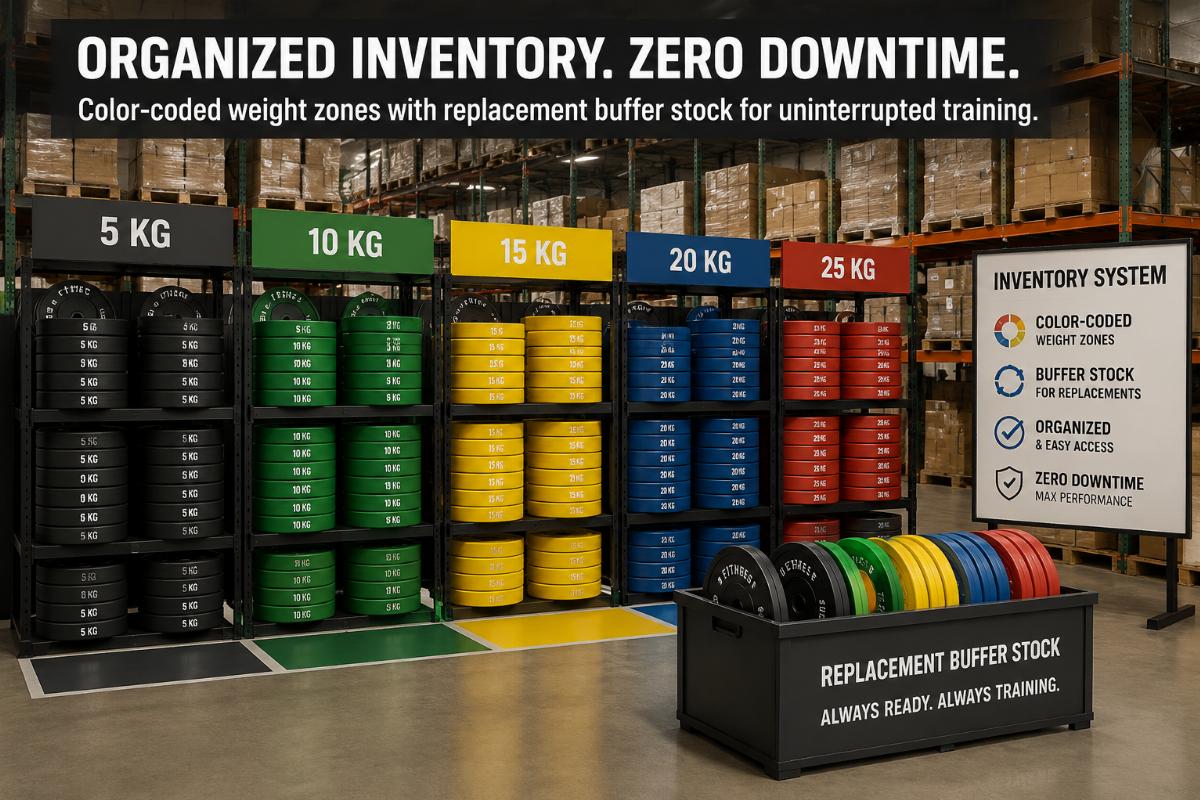
A replacement buffer stock held on-site, sized to cover the most frequently used weight ranges. In 24-hour gyms, the mid-range plates typically see the highest turnover and the earliest wear.
-
A scheduled inspection protocol at regular intervals, checking for insert loosening, edge deformation, and odor recurrence. Any plate showing early signs of failure should be pulled immediately, not waited on.
-
A direct communication channel with the bumper plate set supplier for batch-matched replacements. Mixing plates from different production batches can create diameter and density mismatches that affect barbell balance during drops.
A gym chain operator in Fukuoka structured their first order without a replacement buffer. Within a short period, they had several plates showing insert movement and needed replacements urgently. The original supplier’s next production batch had slight diameter variations, and mixing the new plates with the old created balance issues on loaded barbells. The operator had to order an entirely new matched set, turning a manageable maintenance cost into a full replacement expense.
The lesson is straightforward: a bumper plate set for a 24-hour gym in Japan is not a product purchase. It is a deployment with an ongoing maintenance commitment. The supplier you choose must support that commitment with batch consistency and responsive replacement logistics.
Conclusion
Sourcing a bumper plate set for Japanese 24-hour gym chains is an exercise in environmental matching, not specification checking. The plates must survive continuous use in compact, poorly ventilated spaces on sensitive flooring, and they must do so without generating complaints that no unstaffed venue can absorb. The supplier who understands this context, provides verifiable test data, and supports ongoing replacement needs is the one worth building a relationship with.