T-Bar Row Machine for Multi-Site CrossFit Boxes Rollout Wholesale
Most operators assume commercial-grade T-Bar row machines are universally built for any environment. In reality, standard sealed bearings and spot-welded frames routinely fail within months when deployed across high-heat, high-dust CrossFit boxes.
For multi-site CrossFit box rollouts, a T-Bar Row Machine for CrossFit Boxes must be validated against site-specific environmental stressors before bulk deployment. Bearing IP protection ratings, welding fatigue resistance, and anti-slip coating durability must be confirmed per location microclimate—not assumed from generic "commercial" labels.
I still remember the WhatsApp voice messages from a box owner in Riyadh. He had ordered a full batch of T-Bar Row Machine for CrossFit Boxes units for his chain, and within a single summer, the bearings on every single unit seized solid. The timing was brutal—right before Ramadan, when training volume peaks and membership revenue is highest. Downtime during that window cost his business far more than the original equipment price. The root cause was not poor training technique or abusive usage; it was a mismatch between the bearing seal rating and the local environment. Dust infiltration combined with ambient temperatures regularly exceeding fifty degrees Celsius accelerated grease breakdown and raceway wear at a pace no standard commercial spec could survive [NEED_CITE: bearing failure mode distribution under high-temperature and particulate contamination per ISO 15243].
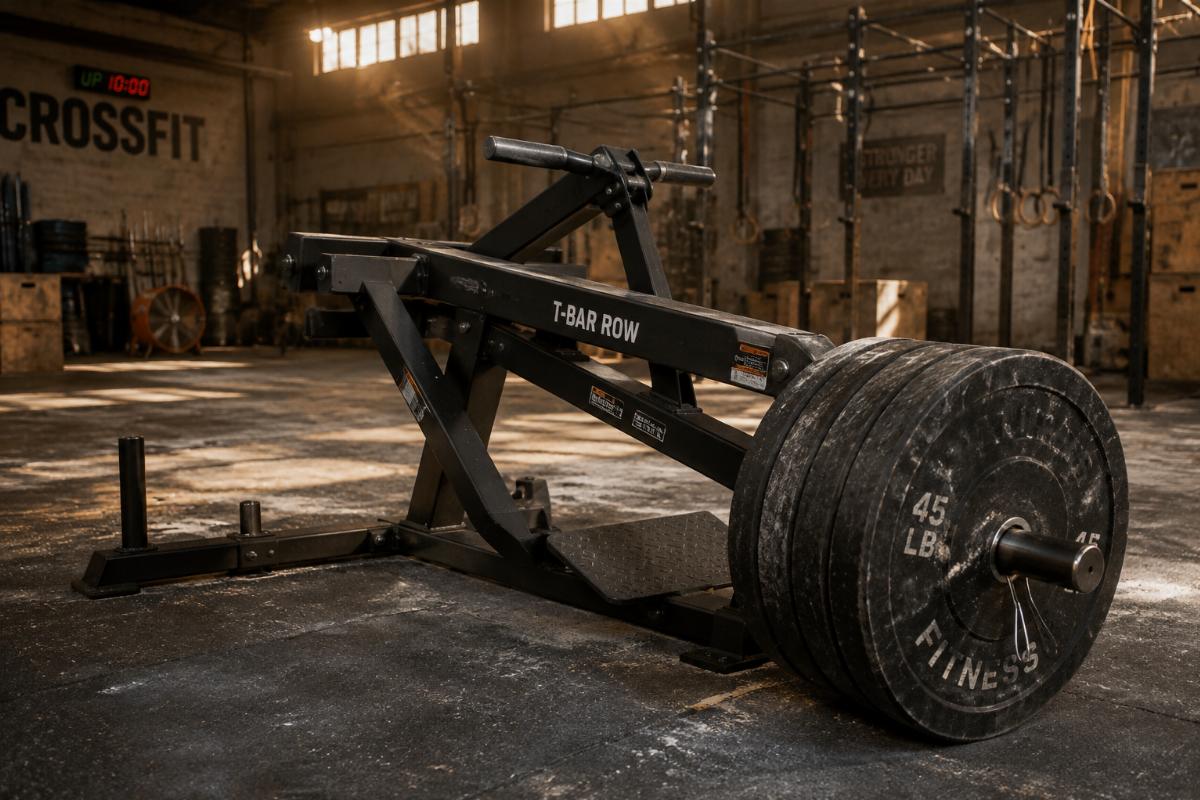
This pattern repeats across multi-location deployments worldwide. The lesson is consistent: a T-Bar Row Machine for CrossFit Boxes that performs flawlessly in a climate-controlled European studio will not automatically survive a Middle Eastern desert box or a Southeast Asian warehouse conversion without configuration adjustments.
Why Standard T-Bar Row Machines Fail in Multi-Box Rollouts?
Generic commercial specifications are designed for moderate, climate-controlled environments. They are not engineered for the compounding stress of extreme heat, abrasive dust, and high-repetition functional training.
CrossFit boxes operate under conditions that push equipment well beyond typical commercial gym usage. The training methodology emphasizes high-volume, high-intensity repetitions with rapid transitions between movements. A T-Bar Row Machine for CrossFit Boxes in such a setting sees continuous loading cycles, aggressive grip changes, and frequent plate loading and unloading—all of which generate vibration, impact stress, and friction at pivot points [NEED_CITE: equipment wear patterns in high-intensity functional training facilities].
When multiple boxes are rolled out simultaneously using a single uniform SKU, operators often discover that failure rates cluster in specific locations rather than spreading evenly. The failures are not random. They correlate directly with environmental variables: ambient temperature, airborne particulate concentration, humidity swings, and floor vibration from adjacent training zones.
Consider a regional rollout across the Middle East. Boxes located in coastal cities face salt-laden humidity that accelerates corrosion on untreated steel surfaces. Inland desert locations deal with fine silica dust that infiltrates bearing seals and acts as an abrasive paste inside raceways. Mountainous or high-altitude locations experience wider thermal cycling, which causes grease to thin and migrate away from critical contact zones. A single bearing specification cannot address all three scenarios.
The welding method used in frame construction also plays a decisive role. Spot welding, common in cost-optimized production, creates localized stress concentrations that fatigue under repetitive loading. In a high-volume CrossFit box where a T-Bar Row Machine for CrossFit Boxes may see hundreds of reps per day across multiple users, spot-welded joints can develop micro-cracks within months. Full-penetration welding distributes stress more evenly and extends structural fatigue life substantially [NEED_CITE: fatigue life comparison of full-penetration versus spot welding in cyclic loading applications].
Anti-slip coatings on foot plates and handle grips face their own challenges. Standard powder coatings, adequate for moderate use, chip and peel under the combination of chalk residue, sweat, and repetitive foot impact. Once the coating degrades, the surface becomes dangerously slick, creating both a safety hazard and a liability exposure for the box owner.
What Specs Must Be Upgraded for Harsh-Environment Boxes?
Bearing seal ratings, welding methodology, and coating durability must each be matched to the specific environmental profile of each deployment site.
The first specification to verify is the bearing IP protection rating. Standard commercial bearings typically carry basic dust protection sufficient for indoor, climate-controlled use. In high-dust environments, bearings must meet elevated ingress protection standards to prevent particulate contamination of the lubricant and raceway surfaces [NEED_CITE: IP rating requirements for bearings in abrasive industrial environments]. The seal design must also accommodate thermal expansion without compromising the sealing lip contact pressure—a detail often overlooked in generic spec sheets.
For the frame structure, the welding process must be confirmed as full-penetration continuous weld rather than intermittent spot weld. This is not merely a cosmetic preference; it directly affects the fatigue life of the pivot housing and the base plate connection. A T-Bar Row Machine for CrossFit Boxes subjected to dynamic loading from explosive concentric pulls and controlled eccentrics generates cyclic stress that exploits any weld discontinuity.
| Specification Element | Standard Commercial Grade | Harsh-Environment Grade |
|---|---|---|
| Bearing Seal Protection | Basic dust shield | Elevated IP-rated multi-lip seal |
| Welding Method | Intermittent spot weld | Full-penetration continuous weld |
| Anti-Slip Coating | Standard powder coat | High-abrasion textured industrial coating |
| Grease Specification | General-purpose lithium | High-temperature synthetic with particulate resistance |
| Pivot Bushing Material | Standard polymer | Reinforced self-lubricating composite |
The grease specification inside the bearings deserves separate attention. General-purpose lithium greases thin out at elevated temperatures and lose their film strength, allowing metal-to-metal contact. Synthetic high-temperature greases maintain viscosity stability and resist washout from moisture ingress. In dusty environments, the grease must also possess adhesive properties that resist being displaced by fine particulate intrusion.
Anti-slip coatings should be evaluated using standardized abrasion resistance testing methods rather than subjective visual inspection. A coating that appears durable in a factory showroom may wear through rapidly under actual box conditions. Requesting documented abrasion test results ensures the coating will maintain functional grip surface throughout its expected service interval [NEED_CITE: standardized abrasion resistance testing methods for industrial coatings].
How to Validate Supplier Claims Before Bulk Deployment?
Require documented environmental test reports, a structured spare parts pre-positioning plan, and written after-sales response commitments before approving any multi-site rollout order.
Supplier marketing materials routinely claim "commercial-grade" durability without defining the environmental parameters behind that claim. A T-Bar Row Machine for CrossFit Boxes described as suitable for "intensive gym use" may have been validated only in a temperate, low-humidity test facility with controlled maintenance intervals. This does not constitute validation for desert heat, coastal salinity, or unfiltered dust exposure.
The first validation step is requesting a bearing environmental test report that demonstrates performance under conditions matching your deployment sites. This report should document bearing temperature rise, seal integrity after extended particulate exposure, and grease retention under thermal cycling. If the supplier cannot produce such documentation, the bearing specification is unverified for your use case.
The second validation step involves confirming the welding inspection protocol. Ask whether welds undergo non-destructive testing such as magnetic particle inspection or ultrasonic examination on a sampling basis. Visual inspection alone cannot detect subsurface porosity or incomplete fusion defects that become failure initiation points under cyclic loading.
The third validation step addresses after-sales logistics. In a multi-site rollout, equipment downtime directly translates to lost membership revenue and member churn. A supplier offering a standard warranty but no spare parts pre-positioning strategy leaves the operator dependent on international shipping timelines for every bearing replacement. A structured approach involves pre-positioning spare bearing kits at a ratio proportional to deployment volume, ensuring that routine maintenance does not require emergency air freight [NEED_CITE: spare parts inventory optimization models for distributed equipment fleets].
A manufacturer capable of supporting multi-site rollouts should provide a complete configuration confirmation workflow that maps each deployment site’s environmental profile to specific equipment specifications. Bick, for example, walks multi-location operators through this exact process—collecting site data on temperature ranges, dust exposure levels, and usage intensity, then confirming bearing seal ratings, welding standards, and coating specifications on a per-site basis before production begins. This approach eliminates the assumption that a single SKU fits all locations and reduces post-deployment failure rates substantially.

What Are the Hidden Costs of Equipment Downtime in Peak Seasons?
The revenue loss from a single peak-season equipment failure frequently exceeds the price difference between standard-spec and environment-validated equipment across an entire rollout.
CrossFit boxes experience pronounced seasonal demand peaks. In the Middle East, the period leading into Ramadan sees a surge in training attendance as members prepare for fasting-month conditioning. In Western markets, the post-holiday resolution wave and pre-summer body composition pushes drive similar spikes. During these windows, every piece of functional training equipment is under maximum utilization.
When a T-Bar Row Machine for CrossFit Boxes goes offline during a peak period, the impact extends beyond the machine itself. Members who arrive expecting to complete a programmed workout that includes T-bar rows must be redirected to alternative movements, reducing training quality and satisfaction. Repeated equipment unavailability erodes member confidence in the box’s operational standards and accelerates churn—often among the highest-value members who have the most alternatives.
The financial calculus is straightforward. The incremental cost of specifying elevated bearing seals, full-penetration welding, and premium coatings on a batch of T-Bar Row Machine for CrossFit Boxes units is modest relative to the total order value. The cost of emergency air-freighting replacement bearings to multiple international sites, combined with technician dispatch fees and member goodwill credits, routinely dwarfs that incremental investment.
A preventive spare parts strategy addresses this risk systematically. Pre-positioning bearing replacement kits at each deployment site—or at a regional hub serving multiple sites—ensures that routine maintenance can be performed during scheduled off-peak hours rather than as emergency repairs during training sessions. This approach transforms unpredictable downtime events into planned maintenance activities with known cost and duration.

Operators who have learned this lesson the hard way report that the shift from reactive repair to preventive spare parts planning reduced their total cost of equipment ownership meaningfully, even after accounting for the upfront investment in pre-positioned inventory. The T-Bar Row Machine for CrossFit Boxes units themselves remain in service longer, member satisfaction remains stable through peak seasons, and the box operator avoids the reputational damage of visible equipment failures on social media.
Conclusion
Multi-site CrossFit box rollouts succeed or fail on the specificity of equipment configuration, not the generality of commercial-grade marketing claims. A T-Bar Row Machine for CrossFit Boxes deployed across diverse environmental conditions must be validated against site-specific heat, dust, and usage intensity before bulk ordering. Bearing protection, welding integrity, and coating durability are the three specification areas where standard configurations routinely fall short. Pre-positioning spare parts and confirming supplier environmental test documentation before deployment prevents peak-season downtime costs that far exceed the incremental investment in environment-validated equipment.