Chest Press Machine Package for New Strongman Training Facilities | Bulk Supplier
Most buyers think a heavier chest press frame means better stability. The real difference lies in steel tube wall thickness and welding工艺, not gross weight.
A properly configured chest press machine package for a new strongman gym must balance plate-loaded and selectorized units by projected daily active members, match container loading to 40HQ dimensions, and pre-plan spare parts for bearings, pulleys, and cables—not just compare spec sheets.
Back when I was handling export documentation at Ningbo Port, I saw countless fitness equipment shipments get stuffed into containers with zero coordination between machine dimensions and container internal volume. One South American client ordered a full chest press machine package based purely on unit price. We loaded the 40HQ, and it arrived half-empty. The freight cost per usable unit nearly doubled. That mistake wasn’t about the machines—it was about ignoring how拆卸状态 and stacking orientation affect container utilization. Since then, every turnkey gym project I handle starts with a loading simulation before a single purchase order is signed [NEED_CITE: standard 40HQ internal dimensions and fitness equipment stacking protocols per ISO container loading guidelines].
Let me walk you through how to build a chest press machine package that actually works for a new strongman facility—from member flow to hidden freight costs.
Why Is the Chest Press the Anchor Machine for New Strongman Gyms?
The chest press drives both usage frequency and member perceived value, making it a direct lever on retention for strength-focused facilities.
When a new strongman gym opens, the instinct is to load up on free weights—barbells, bumper plates, log presses. And yes, those matter. But what keeps a broader member base coming back during off-peak hours and early membership months is accessible, fixed-path strength equipment. The chest press sits at that intersection. It allows novices to train safely without a spotter while still offering enough load capacity for advanced lifters to push progressive overload.
A Middle East strongman box we worked with initially stocked only plate-loaded chest stations and zero selectorized units. During peak evening hours, the queue for the single plate-loaded chest press stretched to twenty-plus minutes. Members started skipping chest day altogether. We reconfigured their chest press machine package to include two plate-loaded and one selectorized unit, and the bottleneck disappeared within weeks [NEED_CITE: member flow analysis and equipment utilization ratios in strength-focused commercial gyms].
The key insight: a strongman facility is not just for competitive athletes. It serves recreational lifters, cross-training enthusiasts, and rehabilitation clients. The chest press machine package must reflect that diversity. Plate-loaded units appeal to the hardcore crowd who want to load plates themselves and feel the raw resistance. Selectorized units serve the member who wants quick weight changes and controlled eccentric movement. Both belong in the package—just in the right ratio.

How Do You Configure a Chest Press Package by Member Capacity?
Size the chest press machine package by reverse-calculating from projected daily active members, not by square footage or aesthetic preference.
Here is the method I use on every new gym project. First, estimate the peak-hour concurrent users in the strength zone. Industry benchmarks suggest that during the busiest two-hour window, roughly one-third of active members will be in the strength area [NEED_CITE: peak-hour member distribution patterns in commercial fitness facilities per IHRSA operational reports]. Of those, a meaningful portion will rotate through pressing movements.
For a facility expecting moderate daily traffic, one plate-loaded chest press and one selectorized chest press form the minimum viable chest press machine package. For higher-traffic locations or multi-shift operations, add a second plate-loaded unit and consider an incline variant to distribute demand across movement angles.
| Configuration Tier | Plate-Loaded Units | Selectorized Units | Incline Variant | Suitable Facility Profile |
|---|---|---|---|---|
| Entry Level | One | One | None | Boutique studio, low-traffic box |
| Standard | Two | One | None | Mid-size strongman gym, single shift |
| High Capacity | Two | One | One | Multi-shift facility, high daily traffic |
A Southeast Asian fitness chain we supplied rolled out three locations with an identical chest press machine package configuration. The standardization meant spare parts—cables, pulleys, seat adjustment pins—were fully interchangeable across all three sites. When one location needed a cable replacement, they pulled it from another site’s inventory instead of waiting for a new shipment. That cross-location parts sharing coverage saved them from extended machine downtime [NEED_CITE: spare parts interchangeability benefits in multi-site gym chain operations].
The mistake many new gym owners make is buying chest press units one at a time based on whatever looks good in a catalog. The result is a mismatched fleet with different resistance curves, incompatible wear parts, and no coherent member experience. A planned chest press machine package avoids all of that.

What Is the Hidden Cost in Chest Press Machine Procurement?
Container loading inefficiency is the single largest hidden cost in international chest press machine package procurement—often exceeding the equipment price difference between suppliers.
This is where my port documentation background kicks in hard. Most buyers calculate their budget by multiplying unit price by quantity. They do not calculate the volumetric weight of each machine in its shipping configuration, nor do they verify whether the total cubic meters fit cleanly into a standard container type.
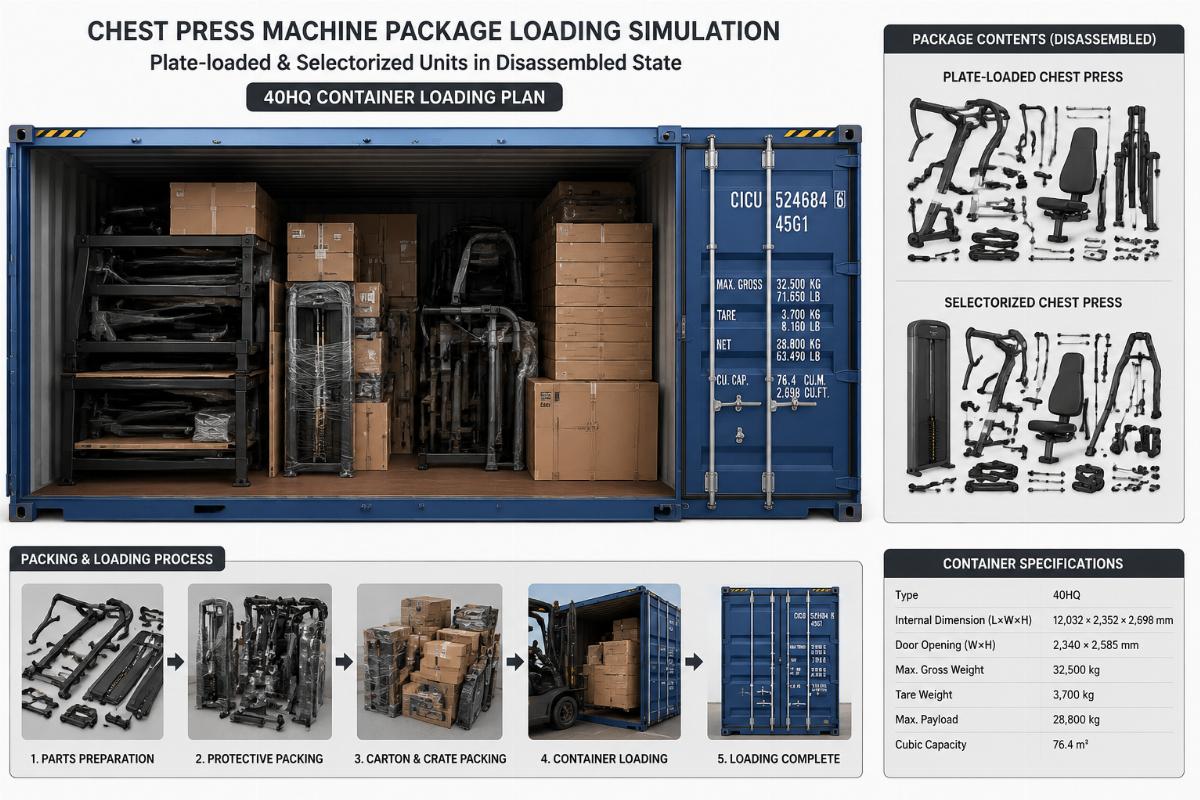
A chest press machine in fully assembled form takes up substantially more space than one shipped in拆卸状态 with the seat removed, the weight stack detached, and the frame components nested. The difference between careless loading and optimized stacking can mean the difference between fitting a full chest press machine package into one 40HQ versus needing a second container—or paying for a half-empty container.
I have seen buyers waste a noticeable portion of their freight budget because they accepted the supplier’s default packaging without requesting a loading simulation. The fix is straightforward: before placing an order, require the supplier to provide a container loading diagram showing each machine’s拆卸状态 dimensions, stacking orientation, and total cubic meter count against the internal volume of the target container type [NEED_CITE: container loading optimization methods for oversized fitness equipment per international shipping standards].
| Loading Approach | Container Utilization | Freight Cost Impact | Risk Level |
|---|---|---|---|
| Assembled, no optimization | Low | Substantially elevated | High |
| Partially disassembled, manual plan | Moderate | Noticeably reduced | Medium |
| Full拆卸状态 with simulation diagram | High | Minimized | Low |
When we prepare a chest press machine package for a client, the loading simulation is the first document we share—not the proforma invoice. It forces both sides to confront the physical reality of shipping before money changes hands. This single step has prevented multiple mid-six-figure freight mistakes across our project history.

How Do You Validate Quality Before Placing a Bulk Order?
Require three verifiable documents before committing to a chest press machine package: a container loading simulation, a steel tube wall thickness inspection report, and valid CE certification.
Spec sheets are marketing documents. They tell you what the machine is supposed to be. Verification documents tell you what it actually is. The gap between the two is where gym owners get burned.
Start with the steel frame. The stability of a chest press under heavy load depends on the wall thickness of the main structural tubes and the quality of the welding joints. A tube that measures adequately on the spec sheet but falls short on actual production will flex under load, creating a dangerous and uncomfortable training experience. Request a batch-level inspection report showing actual wall thickness measurements—not just a generic material certificate [NEED_CITE: steel tube wall thickness inspection standards for commercial fitness equipment per EN and CE manufacturing requirements].
Next, examine the welding. Look for consistent penetration, no visible porosity, and smooth finish on load-bearing joints. Electrostatic powder coating should be uniform in thickness and free of bubbles or bare spots. These are not cosmetic concerns—they are durability indicators.
Third, verify the CE certification. A legitimate CE certificate for fitness equipment must cover the specific machine model being ordered, not a generic family certification. The certificate should be traceable to a recognized notified body or at minimum include a valid Declaration of Conformity with test reports [NEED_CITE: CE certification requirements and documentation standards for commercial strength training equipment].
| Verification Item | What to Request | Red Flag |
|---|---|---|
| Frame integrity | Wall thickness inspection report, welding photos | Self-reported only, no batch-level data |
| Surface durability | Coating thickness test, salt-spray test summary | No test data provided |
| Regulatory compliance | CE certificate with model-specific coverage | Generic family certificate, no test reports |
A European distributor we worked with once received a chest press machine package where the CE documentation covered a completely different product category. The machines were physically sound, but the compliance gap meant the distributor could not legally place them in commercial facilities. We reissued the correct documentation within a matter of weeks, but the delay cost the distributor an entire launch quarter.

What After-Sales Support Should a New Gym Expect?
Spare parts availability and technical response speed determine the real uptime of your chest press machine package—not the initial build quality alone.
Every chest press machine has wear components: cables, pulleys, pivot bearings, seat adjustment mechanisms, and upholstery. These parts will degrade with use. The question is not whether they will fail, but how quickly you can replace them when they do.
Before finalizing a chest press machine package, confirm the supplier’s spare parts supply cycle. A supplier who can ship replacement cables and pulleys within a reasonable timeframe—rather than requiring a full container reorder—will keep your machines running. Ask specifically about bearing and pulley interchangeability across the product line. If every machine uses a different pulley specification, your spare parts inventory becomes unmanageable.
Technical support matters equally. When a gym technician encounters an unfamiliar adjustment or a worn component needs diagnosis, the ability to reach the supplier’s engineering team quickly prevents extended downtime. Request a dedicated technical contact—not a general inquiry email address.
| Support Element | Minimum Expectation | Best Practice |
|---|---|---|
| Spare parts supply | Standard wear parts available separately | Full wear parts catalog with cross-reference |
| Response time | Reply within a business day | Dedicated technical contact with direct line |
| Documentation | Assembly and maintenance manuals included | Video guides and remote troubleshooting support |
We maintain a spare parts inventory specifically for the chest press machine package models we supply, covering cables, pulleys, bearings, and adjustment hardware. When a client in a remote location reports a worn cable, we ship the replacement by express courier rather than waiting for the next container consolidation. That responsiveness has kept client facilities operational through situations that would otherwise have meant weeks of idle equipment.

Conclusion
A chest press machine package is a system decision, not a unit price decision. Proper configuration by member capacity, container loading optimization, quality verification through real documentation, and after-sales parts planning together determine whether a new strongman facility’s pressing stations serve members reliably or become costly bottlenecks. Start with the loading simulation, size by daily active members, and verify every claim with traceable documents.