CrossFit Boxes Retrofit with Functional Trainer – OEM Manufacturer
Most CrossFit boxes fail retrofit projects not because they pick the wrong functional trainer, but because they ignore floor loading limits and anchor-point spacing before ordering.
Retrofitting a CrossFit box with a functional trainer requires matching multi-station versatility to your existing footprint, verifying ceiling height and floor load capacity, and selecting commercial-grade pulley ratios that survive high-intensity daily programming. A well-planned retrofit consolidates fifteen to twenty movement patterns into one footprint, replacing scattered single-purpose machines while keeping class throughput intact.
I still remember a container that sat at Jebel Ali for nearly three weeks because the anchor bolts we spec’d were too long for the client’s raised flooring. The functional trainer itself was solid—dual adjustable pulleys, plate-loaded, commercial frame—but nobody measured the subfloor before the ship left Qingdao. We ended up air-freighting a shortened bolt kit and paying the storage bill. That kind of mistake doesn’t come from bad equipment; it comes from skipping the site audit. [NEED_CITE: facility site-assessment checklist for functional training zone installation]

Once the site constraints are locked, the rest of the retrofit—specs, shipping, installation—falls into a predictable sequence.
Why Are CrossFit Boxes Choosing Functional Trainers for Retrofit?
Functional trainers compress multiple movement patterns into a single footprint, which is exactly what a space-constrained CrossFit box needs when replacing aging rigs or single-purpose machines.
A few years ago, a small CrossFit box in the Middle East—roughly two hundred square meters—was running three separate cable machines, a lat pulldown, and a dedicated tricep station. Each piece ate floor space and created traffic bottlenecks during peak WOD rotations. They swapped all of it for a dual-station functional trainer with adjustable pulleys and a pull-up rig integrated on top. The result:工位 utilization went up noticeably, and coaches could program cable crossovers, face pulls, resisted sprints, and assisted pull-ups from one station without moving athletes across the floor. [NEED_CITE: space-efficiency comparison of multi-station functional trainers versus single-purpose cable machines in boutique gyms]
The trend is visible across regions. European chain boxes retrofitting older warehouses are bundling functional trainers with free-weight zones in full container loads, consolidating what used to be a dozen SKUs into one shipment. Hotel fitness areas with tight ceiling heights are choosing compact-profile functional trainers that fit under standard clearance without sacrificing cable travel. The common thread is not just equipment—it is programming flexibility under real estate pressure.

What makes the functional trainer work for CrossFit specifically is the cable system’s ability to handle both high-rep metabolic conditioning and controlled strength work. Athletes can move from kettlebell-style cable pulls to banded squats to rotational woodchops without changing stations. That versatility is what turns a retrofit from a simple equipment swap into a programming upgrade.
What Space and Layout Constraints Must You Plan Before Retrofitting?
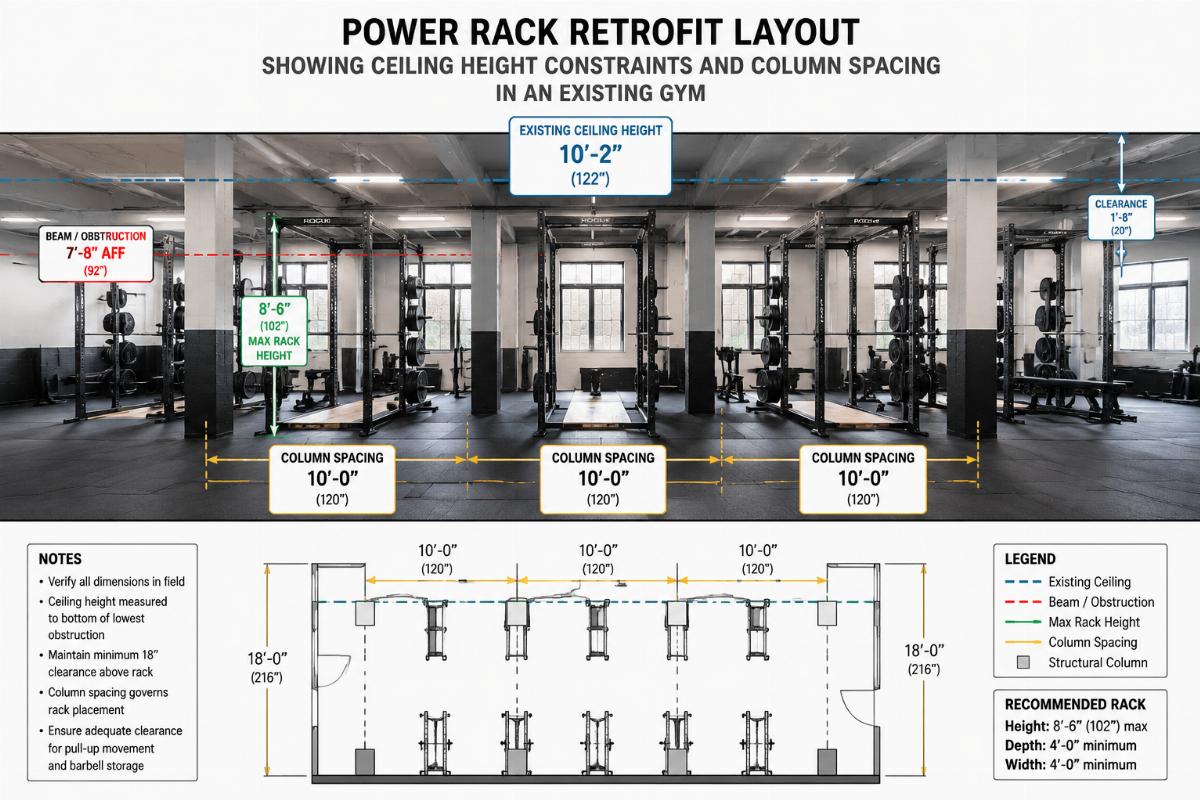
Ceiling height, floor load capacity, and traffic flow around the functional trainer dictate whether a retrofit succeeds or requires expensive structural modifications after delivery.
Most box owners focus on the machine’s footprint dimensions and forget the vertical and subfloor realities. A commercial functional trainer with a full cable travel frame typically needs a minimum overhead clearance that accounts for both the frame height and the athlete’s full range of motion during overhead presses or rope climbs. In older warehouse conversions—common for CrossFit boxes in North America and Northern Europe—exposed HVAC ducts and steel trusses can cut usable height sharply. [NEED_CITE: minimum ceiling clearance requirements for commercial functional trainers with full cable travel]
Floor loading is the other silent killer. Functional trainers with plate-loaded weight stacks or selectorized stacks concentrate significant point loads through four small foot pads. On a raised access floor or a timber-suspended gym floor, those point loads can exceed design limits without reinforcement. I have seen retrofit projects where the equipment arrived on time but the floor had to be torn up and re-poured with additional steel mesh before the machines could be anchored. The delay cost multiples of what a simple structural survey would have cost upfront.
Traffic flow matters just as much. A functional trainer in a CrossFit box sits in the middle of high-intensity movement—athletes carrying barbells, jumping onto plyo boxes, sprinting with sleds. If the trainer’s cable arms extend into a primary movement lane, you create a collision risk during partner WODs. The fix is simple: map the full arm extension arc and keep it outside the main traffic corridor. [NEED_CITE: gym layout best practices for functional training zones in high-traffic CrossFit environments]

Which Specs Matter Most for Commercial-Grade Functional Trainers?
Steel frame gauge, pulley ratio, cable travel length, and weight stack capacity determine whether a functional trainer survives CrossFit-level daily abuse or starts showing wear within months.
CrossFit programming is uniquely punishing on cable machines. Athletes move fast, drop weight stacks, and use cables for movements they were not originally designed for—like resisted tire flips or anchored band work. The frame has to handle dynamic loading, not just static weight.
Commercial-grade functional trainers meant for this environment use heavy-gauge steel tubing with continuous welds at stress points, not intermittent tack welds. The difference shows up in frame flex under load. A frame that flexes noticeably during heavy cable rows will feel unstable to athletes and accelerate wear on pulley bearings. [NEED_CITE: commercial fitness equipment steel frame welding standards for high-intensity training environments]
Pulley ratio is where many buyers get misled. A two-to-one ratio gives smoother, lighter cable feel—ideal for isolation work and rehab. A one-to-one ratio delivers direct resistance, better for strength-focused athletes. For a CrossFit box that serves both populations, a dual-ratio system or adjustable pulley positions give the most programming range. The key is matching the ratio to your typical class profile, not just picking the highest number on the spec sheet.
Cable travel length matters for taller athletes and overhead movements. Short cable travel forces athletes to stand closer to the stack, limiting range of motion on exercises like cable squats or standing chest presses. Full travel cables that reach near floor level and extend well overhead give coaches maximum programming latitude.
Weight stack capacity should match your strongest members. A stack that tops out too light becomes useless for advanced athletes, forcing the box to buy additional plate-loaded attachments. Starting with a higher-capacity stack—or a plate-loaded variant where athletes load their own bumpers—keeps the machine relevant as your membership’s strength levels grow. [NEED_CITE: functional trainer pulley ratio and cable travel specifications for commercial gym applications]

How Can You Reduce Retrofit Cost Without Sacrificing Quality?
Container-load consolidation, direct factory sourcing, and OEM branding flexibility cut landed costs substantially compared to buying premium Western brands piece by piece.
A CrossFit box retrofitting on a budget often faces a false choice: buy cheap equipment that breaks in a year, or buy premium brands that eat the entire capital budget. There is a third path—sourcing commercial-grade functional trainers directly from manufacturers who produce to the same material and welding standards but without the brand markup.
The cost advantage comes from several layers. First, container-load consolidation. Shipping a functional trainer alongside a Smith machine, a set of adjustable benches, and a free-weight rack in one full container spreads freight cost across many SKUs. The per-unit shipping cost drops noticeably compared to ordering each piece separately via LCL. [NEED_CITE: container-load consolidation cost comparison for commercial gym equipment imports]
Second, factory-direct pricing eliminates distributor margins. A functional trainer that retails for a premium price under a Western brand name can often be sourced at a fraction of that cost from the original manufacturing facility, with identical or equivalent steel gauge, pulley hardware, and cable specifications.
Third, OEM flexibility lets boxes brand the equipment under their own name or keep it unbranded—useful for affiliate boxes that want a cohesive look without paying franchise equipment fees.
I worked with a European distributor who was buying functional trainers from a well-known brand and reselling to boutique gyms. The per-unit cost left almost no margin after shipping and customs. Switching to a direct factory source with CE-certified export documentation cut his per-unit landed cost by nearly half, and he could offer his gym clients the same commercial warranty and spare parts availability. The equipment was built to the same heavy-duty standard—just without the logo premium. [NEED_CITE: OEM functional trainer pricing comparison versus premium branded commercial gym equipment]

What After-Sales Support Should You Expect Post-Retrofit?
Spare parts availability, warranty coverage on frame and moving components, and access to technical documentation determine whether a functional trainer stays operational for years or becomes a costly paperweight after a cable snaps.
In a CrossFit box, equipment runs hard every single day. Cables fray, pulley bearings wear, and adjustment pins get bent by athletes rushing through transitions. The question is not whether something will break—it is how fast you can get it running again.
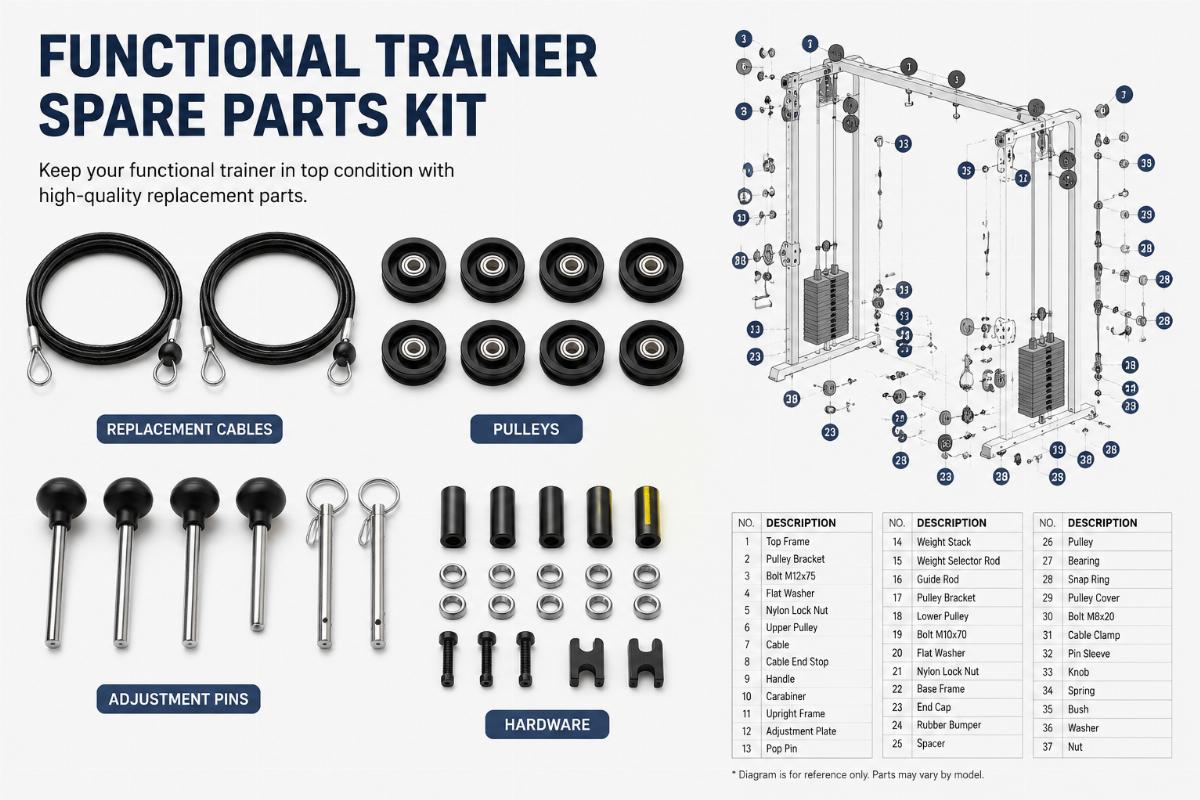
A reliable after-sales package should include readily available replacement cables, pulleys, and adjustment hardware. Some manufacturers stock these parts and ship them within days; others treat spare parts as an afterthought, leaving you waiting weeks while a station sits idle. For a box running multiple daily classes, a single down station during peak hours means turned-away members and lost revenue.
Warranty terms should clearly cover the frame structure for an extended period and moving components—cables, pulleys, bearings—for a reasonable commercial-use duration. "Lifetime frame warranty" means little if the cable system that makes the machine functional is only covered for a few months.
Technical documentation—exploded parts diagrams, cable routing guides, and adjustment procedures—should be available in English and accessible digitally. When a cable needs rerouting or a pulley needs replacement, having the manual on hand saves hours of guesswork and prevents incorrect reassembly that could create safety hazards. [NEED_CITE: commercial functional trainer warranty and spare parts availability standards for gym equipment]
Conclusion
A successful CrossFit box retrofit with a functional trainer starts with a thorough site audit, prioritizes commercial-grade specs that match high-intensity use, and leverages direct factory sourcing to keep costs in check. Space planning, structural verification, and after-sales readiness are just as important as the equipment itself—overlooking any of them turns a straightforward upgrade into an expensive lesson.