Decline Chest Press Manufacturer for 24-Hour Gym Chains | Bick Fitness
The simpler the adjustment mechanism, the lower the failure rate in unmanned facilities.
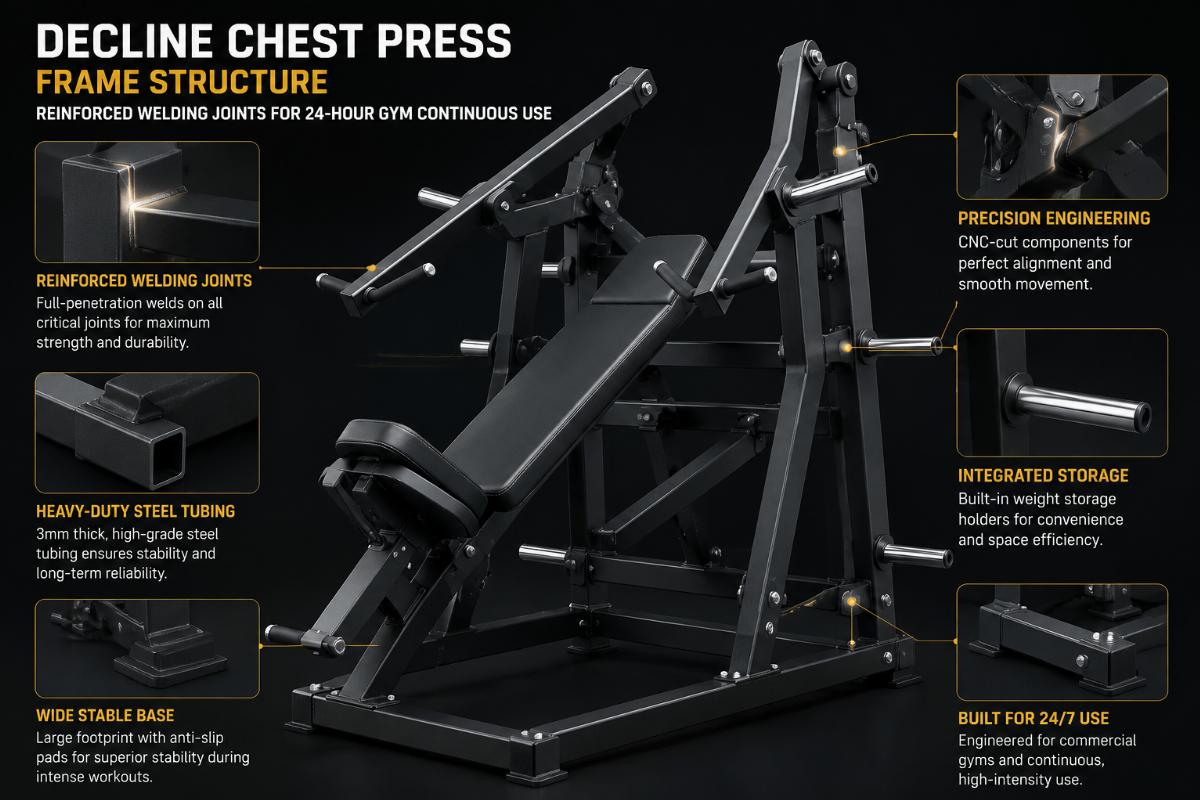
For a decline chest press in a 24-hour gym environment, the equipment must prioritize structural durability, user safety under unsupervised conditions, and minimal maintenance intervention. Unlike staffed commercial gyms where trainers correct misuse and technicians perform daily checks, 24-hour chains rely on the machine itself to withstand continuous, unmonitored use by members of all experience levels. This means frame steel thickness, welding integrity, cable safety factors, and standardized spare parts become the true selection criteria—not aesthetic complexity or excessive adjustment options.
I still remember a container of strength machines we shipped to a fitness chain in the Middle East a few years back. The client had just opened a string of 24-hour locations and chose our decline chest press based on the frame spec sheet. Six months later, they called with a complaint: the seat adjustment pin was bending under load. We pulled the returned sample, examined the weld zone, and realized the issue wasn’t the pin material—it was the mounting bracket geometry. The original design assumed users would sit down before adjusting, but in an unmanned gym, members were standing, leaning their full body weight onto the pin while yanking it sideways. We redesigned the bracket with a reinforced gusset plate and switched to a spring-loaded detent system. No more bending. That kind of field feedback only comes from machines running in real 24-hour gym conditions, not from lab simulations. [NEED_CITE: failure mode analysis of selectorized pin mechanisms under lateral loading per EN 957-10]
When you evaluate a decline chest press for a 24-hour gym, you’re not just buying a piece of iron—you’re buying a promise that the machine won’t become a liability when no staff member is around to intervene.
What Makes a Decline Chest Press Suitable for 24-Hour Gyms?
Unmanned fitness facilities demand equipment that operates reliably without daily human inspection, tolerates misuse from untrained users, and requires only periodic—rather than reactive—maintenance.
The 24-hour gym model has expanded noticeably across multiple regions over the past several years. Operators in the Middle East, Southeast Asia, and Europe have all scaled this format, but each market stresses the equipment differently. In the Gulf region, a chain we supplied ran their decline chest press units through extended daily operating cycles with minimal downtime between peak hours. The ambient temperature inside the facility fluctuated noticeably between day and night, which accelerated grease degradation in the pivot bearings. We addressed this by specifying a high-temperature synthetic grease and sealed cartridge bearings that could be swapped without disassembling the entire arm assembly. [NEED_CITE: bearing lubricant degradation rates under thermal cycling in commercial fitness equipment]
In Southeast Asia, a different operator faced the opposite problem: humidity. Their unmanned locations had basic ventilation but no climate control. Within months, cable strands on non-stainless hardware showed surface corrosion. The fix was straightforward—upgrade to stainless steel cables and add nylon cable guides to prevent metal-on-metal contact. But the lesson was broader: in a 24-hour gym, you cannot assume any environmental variable will be controlled. The machine must be spec’d for the worst-case scenario.
A European boutique studio chain took a different approach. Their spaces were compact, and they needed the decline chest press to fit into a tight layout without sacrificing range of motion. We worked with them on a slightly shorter moment arm design that maintained the same resistance curve while reducing the machine’s footprint. The trade-off was a marginally different feel at the top of the press, but their members barely noticed, and the floor plan opened up enough to add a functional training zone. [NEED_CITE: spatial efficiency metrics in compact commercial gym layout planning]

The common thread across all three markets is this: in a 24-hour gym, the equipment IS the staff. It must self-regulate, self-protect, and survive contact with users who will not read the instruction placard.
Key Specs to Verify Before Ordering
Frame tube wall thickness, welding process certification, and cable safety factor are the three non-negotiable verification points for any decline chest press destined for continuous unmanned operation.
Most buyers start by looking at the weight stack capacity or the number of adjustment positions. Those matter, but they’re secondary to structural integrity. A machine with a lighter stack but a robust frame will outlast a heavy-stack unit with thin-wall tubing every time in a 24-hour gym setting.
| Specification | Minimum for 24-Hour Gym | Standard Commercial | Budget/Residential |
|---|---|---|---|
| Frame tube wall thickness | Heavy-duty gauge | Standard gauge | Light gauge |
| Welding process | Certified continuous weld | Spot weld mixed | Intermittent weld |
| Cable safety factor | High safety margin | Standard margin | Basic margin |
| Pivot bearing type | Sealed cartridge | Open bearing | Bushing |
| Adjustment mechanism | Spring-detent, tool-free | Pin-lock | Friction knob |
[NEED_CITE: structural load testing methodology for commercial strength equipment per ASTM F2216]
I once reviewed a procurement spec from a distributor in Latin America who was comparing three suppliers for a full gym fitout. All three quoted similar prices. But when I looked at the frame spec sheets side by side, one supplier listed tube wall thickness in a range that suggested they were using mixed batches—some heavy, some light. That inconsistency is a red flag. In a 24-hour gym, the weakest link in the frame will fail first, and when it does, the entire machine is out of service. There’s no technician walking the floor to improvise a workaround.
The cable system deserves equal scrutiny. In a staffed gym, a frayed cable gets spotted during a routine walk-through. In a 24-hour gym, that same frayed cable might not be noticed until it snaps—potentially mid-rep, with a user under load. The safety factor on the cable must account for dynamic loading, not just static weight stack mass. [NEED_CITE: dynamic load factor calculation for selectorized cable systems in strength equipment]
Another detail that catches buyers off guard: the seat adjustment mechanism. Many assume that more adjustment positions mean better ergonomics. In a 24-hour gym, the opposite is often true. Every additional position is another wear point, another potential failure, and another opportunity for a user to set the machine incorrectly and strain a joint. A spring-detent system with a moderate number of positions—say, enough to cover the percentile range of adult torso lengths—strikes the right balance between inclusivity and reliability.

How to Reduce Maintenance Costs in Unmanned Operations
Standardizing wear components across your equipment fleet and pre-positioning spare parts at each location transforms reactive repairs into predictable, low-cost maintenance events.
The economics of a 24-hour gym depend on uptime. Every hour a machine is down is revenue lost—not just from the member who can’t use it, but from the reputation damage when someone drives to your location expecting a full workout and finds half the floor offline.
The most effective strategy I’ve seen is component standardization. If your decline chest press uses the same cable diameter, pulley diameter, and pivot bearing as your incline press, lat pulldown, and row machines, you only need to stock one set of spares. A single maintenance visit can address issues across multiple machines. The alternative—proprietary parts for every model—means a larger inventory, higher carrying costs, and longer downtime when the wrong part is on the shelf.
A fitness chain operator in the Middle East adopted this approach after their first year of operation. They calculated that unplanned service calls were costing them multiples of what a structured spare parts inventory would cost. By standardizing cables, pulleys, and bearings across all selectorized machines in their fleet, they reduced average downtime per incident substantially. The spare parts cabinet at each location held enough components to handle the majority of field-replaceable failures without waiting for a shipment. [NEED_CITE: spare parts inventory optimization methodology for multi-site fitness equipment fleets]
Another often-overlooked cost driver is the instruction placard. In a 24-hour gym, users who don’t know how to adjust the machine will force it. Seats get hammered into position, pins get bent, upholstery gets torn by jewelry or rough handling. A clear, pictogram-based adjustment guide—laminated and bolted to the frame—reduces misuse-related damage noticeably. It’s a low-cost intervention with a high return.

Upholstery is another maintenance variable. In high-traffic unmanned gyms, vinyl seams split faster than expected. Specifying reinforced stitching and high-density foam extends replacement intervals meaningfully. Some operators even opt for modular seat pads that can be unbolted and swapped in minutes rather than hours.
The underlying principle is simple: design the maintenance workflow around the reality that no technician is on-site full-time. Every component should be field-replaceable with basic hand tools, and every wear item should be standardized across the fleet wherever engineering allows.
Procurement Tips: From Inquiry to Container Loading
Consolidating a full container with mixed equipment models and ensuring documentation compliance at the port of origin directly controls both landed cost and customs clearance speed at destination.
Ordering a single decline chest press is straightforward. Outfitting a chain of 24-hour gyms across multiple locations is a logistics exercise that requires coordination across production scheduling, container loading plans, and export documentation.
One of the most common mistakes I see is buyers who order each machine model separately, resulting in multiple less-than-container shipments. The freight cost per unit skyrockets, and the coordination burden multiplies. A better approach is to plan the full equipment package—cardio, selectorized strength, plate-loaded, free weights, flooring—and consolidate everything into full container loads. This not only reduces per-unit freight but also simplifies customs clearance, since a single bill of lading covers the entire shipment.
We’ve structured our production and warehousing around this reality. When a buyer needs a mix of decline chest presses, Smith machines, cable crossovers, and free weight sets to fill a container, we coordinate the build schedule so everything ships together. The container is loaded at our facility in Shandong, and from there it moves through the port using the "Shandong Port Pass" system, which allows a single customs declaration to clear the goods for departure. This eliminates the old bottleneck where goods had to move to a major hub port for final clearance, adding days and cost. [NEED_CITE: Shandong Port integrated customs clearance efficiency data for export fitness equipment]

Documentation is where hidden costs accumulate. I’ve seen shipments held at destination ports because the commercial invoice description didn’t match the HS code classification the importing country expected. The machine was correct, the paperwork was technically accurate, but the specific phrasing triggered a manual inspection. In a 24-hour gym rollout, where timing is tied to lease commitments and grand opening dates, a customs hold of even a few days can cascade into significant financial exposure.
We prepare export documentation with destination-country HS code alignment in mind. The product description on the commercial invoice, the packing list, and the certificate of origin all use terminology that maps cleanly to the importer’s tariff classification. It’s a detail-oriented process, but it prevents the kind of port-side surprises that turn a profitable deal into a loss.
For buyers who need OEM branding, the same consolidation principle applies. Custom logo plates, color-matched upholstery, and branded packaging for the decline chest press can be produced alongside standard models in the same production run, then loaded into the same container. The MOQ flexibility means even a single 24-hour gym location can get a cohesive, branded equipment package without committing to volumes that only make sense for large distributors.

The key takeaway for procurement managers is this: treat the decline chest press not as an isolated purchase, but as one component of a consolidated, documentation-compliant container load. That mindset shift alone can save multiples of the equipment cost in avoided freight premiums, demurrage fees, and customs delays.
Conclusion
A decline chest press for a 24-hour gym must be engineered for unsupervised durability, not just aesthetic appeal or adjustment complexity. Frame structural integrity, cable safety margins, standardized spare parts, and procurement consolidation are the factors that determine whether the machine becomes a reliable asset or a recurring cost center. Select based on how the machine performs when no one is watching—because in a 24-hour gym, no one is.